On the morning of September 16th, 1977, the greatest singer of the 20th century collapsed in a Paris apartment with the curtains drawn. The only people who heard her fall were her butler and her maid. She was 53 years old. Twenty years earlier, she had commanded the stages of the world, and kings, presidents, and millionaires had fought for her attention.
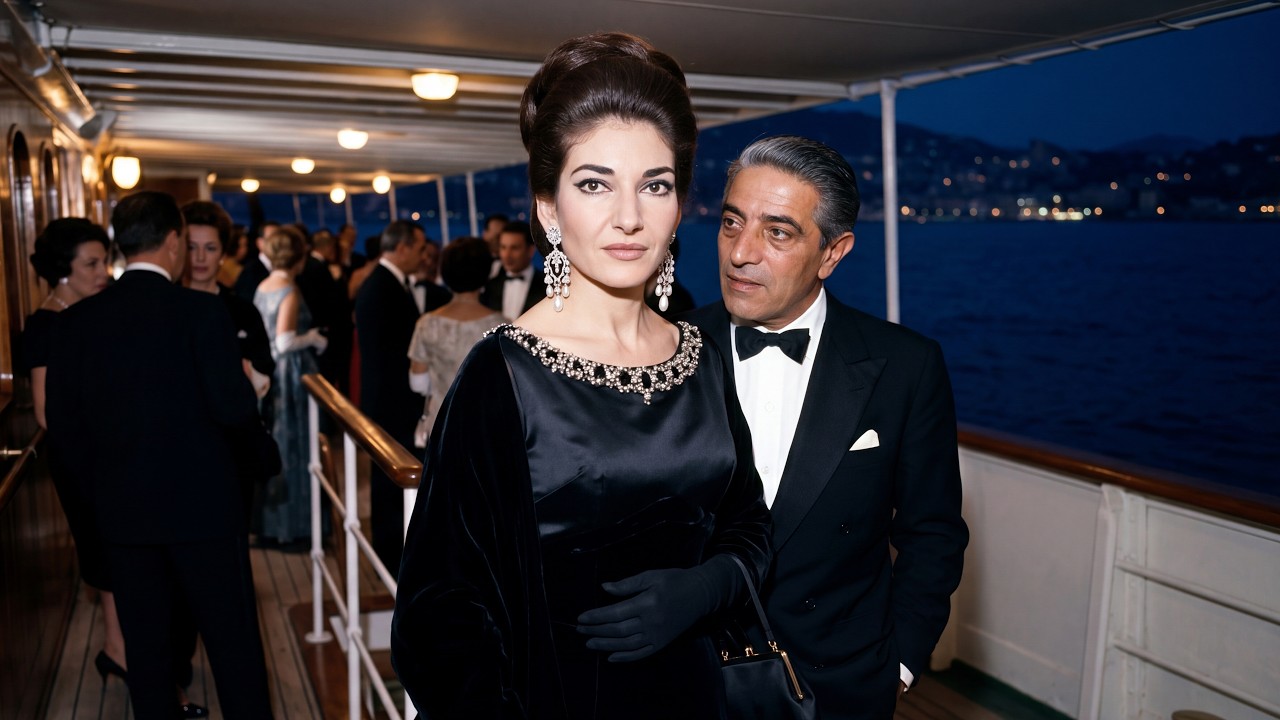
One of those millionaires took her career, took her devotion, and took nine years of her life. Then he married the most famous widow in America and let her read about it in the newspapers. This is the story of Maria Callas and the men who consumed her. Before anyone paid to hear Maria Callas sing, her own mother had already decided the voice belonged to her.
Born on December 2nd, 1923, in Manhattan to Greek immigrants, the baby was christened Maria. The family had recently lost a son to typhoid, and by the accounts passed down through the family, her mother Evangelia had prayed for another boy. When the nurse announced a girl, the story goes, Evangelia would not look at the baby for days. No one ever disputed the larger truth it pointed to: Maria was not the child her mother wanted.
Her older sister was slender, pretty, and adored. Maria was heavy, awkward, and severely nearsighted. When Maria was about five, the household discovered the one thing she had that nobody else did: a voice. Not a sweet child’s voice, but something huge and strange and dark.
Evangelia, whose own dreams of an artistic life had been denied, seized on that voice like a prospector striking ore. There were singing lessons paid for out of a pharmacist’s modest income, radio contests, and talent competitions. Other girls played on the stoops after school. Maria practiced.
She won prizes, once a watch for singing on a national radio program. Each win tightened the arrangement another notch. Maria recorded her verdict on those years much later in one of the saddest sentences any famous woman ever spoke: she could never forgive her mother for taking her childhood away. During all the years she should have been playing and growing up, she was singing or making money.
In 1937, when Maria was 13, Evangelia boarded a ship with her two daughters and sailed for Greece, leaving her husband behind in New York. She told people she was taking Maria home to train her voice properly. What she was actually doing was carrying her daughter toward a war. At 18 years old, Maria sang Tosca for the first time in a city where people were starving in the streets.
In April 1941, the German army rolled into Greece, and Athens fell under Axis occupation. Famine killed Athenians by the thousands. Friends from those years said she walked miles into the countryside in broken shoes to trade for vegetables. She survived on the voice because the voice was the only currency the family had.
In August 1942, she made her professional debut in the title role of Tosca with the Greek National Opera. By the time the war ended, she had sung 56 performances of seven different operas before her 22nd birthday. The Callas household did not starve, in part because Evangelia opened her apartment to the occupiers. Italian and German soldiers came to dinner.
Maria later said her mother pushed her daughters toward those men, pressed her to sing for them and charm them. Her mother denied it to the end of her days, and the full truth of what happened in that apartment is disputed and always will be. What is not disputed is the wound between mother and daughter never closed. In 1950, with her fame rising, Maria cut off contact with her mother almost entirely.
In September 1945, 21 years old, Maria sailed back to New York to find her father and try her luck in the biggest opera market on earth. The two years that followed were a long lesson in rejection. The American industry looked at the greatest natural instrument of the century, attached to a heavy, intense, unglamorous young woman, and largely passed. In the summer of 1947, an engagement nobody else wanted carried the unknown 23-year-old soprano to an ancient Roman arena in northern Italy.
Verona was waiting. So was a 51-year-old businessman with a box at the opera and an eye for an opportunity. His name was Giovanni Battista Meneghini, a wealthy industrialist from Verona, a manufacturer of building materials, a fixture of the city’s opera society, and a bachelor of 51. Maria was 23.
He attached himself to her almost from the night she arrived to rehearse, squiring her to dinners, paying her bills, smoothing her path. To a young woman who had been hungry, unloved, and used for her entire life, his attention felt like rescue. Her Italian debut came on August 2nd, 1947, in the vast open-air arena of Verona in La Gioconda under the baton of Tullio Serafin, one of the great opera conductors of the century. Serafin heard in this unknown girl something that the rest of the industry had missed.
He became her mentor and the architect of her sound. Then came January 1949 in Venice and one of the most famous gambles in the history of opera. Maria was in town singing Brünnhilde in Wagner’s Die Walküre, the most punishing dramatic soprano role in existence. Across the same season, the company was mounting Bellini’s I puritani, a delicate bel canto showpiece whose heroine requires the lightest, most acrobatic kind of voice, the polar opposite of Brünnhilde.
The soprano singing Elvira fell ill. There was no replacement anywhere in Italy. Serafin told the management his young Wagnerian would learn the role in days and sing it. The idea was considered close to insane.
She did it. She sang Brünnhilde and Elvira on the same stage within the same month, and the operatic world had no category for what it had witnessed. That Venice season was the birth of the legend. Three months later, in April 1949, she married Meneghini in Verona.
The marriage made her an Italian citizen, a detail that seemed administrative at the time and would later help lock the cage because Italy was a country without divorce. He gave up his own business interests to manage her career. From that point forward, the world knew her by a billing he engineered: Maria Meneghini Callas, his name stitched into hers on every poster. He negotiated her fees, controlled her bookings, and handled every lira she earned.
In those early years, his devotion was real, and she leaned on it. He believed in her before the world did. But notice the shape of the arrangement, because it is the same shape as her childhood. Someone older controls the voice.
The voice generates the wealth. The wealth belongs to the controller, and love is the word everyone uses for the arrangement. By the early 1950s, the Teatro alla Scala was the Vatican of the art form. She forced her way in the hard way, substituting as Aida in 1950, enduring the snobbery of a management that considered her voice too strange, too wild, too much.
By December 1951, she had silenced them, opening La Scala’s season in I vespri siciliani. She opened the season six times in a decade. They called her la prima donna assoluta. Opera in 1950 was a museum of perhaps two dozen warhorses.
Callas reached back a century and hauled the buried bel canto repertoire of Bellini, Donizetti, and Cherubini into the light. The critics settled on a single word: la divina, the divine one. But the industry that crowned her wanted more than the voice. At her heaviest, she weighed around 200 pounds, and the directors made sure she knew it.
Through 1953 and 1954, she shed roughly 80 pounds, one of the most extreme physical transformations any performer has ever undergone. The transformation worked in the way such bargains always work at first. The new Callas was a swan, dressed by the Milanese designer Biki, photographed like a film star. With the director Luchino Visconti, she created productions at La Scala that people described 50 years later with tears in their eyes, including the 1955 La Traviata, perhaps the most famous single opera production of the 20th century.
America finally got its prize on October 29th, 1956, when she made her Metropolitan Opera debut in Norma. The week of that debut, Time magazine put her on its cover, and the story inside was a demolition, dwelling on the feuds and serving up the testimony of her own estranged mother. To the American public before she had sung a single note on the Met stage, Maria Callas was introduced as a monster who had abandoned her own mother. Count what the voice was earning now and watch where the money went.
By 1954, the Lyric Opera of Chicago was paying her $2,000 a night, among the highest fees in the world at a time when the average American family lived on about $4,000 a year. Her recording contract with EMI generated albums that have never once gone out of print in 70 years. All of it passed through the hands of her husband and manager. Years later, in a private letter, Maria wrote that Meneghini had robbed her of more than half her money by putting everything in his own name from the day they married.
The most celebrated singer on Earth did not control her own bank account. The machine had begun to consume its greatest asset. By the middle of the 1950s, listeners began to hear the cost: a wobble on the top notes, a hardness creeping into the sound. The causes are debated to this day, the crushing workload, the sudden weight loss, or a degenerative disease of the muscles called dermatomyositis that some researchers believe she suffered from.
Whatever the truth, 1958 was coming, and it would be the year the entire industry turned on Maria Callas at once. It began on January 2nd, 1958, in Rome, on what should have been a night of triumph. The Rome Opera had built its gala season opener around her, Bellini’s Norma, with the president of the Italian Republic in the box of honor. The day before, Maria warned the management she was sick, her voice failing with an infection of exactly the machinery a soprano lives by, and she told them to have a substitute ready.
The management refused. Their answer has become infamous: no one can double Callas. She was irreplaceable, so she would not be protected. She was the product, so she could not be sick.
She went on. She dragged her ruined voice through the first act of Norma. At the interval, she made the only decision a serious artist could make. She could not continue, and there was no one to replace her.
The president of Italy went home. Then the country went insane. Crowds jeered outside her hotel. Newspapers tried her on their front pages as a national insult.
A member of parliament moved to ban her from Italy’s state-funded opera houses. The fact that doctors confirmed her illness, the fact that the president’s own wife telephoned her sympathy, none of it made the papers in any size that mattered. Maria sued the Rome Opera for what it had done to her name, and she won, but the judgment arrived in 1971 when her career was already a memory. Milan turned next.
Her relationship with La Scala’s management curdled into open hostility, and within months the house that had crowned her let its absolute first lady walk away. Then came New York. Rudolf Bing, the autocratic general manager of the Metropolitan Opera, was locked in a dispute with her over the next season’s repertoire. She balked at alternating the savage role of Lady Macbeth with lighter work in a way she believed no voice could survive.
On November 6th, 1958, while Maria was in Dallas singing Medea, he fired her by cable. Bing fires Callas ran in headlines around the planet. Stand back and look at the score for 1958. In January, she was the most celebrated singer alive.
By November, Rome had branded her a national disgrace, La Scala had let her go, and the Metropolitan had fired her by telegram. Almost nobody printed the other version, the version the documents support: a woman with a failing instrument and a punishing schedule asked the institutions that had made fortunes from her voice for the basic protections any factory gives a machine. Rest, reasonable workloads, a standby when she was ill. The institutions refused.
And when the instrument cracked in public, they blamed the woman and resold the wreckage as scandal. She was 34 years old. She had perhaps two or three years of greatness left in her voice. And into the wreckage of her professional life, at exactly the moment her stages were being taken from her, stepped a man who offered her a different kingdom entirely.
He was short and rich beyond counting, and he had been watching her for a year the way he watched everything he intended to own. His name was Aristotle Socrates Onassis. Born in 1906 in Smyrna, he landed in Buenos Aires as a refugee with almost nothing in 1922 after his world burned. What he built from that nothing was one of the great fortunes of the century: tobacco first, then ships, then tankers above all, until he commanded one of the largest private shipping fleets on earth, plus Olympic Airways, plus a private island in the Ionian Sea called Skorpios.
His calling card was the yacht Christina, a 325-foot Canadian Navy frigate rebuilt for more than $4 million, carrying a seaplane and a crew of about 60, with a swimming pool that rose to become a dance floor. Churchill sailed on her. Garbo sailed on her. The Christina was not a boat.
It was an argument, a floating proof that the refugee from Smyrna could buy anything on Earth. He had met Maria at that Venice ball in September 1957, in the very week the industry was teaching her what her loyalty was worth. In June 1959, he sat in the audience at her London gala performance of Medea, and then threw a party in her honor. Meneghini beamed through all of it, flattered that a man of such wealth was courting his wife’s career.
He had spent 12 years selling access to Maria Callas. He did not recognize a buyer who intended to take the whole company. Then came the invitation: three weeks aboard the Christina, cruising the Greek Islands and the Turkish coast in the summer of 1959, with Sir Winston and Lady Churchill aboard. Maria, fresh from the catastrophe of 1958, exhausted and wounded and 35 years old, said yes.
What happened on that cruise has been told by every survivor of it and disputed in every telling, but the shape is simple. Somewhere between Venice and the coast of Turkey, Aristotle Onassis took Maria Callas away from her husband. He spoke to her in Greek, the language of her childhood, the language Meneghini never learned. He treated the most disciplined woman in Europe to the spectacle of a man who obeyed no rules at all.
By August 1959, she told friends she was separating from Battista. By November, the lawyers had carved up the marriage in a legal separation. Tina Onassis filed for divorce in New York. Meneghini, in the divorce settlements, kept a fortune that had been earned by her throat.
And the man she had left him for, the man for whom she had detonated her respectability in the most Catholic country in Europe, that man had no intention of marrying her. She did not know it yet. She would spend nine years finding out. For nine years, Maria Callas lived at the center of the most glamorous world on Earth and owned none of it.
She was not a wife. Italian law allowed no divorce at all until 1970, so on paper she remained bound to Meneghini while the man she loved was completely free. Onassis did not value the voice. Opera bored him, and he made sure she knew it, taunting her about her profession in front of guests.
The most disciplined artist of the century simply stopped working. The performances thinned year by year. The woman who had once sung 56 performances during a famine now sang a few evenings a year. In 1966, she settled permanently into Paris, buying the apartment at 36 Avenue Georges Mandel that would be her final address.
She reorganized her nationality, her religion’s paperwork, her home, and her life around a wedding that the groom never scheduled. He bought her jewels. He kept her suite on the yacht. And year after year, with a fluency that should have been the warning, he explained why the timing for marriage was never quite right.
In 1964, coaxed by the director Franco Zeffirelli, she returned in Tosca at Covent Garden in London. On July 5th, 1965, at a royal gala at Covent Garden, Maria Callas sang a single performance of Tosca, the same role with which a hungry 18-year-old had made her debut in occupied Athens. She was 41 years old. When the curtain fell that night, the operatic career of the greatest singer of the century was over, though no announcement said so.
She had given the stage away for a man, one night at a time, and the man was about to show her exactly what her sacrifice had purchased. To understand the scale of what Onassis did, you have to understand who Jacqueline Kennedy was in 1968. Since the assassination of her husband in Dallas in November 1963, Jackie had existed in the American mind as something between a queen and a saint. In June 1968, her brother-in-law Robert Kennedy was murdered too, and friends reported her terror: if they are killing Kennedys, then her children were targets.
The man with the highest walls on earth had been courting her quietly for years. He conducted the end game while living with Maria. By most tellings, she learned of the marriage only about three weeks before it happened. After nine years, there was no scene of farewell, no settlement, no honest accounting.
The wedding took place on October 20th, 1968, in the tiny chapel on Skorpios. After his death, the bride’s settlement from the estate would reportedly reach $26 million. The woman who had spent nine years as the partner of Aristotle Onassis received on her dismissal no settlement, no apology, and no telephone call worth the name. The wife was an acquisition with a contract.
The mistress was an expense to be written off. When the press finally cornered her for a comment, she delivered a line dipped in acid and perfectly aimed: Jackie, she said, had done well to give a grandfather to her children. To her friends, in private, she made a different summary, and it may be the truest sentence in this whole story: first, I lost my weight. Then, I lost my voice.
Now, I have lost Onassis. Within weeks of marrying the most famous woman in the world, Aristotle Onassis was back in Paris, standing beneath Maria’s windows at night, whistling for her like a boy. He telephoned. He sent word.
He turned up. In time, a connection resumed, conducted while his wife shuttled between New York and Skorpios. Maria was demoted from companion to secret. She tried to rebuild something of her own.
The Medea film was shot in 1969 under Pier Paolo Pasolini, with Maria playing the role in silence, no singing at all. The critics found it fascinating. Audiences stayed away. In October 1971, she tried another door, teaching two series of master classes at the Juilliard School in New York.
And then she went back one last time. Beginning in Hamburg on October 25th, 1973, Maria Callas and the tenor Giuseppe di Stefano set out on a world concert tour. The houses sold out everywhere, instantly. Audiences rose at the sight of her and wept and screamed her name for the woman she had been.
The critics reported what the microphones confirmed: the voice was a ruin. She knew. Of course she knew. She kept going anyway, city after city.
On November 11th, 1974, in Sapporo, Japan, about as far from La Scala as geography allows, Maria Callas sang in public for the last time. She was 50 years old. When Aristotle Onassis lay dying in a Paris hospital in March 1975, the woman who had given him nine years could not even mourn him as family. The unmaking of Onassis had begun two years earlier on January 23rd, 1973, when his son Alexander was killed when his plane crashed seconds after takeoff in Athens.
Something in Onassis broke that day and never reset. Through it all, the person he leaned on was Maria. He died on March 15th, 1975, with his daughter Christina nearby. His wife flew back for the funeral.
He was buried on Skorpios beside the chapel where he had married Jackie, next to the grave of his son. Maria Callas was not at the hospital at the end and not at the graveside because the world’s protocol had no place for her. People who saw her that year said something had been switched off. She was 51 years old, and the world was about to take its leave of her entirely.
In her last years, the greatest singer alive sat alone in a Paris apartment playing her own old records and grading the ghost of her voice. The apartment at 36 Avenue Georges Mandel was large, formal, and silent, eight rooms of brocade and marble. Her household had shrunk to two faithful people, her butler Ferruccio and her maid Bruna, plus her little poodles. Her days inverted.
She stayed awake deep into the night watching old Westerns on television, and slept through the mornings with the help of the sedative that Onassis’ world had introduced her to years before, Mandrax, known in America as Quaalude. She still dieted fiercely, an old discipline with nothing left to discipline for. She listened to the old recordings of the early ’50s, sometimes nodding, sometimes weeping, the woman auditing the monument. There were a few attempts at working again, but nobody pushed her.
The industry sent flowers on anniversaries and otherwise looked away. On the morning of September 16th, 1977, she rose late, took a few steps, and collapsed. Bruna and Ferruccio carried her to her bed and telephoned frantically for help, but her doctor could not be reached in time, and before any meaningful aid arrived, Maria Callas was dead. She was 53 years old.
The official cause was a heart attack. There was no autopsy. Within days, with bewildering speed, the body was cremated. No theory can ever be proven now because the cremation closed the file forever.
The funeral was held on September 20th at the Greek Orthodox Cathedral on Rue Georges Bizet. Princess Grace of Monaco sat among the mourners. Her ashes were placed in the columbarium at Père Lachaise, then stolen and recovered, and finally, in June 1979, carried out over the Aegean Sea and scattered on the water off the coast of Greece. She left no will.
The estate was worth roughly $8 million, perhaps $40 million in today’s money, plus the unending river of royalties from the most celebrated catalog of recordings in classical music. Her legal heirs were Evangelia, the mother she had not forgiven, and Jackie, the sister she barely knew. Then Meneghini appeared brandishing a will from 1954 naming him sole heir. The two camps settled on a split down the middle.
And gliding among them was Vasso Devetzi, the confidant who had managed the hasty cremation, who took effective control of substantial assets while promising to build a great foundation in Maria’s name. Accusations from the family put sums she diverted at around $2 million. To her last dollar and past it, Maria Callas was a resource to be managed by someone else. Count the ledger one final time, because the arithmetic is the indictment.
The mother took the childhood and got a book deal and an inheritance. The husband took more than half the earnings and got half the estate. The opera industry took the voice, sold it at $2,000 a night, fired her by telegram, and has been selling the recordings without interruption for 70 years. The lover took nine years and her last chance at a family, paid nothing, and married someone else with three weeks of notice to the woman he left.
Every party to the life of Maria Callas walked away with an asset. Maria walked away with none of it, because Maria, at every stage, was the asset. The companies that own the masters have earned, across the decades, sums that dwarf everything Maria Callas was ever paid in her lifetime, and they will go on earning long after everyone watching is gone. The industry’s arithmetic never changes.
The artist is paid once. The product pays forever. And the product is paid to someone else. And yet, put on one of the records, and the voice that comes out of the speaker has outlived every person who exploited it.
The mother’s book is forgotten. The husband’s memoir gathers dust. The Christina was sold off. The island of Skorpios passed to strangers.
But Norma is still there. Violetta is still there, more alive than any of them. Every opera house that fired her now sells her image in its gift shop. The industry that called her a monster in 1958 spent her centenary in 2023 holding galas in her honor.
We bought the records and we bought the newspapers that called her a tigress. We wept at her Violetta and we turned the page on her abandonment. We loved the voice and we looked away from the woman because the voice was beautiful and the woman was inconvenient. Every woman in this century who was famous for a gift learned the same lesson Maria learned.
The world will pay anything for what you can do. It will pay nothing for what you are. She was passed from hand to hand for 53 years, from a mother to a husband to a tycoon to an industry to an audience. And every hand took something.
And at the end, alone behind drawn curtains, what remained was the one thing none of them had managed to take. The sound.