Lady Sarah Armstrong Jones was at her mother’s bedside when Princess Margaret died peacefully in her sleep at about six in the morning on the ninth of February 2002. The world knew Margaret as the Queen’s glamorous, wounded sister. Almost nobody knew the daughter at all, and that was exactly how she had wanted it. Sarah had been born at the very center of the most watched family in Britain, yet she had spent a lifetime moving quietly away from it.
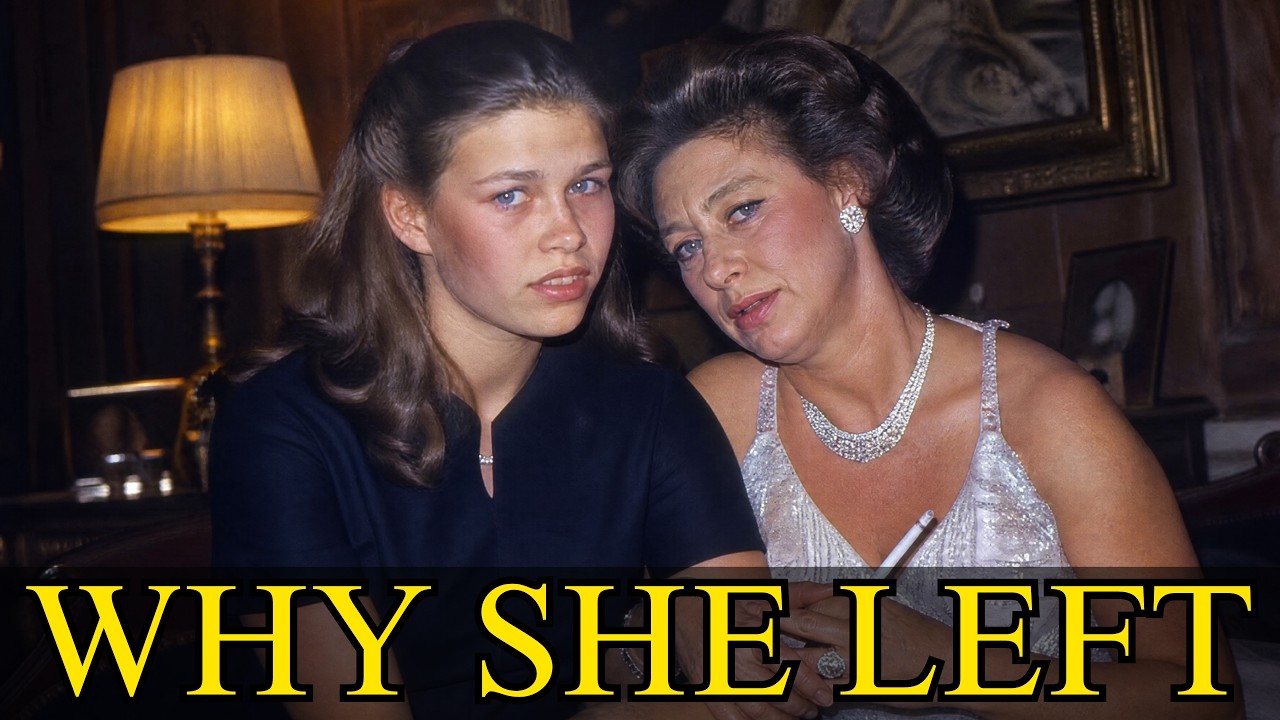
Her story is one of deliberate withdrawal, of a woman who refused the spotlight, built a career as a professional painter under a name that carried no crown, and in doing so, became one of the most trusted figures her family possessed. She was born on the first of May 1964 at Kensington Palace, seventh in line to the throne, the only niece Queen Elizabeth II would ever have. Her parents were Princess Margaret and Anthony Armstrong Jones, the Earl of Snowdon. The marriage into which she was born had begun as a fairy tale.
On the sixth of May 1960, Margaret had married the professional photographer in the first royal wedding ever broadcast on television, watched by an estimated three hundred million people. Armstrong Jones was charming, gifted, and enormously talented, and the union was greeted as a sign that the monarchy might be loosening into something modern. He was created Earl of Snowdon in 1961 so that the children of the marriage would carry titles. His son David was born that November, and Sarah followed in 1964.
The family settled into apartment 1A at Kensington Palace, a warm home full of eighteenth-century antiques. There was also the Sussex garden estate at Nymans, and the Caribbean villa on Mustique called Les Jolies Eaux, designed by Snowdon’s uncle and given to Margaret as a wedding present. By the time Sarah was born, the cracks were already forming. According to the people who later wrote the marriage down, the passion that had made the union so vivid soon curdled into something colder.
Anne de Courcy, whose biography was written with Snowdon’s cooperation, described a slow disintegration blighted by drink, infidelities, quarrels, and betrayals. Lady Glenconner, Margaret’s lady-in-waiting, recorded how Snowdon would hide cutting notes for his wife to find, slipped inside her books, tucked among her gloves and handkerchiefs. The couple would eventually pass each other in the hallway with exchanged grunts. The betrayals produced consequences that could not be hidden.
A DNA test later confirmed that Snowdon had fathered a daughter, Polly Fry, born within months of the abbey wedding. The infidelities ran in both directions, and the marriage was a shared wounding rather than a single crime. The public rupture came in the winter of 1976. A photographer captured Margaret at ease with Roddy Llewellyn, a landscape gardener seventeen years her junior, on Mustique.
The tabloids branded her a cradle robber, and a member of Parliament called her a royal parasite. Sarah was eleven, turning twelve, old enough to know exactly what was being said about her mother. The family’s private war had become a national spectacle. In March 1976, weeks after the photographs ran, the couple formally separated.
The divorce was finalized in the summer of 1978, when Sarah was fourteen. It was the first divorce of a senior royal in generations, the first since 1901. In 1936, a king had given up the throne rather than marry a divorcée; forty-two years later, the queen’s own sister was divorced, and the throne stood. Sarah was at the center of that historic moment, and the record of what it did to her is almost blank.
One report allowed only that she was reportedly quite shaken. She said nothing then and has gone on saying nothing for fifty years. Her schooling reflected the direction she was already choosing. She attended Bedales, a progressive arts school, and left with a single qualification, an A-level in art.
While the newspapers fought over her mother, she was quietly building a craft. She was a bridesmaid at Princess Anne’s wedding at nine, and at seventeen she was the eldest of five bridesmaids at the wedding of Charles and Diana, standing at the visual center of the most photographed royal occasion of the decade. She treated it, by everything she did afterward, as an occasion to be got through rather than built upon. Her first real job was working in the wardrobe department on the film Heat and Dust in India in the early 1980s, uncredited, far from the palace.
It was there she met her future husband, the actor Daniel Chatto. He came from a world of books and the theater. His ancestor had founded the publishing house Chatto and Windus. The romance grew slowly through the second half of the 1980s, developing privately and away from any spotlight.
She trained seriously as a painter, at Camberwell School of Art, then Middlesex Polytechnic, then the Royal Academy Schools, completing a postgraduate diploma around 1991. She won the Windsor and Newton Prize in 1988 and the Creswick Landscape Prize in 1990. She exhibited under the name Sarah Armstrong Jones, and from 1995, she showed with the Redfern Gallery in London. Her subjects were landscapes and interiors, quiet scenes that rewarded patient looking rather than spectacle.
She sold her paintings at painters’ prices, under a painter’s name, and let the royal association add nothing to the total. She married Daniel Chatto on the fourteenth of July 1994 at St Stephen Walbrook, one of Christopher Wren’s small city churches, before about two hundred guests. The service was conducted by the founder of the Samaritans. She wore her mother’s tiara and earrings, and she left the church with the plainest style available to her.
She took her husband’s surname and kept only the courtesy title she had always held as the daughter of an earl. Her commoner husband received no title at all. The marriage produced two sons. Samuel was born in 1996 and became a sculptor and ceramicist.
Arthur was born in 1999, served as a page of honor to the Queen, and later became a Royal Marines officer. Margaret’s decline began on the island she loved most. On the twenty-third of February 1998, she suffered a stroke at Mustique. In early 1999, she badly scalded her feet in a bath, and her mobility was never the same.
Further strokes left her with partial loss of vision and paralysis down her left side. Through all of it, the quieter of her two children was a steady presence at her side. Sarah had built her whole adult life at a deliberate distance from royalty, yet she was close and attentive through the long decline. Princess Margaret died at King Edward VII’s Hospital on the ninth of February 2002, four years after the first stroke.
Her children were with her. Margaret was cremated, and her ashes were interred in the King George VI Memorial Chapel beside her parents. Seven weeks later, the Queen Mother died at the age of 101. After Margaret was gone, the relationship between Sarah and the Queen deepened into something the record describes as unusually close.
When Prince Philip died in the spring of 2021, his funeral was held under pandemic restrictions, limited to about thirty mourners. Sarah was among them, one of the few people the Queen most needed beside her. She is also godmother to Prince Harry and to Lady Louise Windsor. The girl born seventh in line had drifted to roughly twenty-ninth by the middle of the 2020s.
That drift is the plainest map of her life. She began at the center and moved steadily toward the periphery, and every step was in the direction she chose. Her mother had been consumed by proximity to the throne. Sarah treated distance as the answer.
She took the one inheritance that never hurt anyone, her father’s eye, and built a life the public was never invited into. In a family where everyone either performed the drama or was broken by it, she did neither. She walked away, and that withdrawal earned her the family’s trust. The woman who asked for nothing became the one the Queen kept nearest.
Nobody blamed her for leaving, because leaving, done her way, was the most loyal act anyone in that family managed. The walking away and the sitting at the bedside were the same act seen from two sides: distance from the spectacle, closeness to the person. The record keeps her silence, and so must any honest telling.
In a family whose every wound was eventually printed, she made her own grief the one thing that stayed private.