On the morning of March 3, 1988, Dorothy Harwick drove her blue Oldsmobile to Lincoln Elementary School in Lancaster, Pennsylvania, unlocked her classroom, arranged the chairs into the reading circle her students loved, and walked to the office supply room at the end of the hall for construction paper. She was never seen alive again. Dorothy Harwick was 44 years old. She had taught third grade at Lincoln Elementary for 16 years, long enough to have taught the children of her former students.
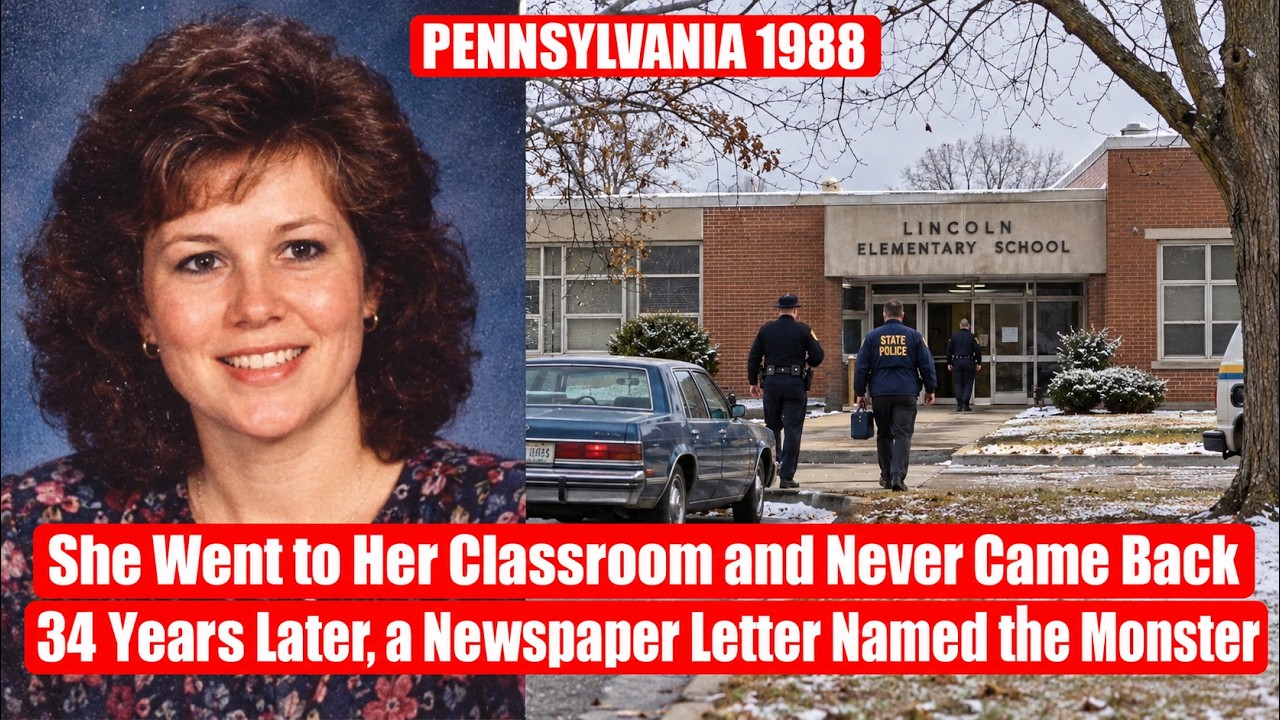
She had taught older siblings and younger siblings, and she kept class photographs from every year pinned to a corkboard in her kitchen, updated every June. She was precise, short, with wire-rimmed glasses and the kind of posture her students unconsciously imitated. She was also warm in the specific way that experienced elementary teachers are, patient with the difficult, generous with the slow, delighted by the unexpected. She lived alone in a two-bedroom house on Maple Street in Lancaster’s southwest quarter.
She had been married briefly in her late 20s and had remained on good terms with her former husband, who now lived in Harrisburg. She had no children of her own, a fact she described with equanimity rather than regret. Her classroom was her life’s work, and she was unembarrassed about saying so. Her routines were fixed.
School by 7:15 a. m. Coffee from the faculty lounge before students arrived. Parent conferences every third Thursday.
Weekend mornings walking the Conestoga River Trail with her neighbor Margaret Holloway, who had been her closest friend for 20 years. On March 2, the day before she vanished, Dorothy stayed late at school to help a struggling student practice reading. She called Margaret that evening to confirm their Saturday walk. She left a note on her own kitchen counter: “Pick up milk.
Call insurance. Return library books Saturday. ” She never made it to Saturday. At 11:15 a.
m. on March 3, Dorothy Harwick’s classroom was found empty with the door open and the construction paper still uncollected from the supply room. The principal sent a teacher’s aide to check. The aide returned and said she was not in the building.
By noon, a substitute had been called in for Dorothy’s class. By 2:30 p. m. , Margaret Holloway, who had not heard from Dorothy and could not reach her at school, called the Lancaster City Police.
By 4 p. m. , Dorothy’s car was found in the school parking lot. Her purse was on the front seat.
Her keys were in the ignition. By the evening of March 3, Dorothy Harwick was missing. She was found six days later, on March 9, in a wooded area near the Conestoga River, on the same trail she and Margaret had walked every Saturday. She had been murdered.
The community responded with grief that was also unmistakably rage. This was not a stranger in an anonymous city. Dorothy Harwick was someone’s child’s teacher. She was the person who had called dozens of families to say their son or daughter had had a hard week and deserved a kind word at home.
The school held a memorial. The church held two. Lead investigator was Detective Frank Moran of the Lancaster City Police Department, a 22-year veteran who had worked major crimes for 9 years. Moran was 50 years old and scheduled to retire in 18 months.
He had seen terrible things in his career. He told a colleague this one was different in a way he could not fully articulate. Something in the precision of it, the selection, the location by the trail she walked every week. Moran developed several suspects in the early months.
A handyman who had done work at the school two months prior. A former student’s parent with an unresolved grievance. A man with a prior assault conviction seen near the school the week before Dorothy’s disappearance. None produced physical evidence.
All were cleared by 1989. What Moran did not know, what no one in the investigation knew until 34 years later, was that Dorothy’s killer had already introduced himself. The years moved forward with the slow, grinding indifference of unsolved cases. The school named a reading award after her.
Her class photographs were donated to a local historical archive. Margaret Holloway attended every anniversary memorial and planted a rose bush on the Conestoga Trail near the spot where Dorothy had loved to stop and watch the herons. By 1995, seven years had passed. The Lancaster Cold Case Unit had been established, and Dorothy’s file was transferred there.
A new review produced no new leads. By 2002, Detective Frank Moran had been retired for 11 years. He was 74. He still had the file.
He still read it. He had developed a theory about the precision of the crime’s location. The perpetrator had known the trail, had known when Dorothy walked it, had known more than a stranger would have known. But he had never been able to connect that theory to a name.
By 2010, Margaret Holloway was still walking the Conestoga Trail. She had started bringing a small photograph of Dorothy with her, tucked in the breast pocket of her coat. She said she told Dorothy about whatever was happening in the world that week, the same way she had when Dorothy was alive. The case had been cold for 34 years when an editor at the Lancaster Intelligencer Journal received a letter.
It arrived in the spring of 2022, not digitally, but on paper, handwritten in a careful, slightly formal script, postmarked from within Lancaster County. It was addressed to the crime desk. The writer identified themselves as someone with knowledge of the Dorothy Harwick case. They described details of the crime that had never been made public.
Details the Lancaster Cold Case Unit had deliberately withheld for evidentiary purposes. They wrote about the school. They wrote about the trail. They wrote with the particular specificity of someone who had been there.
They did not provide a name. The editor contacted the Cold Case Unit that same afternoon. Detective Sarah Okafor, who had been assigned the Harwick file two years earlier, read the letter three times before she picked up her phone. What happened next was methodical and careful, because a letter had never been a conviction, and Okafor knew that.
She sent the letter to a forensic linguist at Millersville University of Pennsylvania, a specialist in written language analysis who worked with law enforcement on cases involving anonymous documents. The linguist’s analysis was specific. The letter’s sentence structures, its vocabulary patterns, its use of subordinate clauses and passive constructions pointed toward an individual in a specific age range, likely educated, likely male, likely from the Lancaster region, and likely someone with a professional or semi-professional background who had never come to the attention of law enforcement. The writing was controlled.
It was not the writing of someone who was remorseful. It was the writing of someone who could not stop talking about it. Okafor cross-referenced the linguistic profile with the records from Moran’s original investigation, specifically the list of individuals who had had access to the school and who had some knowledge of Dorothy Harwick’s routines. One name sat at the intersection of every variable.
A man named Raymond Clare, who had worked as a district maintenance supervisor for the Lancaster School District from 1985 to 1993. He had serviced Lincoln Elementary multiple times in 1987 and early 1988. His work orders showed three visits to the school in the six weeks before Dorothy’s disappearance. Raymond Clare was 71 years old in 2022.
He had retired in Lancaster. He still lived there. A DNA warrant was obtained. Evidence from the original 1988 crime scene, preserved through four decades in the Lancaster evidence vault, was retested against the new sample.
The match was confirmed in November 2022. On November 18, 2022, Raymond Clare was arrested at his home in Lancaster. He answered the door without expression. He said nothing to the arresting officers.
His neighbors could not make sense of it. One woman who had lived across the street from him for 15 years told local news she had considered him a friend. She said she had never had a reason not to. She had been to his house for dinner.
Raymond Clare was charged with first-degree murder. He entered a guilty plea in early 2023 and was sentenced to life in prison without the possibility of parole. He was 72 years old. He had written to the newspaper because, after 34 years of silence, something in him had not been able to maintain it.
Whatever he had expected from that letter, absolution, recognition, a kind of dark satisfaction, he had not expected what he received. He had not expected Sarah Okafor and a forensic linguist and four decades of carefully preserved evidence. Margaret Holloway was 81 years old when the verdict was announced. She made the trip to the courthouse with the help of her daughter, who had been one of Dorothy Harwick’s students in 1979.
She stood on the courthouse steps in the November cold and said Dorothy had loved this time of year, the bare trees against the gray sky, the smell of woodsmoke in the mornings. She said she had kept their walks on the trail even after Dorothy was gone because she had not known how to stop. She said she had the photograph in her pocket. She patted the front of her coat to show where it was.
Dorothy Harwick had given years of professional life to children who were not her own and asked nothing in return. She had arranged the reading circle the morning she disappeared. The construction paper she had gone to collect was still there when investigators arrived. Justice came for Dorothy Harwick after 34 years, through a letter the killer could not stop himself from writing, a forensic linguist who read it closely, and evidence kept safe for four decades.
Margaret Holloway’s rose bush still stands on the Conestoga Trail, near the spot where Dorothy had loved to stop and watch the herons.