The calls started three days after her body was found. A man’s voice, calm, asking the same questions each time: Had they found anything? Had they identified a suspect? Was the investigation still active?
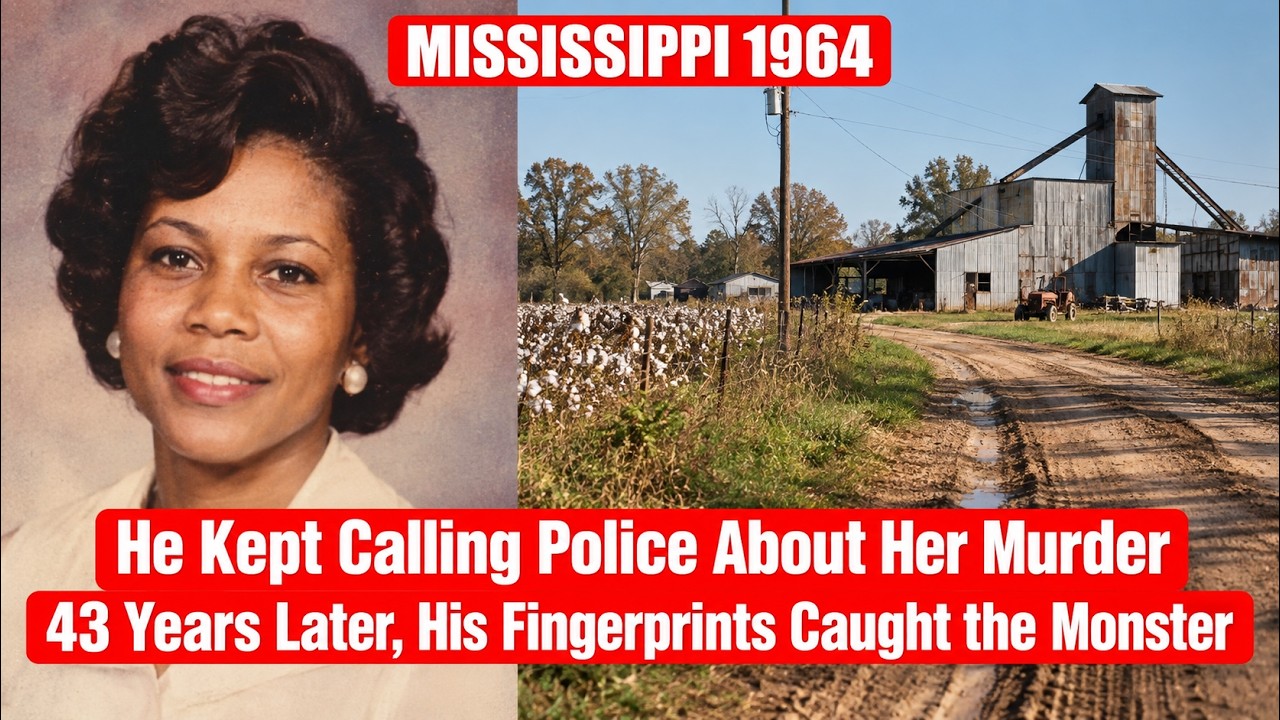
The deputy who took most of the calls logged them as routine. A concerned neighbor checking in, he assumed. It would take 43 years, a cold case review, and a fingerprint analyst in Jackson to understand what those calls actually were. That is the story of Luella Mae Dawson, age 41, found on the morning of September 8th, 1964, on a dirt road behind the cotton gin in Sunflower County, Mississippi.
Sunflower County in 1964 was cotton country in the Mississippi Delta, flat and hot, its small towns of Indianola, Ruleville, and Drew close enough that everyone knew everyone. The civil rights movement had been there for two years. Fannie Lou Hamer had been beaten returning from a voter registration workshop the summer before, and the Freedom Summer workers had passed through in June and July. Three of them, Chaney, Goodman, and Schwerner, had been murdered in nearby Neshoba County in June.
That was the Mississippi that Luella Dawson moved through daily. She was born in 1923 in Sunflower County, the daughter of a sharecropper family that had worked the same land for two generations without owning an acre of it. She left during the war years to work in a cannery in Memphis and came back in 1947 to care for her ailing mother. She lived in a wood-frame house on the east side of Drew with her son Marcus, 19, who worked at the cotton gin, and her daughter Celestine, 16, a junior at the colored high school and one of the finest students her teachers had seen in years.
Luella worked as a domestic, cleaning houses for three white families on the north side of Drew, six days a week, fifty weeks a year, for wages the law was beginning to say should be higher and the families were not yet prepared to acknowledge. What Luella had that no wage could give her was standing. In the east side community of Drew, she was the woman you brought your problems to. Her neighbor Estella Byrd called it backbone.
Her pastor at Greater Mount Calvary Missionary Baptist called it wisdom. Celestine would later call it the ability to see the right thing clearly in situations where other people couldn’t quite make it out. She had kept two families from losing their homes by helping them navigate paperwork. She had talked a young man out of doing something violent by sitting with him on a porch in August heat and asking questions until he told her what was actually wrong.
She was not famous. In Sunflower County in 1964 she was not in a position to be famous. But the people around her knew what she was. On the evening of September 7th, 1964, Luella left her house at approximately 7:00.
Marcus would later tell investigators she said she was going to visit Estella Byrd two streets over and would be back by nine. Estella would say Luella never arrived. Marcus called for her at nine, at ten, at eleven. He walked to Estella’s house and came back without answers.
He did not call the sheriff’s department that night. Asked about it by a federal investigator forty years later, he explained simply: it was 1964. He was a nineteen-year-old black man in Mississippi, and calling the sheriff’s department at eleven at night to report his mother missing was not something the world he lived in made safe to do. He waited until morning.
The call came at 7:15 a. m. on September 8th. A gin worker named Elmore Tatum had found a woman’s body on the dirt road behind the cotton gin on the south edge of Drew.
The sheriff arrived and identified Luella Dawson. She had been killed the night before by blunt force trauma. The road where she was found was not on any route between her house and Estella’s. The investigation lasted three weeks.
The Sunflower County Sheriff’s Department had eleven full-time deputies for a county of 38,000 people. It had no forensic capacity, no specialist investigator, no working relationship with the state bureau of investigation. Its chain of command ran through a sheriff elected by an electorate that was overwhelmingly white at the ballot box, because the ballot box was not yet open. The lead officer, Deputy Howard Greer, interviewed nine people.
No physical evidence was collected in a usable manner. No fingerprints were lifted. No murder weapon was recovered. What the original report noted almost as an aside was that a man from the neighborhood had come into the sheriff’s office three days after the body was found to ask about the investigation.
The deputy logged it as a courtesy contact. The man gave his name, asked about suspects and leads, was told pleasantly that the investigation was ongoing, and left. His name was Darnell Eugene Prior. He was 37 years old.
He lived four streets from Luella Dawson. Three days later he called again, then again the following week. Greer noted the calls with neither suspicion nor interest. A concerned citizen, the note said, follows up regularly.
The investigation went cold by October. Luella Dawson’s death was filed as an unsolved homicide. Marcus Dawson drove a tractor on a soybean farm east of Drew for 31 years. He raised three children.
He went to the sheriff’s department once a year every September for eleven years, until 1975, when the deputy he’d been speaking to retired and the new one told him there was nothing new. After that he went every three years, then every five. The last time he went he was 61, and the investigator who met with him was younger than his youngest child. Marcus said he understood there was probably nothing, he just wanted to make sure the file was still where it was supposed to be.
Celestine left Mississippi in 1967 for Detroit. She attended Wayne State University on a scholarship, became a social worker, married, had four children. She did not go back to Sunflower County except once, in 1989, for a cousin’s funeral. She told her oldest daughter that Mississippi was a place she carried inside her, not a place she could go back to.
In 2005, the Mississippi Attorney General’s office launched a formal cold case initiative focused on civil rights era unsolved homicides. The investigator assigned to the Dawson case was a state-level special agent named Gerald Fontenot, the son of a Louisiana Creole family, a man who had spent his career working cases other people had stopped working. He pulled the original file in the spring of 2006. He read the three-week investigation summary, the witness interviews, and then the call log.
Darnell Eugene Prior, four calls in three weeks, logged as concerned citizen. It was all there in Howard Greer’s original notes. Fontenot ran the name through the state criminal database. Prior had a domestic violence charge in 1971 that resulted in a fine and probation.
He had died in 1999 in Greenville, Mississippi, at age 72, of kidney failure. But Fontenot did not close the file. The original case had not included fingerprints because the scene had not been processed properly. What it did contain was a single item of physical evidence: a glass bottle found near the body, placed in an evidence envelope by the first deputy on scene, and against all expectation of the era, it had remained in Sunflower County evidence storage for 42 years.
Not because anyone had been careful with it. Because it had been misfiled into a box labeled with a different case number and had simply never been found until Fontenot, going through the storage room with a flashlight and a yellow legal pad, matched the tag number to a notation buried in the original case narrative. He submitted it to the Mississippi Crime Laboratory in Jackson in the summer of 2006. He drove it there himself.
He did not want to mail it. The fingerprint analyst who processed the bottle was a woman named Sandra Okafor. She worked it over three sessions across two weeks, recovering two partial prints that were individually insufficient and one near-complete print from the lower neck that was, in her professional assessment, usable. The state database returned no match.
The federal database maintained by the FBI did. On a Thursday morning in October 2006, Okafor called Fontenot with a match. The print from the bottle matched a set of prints on file from a 1971 domestic violence arrest in Sunflower County. The arrested party: Darnell Eugene Prior.
Fontenot pulled the call log back out. Four calls in three weeks. Concerned citizen. Follows up regularly.
A man who had been so close to being caught, and so certain he wouldn’t be, that he had done the one thing a guilty man should never do. He had kept returning to the scene, not the physical scene, but the investigative scene. He kept circling it, watching to make sure the circle never closed. For 42 years it hadn’t.
He had died in 1999 knowing that nobody ever would. He was wrong by seven years. The Mississippi Attorney General’s office issued its formal findings in December 2007. Darnell Eugene Prior was identified, with physical evidence confirmed by forensic fingerprint analysis and corroborated by the documented pattern of his post-crime contact with the investigating agency, as the individual responsible for the murder of Luella Mae Dawson on September 7th, 1964.
The finding was entered into the public record of Sunflower County and into the state’s civil rights cold case registry. Marcus Dawson was 62 years old when Fontenot called him. He listened without interrupting. When Fontenot finished, Marcus asked one question: did anyone know why?
Fontenot told him that in cases from this era, a complete motive picture was rarely available. Marcus thanked him and said the name was more than he’d had for 43 years, and that it was something. Then he said his mother had been the kind of woman who did not let things stand when they were wrong, and that whoever had done this had probably known that about her. Celestine was in Detroit when her brother called.
She was 60 years old. She sat down at her kitchen table with the phone in her hand after the call was done. Her oldest daughter came in and found her there. Celestine told her, they found out who did it.
Her daughter asked what she felt. Celestine said she felt like she had been carrying something very heavy for a long time and someone had just told her she could set it down now. Except you never actually set it down. You just know what it is.
You know its name. Luella Mae Dawson was 41 years old. She worked six days a week, kept her neighbors’ paperwork straight, talked young men down off porches in August heat, and raised two children on a domestic worker’s wages. She had a son who went to the sheriff’s office every September for eleven years because she deserved someone who would go.
She had a daughter who carried her across a thousand miles to Detroit because that was the only way to keep her close. She had a future beyond 41. It was taken from her by a man who then called the people investigating her murder four times in three weeks to make sure they weren’t getting close. He spent 43 more years not being close to justice.
He did not live to see it catch him. But it caught him anyway.