On December 1, 1981, a man with a country accent called a real estate office in College Station, Texas, and said he had $73,000 in cash to buy property far from town. He asked for no one by name. Virginia Freeman, who went by Ginger, was next on the rotation list, so the call went to her. A 40-year-old Baylor graduate, mother of two, and Sunday school teacher at First Baptist Church, she was known for taking difficult listings and unusual clients.
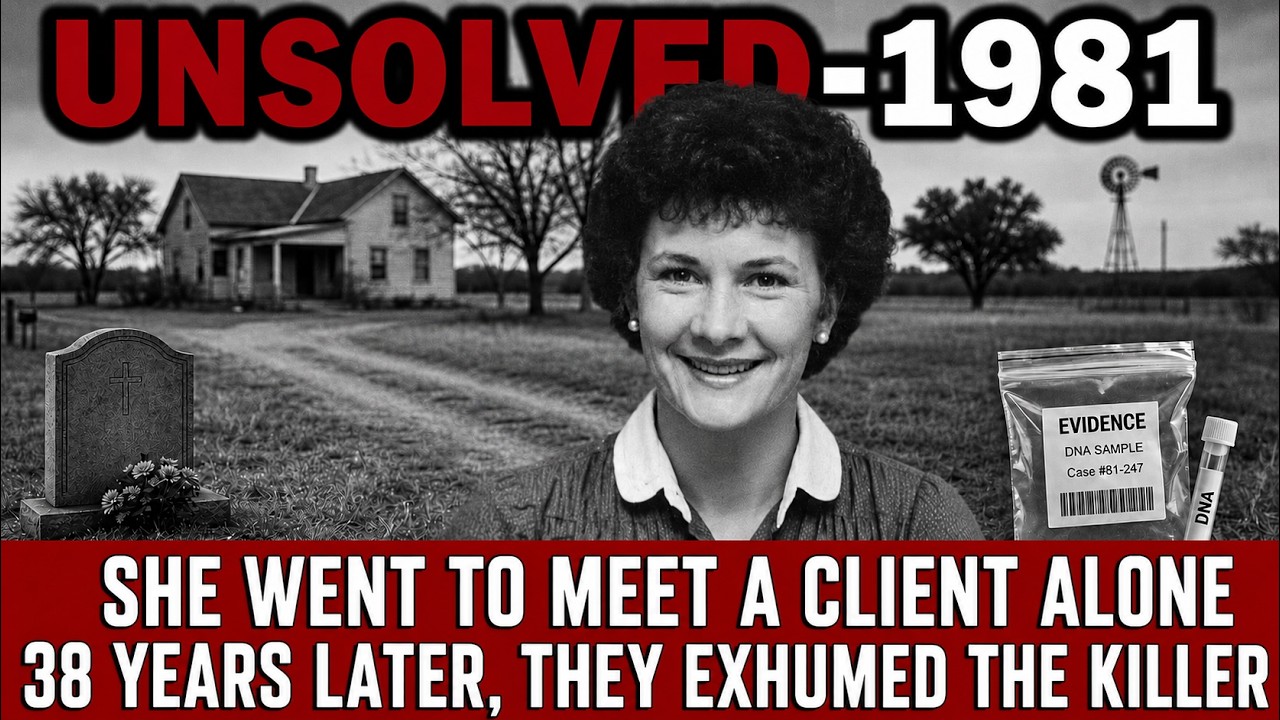
She told her children she would be back soon, then drove south to a vacant house on Greens Prairie Road. She never came home. Her husband, Charles, found her body that evening behind the locked house. She had been beaten with a rock, stabbed eleven times, and strangled, her hyoid bone broken and neck fractured.
Her fingernails were torn and broken. She had fought for her life, and whatever she clawed from her attacker remained trapped beneath those nails. A detective named Dick Gullage made a decision that afternoon that would not pay off for nearly four decades. He ordered her hands bagged and her fingernails scraped.
In 1981, DNA testing did not exist, but Gullage wanted to preserve every trace of the man who killed her. The evidence sat in storage for thirty-seven years. When it finally spoke, it pointed to a man who had already been dead for almost two decades, executed by the state of Texas for a different murder. To prove he killed Ginger Freeman, investigators had to dig up his body from a cemetery in Huntsville.
Ginger Bradford was born in 1941 in Gatesville, Texas, graduated from high school there in 1960, and earned her degree from Baylor in 1964. That same year she married Charles Freeman. She taught homemaking in Troy, Texas, and later followed her husband to North Dakota during his Air Force assignment. They returned to College Station in 1970, and she became a real estate agent at the Real Estate Mart.
Beyond work, she taught Sunday school, hosted dinners for international students from Texas A&M, led Girl Scout and Cub Scout troops, served on a school district advisory council, and volunteered with the Red Cross. Her colleagues knew her as someone who never slowed down and who willingly took the difficult or unusual appointments. On the afternoon of December 1, 1981, the caller had described himself as a cash buyer looking for rural property. Ginger postponed her dinner plans, drove home to tell her children about the potential sale, and headed out.
She arrived at the vacant house around 3:30. The front door was still locked when her body was found, so the attack began outside. She was struck with a four-pound rock found on the property, stabbed eleven times, and strangled. Nothing was taken from her vehicle, and her purse remained in the car.
There was no sign of sexual assault. Investigators concluded this was not a robbery or a random act. The cash buyer did not exist. The entire scenario had been constructed to get a woman alone at an isolated property.
When Ginger did not come home, Charles Freeman reported her missing by early evening and then went looking for her himself. He drove down Greens Prairie Road, found her car at the listing, and discovered her body behind the house. A young deputy named Chris Kirk was called to photograph the scene, his first ever crime scene. He had no way of knowing that thirty-seven years later, as sheriff of Brazos County, he would be the one announcing the case solved.
Investigators worked the case with the Texas Rangers through the winter into 1982. A passing brickmason reported seeing a man and a vehicle near the property around the time of the murder, a composite sketch was produced, and a partial license plate number was circulated, but neither produced a suspect. Charles Freeman was examined as a matter of procedure and quickly cleared. The case went cold.
Over the following years, leads went nowhere. Henry Lee Lucas, the notorious serial confessor, claimed responsibility and even described the stab wounds to the neck, but could not identify the crime scene or provide any convincing detail. Investigators dismissed it as another false confession. In 1993, Brazos County investigator Kenny Elliot reopened the case and refused to let it die.
In 1997, after sixteen years, DNA technology finally allowed a lab to recover a full unknown male profile from beneath Ginger Freeman’s fingernails. The profile was real, but matching it to a name proved difficult. Texas law at the time did not allow DNA to be compelled from a suspect based on suspicion alone. Investigators believed the profile belonged to James Otto Earheart, a heavy-set appliance repairman and junk dealer who lived in the Bryan-College Station area.
He had been an early person of interest in the Freeman case, matching the witness description, but there had never been enough evidence to charge him. Earheart’s pattern became clearer in May 1987, when he responded to a newspaper ad from the Kirtland family, who were selling a paint spray gun. He came to their home, looked at the item, and left. Eight days later he returned and asked a neighbor when the family would be home.
That afternoon, nine-year-old Candy Kirtland stepped off her school bus and vanished. Her body was found two weeks later, hands bound behind her back with electrical cord, shot once in the head. Earheart was arrested, convicted of capital murder, and sentenced to death. On August 11, 1999, James Otto Earheart was executed by lethal injection in Huntsville.
He made no final statement. Texas did not routinely collect DNA from death row inmates before execution, and nobody thought to take a cheek swab before the needle went in. Earheart’s DNA went into the grave with him, and the Freeman case seemed destined to remain cold forever. But in 2016, a new technology changed the investigation.
Genetic genealogy allowed forensic genealogists to upload crime scene DNA to public databases and search for relatives of an unknown suspect. In 2018, CeCe Moore, a pioneer in the field, ran the DNA from Ginger Freeman’s fingernails through the public database GEDmatch. She found two strong matches, both second cousins of the unknown suspect. She traced their family trees backward through census records and marriage certificates until the two lines converged on a couple who had lived in the 1800s.
Then she worked the tree forward, generation by generation, eliminating one branch after another until only one name fit every criterion: James Otto Earheart. Investigators still needed direct confirmation. Earheart’s son agreed to provide a voluntary DNA sample, and the lab confirmed a parent-child match between the son and the unknown male profile from beneath Ginger’s fingernails. On June 25, 2018, Sheriff Chris Kirk held a press conference and named James Otto Earheart as the man who in all probability had murdered Ginger Freeman thirty-seven years earlier.
But to close the case permanently, they needed Earheart’s own DNA. That meant exhuming his body. In late June 2018, investigators gathered at Blackjack Cemetery in Huntsville. When they reached the burial site, they discovered that Earheart had been buried in a cardboard box, his remains fully skeletonized after nineteen years in the earth.
The team recovered a femur, clay-caked and exposed to soil and moisture. There was no guarantee any usable DNA remained. The bone was sent to a laboratory in Austin, where extraction proved slow and delicate. Over a year passed.
On August 30, 2019, the Texas Department of Public Safety Crime Laboratory delivered its report. The DNA extracted from the femur was a conclusive match to the DNA recovered from beneath Ginger Freeman’s fingernails in 1981. After thirty-eight years, the identity of her killer was confirmed with scientific certainty. In October 2019, the Brazos County Sheriff’s Office announced that the county’s oldest cold case was officially closed.
Kirk credited everyone who had contributed across four decades: Dick Gullage, who preserved the fingernail evidence; Kenny Elliot, who reopened the case in 1993 and spent twenty-five years pushing it forward; the Texas Rangers; the DPS Crime Lab; and Parabon Nanolabs. He also voiced the one regret that hung over the resolution: Earheart was dead, so there would be no trial, no handcuffs, no courtroom reckoning. Ginger Freeman’s children issued a statement expressing gratitude to everyone who solved their mother’s case. Their father, Charles, never learned who killed his wife.
He died without an answer, having raised their children through the aftermath of a murder that shook the whole community. After Ginger’s death, real estate offices in the Bryan-College Station area changed how they operated, requiring agents to meet unknown clients in person at the office first, verify identity, and never show remote properties alone. Those safeguards spread across Texas as the story circulated through the industry. The case became a textbook example of what genetic genealogy can accomplish when traditional methods run out of road.
But at its core, the story is about a detective who preserved evidence he did not fully understand, an investigator who refused to let the case die, a genealogist who traced two family trees to a couple who lived in the 1800s, and a son who helped prove what his father had done. It is also about Ginger Freeman herself, who on the last afternoon of her life drove down Greens Prairie Road because helping people find a place to live was what she did. When it became clear what was happening, she fought, clawing at her attacker and holding the evidence of his identity beneath her fingernails.
Thirty-eight years later, that evidence spoke his name.