On a spring morning in 1898, a servant in Sydenham, south London, returned from the local chemist with a small bottle of prussic acid, obtained under the medical authority of Edward Aveling. Before the afternoon was over, Eleanor Marx, the most gifted daughter of Karl Marx, would swallow that poison and die alone in her bed at the age of forty-three. In her final letter, she wrote the word love. Her partner, Aveling, had left the house that morning knowing the poison had been procured in his name, and he did not return until it was too late.
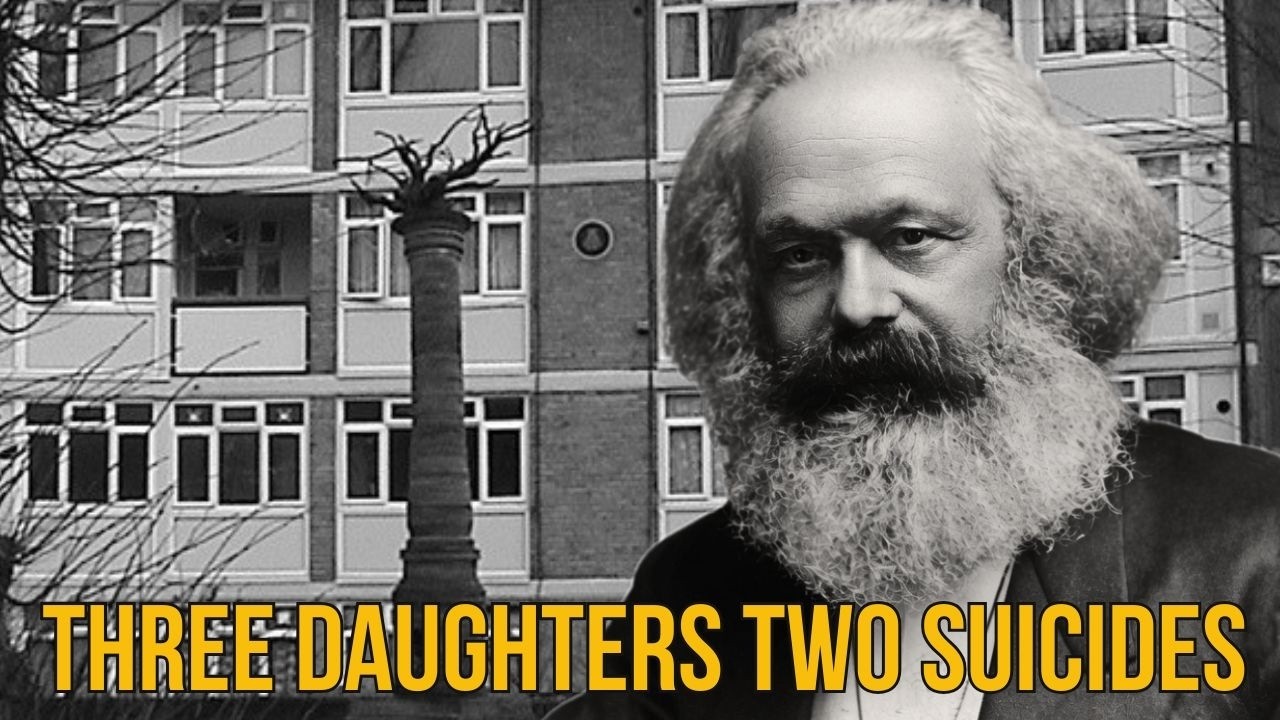
Her death was not an isolated tragedy. It was the third in a sequence that destroyed the women closest to the man who promised the world an end to human suffering. Karl Marx, whose writings would govern the lives of over a billion people within seventy years of his death, had three daughters who survived to adulthood. All three devoted themselves completely to his cause.
The eldest, Jenny, died of cancer at thirty-eight. The two younger daughters, Laura and Eleanor, both ended their own lives with poison. The public remembers Marx as a prophet of history and revolution. His daughters remembered a deeply affectionate father, a man who let them tie him up and ride him like a horse around the room, who read Shakespeare aloud for hours, who invented endless stories about a magical hero called Hans Röckle, and who was known in the family by the loving nickname Moor.
Yet that same father presided over a home of devastating poverty. In their early years in Dean Street, Soho, the family lived in two small rooms in one of the poorest quarters of Victorian London. A Prussian police spy who visited reported dust and dirt everywhere, broken furniture, a thick cloud of tobacco smoke, manuscripts, children’s toys, and his wife’s sewing tools all piled together, while Marx sat calmly in the middle of it all. To feed the family, clothes, shoes, and even Jenny’s inherited family silver went to the pawnbroker, again and again.
Jenny von Westphalen, Marx’s wife, had been a genuine German baroness who abandoned her noble family to marry the penniless radical she had loved since childhood. She followed him into exile, bore him seven children, and watched most of them die. Of those seven children, only three reached adulthood. The others died as infants in cold, damp rooms from the diseases of poverty, while Marx sat upstairs writing a book meant to end human suffering forever.
In 1850, the infant Heinrich Guido died before his first year. In 1852, another daughter, Franziska, died as a baby; the family could not afford a coffin and had to borrow one from a French refugee neighbor. Then in 1855, his son Edgar, the family’s adored boy, died of tuberculosis at age eight in Marx’s arms. Marx wrote later that his life had known many misfortunes, but only then did he know what unhappiness truly meant.
The three daughters who survived grew into brilliant, multilingual, fiercely political women. Jenny, born in 1844, was the steady one, dark-haired, serious, and extremely intelligent. Laura, born in 1845, was elegant. Eleanor, born in 1855 in the same year her brother died, was the dazzling youngest, her father’s companion and secretary in his final years.
Their father raised them to be revolutionaries, not Victorian ladies. And the only man who kept the family from starving, year after year, decade after decade, was not Marx at all. It was his friend Friedrich Engels, the son of a wealthy German textile manufacturer, who worked for twenty years at a business he secretly hated, managing his family’s cotton trade in Manchester, and sent money faithfully to keep Marx and his daughters alive while Marx wrote Capital. Without Engels, Marxism as a philosophy would not exist, because Marx himself would not have survived.
The daughters learned one lesson above all others: love meant complete self-sacrifice for a man and his cause. Their mother embodied that ideal, a baroness who pawned her family silver for the revolution. Each daughter then went out and found her own version of a great but difficult man. Jenny married Charles Longuet, a French radical and veteran of the Paris Commune, and entered the same poverty, exile, and endless childbearing that had broken her mother’s health.
She gave birth to six children in about a decade and watched one die in infancy, while managing a household with very little money. By the early 1880s, she was dying of bladder cancer. In the same period, her mother was dying of cancer, and her father, an old man broken by illness and grief, was also failing. Neither father nor daughter told the other how serious his or her condition truly was.
Jenny Caroline Marx Longuet died on January 11, 1883, in Argenteuil, outside Paris, at age thirty-eight. The family gave the task of telling Marx to his youngest daughter, Eleanor. She later described it as the worst hour of her life. She said her father knew the news from her face before she spoke a word.
Marx did not long survive his eldest daughter. He had lost his wife in December 1881. Now he lost the daughter who had been the great love of his old age. He stopped resisting.
On March 14, 1883, only two months and three days after Jenny’s death, Karl Marx died in his chair in London. Engels, who found him, said simply that the greatest living thinker had ceased to think. Two daughters remained: Laura, married to the charming French socialist Paul Lafargue, and Eleanor, already bound to Edward Aveling, a socialist lecturer and writer who was, by near-universal agreement, a moral disaster. He borrowed money from everyone and never repaid it, was vain, dishonest, and a serial seducer.
Eleanor knew something of his real nature, but she had been raised to believe that absolute devotion to a difficult, brilliant man committed to the cause was what a meaningful life looked like. Aveling was already married and could not obtain a divorce, so Eleanor lived openly with him, calling herself his wife, supporting him with her income and inheritance. For fourteen years she gave him everything. In June 1897, while still living with Eleanor and taking her money, Aveling secretly married a young actress named Eva Frye.
Eleanor did not learn the truth until early spring of 1898. It destroyed her completely. There was another secret that had already begun to break her. In 1851, in the deepest poverty of Dean Street, Helene Demuth, the family’s devoted household servant, had given birth to a son named Henry Frederick Demuth, known as Freddy.
The father’s name was not recorded at birth. The agreed story, maintained for nearly forty years, was that Engels was the father. The truth, revealed to Eleanor only as Engels lay dying of throat cancer in 1895, was that the boy was Marx’s own son, conceived with the servant in his household while his wife was pregnant or grieving a dead child, and then sent away to be raised by strangers. Marx had allowed his loyal friend to carry the shame to protect his own moral authority.
Eleanor, who had built her identity on the perfection of her father, learned in the same few years that her father had exploited and concealed the servant in his house, while her partner was doing the same to her. In her final months, she did one noble thing. She embraced her half-brother. She wrote to Freddy with genuine warmth and treated him at last as a member of the family.
It came too late to save her. Thirteen years after Eleanor’s suicide, Laura Marx Lafargue and her husband Paul carried out a pact they had made long before. They were determined not to grow old, weak, and useless in old age. Laura had buried all three of her children, her parents, and both her sisters.
On the night of November 25, 1911, in their home in Draveil outside Paris, Paul, a trained physician, prepared syringes of cyanide. The two elderly revolutionaries dressed carefully, injected themselves, and lay down to die side by side. Laura was sixty-six. At their funeral, a young Russian exile named Vladimir Lenin gave one of the eulogies.
Within six years, he would seize a nation in the name of Laura’s father. In the end, the man who wrote the most celebrated theory of justice in the modern world could see exploitation in every factory in England and could not see it in his own kitchen. He gave his daughters a cause to live for and, unwittingly, a cause to die for. The lesson they learned was the lesson of their home: give everything, ask for nothing, and the cause will be enough.
It was not enough. Jenny died exhausted at thirty-eight. Eleanor died of poison at forty-three. Laura died by mutual suicide at sixty-six.
Their father, who loved them more than anything, died before he could see how their stories ended. He rests under a great bronze monument in Highgate Cemetery, while the women who sustained his life lie in silence beneath it.