The field sits flat and treeless on the right as you head north out of Point Pleasant along the Ohio River. A state historical marker stands at the edge of it, and behind the marker there is nothing. No building, no foundation, no gate. What once stood there was a hospital, and what came to that hospital was a steel instrument roughly the length of a pencil, driven above the eyeball with a hammer.
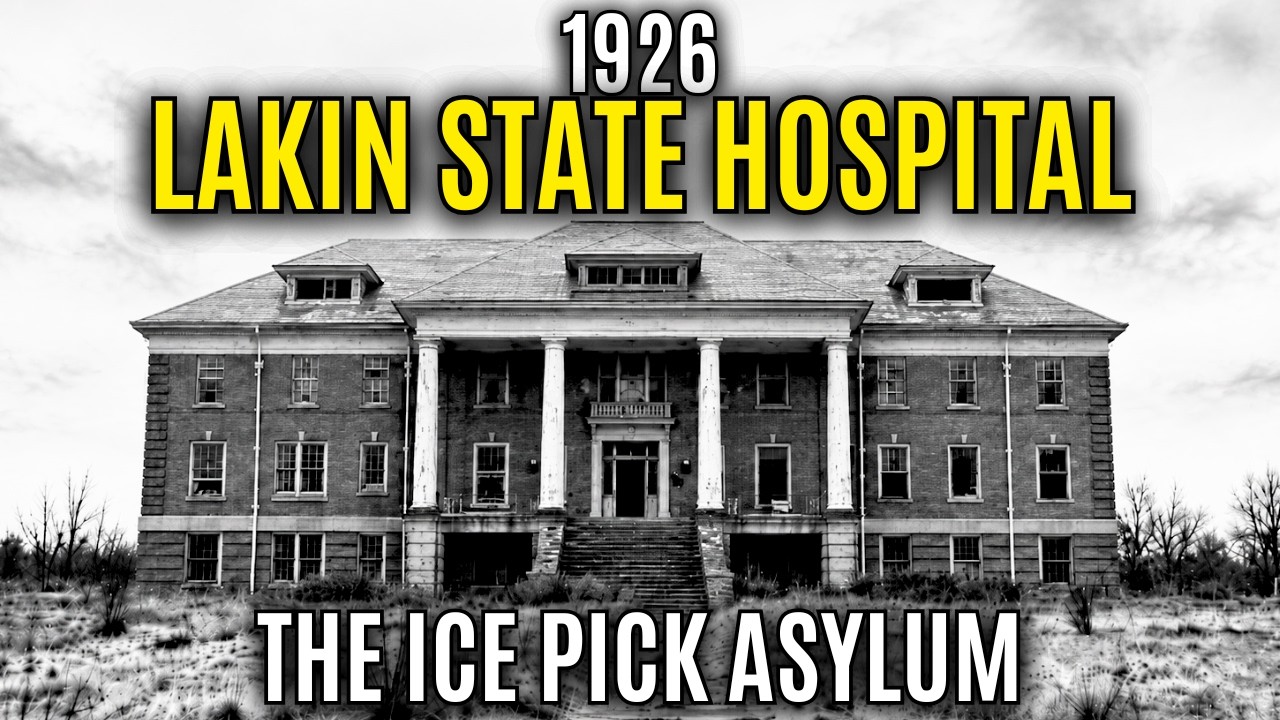
The most repeated number is about 150 times per patient, though no one has ever proven it. This was Lakin State Hospital for the Colored Insane, the only asylum in America run entirely by Black physicians and staff, and the West Virginia hospital where Walter Freeman did his fastest work. It was built to prove that segregation could be equal. Black legislators wrote the law.
Black doctors ran the wards. And handing them full responsibility is what made it so poor, so remote, and so invisible that it could not refuse anyone. The story of this land does not begin with the hospital, however. It begins more than a century earlier, in 1803, when a family from Virginia crossed the Ohio River and settled on this stretch of road.
They owned the land. They also owned people. Their grandson would grow up to write Huckleberry Finn. Samuel Clemens came with his wife Pamela in 1803 to the lowlands along the Ohio above Point Pleasant.
Two years later, he was killed in an accident while building a house. His eldest son, John Marshall Clemens, lived on this land until he was old enough to head west. He settled in Missouri, and one of his sons was Samuel Langhorne Clemens, who took the name Mark Twain. West Virginia placed a marker for that family in 2009, about 350 yards down the road from the hospital marker.
The same road, the same soil. The Clemens family owned land in Virginia and owned people there as well. Before 1926, if you were Black in West Virginia and a court decided you were mentally ill, you went to Weston. Weston State Hospital was a massive structure of hand-cut stone that had been accepting patients since the Civil War, and it was not built for you.
Separate quarters for Black patients were not completed until 1873, nine years after the first patient arrived. Weston was already failing by its own standards. The building was designed for 250 people, and by the 1950s it held nearly ten times that many. The change did not come from a doctor.
It came from three politicians. Between 1919 and 1921, three African American members of the West Virginia House of Delegates, T. G. Nutter, Harry Capehart, and T.
G. Coleman, pushed through a series of laws unprecedented in the region. An industrial school for Black boys at Lakin. An industrial home for Black girls in Huntington.
A school for the Black deaf and blind at Institute. An orphanage in Huntington. A tuberculosis sanatorium in Denmark. And a hospital at Lakin for what the law called the colored insane.
The 1919 law that created the hospital stated its purpose plainly: the institution was founded for the care and treatment of the colored insane of this state. Care and treatment, not custody. It took seven years to build. On February 1, 1926, 162 patients were moved from Weston across the state to a new brick campus on the Ohio River where every person who would care for them was Black.
Lakin was the only state hospital in the country under the direction of an African American superintendent. Not merely the only one with a Black staff, but the only one where the person in charge was Black. And it was not just the superintendent. Doctors, nurses, attendants, secretaries, farm workers, all of them were Black.
Institutions created for Black patients elsewhere kept at least one white physician on staff, because the arrangement was never meant to serve Black patients. It was meant to keep them out of white wards while preserving white authority. Lakin did not do that. Only one other facility in the country had this arrangement, the Veterans Hospital at Tuskegee.
The Journal of the National Medical Association, the journal of the nation’s Black physicians, noted in the summer of 1926 that West Virginia had acknowledged the capacity of the Black medical profession to run the institution, and that the hospital opened a field of practice practically closed to young Black doctors. Larry Moore, a social worker who worked there from the late 1960s until 2004, put it clearly. At a time when care for Black Americans elsewhere meant minimal service in inadequate buildings by openly biased staff, Lakin was a serious attempt at the equal half of the separate but equal slogan. The official photographs of Black institutions across the country in that era all look the same, a row of white men in hats.
Lakin’s official photo looks like a family portrait. Women are on the staff. A small child is in the frame. Construction began in 1919 and the doors opened in 1926.
The campus was built of brick on a stone foundation under a slate roof, in an economical sort of Art Deco style. Symmetrical windows, decorative columns, a two-story portico on simple rectangular pillars. One writer described the main building as wide and featureless, with stripped windows and structural columns, looking like a prison. That was an odd observation until you learn that the real reform school stood across the road.
The campus was built in pieces, and at first there was no housing for staff, so they slept in rooms in the patient wards. That continued until male and female staff residences were established in 1952, twenty-six years after opening. By 1960, the campus consisted of two main three-story buildings separated by sex, a two-story administration building, a canning factory, a new administrative and dietary complex, two staff residences, physician housing, a short-term treatment medical center, and six older buildings renovated as laundry, workshops, and a recreation hall. What is missing is the record.
No one can say who designed it. No one can say what the legislature appropriated, what it cost, how many acres the state bought, or how many patients the buildings were meant to hold. All of those numbers exist for the white hospital at Weston. None of them exist for Lakin.
The state ran this place for more than fifty years and left no accessible record of what it spent. Across the river in Ohio, Athens Hospital had grounds designed by a student of the man who designed Central Park. Lakin got brick, grass, and wind. For a time, it worked.
The best years at Lakin are measured not in programs or outcomes, because the state recorded no outcomes here, but in people. In 1947, a young physician named Mildred Mitchell arrived, hired as staff doctor after finishing her medical degree and still in training in Philadelphia. That same year, a doctor named Luther D. Robinson joined the staff and stayed until 1949.
On Christmas Day 1947, Mildred Mitchell married a therapist at Lakin named William Bateman. The hospital was not just a place to work. It was the entire town, because housing for Black residents in Mason County was practically nonexistent. Every employee lived on the grounds.
There was nowhere else to go. The hospital ran a working farm with orchards and cattle. Patients ran a canning factory, barber and beauty shops, an automotive shop, and a house of worship. If you went up the road in 1948, you would not have seen a warehouse.
You would have seen a village with a hospital at its heart. In January 1948, West Virginia’s first lobotomy was performed. Not at Lakin, but in that state, in that system, under that board. The golden age and the first warning came in the same calendar year.
Who ended up in this building? The first criterion was race. Not diagnosis, not county, not severity of illness. Race.
Lakin was the Black hospital, meaning it took patients from the entire state. A white patient from Mason County went to a hospital near home. A Black patient from anywhere in West Virginia came here, no matter how far that put them from anyone who might visit. Segregation decided not only who treated you, but how far you were from your family.
The second criterion was poverty. Medical historian Edward Shorter wrote that by the early 1950s, Walter Freeman’s focus was on what the wards called the chronics, the poorest chronic patients whose families had stopped visiting. These were the people with no one to object to their fate. As a former hospital worker named Julius Maud put it, the poor are the ones who end up in these institutions.
If you can afford another kind of treatment, you do not come here. The third criterion should stop you, because Freeman stated it himself. Historian Jack El-Hai, who examined Freeman’s private papers, found that Freeman actively preferred Black patients, especially Black women. His stated reason was what he called the greater family solidarity of these people.
He believed Black families were more likely to take a damaged relative home, which made the procedure safer for him because it moved the consequences out of the hospital ward and into someone’s living room. This was not a private idea. In 1951, Freeman volunteered to perform transorbital lobotomies experimentally on Black patients at the Veterans Hospital in Tuskegee, Alabama. A neurosurgeon on staff there objected.
The Veterans Administration banned the procedure at that hospital, and the plan collapsed. One doctor said no in one place, and it stopped. No one said no here. The records on admissions are gone.
What exists are counts. On February 1, 1926, the hospital opened with 162 people. By June 30, 1927, the number was estimated at 228. By June 30, 1930, it was 342.
Four years, more than double. Then the records go vague. There is no available population figure for 1935, 1940, 1945, 1950, or 1955. Nothing for the entire decade in which Walter Freeman drove up from Washington.
The next number anyone has is from 1960, 502, the recorded peak. The state’s own count disappeared for the thirty most important years. What does exist is testimony about how the place felt. It was about supplies.
Attendants recalled there were no towels for patients, no clothes for patients, not enough blankets to cover everyone. A hospital with 500 people could not provide a clean blanket for every bed in a state that promised care and healing. The mechanism for what came next was not a rogue doctor working in secret. It was a board of three men.
The West Virginia Board of Control ran every state institution, prisons, schools, hospitals, three men at a time. In 1952, that board approved a research project within the state hospitals. No deception. A board, an approval, a fee of 25 dollars per operation, and a doctor who worked without a surgical mask and without gloves.
In November 1935, a Portuguese neurologist named Egas Moniz severed the frontal lobes of twenty psychiatric patients and reported that a third of them were free of symptoms. In 1949, he received the Nobel Prize for it, based on a nomination submitted by Walter Freeman. Freeman had arrived at St. Elizabeths in Washington in 1924.
At twenty-eight, he was the youngest laboratory director in that hospital’s history. He was a neurologist. He never obtained a license to perform surgery. In September 1936, working with a neurosurgeon named James Watts, he performed the first lobotomy in the United States on a woman named Alice Hammatt.
That operation took four hours and required an operating room, an anesthetic, and a surgeon. It could not be done on a large scale. So Freeman simplified it. On January 17, 1946, in his office in Washington, he performed the first transorbital lobotomy in America on a homemaker named Sallie Ellenko.
In March of that year, his partner walked in to find him with two ice picks in a patient’s eyes, and was asked simply to hold them steady for a photograph. Watts walked out. By 1950, the partnership was over. Freeman’s position was stated plainly.
Any fool, even a state hospital psychiatrist, could learn it in one afternoon. The first instrument came from a kitchen drawer. Freeman’s house on Connecticut Avenue had no refrigerator. It had an icebox.
An icebox needs an ice pick. His son remembered that the first instrument came straight from that drawer and worked perfectly. The procedure itself took three or four minutes. The patient was unconscious, not from anesthesia, because there was no anesthesiologist, but because of electroshock, usually three consecutive seizures.
An elderly patient might need only one. A strong young patient might need four or six. A nurse held a towel over the patient’s nose and mouth while the seizure subsided. The eyelid was pulled back.
The instrument entered above the eyeball, along the nose, until it hit bone at the roof of the orbit. Then the hammer. One tap, and it penetrated the bone into the frontal lobe. Then the sweeping motion, described by one of Freeman’s students as like sweeping glass, back and forth about seven centimeters deep from the upper eyelid, cutting the connections between the front of the brain and everything below it.
A gauze pad over the eyeball. The instrument out. Dark glasses, because both eyes would be blackened. Then back to the ward.
In the summer of 1952, over twelve days, 228 patients in West Virginia underwent this procedure. Four died, two from hemorrhage and two from dehydration. We know the causes because Freeman ordered autopsies and published the results himself in the Journal of the American Medical Association in 1954. Those are his numbers.
A PBS documentary gives 238 patients over thirty days. A West Virginia newspaper says 225 in twelve days. Four hospitals were used. Weston, Spencer, Huntington, and Lakin.
Between 1952 and 1955, 787 West Virginians underwent lobotomies in those four hospitals. There were more than a hundred additional cases before the project began, bringing the state total to about 900. For the population, that was the highest rate of any state in the country. Newspapers called it the ice pick operation.
The number that has been repeated most often for Lakin is 150, published three times. A West Virginia University-affiliated group estimated more than 150. A magazine article estimated between 150 and over 200. A local newspaper said some records indicated about 150.
None of the three sources cited a primary document. The university account dates that era from 1940, but the procedure did not exist until 1946. What is actually recorded about Lakin? Twenty.
Freeman wrote that number himself in his own papers, found by his biographer. He described returning about a week after operating on what he called 20 very dangerous negroes, and finding 15 of them sitting under the trees with only one guard in sight. He reported that half were released soon after. Twenty is the only number for Lakin traceable to a document.
It may be only a fraction of the true total, because he returned over several years. But no one ever counted Lakin separately, or if they did, that count is lost. As for results, Freeman published those too. In 1952, he gave encouraging numbers to the press.
Out of 228 cases, 86 were discharged, only five returned, and he estimated 100 would be well enough to leave within six months. Then, in his 1954 paper, he counted those who remained. Out of 195 patients still in the hospital after the operation, he estimated only eight could be considered improved. Not more than eight.
Those are the man’s own calculations, published under his name in the country’s most prominent medical journal. Eight out of 195 patients subjected to a procedure he was still promoting. Lobotomy did not end because someone had a change of heart. In 1954, a drug called Thorazine reached the state hospitals, initially marketed as a chemical lobotomy.
The project ended in 1955. It was replaced because something cheaper and faster had appeared. The tools changed. The logic did not.
There are names attached to this hospital, and they belong almost entirely to the staff. There is only one patient. In 1897, in a Greenbrier County courtroom, a man named James P. D.
Gardner sat as assistant defense counsel in the most famous murder trial in West Virginia history, a case folklore calls the Greenbrier Ghost. He was the first Black attorney to argue in that county’s court, and newspapers printed his name beside the white lawyers. Thirty years later, after a suicide attempt, he became a patient at Lakin under the care of a young Black psychiatrist named James Boser. After Gardner, the names run out.
C. C. Barnett, the superintendent, appears under state photos of the campus. Luther D.
Robinson, staff physician for two years. Katherine, the director from 1961. A name, a date, and nothing else. Julius Maud, who said the first time he saw someone drive what he called a nail into a human skull, he wanted to run.
Larry Moore, who worked as a social worker for forty years and spent his retirement arguing online about what this place was. And then there is one person whose life the record follows completely. Mildred Mitchell Bateman decided to become a doctor at age twelve, working alongside Red Cross volunteers caring for hurricane victims. Born in Brunswick, Georgia in 1922, the daughter of a pastor and a registered nurse.
She came to Lakin in 1947, hired while still an intern, married on Christmas Day of that year. She left to receive proper training, spending three years at the Menninger School of Psychiatry in Topeka, then returned in 1955. She returned to Lakin as clinical director. In 1958, she became superintendent and began working with the same population Freeman exploited, patients the system considered hopeless.
Her approach was psychosocial rehabilitation. Her stated position, clearly and repeatedly, was that no one has the right to decide in advance that a patient will not improve. In 1960, she moved to the state Department of Mental Health. In July 1962, her director died.
On December 17 of that year, Governor William Wallace Barron appointed her director of the department, making her the first African American woman to head a state agency in West Virginia. She held the post for fifteen years. A newspaper headline from that period summarizes it. Dr.
Mildred Bateman will not ignore complaints. She was critical of Lakin. In 1973, she became the first Black woman to serve as vice president of the American Psychiatric Association. In 1977, she served on the President’s Commission on Mental Health.
She founded the psychiatry department at Marshall University and practiced until her death in 2012. The other woman arrived in 1951. An eighteen-year-old girl left her home in Fayette County, West Virginia, looking for work. Her name was Edith Ross.
What she found was a hospital on the Ohio River that would hire a young Black woman and give her a place to sleep. She took the job. She got six months of training before being allowed near any patient, more than most attendants in American asylums received in that decade. Her pay was 90 dollars a month, meals included.
She lived at the hospital because there was nowhere else to live in Mason County, which meant she was always on call. She said it made the place feel like family. She said the patients cleaned that hospital like a hotel. She said if not for the patients, that place would never have kept going.
Then, the year after she arrived, Walter Freeman came. She was on the wards by then. She said the operations were done only on patients who had, in the language of the wards, no hope. She said she saw improvement in some in the years before any drugs existed, enough improvement that families could take them home.
Some left and never returned. Some came back, some better, some worse. About Freeman himself, she used one word. Cold.
She remembered two who died. But she stayed. She worked at Lakin through segregation and integration in 1954 and after, as the patients changed and the staff changed and the wards emptied and the mission became something else entirely. She retired from the same hospital she entered at eighteen.
In her later years, a reporter from the Point Pleasant Register sat with her and she talked. That interview is the closest thing that exists to a firsthand account from inside those wards. Edith Ross died in early 2017. Two women, the same buildings, the same years.
One ran the state’s mental health system and had a hospital named after her. The other earned 90 dollars a month and gave one interview. Neither chose to be in the room when that instrument came out of the bag. Yet both stayed, because the alternative was leaving the patients to whoever came next.
Follow the money, because the money explains everything. West Virginia in 1952 could not afford to spend on the people its asylums held. The state was threatening to close Lakin and similar hospitals, because the cost of keeping human beings alive in them exceeded what the legislature was willing to allocate. Then Freeman arrived with a budget solution.
He was not selling treatment to families. He was selling discharge rates to the state. His promotional pitch in four words was that lobotomy sends them home. His son said that on camera, the most damning sentence anyone in that family ever uttered.
His father had moved from solid ground, easing the distress of the individual, to entirely different ground, easing the financial burden of the state. The son said it was the wrong thing to do. The state encyclopedia lists the reasons West Virginia without hesitation. An available patient population, a sympathetic and financially burdened state government, proximity to Freeman’s base in Washington, and restrictions in other states that limited where he could work.
Cheap patients, a broke government, a short drive, and nowhere else that would take him. The hospital ran on unpaid labor. The farm, the cattle, the canning factory, the kitchen, the cleaning, all done by patients. The woman who worked those wards said plainly the place would not have survived without them.
The institution that could not buy sheets stood because of the people who slept without them. The land itself still produces. The women’s prison built here cost 24. 5 million dollars.
An expansion four years later cost another 6. 2 million. Housing one woman there cost 4,756 dollars per day in 2016. The prison operates a garment and embroidery factory, and what those women make is the inmates’ clothing.
The state still gets its labor. The nursing home that replaced the hospital on the same grass was sold. In 2015, the governor announced that Lakin and three other state long-term care hospitals would transfer to a New York development group for 60 million dollars. The buyer committed an additional 80 million to build new facilities.
The hospitals were licensed for 511 beds and lost a combined 6 million dollars a year. Behind that transaction, another figure from a legislative audit. Since 2015, West Virginia has spent 284 million dollars on contracted nursing staff because contract jobs pay more than full-time state nursing positions. The priority expressed in dollars over a hundred years never changed once.
There is no archive. The West Virginia University Regional History Center, the institution most qualified to preserve this material, acknowledges it holds no collection devoted to Lakin State Hospital. No name of any person who underwent a lobotomy at Lakin exists anywhere. Not in a newspaper, not in a court file, not in a memoir, not in a study, not in a printed family history.
The only patient names that survive in the public record belong to the white hospitals and Freeman’s private practice. The people in this building are a quantity. They are not a list. The two deaths at Lakin exist only in one woman’s memory.
No death certificate, no investigation, no official finding. The four deaths in the 1952 project are documented collectively by cause by the man who caused them. A cemetery in Mason County listed under the hospital’s name holds 562 memorial records collected by volunteers on a genealogy website. No description, no coordinates, no photo of the site.
There is no audit, no grand jury finding, no inspection report, no legislative investigation. If West Virginia ever officially examined what happened in those buildings, it left no papers where anyone could find them. In 1954, the year of Brown v. Board of Education, Lakin integrated its staff and patients.
That same year, it became a regional hospital for Jackson, Mason, Putnam, and Wood counties. The hospital built for Black patients from the entire state became a hospital for everyone from four counties. It was not a closure. It was a reallocation.
In 1955, the lobotomy project ended after Thorazine arrived the previous year. In 1957, the hospital absorbed the grounds of the industrial school that had just closed across the road. In 1958, Mitchell Bateman became superintendent, and by 1960, lobotomies at Lakin were over. But the state’s own handbook for 1960 and 1961 lists the practices in use there.
Group therapy, recreational therapy, psychotherapy, all new, all humane, all modern, and also electroshock therapy and insulin coma therapy, in which the patient is pushed to the edge of death by a deliberate overdose of insulin. The lobotomies stopped. The electroshock remained. Two of the three physical assaults on the brain that this building had used were still on the treatment list a decade later.
In 1961, a new director named Katherine A. Rainbow took over. In the mid-1970s, the state built a new intermediate long-term care building. In 1974, by legislative decision, the phrase for the colored insane was removed from the name.
After 48 years, it was called simply Lincoln Hospital. By the end of the 1970s, the mission had changed entirely. Adult psychiatric services were phased out. The census shifted toward the elderly and adults with physical disabilities.
The date usually given for the end of Lakin as a psychiatric hospital is 1979. Since then, the state has operated a nursing home on the site. Then most of the buildings were demolished. And here is where the real problem begins, because the demolition happened at the wrong address.
Lincoln State Hospital never went through a period of abandonment. It was never empty. It became a nursing home, and its old buildings were torn down piece by piece during the 1970s while people worked on the site the whole time. The main building was gone by the end of that decade.
No one broke in, because there was nothing to break into. But on the other side of Route 62, a building stood empty for fifty years. Lakin Industrial School for Colored Boys opened in 1924, created by the same legislation and the same three delegates. It was a reform school for boys who had not committed violent crimes, some as young as ten.
Before it existed, those boys went to a facility that held children as young as six. For thirty years, they worked the surrounding farm. It closed in 1956 when desegregation sent them to Prunty Town. Then the building sat abandoned.
The hospital acquired the land in 1957. In 1976, ownership passed to the state Department of Agriculture, run as a farm until the early 1990s, then passed to a power company. In November 2006, the school and everything around it was bulldozed to create a water utility yard. For fifty years, a large, decaying, abandoned institutional building stood on Route 62 that anyone could enter, and people did.
By the 2000s, the stories had taken shape. People pushed down stairs, audio recordings, light anomalies, ghosts on the staircase. An internet post from 2008 describes the building as a mental hospital and a school and a home for colored boys all at once, built around 1924 and closed in 1956, where they say lobotomies happened, giving the place the nickname Capitol of Lobotomy in the East. Every factual element in that description belongs to two different institutions that have been merged together.
The building being described is the school. The lobotomies happened across the road. The school closed in 1956, the hospital continued for 23 more years. The state identified the causes in its own 1961 handbook.
Geographic proximity, similarity of names, and the fact that the hospital used the school’s buildings after 1957. Two institutions on one road, both named Lakin, one abandoned and suitable for filming. A writer investigating the place found that if you search for Lakin, you get page after page about ghost sightings, and that is the only reason most people have ever heard of it. The building where the operations actually happened on Black West Virginians was demolished quietly and left nothing worth photographing.
The building where none of that happened became famous. The real story eventually reached the country through a chain that can be traced link by link. In 2005, Jack El-Hai published his biography of Freeman based on the doctor’s own papers. That November, NPR broadcast a documentary by Howard Dully, who had been lobotomized by Freeman at age twelve and spent his adult life trying to find out why.
In 2008, PBS aired a film based on El-Hai’s book, and that film named Lakin on screen. In 2017, novelist Sharon McCrum set half her book inside Lakin in 1930. By 1967, Walter Freeman had personally performed more than 2,900 lobotomies in 23 states, including on 19 children under eighteen, one of them four years old. Across the country, about 50,000 Americans underwent lobotomy in total.
But notice whose story this is. It is Freeman’s story. It is Dully’s story. It is the Kennedys’ story.
The films and books center on the men who held the scalpel and a handful of patients articulate enough and white enough to be found and interviewed later. Weston, where the same project was carried out on white patients, was listed on the National Register in 1978 and became a National Historic Landmark in 1990. It closed in 1994 and was sold at auction in 2007 for one and a half million dollars to a demolition contractor who reopened it the next year under its original name as a tourist attraction. Today you can pay to walk through it.
Some of Freeman’s tools are displayed there. Lakin got a field. A nursing home now stands at 1 Circle B Man, West Columbia. The road is named for the woman who ran the hospital and then ran the state’s mental health system.
The state operated the facility from 1979 until October 31, 2025. The company is not bound by its contract with the state to rebuild on this site. In July 2026, bipartisan state senators, including the senate president, raised the issue publicly. The new facilities may move elderly patients and local jobs somewhere else entirely.
Of the original hospital, only one building remains, the late-1950s office building that housed the operating room and private-pay patients. It is now used as a storage warehouse for the women’s prison. The hospital’s activities building still stands too, absorbed into the prison and now serving as a gymnasium. Larry Moore’s position is on record, and it is not what you might expect.
He said he was frustrated that years of effort were wasted denying the history and legacy of Lakin, and that removing a sign does not change the fact that racial bias shaped every aspect of Black life here. He regretted that the buildings were not preserved as a reminder of what the state was and what it tried to do. But when the state considered converting Lakin into a men’s prison and moving the women to Sugar Grove, the residents of Mason County and their elected officials killed the plan. When the governor proposed using part of the nearby armory, locals objected to that as well.
This county fought to keep the institution and its jobs for a quarter century. That too is preservation. It preserves payrolls instead of the building. Weston is a museum now.
Spencer closed. Huntington remains open, and in October 1999 it was renamed for Mildred Mitchell Bateman. Central State Hospital in Petersburg, Virginia, opened in 1870 as the first institution in this country for Black people with mental illness, still operates. The industrial school across the road was leveled for an equipment yard.
Every institution in this story is either a landmark, a hospital, or a memorial to someone. Except this one. This is just a barren field with a prison at its edge. Care and healing.
That is what the 1919 law promised in the state’s own words before a single foundation stone was laid. Not custody, not management, but care and healing. What the state actually produced was 900 of its citizens lobotomized, the highest per capita rate of any state in the country. No count by hospital, no names, no investigations, no archive.
Lakin was not exceptional in that system. It was one of four. Weston, Spencer, Huntington, and Lakin. One project, one board, one approval, one doctor.
Three years. On January 29, 2003, the first women arrived at the prison built on this land. It opened with capacity for 252 beds. The beds were immediately doubled to 302.
It was expanded in 2006 to 462. By 2019, capacity was raised to 584. That year, West Virginia had 771 women serving prison sentences. More than a quarter of them were held in regional jails instead, without the vocational training or rehabilitation programs the prison offered.
The number of women committed to prisons in this state rose from 80 in 1989 to 622 in 2016, an increase of over 677 percent. The state built an institution on this field. Filled it beyond its design capacity. Expanded it.
Filled it beyond that as well. And placed the overflow in county buildings never meant to hold them. It did this with the hospital. It is doing it now with the prison on the same grass, 77 years apart, in the same county, under the same legislature.
This is a state that keeps building the same building. It built a hospital because there was nowhere else to put people, and it could not afford to care for them, so it took the cheapest available option. It built a prison because there was nowhere else to put people, and it could not afford to care for them, so it put a quarter of them somewhere else. It built a nursing home because it could not find anywhere else to put people, and it could not afford to care for them, so it sold it.
Farmland first, then a hospital for the colored insane, then Lakin State Hospital, then a regional hospital for four counties, then Lincoln Hospital, then a nursing home, then prison ground, then a gymnasium and a storage building in a barren field, and since October 31, 2025, an item in a 60-million-dollar portfolio. What remains of the original is the office building. Brick and a foundation under it and a roof over it. It holds equipment now.
The wind comes through the open corridor as it always did, because no one ever planted anything here. The brick is the only part that remains. The question is not what this building was. The question is addressed to the country that produced it.
What does a state do with the people it cannot afford, when the cheapest available answer comes from someone qualified, respected, and in a hurry? West Virginia answered that in 1952. The answer was yes, and the only thing that stopped it was the arrival of a cheaper answer two years later. The material does not answer.
The brick is still in place, holding up a storage room, and it has outlived the doctrine. The doctors, the patients, the board, the legislature, everyone who promised anything on this land. What the state built here has been covered.
What it means is still being decided.