On the night of May 2, 1863, in the dense woods outside Chancellorsville, Virginia, a group of Confederate soldiers heard the sound of horses approaching through the darkness. Convinced that Union cavalry was bearing down on them, the men of the 18th North Carolina raised their rifles and fired into the oncoming riders. A voice shouted for them to stop, that they were firing into their own men. Another voice ordered them to ignore it.
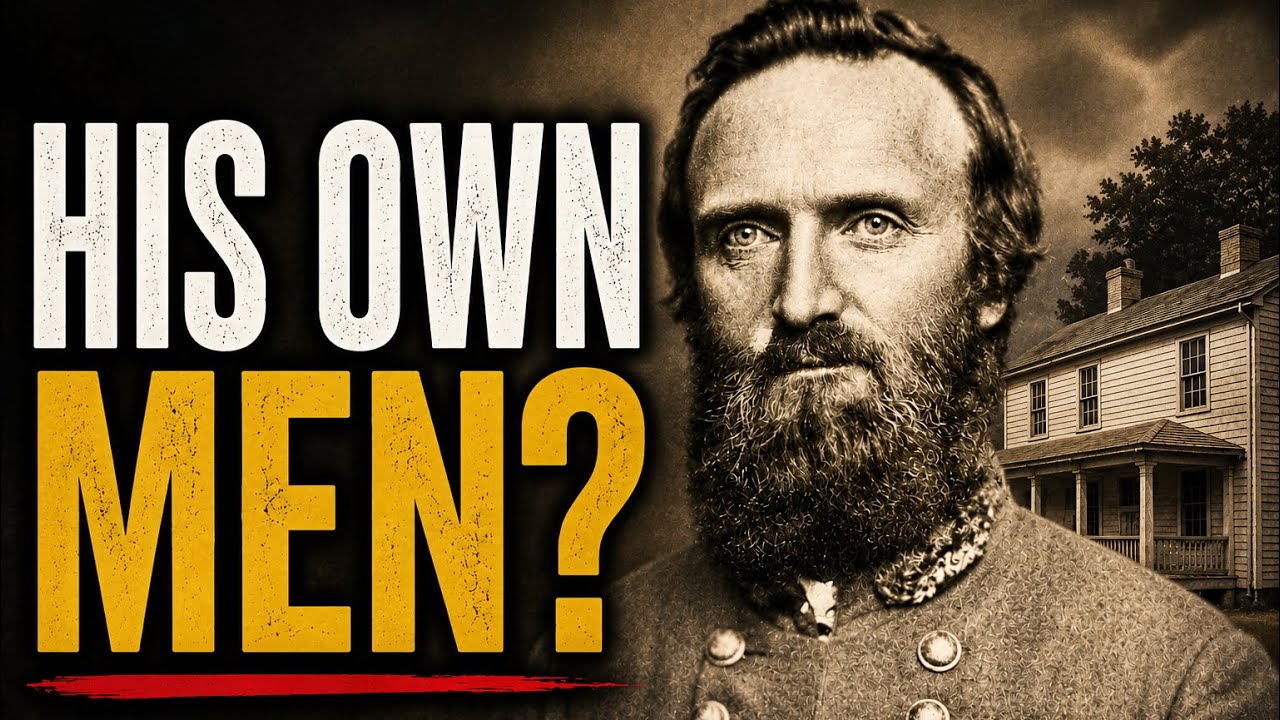
The firing continued. Among the wounded was Lieutenant General Thomas J. “Stonewall” Jackson, the most feared and most trusted officer in Robert E. Lee’s Army of Northern Virginia.
He was struck in the hand and twice in the left arm, with one bullet shattering the bone near his elbow. As the blood poured from his wounds, the legend that had been built on a Virginia battlefield two years earlier began to fall. Jackson had risen from poverty in what is now Clarksburg, West Virginia. He clawed his way into West Point, fought with distinction in the Mexican War, and built a reputation as a demanding instructor at the Virginia Military Institute.
When the Civil War broke out, he resigned his United States Army commission and accepted a high command in the Confederate Army. At the First Battle of Manassas, amid the chaos of the field, Brigadier General Bernard Bee pointed to Jackson’s stand and cried out the words that would become his name: “There is Jackson standing like a stone wall. ”
That stone wall now lay broken in the woods of Spotsylvania County. The wound came at the height of Jackson’s greatest triumph.
In late April 1863, Union Major General Joseph Hooker had moved a large portion of his army across the Rappahannock River and into the Chancellorsville area, hoping to slip around the flank of Lee’s army, which had long been entrenched near Fredericksburg. Lee detected the movement. With Jackson, he devised a plan that defied military convention: split the army in half and send Jackson’s column on a long, hidden march around the Union flank, striking at the exposed rear of the Eleventh Corps. It worked almost impossibly well.
Jackson’s men marched through the Wilderness in silence, pressing forward until they reached the open fields behind the Union lines. The soldiers they were about to hit had no idea they were there. Reports that Confederate troops had been spotted in the distance were dismissed. Union troops were settling into camp, cooking food and relaxing.
Then the animals came pouring out of the woods, fleeing from something unseen. As the soldiers watched in confusion, thousands of Confederates emerged from the tree line in full formation, let out the rebel yell, and swept across the fields. The Union right flank collapsed in panic. Officers scrambled to form their men, but the formations melted and fell back, ridge after ridge, until the shattered units finally regrouped far to the rear and slowed the Confederate advance.
The damage to the Eleventh Corps was done, and the situation for Hooker’s army had turned critical. Determined not to lose the momentum, Jackson rode forward into the darkness that night, beyond his own lines, scouting for a position from which to press the attack. It was there, on a dirt road in the moonlit woods, that his own men mistook his party for enemy cavalry and opened fire. His left arm was shattered beyond repair.
He was carried from the field, and on the morning of May 3, Dr. Hunter McGuire amputated the arm. At the time, it was the standard treatment for such a wound, and the operation appeared to go well. For a time, Jackson seemed to be recovering.
But complications set in. He developed what was first thought to be a cold, then diagnosed as pneumonia in his right lung. The Confederacy had no way to treat it. While Jackson fought for his life, his army continued to fight without him.
In the chaos after his wounding, officers repeatedly approached him with reports and questions. One told him he did not think the line could be held because it was so broken. The wounded general roused himself and answered sharply: “You must hold this line. ” They did.
When another senior general fell wounded, command passed to cavalry commander Jeb Stuart, who sent back to Jackson for instructions. By then, Jackson was too overwhelmed to direct the battle. He told Stuart to do what he thought best. Lee’s army carried the fight forward, but the cost was already counted.
On May 5, Jackson was moved to a small outbuilding on the Chandler family plantation, a 740-acre estate in Guinea Station. The Chandlers had offered the use of their property for the wounded. The main plantation house had been pressed into service, and Jackson was placed in what had once been the family’s office, a quiet, private building set apart from the noise of the farm. The rails leading further to Guinea Station had been cut, so this was where he would stay.
There, behind the front porch and the entrance hall, in a room now known simply as the death room, Jackson’s grip on life weakened. By May 9, he had grown delirious. Dr. McGuire told Jackson’s wife, Mary Anna, that her husband did not have much time left, and she told Jackson that he was about to die.
On Sunday morning, May 10, she told him that the doctor did not think he would live through the day. “Very good, it is all right,” he answered, adding that he had always wanted to die on Sunday. “It will be an infinite gain to be translated to heaven. ”
His mind wandered after that.
He called out orders to subordinates, instructing A. P. Hill to prepare for action one last time. In the mid-afternoon, while the room was filled with spring sunshine, he spoke one final sentence in a firm but quiet voice: “Let us cross over the river and rest under the shade of the trees.
”
Then he died. Lee announced the loss in General Order Number 61: “With deep regret, the commanding general announces the death of Lieutenant General T. J. Jackson.
Let his name be a watchword for his corps, who have followed him to victory on so many fields. Let his officers and soldiers emulate his invincible determination to do everything in the defense of our loved country. ”
The myth began almost immediately. Jackson’s amputated arm was buried separately and later placed in a metal box at a plantation where it remains enshrined to this day.
Songs, poems, and books built him into the Confederacy’s greatest legend. The what-ifs multiplied for generations: what if he had been at Gettysburg, what if he had lived, what would have changed. Even the words of Lee himself fed the legend that outlived the war. But the war itself moved on.
Grant and Meade ground the Confederacy down through the campaigns of 1864 and 1865, through the long Petersburg siege, until the line finally broke. Lee and what remained of his army marched west and surrendered at Appomattox Court House. The Confederacy was finished, and the country began the long and bitter work of reunion. Long after that, and long after the battles and the songs, the small frame office building at the Chandler plantation still stands beside a quiet road.
The plantation fields that once required the labor of enslaved people are gone, reduced to a small preserved parcel. The building is often closed, and few visitors come. There is little to see but the old structure, the grass, the benches, and the silence. For a place that was once part of a busy plantation and then the site of one of the most famous deaths in American military history, it is remarkably still.
The myth of Stonewall Jackson continued on, fed by what-ifs and remembrance. But here, in the quiet of the former Chandler office, there is only the building where the legend took its last breath, and the long, peaceful quiet of a man who finally crossed over the river.