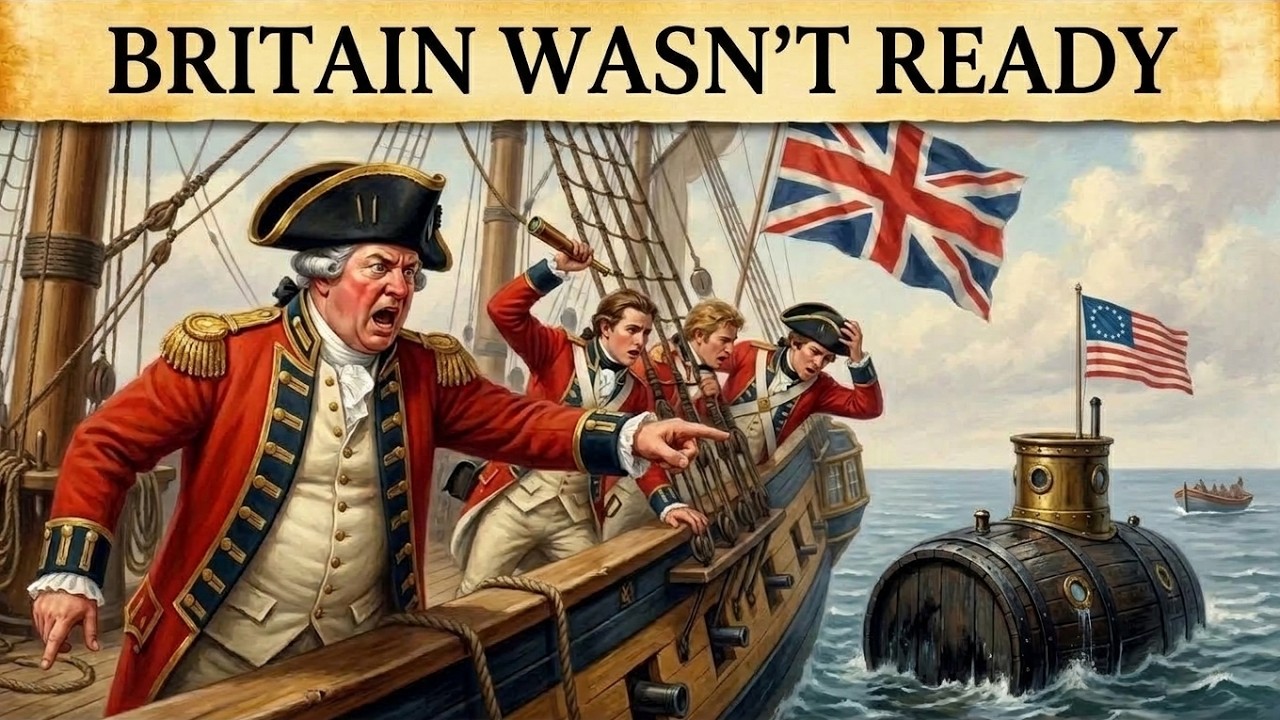
On the night of September 6, 1776, a twenty-seven-year-old sergeant named Ezra Lee sealed himself inside a wooden shell barely larger than a wine cask and opened a valve at his feet to sink beneath the surface of New York Harbor. He was completely alone. Somewhere above him, in the dark water, lay the HMS Eagle, a 64-gun ship of the line and the flagship of Admiral Richard Howe’s British fleet. The most powerful navy in the world had anchored its warships off the southern tip of Manhattan, and the Continental Army could do nothing about it.
Nothing conventional, at least. The thing Ezra Lee sat inside was not a boat. It was a submarine, the first ever used in combat, built in secret by a Connecticut farmer’s son who had not even begun his university studies until age thirty-one. But what makes this story even stranger is that the man who invented it, David Bushnell, almost never existed in this version of history at all.
And the machine he built, that absurd contraption of oak and iron hoops and tar, came closer to changing the course of the American Revolution than anyone at the time could have guessed. David Bushnell was born on August 30, 1740, in Saybrook, Connecticut, a small farming community along the Connecticut River. His family was not wealthy. His parents, Nehemiah and Sarah Bushnell, worked the land and raised five sons.
Nothing in David’s childhood suggested he would one day invent a weapon that would terrify the Royal Navy. He grew up plowing fields and repairing farm equipment. Neighbors described him as reserved, quiet, withdrawn, and intensely private, the kind of person who kept to himself and said little. Then, within roughly three years, everything around him collapsed.
He lost two sisters. He lost his mother. Around 1769, his father died. At twenty-nine, David Bushnell found himself on a farm he did not want to run, with an inheritance he had no interest in keeping, in a world that had suddenly become very quiet.
Most people in that situation would have stayed, taken over the family land, married locally, and melted into the rhythm of colonial Connecticut life like hundreds of thousands of farmers before them. Bushnell did something nobody around him expected. He sold his share of the farm to his brother Ezra. He took the money, and at age thirty-one, he walked through the gates of Yale College as one of the oldest students on campus.
A thirty-one-year-old farmer enrolling at Yale in 1771. His classmates were teenagers from wealthy families. He was a grown man who had spent the last decade behind a plow. He had no real academic background, no connections to the scientific or political world, and almost no money left after paying tuition.
But he possessed something none of the younger students had. He had a fixed idea, something that had been turning in his mind for years on that farm, and he did not intend to let it go. David Bushnell wanted to prove that gunpowder could be detonated underwater. At the time, conventional wisdom was clear.
Water puts out fire. You cannot ignite an explosive charge if it is submerged. The conditions necessary for combustion simply did not exist beneath the surface. But Bushnell, who had been quietly reading everything he could find on chemistry and engineering for years at his farm, was not convinced.
Within his first year at Yale, he began taking containers of black powder into the water and running experiments that alarmed anyone within a quarter mile. His first attempts were small. He sealed about two ounces of gunpowder inside a waterproof container, fitted it with a fuse designed to keep a flame alive long enough to reach the charge, and lowered it fully into the water. When it exploded, the blast sent a fountain of water shooting up from below the surface.
It worked. So he scaled it up. Two ounces became a quarter pound. A quarter pound became a full pound.
By his final year at Yale, Bushnell had successfully detonated two pounds of gunpowder underwater using a trigger mechanism taken from a musket. He had taken what the scientific establishment considered impossible, built it in borrowed workspace with his own money, and proven them wrong. But here is where Bushnell’s thinking went a step beyond just blowing things up. He understood something that made his discovery dangerous rather than merely impressive.
A bomb exploding beneath a ship’s hull, below the waterline, would cause far more catastrophic damage than any cannonball fired from the side. The hull was the weakest point, the thinnest layer between the ocean and the crew. If you could place explosives under a warship and detonate them, you would not just damage the ship. You would sink it.
The problem was delivery. You could not row a boat alongside a British warship and start tying powder kegs to its belly. You would be spotted, shot, and killed before you got close. Even at night, British warships kept lookouts who could spot movement on the water from a distance.
If you wanted to place a bomb under a hull, you had to get there unseen. You had to go underwater yourself. In early 1771, while Bushnell was still a student, Yale students gathered in a local tavern to discuss how the colonies could defeat the Royal Navy if war broke out with Britain. The question was not whether conflict would come.
Many already considered it inevitable. The question was how an outmatched colonial force could face the largest fleet in the world. Bushnell had his answer. He had just spent four years proving it was possible to explode things underwater.
Now he would build a machine that could carry the explosives to the target. In April 1775, during Bushnell’s last year at Yale, news arrived of the shots fired at Lexington and Concord. The war had begun. Yale closed its doors early, and Bushnell returned home to Saybrook, but not to enlist.
He had something else in mind. Working in secret with his brother Ezra, Bushnell began building the vessel on the family property beside the Connecticut River. He also drew on the skills of local craftsmen, because building a submarine in 1775 was not something two farmers could manage alone. The challenge was immense.
Bushnell had to invent a craft that could dive, move underwater, support a living operator, and deliver a weapon. No one had ever combined all four requirements into one working machine. Historians are not entirely certain when construction began, but by the fall of 1775 the vessel was taking shape. They called it the Turtle.
The name came from its appearance. In a letter Bushnell later wrote to Thomas Jefferson in 1787, he described the vessel as resembling two equal upper tortoise shells joined together. Imagine a giant nut or a wooden egg standing on its narrow end. It was about seven and a half feet long and about six feet wide at its widest point, made entirely of carved oak beams bound tightly together and sealed with tar to keep out the ocean.
Iron bands held the two halves together like a barrel. Inside, the operator sat on a small seat in a space so cramped you could barely extend your arms in any direction. Your head pressed against the top of the hull. Your knees practically touched the walls.
Calling it cramped and stifling would be generous. It was a sealed wooden box that smelled of tar and oak and dampness. Once the hatch closed over your head, you were cut off from the world in utter darkness. Bushnell crammed an astonishing amount of engineering into that small space.
There was a brass crank on the operator’s right that drove a propeller at the front of the craft for forward and backward movement. A second crank above the operator’s head operated a vertical propeller controlling ascent and descent. To dive, the operator pressed a foot valve that flooded a small chamber with seawater, adding enough weight to pull the Turtle beneath the surface. To rise again, he used a hand pump to push the water out.
If things went badly wrong, there were two hundred pounds of lead ballast at the bottom of the hull that could be released instantly, sending the submarine to the surface in an emergency. The weapon system was mounted on the outside. A wooden barrel attached to the Turtle’s back could carry up to 150 pounds of gunpowder. On top of the submarine, a wooden screw drill projected upward.
The idea was simple in theory. The operator would maneuver beneath an enemy ship, turn the drill into the wooden hull, detach the powder barrel, and leave it hanging on the ship by a rope attached to the embedded screw. Then a mechanical timing device, built with the help of local clockmakers Isaac Doolittle and Phineas Pratt, would trigger a firing mechanism after a delay the operator could set for up to eight hours. By the time it exploded, the Turtle and its pilot would be far away.
One small but clever detail: because the operator would be locked in absolute darkness once the hatch closed, Bushnell needed a way for the pilot to read the compass and depth gauge inside the cabin. His answer was foxfire, bioluminescent wood that gave off a faint glow in the dark. He painted the compass needle and pressure gauge with this substance. The glow was dim enough that no light leaked from the hull to alert anyone outside, but bright enough to navigate by with difficulty.
The Turtle carried roughly thirty minutes of breathable air inside once the hatch was closed. After that, your time was very limited. The trials went well enough to attract attention. Bushnell and Ezra tested the submarine in the Connecticut River through the summer of 1775, and the results impressed another Yale graduate named Dr.
Benjamin Gale. Gale happened to know Benjamin Franklin personally. He invited Franklin to see the machine, and Franklin traveled to Connecticut in October 1775, stopping on his way to George Washington’s headquarters outside Boston. Franklin was intrigued.
He spoke about Bushnell’s invention with members of the Continental Congress and with Washington’s inner circle. Connecticut Governor Jonathan Trumbull contributed sixty pounds to fund further development. Bushnell had originally hoped to deploy the Turtle against the British fleet blockading Boston Harbor during the siege of Boston, but winter ice made it impossible to put the submarine in the water. By spring 1776, he was ready to go.
Then the British did something that changed the calculations entirely. They withdrew from Boston and moved their fleet south to New York. By the summer of 1776, New York Harbor had become one of the most heavily armed bodies of water anywhere on earth. The British had assembled the largest expeditionary force in the history of their empire up to that point.
The harbor and surrounding waters teemed with hundreds of warships. Tens of thousands of British and Hessian soldiers were preparing to invade Manhattan. Washington’s Continental Army, outnumbered and outgunned, watched from shore a fleet it could not fight growing larger every week. Washington met with Bushnell personally to arrange for the Turtle’s transport to New York.
The general was ready to try almost anything at that stage. By late August, the British had overrun Long Island and crushed Washington’s forces at the Battle of Brooklyn, forcing a desperate nighttime retreat across the East River. The situation was getting worse by the day. The British navy was strangling supply lines and cutting off any possibility of moving troops by water.
If this small strange machine of Connecticut oak could destroy a major warship, the chaos it caused might give Washington the few days he desperately needed. The target was the HMS Eagle, the flagship of Admiral Richard Howe, a 64-gun ship of the line and one of the most fearsome warships in the harbor. The plan was to approach the Eagle from below, drill into the hull, attach the explosives, set the timer, and escape. If the flagship sank, it would throw the entire British command structure into chaos at the worst possible moment.
But the plan began to fall apart before the Turtle even touched the water. Bushnell’s brother Ezra, who had spent months training as the pilot and knew the controls intimately, came down with a severe fever just before the mission. He could not go. General Israel Putnam gathered three volunteers from the Continental Army, and Bushnell trained them as quickly as he could.
The most capable was Sergeant Ezra Lee, a twenty-seven-year-old soldier from Lyme, Connecticut. Lee received about two weeks of training in the submarine before the scheduled mission. Two weeks to learn how to operate a machine no one on the planet had ever used in combat. Around 11:00 on the night of September 6, 1776, two whaleboats slipped quietly into the water from South Ferry at the southern tip of Manhattan.
They towed the Turtle into the harbor under a moonless sky. Shortly after midnight, Ezra Lee climbed inside, sealed the brass hatch over his head, and began turning the crank. The currents were far stronger than anyone had expected. Lee wrestled the tide with nothing but his own muscles, one hand on the propeller crank, the other on the rudder, his feet working the ballast valve.
He was surrounded by absolute darkness except for the faint green glow of the bioluminescent paint on his instruments. The air inside the Turtle was already beginning to spoil while the HMS Eagle still lay somewhere ahead of him, invisible in the black water. It took Lee more than two hours of continuous cranking to reach the warship. When he finally arrived beneath the Eagle’s stern, something extraordinary happened.
Lee looked up through a small porthole and could make out the dark shapes of British sailors standing on the deck above him. He could hear their voices, their ordinary conversations traveling down through the wood and water toward a man sitting alone in a submarine the British had no idea existed. He was there, directly beneath the flagship of the largest naval force ever assembled in American waters, and no one above him had the slightest clue. Lee submerged the Turtle completely.
He raised the submarine beneath the Eagle’s hull and placed the drill against the underside of the ship. He began turning the wooden screw. Nothing happened. The drill would not penetrate.
Lee turned the handle harder. He pushed the Turtle against the hull with all his strength, but the screw slid across the surface without biting in. What he did not know at the time was that he had most likely struck an iron strap running along the ship’s keel, or a copper sheathing that the British had begun using on the hulls of their warships to prevent exactly the kind of underwater damage Bushnell had designed his weapon to inflict. Lee repositioned the Turtle and tried again.
Same result. The wooden screw was designed to penetrate oak or pine. Against metal, it was useless. By this point, Lee had been sealed inside the submarine for hours.
His arms were shaking from continuous cranking. The air inside the Turtle had turned from foul to suffocating, and the first gray light of dawn was beginning to appear over New York Harbor, which meant he was about to become visible to every lookout on every British ship in the area. Lee made the decision to withdraw. He released the emergency ballast, let the Turtle rise to the surface, and began cranking back toward Manhattan as fast as his exhausted arms would allow.
But the night was not over. As Lee surfaced and began his retreat across the harbor, British guards stationed on Governors Island spotted something moving across the water that did not look like any boat they knew. They sent a small boat to investigate. Lee saw them coming.
He was so completely drained that he could not outrun anyone. He did the only thing that came to mind. He detached the 150-pound powder magazine and let it drop into the water behind him, hoping to frighten his pursuers or buy enough distance to disappear. The charge drifted with the current while the clockwork mechanism still ran, and it exploded somewhere in the East River shortly afterward.
The blast was enormous, sending a towering column of water and spray into the gray morning sky. But it hit nothing but open water. The British soldiers in the pursuing boat apparently decided that whatever they were chasing was not worth investigating, and they turned back toward Governors Island. Lee reached shore alive.
The Turtle was recovered, and the first submarine attack in the history of naval warfare was, by every military measure, a complete failure. But the failure did not stop Bushnell. Two additional missions were attempted in the weeks that followed. Ezra Lee led the second attack, and a volunteer named Phineas Pratt led the third.
Both failed. The tides in New York Harbor were violent, navigation was guesswork at best, and the drilling mechanism simply could not penetrate British hull defenses. Then, in October 1776, British frigates discovered the small boat transporting the Turtle between staging areas and sank it. Bushnell claimed he recovered the submarine and moved it to Connecticut, but it saw no further combat.
What happened to the Turtle afterward is one of the minor mysteries of the Revolution. Pratt’s son later said he saw the machine’s disassembled parts when he was a teenager around 1800, but the submarine itself vanished from the historical record. Bushnell, however, did not abandon the war effort. He changed his strategy.
If he could not deliver explosives by submarine, he would deliver them by current. He designed floating mines, which he called torpedoes, barrels filled with gunpowder rigged to explode on contact with a ship’s hull. He refined the design, tested the mechanism, and waited for the right opportunity. It came in January 1778, when the British fleet was anchored off Philadelphia in the Delaware River.
Bushnell launched a squadron of his floating explosive barrels into the current and let the river carry them toward the warships. The result was utter chaos. The British spotted the barrels drifting toward their fleet and completely lost their composure. Sailors on ship after ship opened fire on anything floating in the river.
They fired at logs, debris, chunks of ice, empty barrels, everything on the surface. Officers shouted orders. Cannons roared for hours. The entire fleet was shooting at the Delaware River itself.
The actual damage to the British was negligible, but the spectacle was so absurd that a Philadelphia poet named Francis Hopkinson immortalized the incident in a satirical poem called “The Battle of the Kegs,” publicly mocking the great Royal Navy for spending an afternoon shooting at floating timber. Bushnell spent the rest of the war as a captain in a corps of engineers, a unit that was a predecessor of the modern Army Corps of Engineers. He fought at the siege of Yorktown in Virginia in the fall of 1781, where the British surrender effectively ended the war. His Yale friend Nathan Hale had been captured and executed as a spy five years earlier.
Bushnell continued the war to its end. Then, true to every description ever given of his character, David Bushnell disappeared. After his honorable discharge in 1783, he returned briefly to Saybrook, but something about the life waiting for him in Connecticut did not fit. In 1787, he left town under the vague pretext of traveling to France to continue his underwater experiments.
Then he vanished completely. Rumors circulated for years. Some said he had been killed during the French Revolution. Others claimed he had made a fortune abroad and lost it.
His old acquaintances in Connecticut eventually assumed he was dead. The truth, when it finally emerged decades later, was stranger than any of the rumors. Bushnell had quietly changed his name, traveled south to Georgia, and started a new life in the small town of Warrenton. He worked as a schoolteacher.
He practiced medicine. He lived a quiet, reclusive life among people who had no idea who he really was. No one in Georgia knew that the modest old doctor in their community had once built the world’s first combat submarine and sent it gliding through the dark waters of New York Harbor to attack the British fleet. He died in 1824 at the age of eighty-three.
Years earlier, in 1785, George Washington had written a letter to Thomas Jefferson about Bushnell and the Turtle. In it, Washington described Bushnell as a man of great mechanical powers, fertile in invention, and master of execution. And regarding the submarine itself, Washington wrote a single line that stands as the best epitaph anyone ever gave that strange wooden machine and the quiet man who built it. He called it an effort of genius.
The Turtle never sank a British ship. Ezra Lee never drilled through a hull. The mission, by every conventional standard, failed. But the concept Bushnell proved that night, the idea that a small hidden craft could approach beneath the water to within striking distance of the greatest warships on earth, attack without warning, and vanish, that concept did not die with the Turtle in New York Harbor.
It survived. It grew. And it slowly reshaped the way nations thought about war at sea. Roughly ninety years later, during the American Civil War, the Confederate submarine H.
L. Hunley became the first submarine in history to successfully sink an enemy warship. It used an approach David Bushnell would have recognized immediately. A small crew in a cramped hand-powered vessel delivering an explosive charge to a hull underwater.
And Bushnell’s line continued to evolve. Through World War I, when German U-boats brought the idea of stealthy underwater warfare to a global scale that terrified the entire Allied shipping fleet. Through World War II, when submarine fleets on both sides reshaped the Atlantic and Pacific theaters of war. And into the Cold War, when nuclear-powered submarines carrying intercontinental ballistic missiles became the most strategically important weapons platforms on the planet.
Every modern submarine, from diesel attack boats prowling the Pacific to ballistic missile submarines lying silently beneath the Arctic ice, traces its conceptual roots back to that wooden shell floating in the dark waters off Manhattan in September 1776. Back to a Connecticut farmer’s son who buried his family, sold everything he owned, enrolled at Yale at thirty-one, and spent his last penny building a weapon nobody in the world believed would work.