In December 1882, former president and Union general Ulysses S. Grant took up his pen to acknowledge an injustice that had destroyed the life of an innocent man. Grant had accepted Robert E. Lee’s surrender at Appomattox and served two terms in the White House.
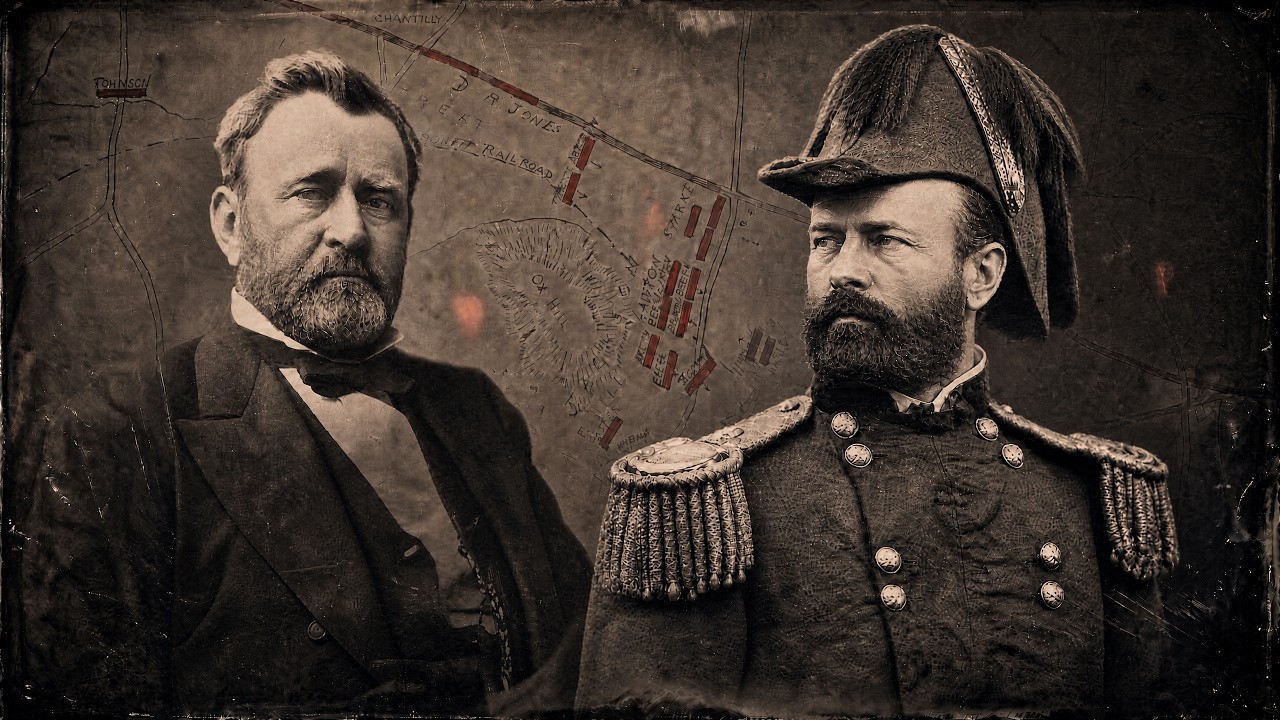
When he spoke about the war, the country listened. Now he was about to write something that would turn that trust against the army he had once led. He gave it a blunt and damning title: “An Undeserved Stigma. ” The stigma belonged to a Union general named Fitz John Porter.
Twenty years earlier, a court-martial had convicted Porter of disobeying orders and misconduct before the enemy, stripped him of his rank, and dismissed him from the army in the middle of a war for national survival. The conviction left him publicly disgraced, widely accused of cowardice and treason. Grant had accepted that verdict for nearly two decades. He no longer believed it.
He had finally examined what Porter faced on that battlefield, and what Porter saw should have saved his career. Instead, it destroyed it. This is not a story of a lost battle. Many generals lost battles and kept their careers.
It is a story of what happens when a soldier reads the field correctly, refuses to send his men into a slaughter, and learns that being right can be the most dangerous thing a man can do. In the summer of 1862, Union war efforts in Virginia were collapsing. Robert E. Lee had just driven McClellan’s enormous army away from the gates of Richmond in a week of vicious fighting known as the Seven Days.
In that campaign, Fitz John Porter proved his worth. At Gaines’ Mill on June 27, 1862, his corps held a strong defensive line through the afternoon against one of the largest Confederate attacks of the war. Wave after wave broke against his positions before his line finally gave way at dusk. Days later at Malvern Hill, his men again played a leading role in breaking Lee’s assaults.
By reading the terrain and holding under pressure, Porter was among the best the Union had. He was promoted to major general of volunteers on July 4, 1862. The man who would be accused of cowardice had just been rewarded for steady conduct in crisis. Washington then built a new army and gave it to Major General John Pope, who arrived from the Western theater full of bluster.
He boasted about what he would do, and dismissed the caution of Eastern commanders who had taken bloody losses at Lee’s hands. Lincoln removed McClellan from overall command, and Porter’s corps was ordered away from McClellan to reinforce Pope, a commander Porter neither trusted nor respected, and he made little effort to hide it. That resentment would be used against him later. Lee saw a chance to crush Pope before the two Union armies could fully unite, and he took a tremendous risk to do so.
He divided his army in view of the enemy. He sent Stonewall Jackson’s wing on a long, exhausting march to swing around the entire Union flank. Jackson captured the huge Union supply base at Manassas Junction, burned it in a sea of flame, and then disappeared into a strong, hidden position along an unfinished railroad grade near Groveton. Lee followed with the other wing of the army under James Longstreet, marching through a gap in the mountains to join Jackson.
On the evening of August 28, 1862, Jackson revealed himself by attacking a passing Union division in close-range battle. Pope drew exactly the wrong conclusion. He decided he had Jackson isolated and could destroy him before the rest of Lee’s army arrived. He spent the next two days attacking a trap, describing it as a victory in the making.
Dawn broke hot on August 29, 1862. Pope pushed his forces toward Jackson’s line along the railroad cut. The attacks came piecemeal and uncoordinated, and they were thrown back again and again. Pope wanted a knockout blow against Jackson’s exposed right, and he wanted Porter’s corps to deliver it.
That morning, he sent Porter and McDowell a written order that people still argue about today. It was difficult to interpret. It ordered the generals to move toward Gainesville, then halt upon contact with the enemy, and warned they might fall back behind Bull Run that same night. It did not clearly order an attack, and it ended with a paragraph allowing commanders to deviate if circumstances required.
It was not an order so much as a riddle. A man’s career would later hinge on how he read it. Porter pushed his column forward, then stopped at a slow, muddy stream called Dawkins Branch. Confederate cavalry under J.
E. B. Stuart raised dust ahead of him, obscuring the view beyond. Behind that curtain came something far worse than cavalry.
Longstreet’s wing. Tens of thousands of men spreading across the very ground Pope wanted Porter to attack. Porter’s cold calculation that afternoon was simple. Pope’s entire plan assumed one Confederate wing on that field.
Porter’s eyes and cavalry told him there were two. Sending his single corps toward the gathering line of Longstreet’s men would not be a flank attack on Jackson. It would be pushing his men into the side of a force more than twice their size. Not a knockout blow.
A massacre. Miles away at headquarters, Pope refused to hear it. Reports arrived through the afternoon that a large Confederate force had appeared on his left. Pope remained unconvinced.
Late in the day, growing impatient, he sent Porter a direct, explicit order to attack the enemy’s flank and rear. By then the light was fading and Longstreet’s line was formed and waiting. Porter did not launch the ordered attack. His men took up defensive positions and he held his ground.
He would be called a coward for it, and he would spend the next twenty years learning the price of that word. Proof of who was right came the very next day. On August 30, 1862, Pope renewed his assault, still convinced the enemy was retreating. When Porter’s corps was finally sent forward against Jackson’s left, exactly what Porter feared happened.
The attack exposed his flank and the entire army’s flank to Longstreet’s waiting men. Longstreet launched one of the largest single attacks of the entire war. Tens of thousands of Confederates swept from their positions into the Union left. Pope’s army was shattered and driven from the field across Bull Run in defeat.
The disaster Porter feared on August 29 occurred on August 30, at the hands of the very force he had reported and was punished for avoiding. Pope lost his battle. His official reports blamed Porter, singling out the one general who had seen the danger clearly and refused to march into it. Within days of the defeat, Pope filed a report shifting much of the blame for his own decisions onto Porter and other officers.
It was the first step in a public fight that would end one man’s military career and shape the controversy for decades. To understand why that campaign worked, stop looking at the battlefield and look at Washington. The Union had just been humiliatingly defeated in sight of its capital. Second Bull Run, barely a year after the first.
The public wanted answers and someone to hold responsible. Fitz John Porter was an easy and convenient target. He was a Democrat in a war run increasingly by Republicans. He was the devoted friend and protégé of George McClellan, the general the administration did not trust and radicals in Congress openly despised.
Striking Porter meant striking the entire McClellan circle. In early November 1862, Lincoln removed McClellan from command of the Army of the Potomac. Porter’s only powerful protector was gone. Within weeks Porter lost his command, and in late November 1862 he was arrested and formally charged.
The charges were severe: disobedience of orders under the Ninth Article of War, and misconduct before the enemy under the Fifty-second Article, a grave charge often treated as tantamount to cowardice. Conviction could mean dismissal or even execution. A court of nine officers convened in Washington under Major General David Hunter, with Judge Advocate General Joseph Holt prosecuting. Among the officers sitting in judgment was a rising man named James Garfield, who would one day become president.
The trial ran from late November 1862 into January 1863. It took all the forms of justice, witnesses, careful statements, meticulously written records, but it operated under one fatal constraint. It judged the battle without a complete picture of Confederate positions. The court heard Union testimony but lacked the Confederate evidence that would later change the understanding of the case.
Later war records showed Longstreet’s wing positioned directly in front of Porter on the afternoon of August 29, 1862. Under that blind spot and the prevailing political climate, the court found Porter guilty on both charges. The punishment left nothing intact. He was dismissed from the service, stripped of rank, and forever barred from holding any office of trust or profit under the United States government.
The findings went to Lincoln, who reviewed them and gave his approval. On January 21, 1863, the verdict took effect. Fitz John Porter ceased to be a soldier. Within weeks, a decorated corps commander had become a public disgrace.
His name was destroyed. His career’s doors closed. For most men, that would have been the end. Porter did the opposite.
He was right about that battle, and he knew it, and he set out to prove it to a country that did not want to listen. Stripped of rank and barred from federal office, he built a new civilian life in trade, construction, mining, and railroads, supporting his wife and children through long years of exile. Later he held a series of public posts in New York City as commissioner of public works, police commissioner, and fire commissioner. From the outside his life looked busy and respectable.
But underneath, one drive moved him for twenty years. He wanted his name and reputation back. He never stopped trying. Appeals were made on his behalf as early as 1863.
Year after year, Porter and his supporters carried the case from administration to administration. They petitioned President Andrew Johnson. They appealed to Ulysses Grant, first when he was acting secretary of war, then when he was president. Every door closed with the same answer.
No. The wall before Porter was not merely a lack of evidence. Reopening the case would require powerful men to do something they did not want to do: admit that the army, the courts, and a wartime president may have wronged a loyal officer. Grant himself was for years one of the men who let the verdict stand.
In 1878, fifteen years after the doors slammed shut, President Rutherford B. Hayes appointed a board of officers to reexamine the entire case, this time in light of evidence the original court never had. The board was led by Major General John Schofield. For the first time in a decade and a half, the case would be weighed away from the immediate demands of wartime politics and against a more complete record.
The board did what the 1862 court could not. It gathered testimony and reports from Confederate officers who had been on that ground, former enemies whose evidence could now be examined. Those accounts confirmed Porter’s central claim. Longstreet’s wing had arrived and deployed directly in front of Porter’s front on August 29, 1862.
The board studied new, accurate battlefield maps showing where the armies actually were. When placed side by side, the evidence told a story far different from the one the court-martial had accepted. In its 1879 report, the board concluded that Porter’s conduct had been obedient, subordinate, loyal, and wise, and that his decision not to attack had saved the Union army from disaster on August 29. It recommended the findings and sentence be set aside and Porter restored to command.
Porter’s case finally reached one of the most influential military voices in America. Ulysses Grant read the evidence himself, and it dispelled a belief he had held for years. Porter had not frozen from cowardice. He had not held back from disloyalty.
He refused to launch the ordered attack because it would have driven his corps into a concealed enemy flank more than twice his strength. The board concluded that had Porter obeyed Pope that day, his corps would have faced Longstreet’s far larger force and the army would have suffered an even worse catastrophe. The decision that was treated as insubordination and destroyed Fitz John Porter’s life had, in the board’s judgment, saved the army from disaster. That was something Grant could not ignore.
In December 1882, Grant presented his conclusion to the entire country in the North American Review under that blunt title, “An Undeserved Stigma. ” He reviewed the evidence and argued that Porter’s conduct on that field was sound and that Pope’s account of events had misled the army and public for twenty years. Grant was a Republican, a former president, and former commanding general of the Union army. Defending Porter meant challenging a verdict approved by a wartime Republican administration and admitting that he himself had accepted an injustice.
He chose to do it. Even with Grant’s support, Porter’s exoneration was not easy. The case remained tangled in the harsh politics of the era. In 1881, the House rejected a proposal to restore Porter’s rank and compensate his losses.
In 1882, President Chester Arthur revoked the part of the sentence barring Porter from federal office, but stopped short of restoring him to the army. In 1884, Congress passed a bill to restore his rank, but Arthur vetoed it on constitutional grounds. After more than twenty years, the door was still not fully open. Then the balance shifted.
In the 1884 election, Grover Cleveland became the first Democrat to take the presidency since before the Civil War. On July 1, 1886, Cleveland signed a relief bill passed by Congress. The following month, Fitz John Porter was appointed colonel in the regular army with seniority backdated to May 14, 1861, as if the lost years were an error the nation quietly corrected. The law still held one cruelty: no back pay.
The government restored his rank but gave him nothing for the two decades stolen from him. Two days after his appointment, at age sixty-three, Porter quietly retired from the army he had rejoined for only a moment. There is a painful truth in the timing. Grant, who had put his name behind Porter’s cause in 1882, did not live to see its end.
He died on July 23, 1885, less than a year before Cleveland signed the relief bill. The man who lit the fuse never saw the fire reach its end. Porter lived his remaining years as a man who had recovered his honor, and died in 1901 with his name restored. The sword was taken, and the sword was returned.
But the fight to regain it consumed most of a soldier’s life. A nation can disgrace a loyal man in a single afternoon, and it can take an entire generation to set things right.