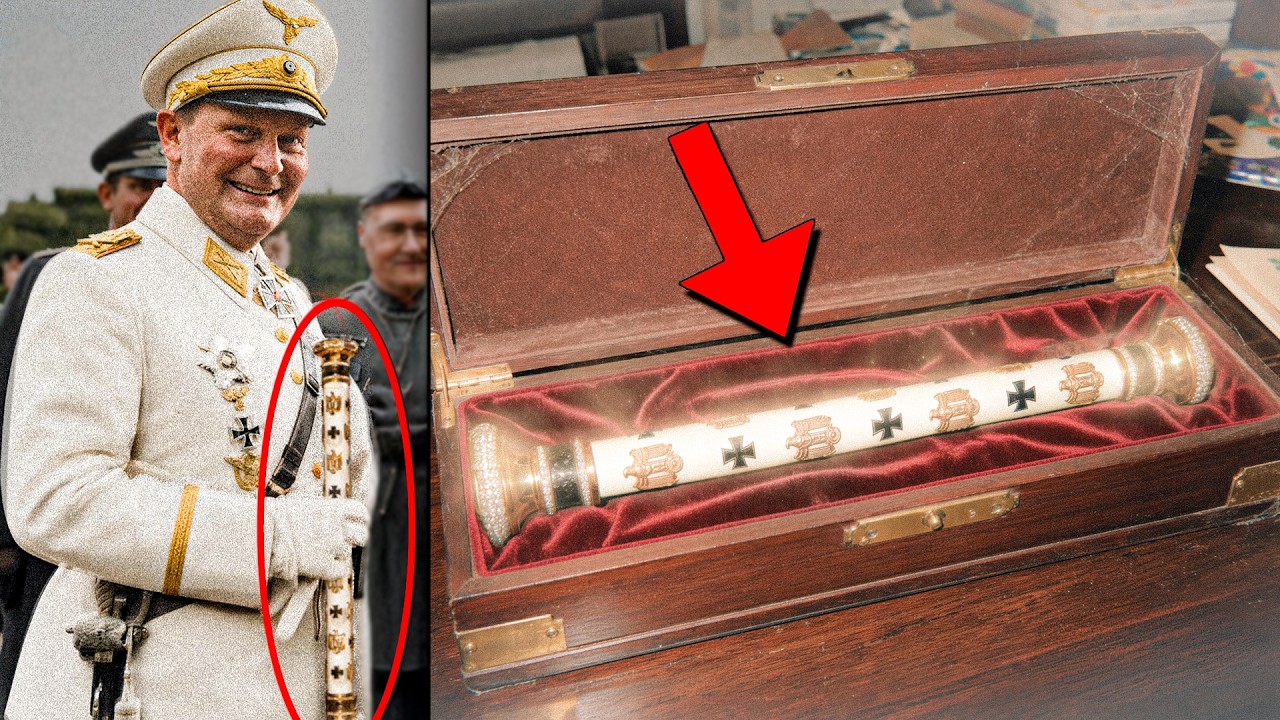
On May 9, 1945, in the final chaos of a collapsing Third Reich, one of the most feared men in Europe formally surrendered to the Seventh United States Army and handed over an object unlike any other in military history: a field marshal’s baton made of elephant ivory and pure gold, studded with more than six hundred diamonds. The man was Hermann Göring, once the second most powerful figure in Nazi Germany. The baton he surrendered had been created for a rank that had never existed before and would never exist again. Göring’s rise to that moment began decades earlier.
Born on January 12, 1893, in Rosenheim, Bavaria, he was the son of a former cavalry officer who had served as governor general of German Southwest Africa. Göring attended military academies and received his commission as a second lieutenant in 1912. When the First World War broke out in 1914, he served as an infantry officer, but he soon transferred to the newly created German Air Force, first as an observer and then as a fighter pilot. He proved to be exceptionally talented, shooting down dozens of enemy aircraft and earning the highest military decoration of the German Empire, the Pour le Mérite, popularly known as the Blue Max.
In July 1918, he reached the peak of his wartime career by taking command of Jagdgeschwader 1, the most famous fighter squadron in Germany, the same unit that had recently been led by Manfred von Richthofen, the Red Baron. Germany lost the war, and for Göring the defeat meant years of drifting. He worked as a commercial pilot in Denmark and Sweden, far from any position of prominence, in a country humiliated by the Treaty of Versailles and torn by economic and political crisis. It was during this period of personal reconstruction that he met the man who would change his life.
In 1921, Göring encountered Adolf Hitler, then a nearly unknown leader of a small far-right party in Bavaria. Göring joined the Nazi Party in 1922, and his status as a decorated war hero gave Hitler a credibility the movement had lacked. Hitler placed him in command of the SA, the party’s paramilitary storm troopers. In November 1923, Göring took part in the failed Beer Hall Putsch in Munich.
Wounded by police fire in the groin, he fled to Austria, but the severity of the injury led doctors to administer morphine. That treatment began an addiction that would follow him for much of his life. Amnestied in 1927, Göring returned to Germany and resumed his place in the Nazi leadership. He became a Reichstag deputy in 1928, and when Hitler became chancellor in January 1933, Göring was among his closest allies.
He supervised the creation of the Gestapo, the regime’s secret police, commanding it briefly before handing it over to Heinrich Himmler. In 1935, he publicly announced the existence of the Luftwaffe, the German air force that had been secretly rebuilt in violation of the Treaty of Versailles, and took supreme command of it. By 1938, when he received his first field marshal’s baton, he was not a newcomer to power. He was a decorated Great War veteran, a founder of the Nazi repressive apparatus, the architect of the German air force, and one of Hitler’s oldest and most trusted friends.
The tradition of presenting command batons to the highest-ranking generals reached back centuries, to the Prussian army of the sixteenth century, and the crossed-baton symbol had long been a mark of supreme military authority. Under the Third Reich, the tradition became more elaborate. Every officer promoted to Generalfeldmarschall received two batons: an ornate ceremonial version made by specialist jewelers and carried only on formal occasions, and a simpler everyday baton, usually made of ebony, for ordinary use. Even the modest version was not cheap; in 1940, a ceremonial army baton cost about six thousand German marks, while the daily version cost about six hundred.
Each branch of the armed forces had its own design. The army and navy used anchors and other emblems, while the Luftwaffe batons bore the Balkenkreuz, the beam cross characteristic of German military aviation, alongside the eagles and Iron Crosses common to all models. Over the entire history of the Third Reich, only twenty-five men received such batons, with twenty-six ceremonial pieces distributed: eighteen for the army, five for the air force, two for the navy, and a single unique Reichsmarschall baton. That special baton came about because of Göring’s ambition.
In 1940, after the German campaign against France, Adolf Hitler created a new rank above all others: Reichsmarschall, a title designed specifically for Göring. The rank demanded a baton more spectacular than anything that had come before. The result was extraordinary. The staff was made of pure white elephant ivory, without the velvet covering used on other models, bearing a solid gold eagle of the German armed forces.
The Iron Cross and straight cross were silver covered in black enamel, creating a striking contrast against the white ivory. The ferrules at each end were pure gold, and the band bearing the personalized inscription was platinum with letters engraved in gold. Along the full length of the baton, between decorative rings above and below the inscription band, craftsmen set more than six hundred diamonds. Some detailed examinations conducted decades later by specialists who studied the piece after it went on display count as many as 640 diamonds, arranged together with twenty gold eagles and twenty platinum crosses across the entire staff.
The baton was handmade by jewelers and goldsmiths, likely the same artisans who produced the regime’s highest-quality decorations. Every metal piece was molded, fitted, and polished onto the ivory individually, and each diamond was cut and fixed by hand. It was literally an object without equal in any other army in the world. Only one Reichsmarschall baton ever existed, made exclusively for Göring, because no other man ever reached that rank during the entire existence of the Third Reich.
The end of the war brought the baton’s story to a dramatically different place. In May 1945, as Nazi Germany collapsed, Göring had already lost everything. Hitler was dead, having died days earlier in Berlin, and Göring, isolated in southern Germany, had tried to claim his position as the regime’s natural successor. He sent Hitler a telegram requesting authorization to assume command, a gesture Hitler interpreted as treason and answered by stripping Göring of all official positions in the regime’s final days.
Still, as the end approached, Göring made a calculated decision. He preferred to surrender to the Americans rather than fall into the hands of the Red Army advancing from the east. In early May 1945, he left his refuge on the Bavarian-Austrian border in search of American troops. On May 9, he surrendered to the Seventh United States Army and personally handed over his Reichsmarschall baton.
American soldiers present described the scene as surreal. The second most powerful man of the Nazi regime appeared in full uniform with all his medals, acting as though he were receiving the Americans as an honored guest rather than being captured as a prisoner of war. Reports from the time say he seemed genuinely to expect treatment as a high-ranking diplomatic emissary, almost a head of state surrendering to another. In the days before his surrender, he reportedly changed uniforms several times a day, making sure his decorations were impeccable, as if preparing for a ceremony rather than an arrest.
The reality was different. Once his surrender was formalized, American officers began the standard process of confiscating the belongings of high-ranking Nazi commanders. The Reichsmarschall baton, the most valuable and symbolic object Göring possessed, was taken from him along with his medals, his dress uniform, and his personal weapon, a Smith & Wesson revolver. Neither baton disappeared into mystery.
There is no secret collection, no smuggling story. The first baton, the Generalfeldmarschall baton from 1938, is preserved at the National Infantry Museum at Fort Benning, Georgia, under the official ownership of the United States Army, part of its permanent collection of artifacts captured from Nazi officials during the American campaign in Europe. The second baton, the Reichsmarschall baton of ivory, gold, platinum, and more than six hundred diamonds, is displayed at the West Point Museum within the United States Military Academy in New York. Weighing about 2.
4 kilograms, it is one of the most visited items in the museum’s Second World War collection, exhibited alongside other personal belongings confiscated from Göring at surrender, including his Smith & Wesson revolver. A plaque beside the piece summarizes its significance: few personal war souvenirs carry as much meaning as that baton. At the time of its seizure in 1945, the baton was appraised at about forty thousand dollars, a considerable sum by the standards of the day. In the decades since, far more speculative estimates have circulated, some suggesting the piece would be worth millions if it ever reached auction, given its precious materials, historical rarity, and the fact that it is a literally unique object.
But that remains speculation, because the baton has never been and probably will never be put up for sale. The originals sit in museum display cases, cataloged, documented, and open to public viewing. Museum copies of the Reichsmarschall baton appeared as early as the 1960s, some supposedly using elements and molds related to the original design but made with far cheaper materials, such as 800 silver instead of solid gold, 18-karat gold plating over the metal parts, artificial ivory instead of real elephant ivory, and stones imitating the original diamonds. Even as replicas, these copies became collector’s pieces in their own right.
One copy made in that decade weighs more than 1. 4 kilograms and is described by collectors as a rare item in itself, even though everyone knows from the start that it is not the original. Today, specialist militaria dealers still openly sell such replicas to collectors, precisely because the real baton will never be offered at auction, remaining permanently in the collection of the American army as historic and military heritage. An object created to be unique, the supreme symbol of a rank that never existed in any other army in the world, now inspires openly sold copies for anyone with money enough to order one.
The two original batons, born as the ultimate symbols of power for one of the most feared men of Nazi Germany, now rest in documented military museums, behind glass, where anyone can see them.