The women who performed for the world’s largest audiences often worked in its deepest shadows. During the twentieth century’s greatest conflicts, a remarkable group of entertainers used their fame as cover for espionage, sometimes at the cost of their reputations, their safety, and in one case, their life. Their stories reveal that the spotlight and the secret service were not as far apart as they seemed. Long before she taught Americans to embrace French cuisine, Julia Child was at her first culinary challenge: developing a shark repellent for the Office of Strategic Services, the World War II-era spy agency that would become the CIA.
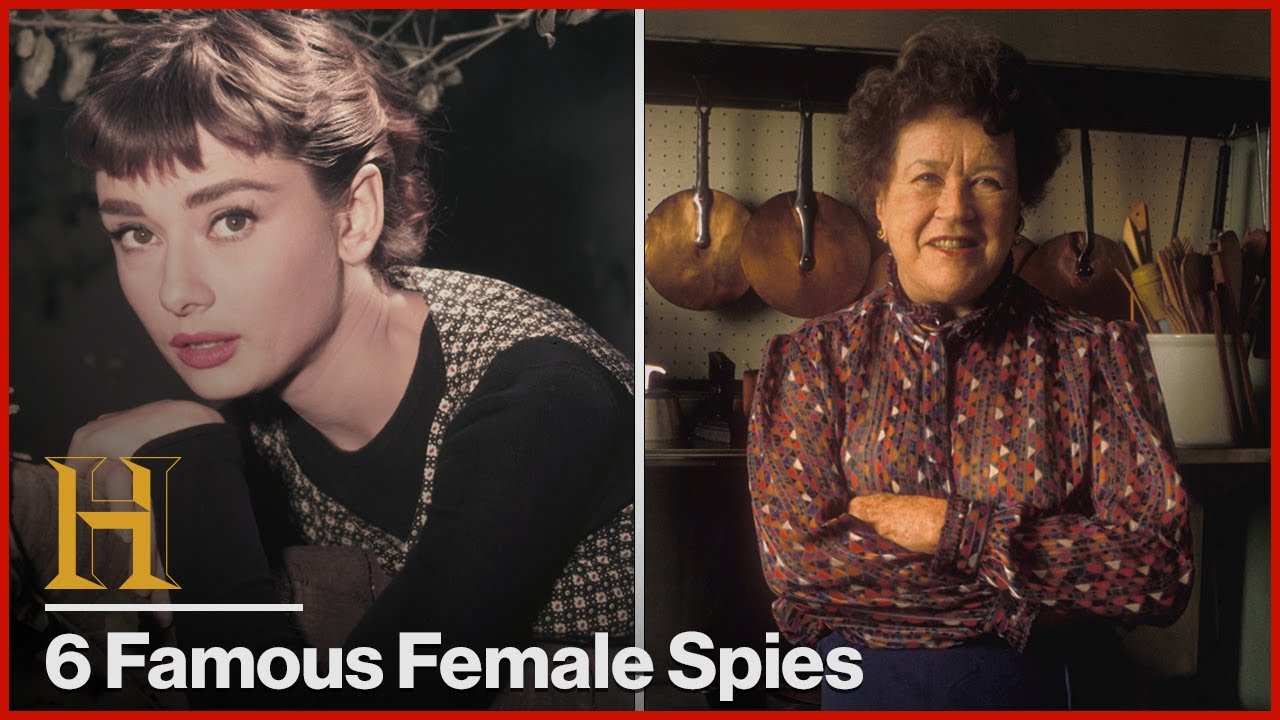
In the early 1940s, Child was fired from an advertising job and applied to the military, only to be turned away for being too tall at six feet two inches. The OSS, however, accepted her. Her interviewer noted that she made a good impression, describing her as pleasant, alert, capable, and very tall. Child was not the stereotypical spy of wigs and gadgets; she worked behind a desk.
But that desk was located in exotic locales, including Sri Lanka and China. Her most significant achievement at the OSS was her participation in developing a shark repellent that the government still uses today. It was an ironic start for a woman whose first creation was designed to prevent eating rather than encourage it. Marlene Dietrich built her career in Berlin before becoming one of Hollywood’s highest-paid actresses and an Oscar nominee in the 1930s.
Her German origins made her a target of suspicion, and FBI director J. Edgar Hoover was convinced she was a spy. For three years, from 1942 to 1944, the FBI ran a formal espionage investigation, tracking her movements and opening her mail. The investigation produced zero evidence of espionage, revealing only details of her active love life.
Dietrich was in fact eager to prove her loyalty to America. She performed enthusiastically in USO shows for American troops abroad, recorded songs for the OSS to use in propaganda, and even agreed to gather observations about subversive activities in Europe while entertaining there as a spy for the United States, though she does not appear to have uncovered much of significance. Mata Hari built her legend on a lie. She claimed to have been born in a sacred Indian temple, taught ancient dances of seduction by a priestess who gave her her name.
In reality, she was born Margaretha Geertruida Zelle in Holland and learned about East Asian culture while living in the Dutch East Indies, present-day Indonesia, with her ex-husband. None of that mattered to the crowds who packed European dance halls and opera houses to watch her slowly strip nude. She became a famous courtesan, and when World War I broke out, her list of lovers was filled with high-ranking military officers. In 1916, the French arrested her as a German spy.
Mata Hari admitted that a German officer had paid her to gather information, but she insisted the intelligence she provided was useless. The French claimed she had shared information about a new Allied weapon called the tank, resulting in the deaths of thousands of soldiers, and they had her executed. There is virtually no evidence that she committed espionage of any consequence, and it is widely believed the French exaggerated her story to distract the public from their own military failures in the war. Alice Marble was a Hall of Fame tennis player, the first woman to win the British and U.
S. women’s singles, doubles, and mixed doubles championships in the same year, and the Associated Press’s Athlete of the Year in 1939. In 1940, according to her autobiography, she added espionage to her résumé. Near the end of World War II, she was recruited to spy for the Allies.
One of her former lovers was a Swiss banker believed to be providing financial services to high-ranking Nazi officers. Marble traveled to Switzerland to play in a highly publicized tennis tournament, her handlers banking on her ex-lover reaching out to her. He did. She discovered a great deal of information about his dealings before being shot in the back while fleeing.
She survived the mission and returned to tennis, later coaching Billie Jean King. Audrey Hepburn is remembered as one of the most iconic film actresses of all time, for roles in Breakfast at Tiffany’s and My Fair Lady, and for her Oscar-winning performance in Roman Holiday in 1953. But in the 1940s, before the glitz and glamour, she was a teenager living in Nazi-occupied Netherlands. Her mother was actually a Nazi sympathizer until her uncle was arrested and executed by the Nazis in 1942.
Around that time, Hepburn met a local resistance leader, Dr. Hendrik Visser ’t Hooft, who saw her as a great asset because her youth allowed her to move virtually undetected by the Gestapo. She made her debut for the resistance as a performer, dancing ballet at secret fundraisers called black evenings, where audiences were forbidden from making a sound. Hepburn later remarked that the best audiences she ever had made not a single sound at the end of her performance.
Her other duties included riding her bicycle on a paper route, delivering napkin-sized resistance newspapers hidden in her socks. She also delivered food and messages to Allied pilots who had been shot down, and became so trusted that she and her mother hid a paratrooper in their basement for a week. Josephine Baker was the classic triple threat: singer, dancer, and actress, and one of the biggest celebrities of the 1920s, 1930s, and 1940s. She was the first Black woman to star in a major motion picture and, for a long stretch, the wealthiest Black woman alive.
On top of all that, she was a full-fledged spy during World War II. When the Nazis occupied Paris in 1940, Baker was thirty-four and had been a French citizen for several years. She accepted an invitation to join the French resistance, declaring that France had made her who she was, that Parisians had given her their hearts, and that she was ready to give them her life. Her espionage work was extensive.
She rented a château in the French countryside where she harbored German refugees, but her real intelligence gathering occurred on the road. While performing around Europe, she was invited to embassy parties at every stop. She would flirt with high-ranking Axis officials, easily disarming them with her sensual celebrity, and get them talking about military subjects such as troop movements and active airfields. Her assistant, who was actually a French secret agent, recorded everything on Baker’s sheet music using invisible ink.
After the war, she was awarded the Croix de Guerre, the highest honor of merit for military and civil action in France. These women navigated the competing demands of public performance and secret service with extraordinary courage. Some, like Julia Child and Alice Marble, survived to build celebrated post-war careers. Others, like Mata Hari, paid the ultimate price for their alleged betrayals, whether real or invented.
What connects them is the unusual duality of their lives: entertaining crowds by day, and by night serving causes that demanded absolute secrecy. Their fame gave them access and cover that ordinary operatives could never achieve, and they used it to shape the course of history in ways that remain remarkable to this day.