At 3:17 a. m. on December 11th, 1978, six masked men entered the Lufthansa cargo terminal at Kennedy Airport in Queens, New York. Forty-five minutes later, they walked out with $5.
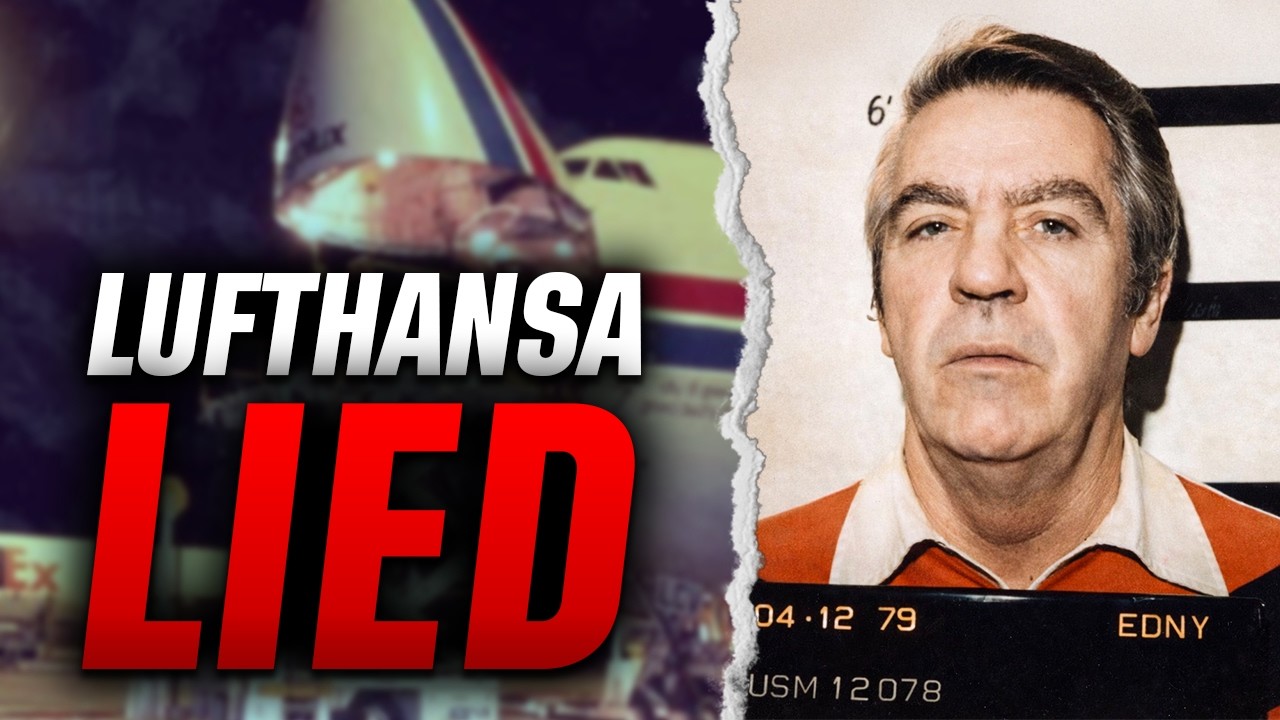
8 million in cash and $850,000 in jewelry. It was the largest cash robbery in American history at the time. For decades, the story of how it happened has been shaped by Martin Scorsese’s 1990 film Goodfellas, which placed Henry Hill at the center of the event. But the movie compressed, dramatized, and in places directly misrepresented what really took place.
The true story begins not with Hill, but with a desperate cargo supervisor drowning in gambling debt. Louis Werner was 47 years old in 1978, a cargo supervisor at the Lufthansa terminal earning roughly $15,000 a year. He was married but separated, supporting an estranged wife, a girlfriend, and three children. He also had a $300-a-day gambling habit.
By that year, he owed $18,000 to bookmakers, with interest piling up weekly. There was no legitimate way out. Werner had robbed Lufthansa before. In 1976, he and a coworker named Peter Gruenwald stole $22,000 in foreign currency from the terminal and got away with it completely.
That success gave him confidence and knowledge. He knew the terminal was vulnerable, and he knew something else that would transform a simple theft into a historic crime. Every few weeks, the Commerce Bank of Frankfurt shipped large quantities of American dollars through the Lufthansa cargo vault overnight on their way to Chase Manhattan Bank in New York. This was currency exchanged abroad by tourists and military personnel.
It had no serial number records, no dye packs, nothing to trace it. Werner knew the alarm codes, the vault location, the employee schedules, and the security blind spots. He had drawn detailed sketches of the building and had been planning for months. What he lacked was a crew.
Werner reached out through his bookmaker. That bookmaker knew Martin Krugman, a bookmaker who owed favors. Krugman knew Henry Hill. Hill knew Jimmy Burke.
Within days, the chain connected, and once Burke became involved, Werner lost control of his own plan. Werner had built the blueprint and created the opportunity. He deliberately stalled the Brink’s armored car on December 8th, guaranteeing the $5. 8 million would sit in the vault through the weekend.
His cut was supposed to be 10 percent. He never saw a dime of it. The crew that entered the terminal that night were real men with specific roles, though Goodfellas reduced them to a faceless blur. Tommy DeSimone was the primary muscle.
A physically imposing man who had already committed multiple murders, he was the one employees remembered. Angelo Sepe, lean and wiry with fourteen prior arrests, was there for intimidation and control. Joe Buddha Manri and Robert Frenchy McMahon both worked at Kennedy Airport and knew the terminal layout from their own employment there. Louis Cafora was a driver; he left the scene immediately after meeting his wife a few blocks away.
Then there was Paolo LiCastri, a Sicilian enforcer sent by the Gambino crime family to represent their interests. The Gambinos were owed a $200,000 cut for allowing Burke to operate at that scale in their territory. LiCastri’s presence was not optional. He took the subway home after the heist.
At 2:55 a. m. , a black Ford Econoline van pulled up to the terminal with six masked men inside. They had bolt cutters, weapons, and a plan built from Werner’s months of preparation.
Four men entered the front of the building while two stayed with the van and drove around to the rear, cutting the security fence and replacing the lock with their own padlock. Inside, the crew moved with brutal efficiency. They grabbed John Murray, a senior cargo agent trying to nap at his desk, ripped his jacket off, and marched him to the lunchroom, where employees were stacked face down on the floor. They called Rudy Eirich, the night shift supervisor, telling him he had a call from Frankfurt.
When he came upstairs, he walked straight into guns. They told him they had men outside his house ready to kill his family if he did not cooperate. He believed them. One employee, a transfer man named Kerry Whalen, tried to run and was pistol-whipped and brought back.
With all ten employees secured, the crew had complete control of the terminal. Eirich was forced to disable the alarm system and open the vault. Inside were 72 cartons, each weighing about fifteen pounds, containing $5. 8 million in untraceable cash and $850,000 in jewelry.
The crew loaded everything into the van in under thirty minutes. No shots fired, no alarms triggered. At 4:21 a. m.
, the van pulled away followed by a crash car. They drove to a garage in Canarsie, Brooklyn, where Jimmy Burke was waiting. The contents were transferred into two cars. Burke and his son Frank drove off in one.
The second carried DeSimone, Sepe, Manri, and McMahon. Parnell Stacks Edwards was left behind with one job: drive the van to a junkyard in New Jersey and have it crushed before dawn, destroying the only piece of physical evidence. Instead, Stacks drove to his girlfriend’s apartment, smoked cocaine, and fell asleep. The van sat on the street for three days until a cop noticed it parked too close to a fire hydrant, ran the plates, and had it towed.
Forensic technicians found fingerprints on the steering wheel, door handles, and gearshift, fingerprints belonging to Burke’s crew. The van did not just unravel the heist; it signed death warrants. Burke had roughly twenty people who knew about the heist, twenty potential witnesses. He made a cold calculation.
The van gave him a convenient excuse to start eliminating them. Stacks Edwards was first, on December 18th, seven days after the heist. Tommy DeSimone and Angelo Sepe walked into his apartment at 6:17 a. m.
and shot him five times in the face and chest. He was 28 years old. Martin Krugman, the bookmaker who had introduced Werner to the chain, kept asking for his cut and kept showing up at Robert’s Lounge when FBI surveillance cars were parked outside. In early January 1979, he disappeared.
His remains were never found. Louis Cafora had ignored Burke’s order to lay low, and his wife Joanna was seen wearing a full-length mink coat weeks after the heist. Both vanished without a trace. Joe Manri and Frenchy McMahon were found on May 16th, 1979, shot execution style in the back of the head while sitting together in a parked Buick in Brooklyn.
Paolo LiCastri was found in June 1979, burned, naked, and shot multiple times, his body left on a trash heap. Burke likely decided $200,000 was cheaper to keep than to pay. The killings continued. Richard Eaton and Tom Monteleone, Florida businessmen accused of skimming from heist money being laundered through their businesses, met brutal ends.
Eaton’s body was found hog-tied in a refrigerated meat truck. Monteleone disappeared. Teresa Ferrara, a woman connected to crew members and accused of involvement in the skimming, had her headless torso wash ashore in New Jersey. By the summer of 1979, nine people connected to Lufthansa were dead or missing.
None of the money was ever recovered, not one dollar. The cash was untraceable by design. Investigators believed Burke moved it quickly through multiple hands. Some went to Paul Vario, his Lucchese family capo, as tribute.
Some went to the Gambino family’s cut, though LiCastri never lived to deliver it. Some was laundered through the Florida businesses. The rest Burke kept and spent slowly and carefully. Louis Werner, the man who made the entire thing possible, was the only person ever convicted for the heist.
On February 28th, 1979, he was sentenced to fifteen years in federal prison. He served his time. The men who carried the money out of the terminal were never charged with the robbery. Too many witnesses were dead.
In 2015, Vincent Asaro was tried for his alleged role in the heist and was acquitted. The crime remains officially unsolved. Goodfellas made Jimmy Burke a criminal mastermind and Henry Hill the tragic narrator. The reality was colder and simpler.
Burke was a calculating businessman who viewed human beings as tools. He used Werner’s knowledge, Stacks’ desperation, DeSimone’s violence, and Hill’s connections. When the job was done, he began eliminating the tools that could get him caught. The men who died were not killed because of their mistakes alone; they were killed because their existence made them dangerous.
Burke died in prison in 1996. Hill died in 2012 after decades in and out of witness protection. Werner died having served his time. The money is still gone.
The real story of Lufthansa was not a heist or a movie. It was a machine for killing the people who built it.