He could be anyone. That was the miracle of him. Pull one mask off, slide another on, and the figure in your hands became a different hero, a different voice, a different world to save. No other toy trusted a boy enough to let him decide every afternoon who the hero was going to be.
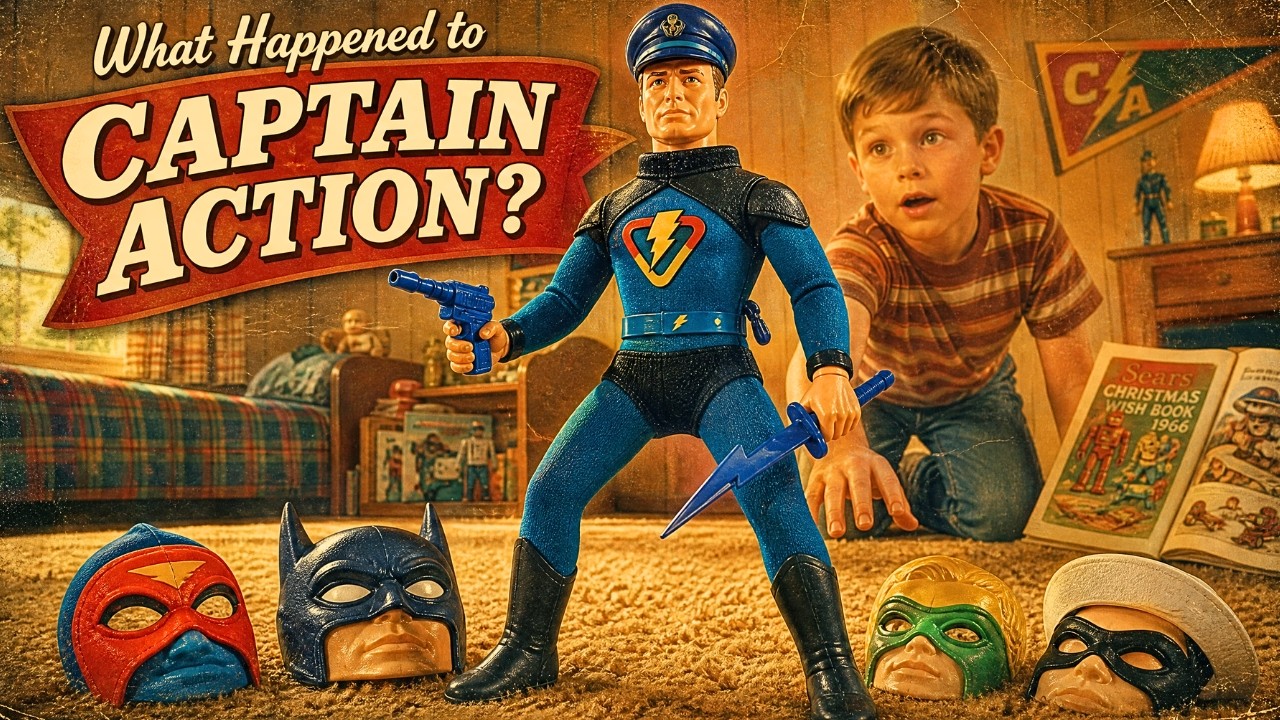
For many boys, the introduction came through the pages of a catalog. It was fall, probably November, when the Sears Christmas Wish Book arrived, thick and glossy. You turned the pages slowly, carefully, and then you stopped. There he stood in his blue and black uniform, surrounded by the faces of heroes you already loved: Superman, Batman, Captain America, The Phantom, The Lone Ranger.
The words underneath promised something impossible. One figure could become all of them. You circled the picture, circled it again, and spent the weeks before Christmas dropping hints and lying awake calculating the days. On Christmas morning, the box was heavier than expected.
Behind the cellophane stood the figure, muscular and articulated, staring back with a strange, serious face. His joints were stiff and new, his blue uniform crisp. He came with a lightning sword, a ray gun, and a belt, everything molded with care. The rest of the morning dissolved.
There was only the boy and the figure and the question that would power every afternoon for years: Who is he going to be today? Not every father understood. Some looked at the box and saw a doll, a word that landed like a verdict. Boys watched their fathers’ faces tighten, heard the edge in a voice saying, “No son of mine.
” Some boys never got one because of that. Others got one and heard about it for years, enduring older brothers’ smirks and jokes about playing with dollies. The people who made him had to coin a new term just to give fathers permission to buy one. They called it an action figure, and that phrase exists today because of the war between a boy’s longing and a father’s pride.
The costumes came in separate boxes, and collecting them was its own kind of fever. Each set included a cloth outfit, a vinyl mask, and accessories so specific they made the transformation feel real. The Superman set had a cape, arm shackles, a block of kryptonite, and a tiny Krypto the superdog. The Batman set came with a batarang and a utility belt.
The Aquaman set included a trident, flippers, and a conch horn you could press to his mouth. You did not just dress him; you equipped him, piece by tiny piece, like a soldier gearing up for a mission. When the last boot was on and the mask was in place, the man who had been nobody a minute ago became the most powerful being on the planet because a boy had made him so. Friends had different costumes, which turned every playdate into a summit.
Jimmy had Captain America and the weapons arsenal. Scotty had Aquaman and the survival kit. You had Superman and The Lone Ranger. Nobody had them all.
The sets were too expensive for one family to buy every one, so boys pulled their heroes together, traded masks across the living room floor, and built a team no single boy could have assembled alone. The figure was designed for one boy’s hands, but the game only reached its full size when the whole neighborhood showed up with their boxes. There was a villain, too, unlike anything seen in a toy store before. He was a blue-skinned alien with an exposed brain and a face that looked like a nightmare sculpted on purpose.
His name was Dr. Evil. He came with a lab coat, a hypnotic eye, a thought scanner, and disguises that let him pass as human, which somehow made him creepier. He was the reason the hero needed to exist.
Without him, the costumes were just dress-up. With him, every afternoon had stakes, a plot, a battle worth winning. There was a sidekick as well, a smaller figure called Action Boy who came with his own costumes: Robin, Superboy, and Aqualad, along with a sleek black panther. If you had a little brother, Action Boy was his.
If you were the little brother, Action Boy was yours. Having your own figure in the same world as the big one made you part of the story instead of just a spectator. The two rode together in a vehicle called the Silver Streak, an amphibious car with rockets that actually fired, and together they saved the world daily from the blue alien in the lab coat. He could fly.
Not in the way imagination usually supplied. He came with a four-foot nylon parachute, and if you threw him high enough off the porch or out a second-story window, he floated down slowly, cape and chute billowing behind him like something out of the comic books. You did it over and over, running downstairs and back up. It remains the closest thing to a real superpower a toy ever gave a boy.
The day the parachute tangled in a tree branch and you had to beg your father to climb up and free him remains one of the funniest stories never told. The man who dreamed him up had already changed the toy world once. Years earlier, he had walked into a meeting with a prototype of an articulated soldier and sold the idea for one hundred thousand dollars. That soldier became the most famous action figure ever made.
But this man was not finished. He took the same concept to a different company and proposed something bolder: not a soldier who could wear different uniforms, but a hero who could become different heroes entirely. The company said yes. They changed the name from the original pitch, Captain Magic, to something sharper and put him on shelves in the same year a television show turned every boy in America into a superhero fanatic.
The timing was perfect. The man who invented the soldier had just invented his own competition, and for a blazing moment, it looked like the competition might win. He arrived at exactly the right time. The year he appeared, a masked man in a cape was exploding across television screens twice a week, and suddenly every boy wanted to be a hero, not just watch one.
Here was a toy that let a boy transform, not pretend. Mask on, cape tied, boots buckled, standing in a bedroom as the most powerful version of yourself you could imagine. He was not just riding the wave; he was the wave, the physical object that turned a television fantasy into something you could hold and control. No screen required, no weekly schedule.
He was there whenever you needed him. The moment of transformation was performed with ritual’s care. You peeled off the old costume slowly, folded it the way the box showed you, set the mask aside. Then you opened the new box and laid out the pieces: the suit, the boots, the accessories, the mask with its painted eyes staring up from the carpet.
You dressed him piece by piece, and last of all slid the mask over his face and watched him become someone else entirely. It was a magic trick performed with your own fingers, and it never got old, because each time he changed, the whole story changed with him. The company built an entire world around him. There were accessory packs, survival kits, weapons arsenals, space communicators.
There was a model kit so you could build him yourself. There were flicker rings that shifted between his face and the heroes he could become. There was even a comic book, five issues drawn by some of the best artists in the business, giving him a real name and a backstory involving ancient coins and the powers of the gods. Everything a boy could want was built around this one figure.
But the garden did not last. The heroes on television cooled off. The costumes cost more to license than the company could sustain. Parents began to pull back, and shelves started filling with the next thing.
After two and a half years, not even three full Christmases, the company quietly stopped making him. No announcement, no farewell. One season he was in the catalog, bright and promising, and the next season the page belonged to someone else. The boy who had circled his picture so hard the ink bled through did not notice at first, because by then the costumes were scattered in a box, the masks were losing their shape, and the afternoons were getting shorter in the way they do when you are growing up without meaning to.
What made him different from every other figure that came and went is that he was the first to let a boy hold a superhero in his hands. Before him, the heroes you loved existed only on screens, in comic panels, in imagination. He was the bridge between the story and the boy, the physical proof that the costume did not just belong to someone on television but to you on your bedroom floor. Every superhero figure that came after him, for decades, walked through a door he opened.
The toys your son played with, the figures your grandson collects today, all trace back to 1966, when one man had the idea that a boy deserved to hold his hero. Most boys lost him gradually, the way childhood itself slips away. A boot went missing in the couch. A mask got chewed by the dog.
The costumes ended up in a shoebox, then the shoebox ended up in a closet, then the closet got cleaned out by a mother who saw old plastic where a boy saw an entire universe. Some boys came home from summer camp to find the box gone, sold at a yard sale for a quarter. Nobody asked. Nobody thought a grown boy still needed a toy he had outgrown.
But the boys who dressed him and fought his battles are men now, most in their sixties and seventies, carrying a memory that grows more precious as the circle gets smaller. Some still have a figure tucked away, a stiff little man in a faded blue suit, missing everything except the feeling he still carries. Others lost him decades ago and would pay almost anything to hold one again, just to feel the weight settle into their palm and remember the morning they opened the box and the whole world was theirs to save.