In the spring of 1859, Cora Lynfield, twenty years old, was hanged in the yard of the county jail in a farming county of Missouri. The execution was public, carried out on a Thursday morning in the second week of June, with perhaps forty people present. Dela Voss, nineteen years old and Cora’s closest friend since they were girls, stood among them. She was near enough to see Cora’s face, and she said nothing.
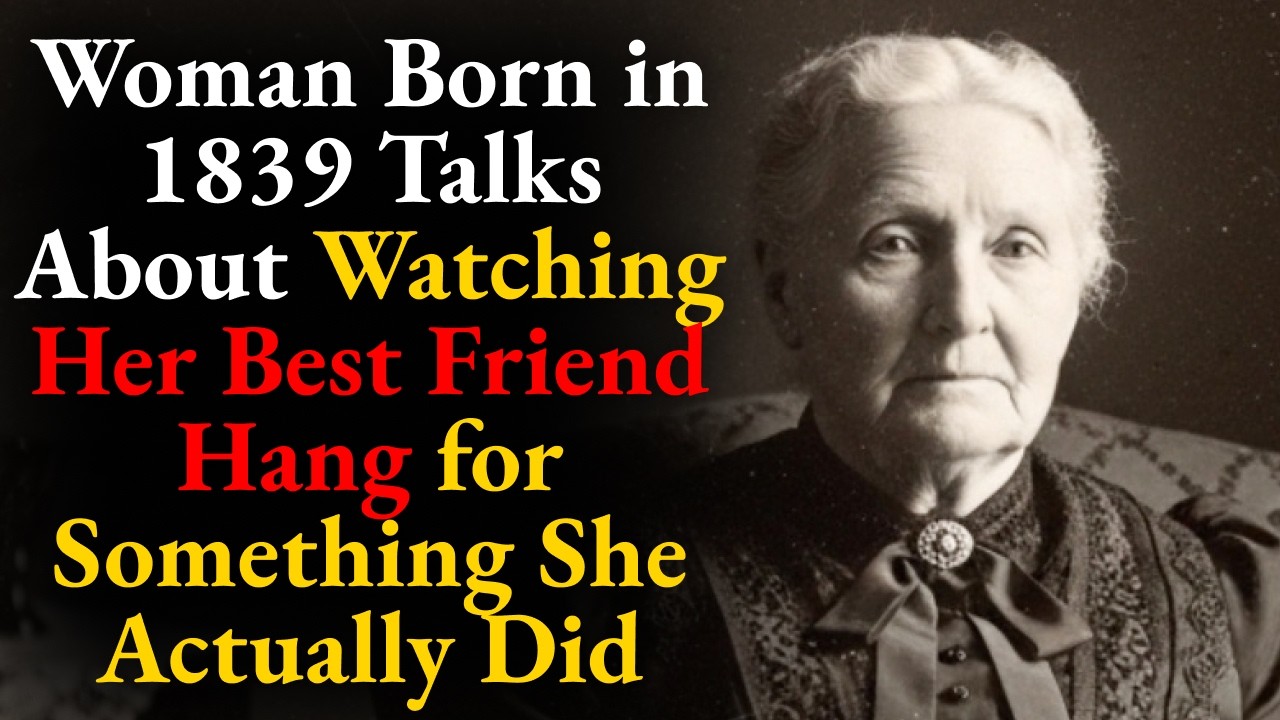
She had the words. She knew what they were and where they were. She kept them. Cora was innocent.
She was hanged for a crime Dela committed. Dela had burned the grain storage of a man named Harlon Goss, a widower of thirty-six who had leased land from a neighbor and had arranged to marry Cora. The fire caught, the building was lost, a fence scorched, and a mule died of smoke. The barn did not catch.
The house did not catch. No person was hurt. But in Missouri in 1859, arson could be a hanging offense, and Harlon Goss was a man determined to see it punished. He had his suspicions, but he could not prove them.
So he named the girl easiest to name. Dela Voss was born Dela Hararp in the autumn of 1839, in a flat, wide settlement about twelve miles east of the Missouri River. Her father raised corn and hogs; her mother kept chickens and a kitchen garden. She was the second of five surviving children.
Cora Lynfield arrived in the spring of 1854, at fifteen, after her family moved from Kentucky to take land sold to them by an uncle. The land proved poor, the family struggled, and Cora’s father drank too much and died in November of 1858. Within two months of the funeral, her mother agreed to Cora’s marriage to Harlon Goss. Cora was eighteen.
She did not want it, and she told Dela so plainly. By then they had been close for years, the particular kind of friendship formed in a small settlement where you walk the same road home and never run out of things to say. Cora was quick and funny, sharp in a way that caught you off guard. She was not afraid of anyone, which Dela found astonishing because she was afraid of nearly everything.
Dela admired that. Looking back, she thought, she admired it partly because she did not have it herself. In early April of 1859, Cora came to Dela in distress. What had happened at the Goss farm had not been recoverable by any of the ordinary means available to a woman in that place and time.
Dela did not detail it, and Cora never spoke of it again. Two nights later, Dela went to Goss’s storage building with a lantern, and she was not careful with it. She meant to damage his property. The whole structure went up in the dry spring.
The talk began by Sunday. By the following week, Goss had gone to the county sheriff with a name: Cora Lynfield. He had no certainty it was her. He may have suspected Dela, but Dela was a farmer’s daughter with a father who had standing.
Cora was an eighteen-year-old girl whose family owed him and who had made it plain she did not want to be his wife. She had less protection. The calculation was that simple. Cora was taken for questioning in late April.
Dela heard about it that same day, standing in the yard splitting kindling. She put down the axe. She told herself she would go in the morning. She told herself things would sort themselves out.
Some of those things might have been true in a different county in a different year. They were not all true in that county in 1859. Those first days were the ones she returned to most often in sixty years of returning, because those were the days when the door was still open, before the hearing was set, before the machinery had built up momentum. Those were the days when it was still possible to walk to the sheriff’s office and say what she knew.
She did not walk to the sheriff’s office. She walked to the well. She walked to the barn. She walked the road to the mill and back with her father that Thursday and passed the black square in the grass where Goss’s building had stood.
Her father looked at it, shook his head, said nothing. Dela looked at it too and said nothing. Cora’s mother came to their door the following Wednesday. She said Cora maintained she had nothing to do with it.
She said Goss was pressing hard. She said she did not know what to do. Dela stood in the kitchen doorway and said nothing. The hearing was held in a room above the feed store because the courthouse was being repaired.
Dela attended both days. The circuit judge, a man named Aldrich from the southern part of the state, showed little interest in the Lynfield family’s position. Goss testified in a measured way about his losses, and he spoke of Cora’s reluctance to marry him as evidence of motive. A neighbor of Goss’s, a man named Delard, testified that he had seen a figure near the road that night.
Cora’s mother, calm in the way she was calm about everything, said Cora had been home that night, but the calm worked against her and read as flat. Cora was not permitted to speak on her own behalf. Women were not allowed to testify in that court at that time. She sat for two days and listened to her life being accounted for by other people, and she did not speak because she was not allowed to.
Dela sat in her chair both days. She was allowed to speak, and she did not. The judge found Cora guilty at the end of the second day. The sentence was death.
The execution was set for June. In the weeks that followed, Dela lived inside what she had built. She had told herself the situation was inevitable, like weather, and by the time she sat in that room, she had lived inside that version long enough that standing up felt like an act requiring something she no longer had access to. She had reasoned through it each morning as if solving a problem.
A young woman, no standing, no guarantee of being believed, a man like Goss already in the sheriff’s ear. The calculation came out the same each day. Underneath all of the reasoning was simpler: plain fear, the kind that lives in the body and moves faster than thought. Cora was held, released for two days, then brought back.
Her mother collected her things, and among them was Cora’s button hook, a plain bone-handled hook she used every morning for her boots and kept in her apron pocket the rest of the day. Her mother handed it to Dela along with a bundle, told her to keep them safe. Cora never came home to reclaim it. Dela kept it.
She put it in a tin tobacco box, and it has lived on the high shelf of her wardrobe for sixty years. The morning of the execution, Cora was brought out at about nine o’clock, wearing the same blue dress from the hearing. Her hands were bound in front of her. She walked without assistance.
Near the end, she looked out at the people gathered there. Dela was there, looking at her. She cannot give Cora even the certainty that she saw her. It was over fast, faster than she expected.
Dela stood in that yard for a while after. Someone touched her arm. She walked home. The button hook was in her apron pocket.
She had put it there that morning without deciding to. Dela lived in Missouri for two more years. She went to church, helped with the harvest, nursed her mother through an illness. At church, Mrs.
Farber, who had been kind to the Lynfields, sometimes caught her eye and nodded with sympathy for having lost a friend. She did not know she was nodding at the person responsible. Dela nodded back. She did that for two years.
By the autumn of 1860, Goss sold his lease and moved south toward Arkansas. Some said there was a rumor of debts elsewhere. Dela never learned what became of him. She understood that he was not the main figure in what she carried.
He was the occasion. She was the cause. In the spring of 1861, she married Elias Voss, a quiet farmer’s second son from the next county over. He did not drink, did not raise his hand to her, worked hard, and never pressed her about the past.
They left Missouri in 1862 for Kansas. They built a sod house, had three sons, and built a life in the ordinary sense of the phrase. Dela loved her sons without reservation, the one thing she could say without qualification about the sixty years that followed Cora’s death. But there were moments, not many, when she came close to speaking.
The clearest was in the winter of 1879, when her sixteen-year-old son Franklin said at the table that a person who knew a wrong was being done and said nothing was as guilty as the one doing it. He was talking about something political, something about railroads and land seizures. Dela looked at his face and thought about what she would say if she began. She thought about it for about ten seconds.
Then she said he was probably right and got up and went to the stove. Elias died in 1901. Dela was sixty-one. She has lived eighteen years since.
The silence got heavier after he was gone. She took the button hook out of the tin box once, about ten years after Elias died, held it for a long time, and put it back. She did not take it out again until now. She has spent sixty years trying to understand why she did not speak.
The reasons were real: she was afraid, she had no legal standing, she could not be sure a confession would be believed or would save Cora. But there was something underneath. By the time the hearing began, she had lived eleven or twelve days with the knowledge, and something had shifted. She had begun to construct a version of events in which she was helpless, in which her silence was not a choice but a fact of the situation, inevitable, like weather.
She had lived inside it long enough that it had become familiar. There is a particular kind of cowardice that does not feel like cowardice from the inside. It feels like reasoning. Cora Lynfield was born in Kentucky around 1839.
She had dark hair, worn in a braid. She was funny and sharp and not afraid of people. She carried a bone button hook in her apron pocket every day. She was twenty years old when they hanged her in the yard of the county jail for a crime she did not commit.
She knew it, and Dela knew it, and Dela stood in that yard and said nothing. Dela is seventy-nine now. She has had fifty-nine years more than Cora had. Every one of those years was available to her because she kept her mouth shut on a Thursday morning in June of 1859.
She has asked herself what Cora thought of her at the end, and she has decided she will never know. She thinks Cora was too sharp not to have put part of it together. Not knowing is its own kind of sentence. She took the tin box down this morning, from behind the folded flannel at the back of the shelf.
The button hook is a small thing, the bone handle worn smooth on one side, discolored with age, the kind of thing you would not look twice at in a peddler’s tray. She has kept it for sixty years, never shown it to anyone, never been able to throw it away. She burnt a man’s property, and a mule died of smoke, and her closest friend was hanged in her place, and she kept a button hook in a tin box and called it carrying the weight of it. She has decided that is not penitence.
It is only familiarity. Some debts do not resolve. You carry them until you cannot carry them any further, and then you put them down, and they stay where they are, unpaid. Dela is putting this one down now.
Cora Lynfield was a real person, and she deserved better than what Dela gave her. Dela is going to put the button hook back in the box.