In the summer of 1943, hundreds of miles west of the Azores, two German submarines lay side by side on the surface of the mid-Atlantic under a bright, calm afternoon sun. One was an ordinary attack boat, far from home, its fuel nearly exhausted after weeks at sea. The other was something special—a huge, thick-hulled supply submarine, the kind crews called a “milk cow. ” It carried no torpedoes to speak of.
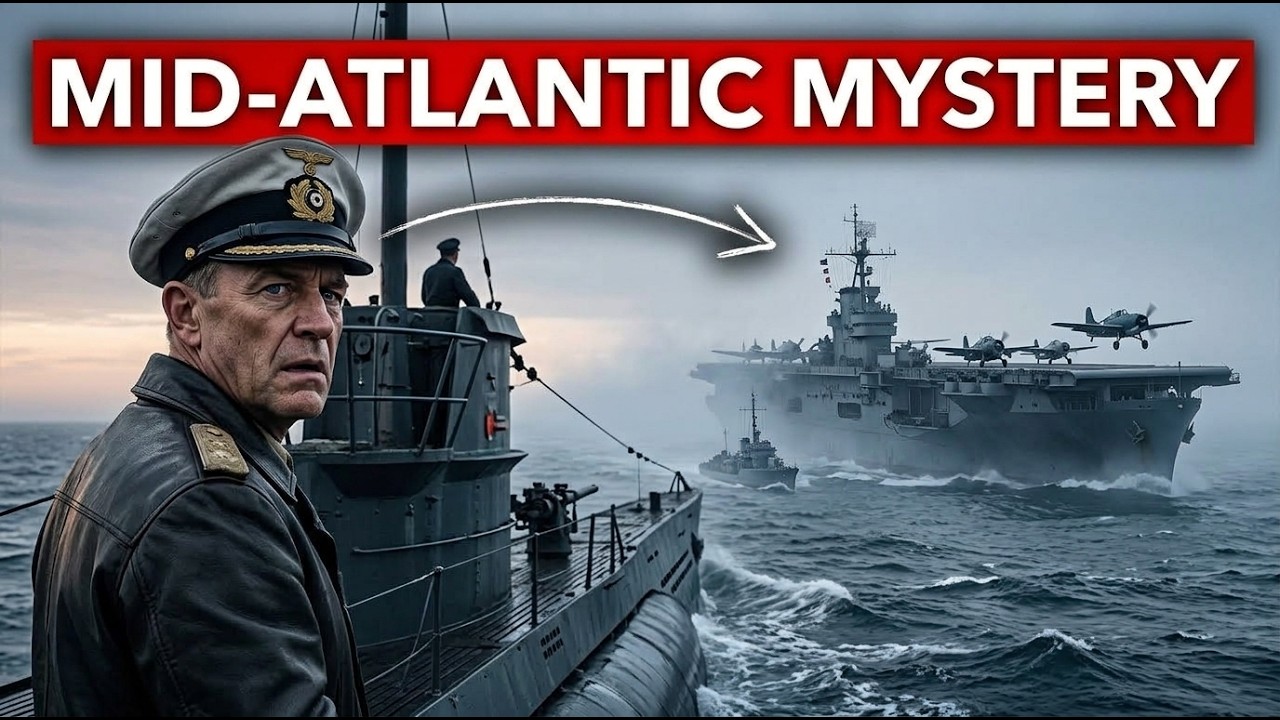
It carried fuel, food, spare parts, and a doctor. Its job was to meet attack boats in the open ocean and resupply them so they could stay on patrol for weeks longer instead of making the long, dangerous voyage back to port. Hoses were connected between the two boats, and fuel began to flow. Men stood on deck, squinting in the sunlight, some stripped to the waist and enjoying fresh air after weeks inside a steel tube.
The captain of the attack boat stood on the bridge and, for the first time in weeks, felt something close to safety. He had good reason for that feeling. He was in the middle of the ocean, far beyond the range of the land-based aircraft that had made life so dangerous near the coasts of Europe and North America. Here, for most of the war, the only threat had been convoy escorts, and there were no convoys on the horizon near this rendezvous point.
The location had been chosen precisely because it was empty. It was, in fact, the safest place in the Atlantic. The lookout saw the aircraft first. Small single-engine planes approaching low from the west—not the huge four-engine patrol bombers that flew from land.
These were carrier aircraft. In the middle of the Atlantic, hundreds of miles from anywhere, there was no time for an orderly separation of the two submarines. The hoses were cut. Men rushed below.
The milk cow, huge and slow to dive, was still on the surface when the first plane passed over—a fighter raking the deck with machine-gun fire to drive the gun crews away, followed by a heavier aircraft trailing behind it. The captain who survived that afternoon, if he survived at all, would spend the rest of the war, and in some cases the rest of his life, trying to understand how the Americans knew exactly where he was. To understand why that rendezvous had seemed so safe, and why it was no longer safe at all, you have to understand the nature of the Battle of the Atlantic. The war against the U-boats was, above all, a war decided by aircraft.
A World War II submarine spent most of its time on the surface. Underwater, it could only move slowly and for limited periods before its batteries ran out. On the surface, it could travel fast and recharge, but it was exposed to detection. The mere presence of an aircraft over a convoy forced every nearby U-boat to dive and stay deep, which meant it could not chase the convoy or get into attack position.
The Allies therefore flew patrols from land bases in Britain, Iceland, Canada, and the United States. Near the coasts, U-boats learned to fear them. But in the middle of the ocean, there was a gap—a vast stretch of water beyond the range of most land-based aircraft. Crews on both sides had names for this region.
It was where U-boat packs gathered, where convoys were most vulnerable, and where the war’s heaviest shipping losses occurred. It was also where U-boats met their supply submarines, because it was the one area where they could safely spend time on the surface. In 1943, the Allies closed that gap from two directions. From land, they introduced extremely long-range aircraft—heavily modified four-engine bombers with extra fuel tanks capable of reaching deep into the mid-Atlantic.
And from the sea, they brought something U-boat crews never expected to meet in the open ocean: small escort carriers sailing with their escorts, on hunter-killer missions. The escort carrier, on paper, was a modest thing. It was not a fleet carrier, not one of the large, fast ships fighting carrier battles in the Pacific. It was a small, slow ship built on a merchant hull, with a flight deck on top and a hangar below.
It carried a modest air group, usually between twenty and thirty aircraft. It was lightly armored and lightly armed. Crews joked bitterly about how easily it could sink. But it could be built quickly and in enormous numbers.
The most remarkable example was a class of escort carriers built in the shipyards of industrialist Henry Kaiser, the same organization mass-producing Liberty ships. Kaiser proposed building carriers the same way he built merchant ships, using prefabricated sections, assembly-line methods, and a workforce that had never built warships before. The Navy was skeptical. Kaiser pushed it through with support from the highest levels of government.
The result was an entire class of fifty escort carriers delivered from a single yard in about a year, at a rate approaching one carrier a week. Escort carriers were used for many roles—transporting aircraft, supporting amphibious landings in the Pacific, escorting convoys. But in the Atlantic in 1943, the U. S.
Navy began using some of them in a new way. Instead of simply sailing with convoys to protect them, a carrier and a group of destroyers or destroyer escorts were formed into a “hunter-killer group”—a force whose job was to go out, find U-boats wherever they were, and sink them. The carriers did not sail alone. Each group included several escorts, destroyers, or the new destroyer escorts, smaller warships built specifically for antisubmarine warfare and, like the carriers themselves, produced in American yards at a staggering rate.
The escorts protected the carrier, used sonar to search for any U-boat that dived, and followed up aircraft attacks with depth charges and forward-firing antisubmarine weapons. The whole system was an integrated antisubmarine force that could be sent anywhere in the ocean: eyes in the air, hunters on the surface, ears under the water. The place they went to hunt was the middle of the ocean. This is the heart of the mystery for U-boat commanders, and it deserves careful attention.
How do you find a submarine in the middle of the Atlantic? The ocean is vast. A U-boat on the surface is a small object. Even carrier aircraft, flying search patterns, can cover only a limited area in a day.
Sending hunter-killer groups out at random would mostly mean finding empty sea. The Allies used several methods, and each mattered. Radio direction finding: U-boats communicated by radio. German U-boat command, run from France and later from Germany, controlled its boats by wireless, ordering them into position, forming wolf packs, and demanding regular reports.
Every time a U-boat sent a signal, it risked revealing its position. Allied listening stations on land and, increasingly, direction-finding equipment on the escorts themselves—which sailors called “huff-duff,” for high-frequency direction finding—could determine the bearing of those signals. Intersecting two or more bearings gave a rough location. Radar: Allied ships and aircraft carried advanced radar that could detect a U-boat on the surface from a useful distance, even at night or in poor visibility.
And then there was the secret method. The Allies were reading a large part of the U-boats’ radio traffic. The German naval Enigma cipher used by the U-boats had been broken by the codebreakers at Bletchley Park in Britain, and the intelligence was shared with the U. S.
Navy. When U-boat command sent orders arranging a meeting between an attack boat and a supply boat at a particular time and place, there was a real chance Allied intelligence officers would read those orders within a short time. The U. S.
Navy set up a special organization, a sort of headquarters that existed in theory as a fleet without ships, to coordinate antisubmarine warfare in the Atlantic using intelligence from all sources. It could steer hunter-killer groups toward locations where German submarines were expected. The supply submarines, the milk cows, were a special target, because sinking one forced several attack boats to return home early. But using this intelligence carried a terrible risk.
If the Germans ever realized their codes were broken, they would change them, and the advantage would vanish. So the Allies were extremely careful. Hunter-killer groups were not always sent directly to the exact location. Aircraft were sent to sweep broad areas, so any attack could be explained as the result of radar or plain luck.
Some opportunities were deliberately missed. The Allies made every effort to make it look as though they had simply become very good at search operations. The U-boat captain at the rendezvous believed he was in the safest place in the Atlantic. In reality, he may have been in one of the most closely watched places on earth.
When the carrier aircraft found a U-boat, what followed was fast and brutal. The carriers operated two main types of aircraft: the Grumman Avenger, a large single-engine torpedo bomber carrying depth charges or ordinary bombs and, in some cases, a new secret weapon; and the Grumman Wildcat, a fighter flying alongside it. The two worked as a team. In 1943, German U-boat command ordered its boats to fight it out with aircraft on the surface rather than dive, and many boats were given heavier antiaircraft armament.
A surfaced U-boat with a well-trained gun crew could put up real resistance against a single plane. So the fighter went in first, hosing the U-boat’s deck with machine-gun fire to drive the gun crews away from their weapons. Behind it came the Avenger, dropping depth charges near the submarine’s hull. The secret weapon was an acoustic homing torpedo—a small torpedo dropped from an aircraft that listened for the sound of a submarine’s propellers and steered toward them.
It was so secret that its crews were given a codename suggesting it was a mine, and it was supposed to be used only when the U-boat had dived and no enemy was on the surface in a position to see it being used. A U-boat diving to escape an aircraft might discover that diving was no escape at all. During the summer and autumn of 1943, American hunter-killer groups built around escort carriers sank large numbers of U-boats in the mid-Atlantic, including a large proportion of the supply submarines. The milk cow fleet, the fleet that had allowed U-boats to operate so long and so far from their bases, was largely destroyed.
Without it, U-boat patrols became shorter, more dangerous, and less effective. It was not one-sided. The U-boats struck back. In May 1944, a U-boat torpedoed and sank the American escort carrier USS Block Island off the Canary Islands—the only American carrier lost in the Atlantic during the war.
Air crews were lost to antiaircraft fire, accidents, and the sea. In June 1944, one hunter-killer group achieved something extraordinary. Off the coast of West Africa, the group led by the escort carrier USS Guadalcanal forced a U-boat, U-505, to the surface. Her crew abandoned her, believing she was sinking.
An American boarding party climbed aboard, closed the valves the Germans had opened to scuttle her, and captured the submarine with her codebooks and encoding equipment. It was the first time the U. S. Navy had captured an enemy warship on the high seas since the nineteenth century.
The capture was kept secret for the rest of the war. The German crew was held in isolation so no one in Germany would learn that their codes had fallen into American hands. U-505 survived the war and is preserved today in a museum in Chicago. For the U-boat crews themselves, the arrival of aircraft over the middle of the ocean changed the entire nature of the war.
For years, the open Atlantic had been their private domain—the place where they could sail on the surface, charge their batteries, dry their clothes, and breathe fresh air. Now there was no such place. Every surfacing carried the risk of a small single-engine plane appearing out of the clouds with no warning. Crews spent more time submerged in stale air, total darkness, and cramped conditions.
Patrols became exhausting. Morale, so high in the years of success, began to erode. The old, experienced crews were lost and replaced by younger men with far less training, making the next losses more likely. Now consider the war from the other side, because the German reaction reveals as much as the American actions did.
The commander of the U-boat force, Admiral Karl Dönitz, and his staff were intelligent, professional officers, and they knew something was wrong. U-boats were being found in places they were not supposed to be. Rendezvous points were being attacked. Losses were climbing to intolerable levels.
In May 1943—the month U-boat men called “Black May”—so many U-boats were lost that Dönitz withdrew the wolf packs from the main North Atlantic convoy routes. That was the turning point of the Battle of the Atlantic. The Germans conducted their investigations. They wondered whether their cipher had been compromised.
They looked for spies or traitors leaking information. They considered the possibility that the Allies had a new form of radar or detection techniques they did not yet understand. Over and over, they concluded that the Enigma cipher was safe. They blamed radar.
They blamed direction finding. They blamed bad luck. They tightened radio discipline and changed procedures, but they never fully accepted the most important explanation: that a large part of what they were saying to their submarines was exposed and readable. The human cost of that failure was enormous.
Of the tens of thousands of men who served in the U-boat force during the war, the great majority did not survive. The figure most often cited is roughly three out of four. They were young men, often very young, sailing in submarines the Allies were increasingly able to find and destroy. That is not a number to celebrate.
It is a number to contemplate. The U-boat crews were brave men serving a system that did not deserve them, dying in great numbers in the cold depths of the Atlantic, often without the enemy ever seeing their faces. So why could the U-boat commanders not explain how the American escort carriers found them in the middle of the Atlantic? Because the answer was not one thing.
It was an entire system. There were the carriers themselves—small, slow, unglamorous ships built on merchant hulls by a shipbuilder who had never built a warship, delivered at a speed no one expected. There were the aircraft and tactics: fighters to suppress antiaircraft fire, bombers to deliver the killing blow, and a secret homing weapon for submarines that dived. There was radio direction finding on land and at sea, tracking the signals of every transmission.
There was radar. And there were the codebreakers, reading enough of the U-boat communications to steer the hunters onto the right track, protected by a careful effort to make every success look like luck. The German U-boat force was one of the most formidable fighting forces of the war, and in 1942 and early 1943 it came frighteningly close to cutting Britain’s lifeline.
It was defeated not by a single weapon but by an enemy able to build carriers a week, fill the sky over the ocean with aircraft, and listen to every word its submarines said—while keeping that fact a closely guarded secret.