On the morning of January 16, 1935, a local handyman named Willie Woodbury arrived for work at a lakeside cottage in Ocklawaha, Florida, and found fourteen FBI agents surrounding the property, armed with enough firepower to invade a small country. The couple he knew as the Blackburns, quiet people who kept to themselves, were not the Blackburns at all. The woman in her sixties who loved jigsaw puzzles and listened to the radio all day was Ma Barker, and the era of the public enemy was about to claim one of its final victims. Born Arizona Donnie Clark on October 8, 1873, in Ash Grove, Missouri, she grew up in the Ozarks and preferred the nickname Arrie.
In 1892, at nineteen, she married a man named George Parker in Lawrence County, Missouri. From that moment, she called herself Kate. George Parker was described by nearly everyone who wrote about him as shiftless, the sort of man who contributed nothing but somehow consumed everything. The couple had four sons: Herman in 1893, Lloyd in 1897, Arthur in 1899, who everyone called Doc, and Fred in 1901.
The family eventually settled in Tulsa, Oklahoma, where the boys began getting into trouble in the faster and more violent way of the era. This was Prohibition-era America, with the Great Depression either arriving or already arrived, depending on which Parker son one discusses. Crime rates were climbing because when people cannot find food, they start making bad decisions, and the Parker boys made some genuinely bad ones. By the early 1930s, a dozen or so men were roaming the Midwest robbing banks and kidnapping the wealthy.
John Dillinger was on the loose, along with Bonnie Parker and Clyde Barrow, Pretty Boy Floyd, Baby Face Nelson, and Machine Gun Kelly. The newspapers called them public enemies because it sounded dramatic and sold papers. J. Edgar Hoover, who ran the Bureau of Investigation, formally renamed the FBI in 1935, was using these men to build his entire brand.
Every time an agent shot a famous outlaw, Hoover received a bigger budget. Two events in particular gave Hoover the jurisdiction he needed. In May 1932, the infant son of Charles Lindbergh was kidnapped and killed, and the national outrage pushed Congress to pass the Federal Kidnapping Act, making it a federal crime to transport a kidnapping victim across state lines. Then in June 1933, the Kansas City massacre occurred, where four officers and a federal agent were killed in an ambush at Union Station while transporting a prisoner named Frank Nash.
That event gave Hoover the political ammunition to transform his bureau into a full federal police force, with agents finally authorized to carry weapons and make arrests. The Barker-Karpis gang fit perfectly into this world. Fred Parker met a Canadian-born criminal named Alvin Karpis inside the Kansas State Penitentiary at Lansing, Michigan, and when they got out, they began working together. The gang operated as a revolving door in Midwest crime, with men like Lawrence DeVol, Harvey Bailey, Frank Nash, and Harry Campbell moving through St.
Paul, Minnesota, committing robberies and kidnappings under the protection of corrupt police officers. The arrangement had a name: the Old Con System, a decades-old residency agreement where criminals could work freely in St. Paul as long as they checked in with police, paid bribes, and committed their crimes elsewhere. In 1931, the killing of Sheriff C.
R. Kelly drove the gang from Missouri to St. Paul for good. In 1932, they rented a house at 1031 South Robert Street in West St.
Paul, posing as a family of speakeasy musicians. In the same year, Oklahoma Governor William Murray, nicknamed Alfalfa Bill, pardoned Doc Parker from a life sentence for killing a security guard. The gang’s first major strike came on June 15, 1933, when they kidnapped a wealthy St. Paul brewer named William Hamm Jr.
, heir to the Hamm’s Brewing fortune. They collected $100,000 in ransom, about $2. 5 million today. Their second kidnapping victim was even more significant.
Edward George Bremer Jr. was president of the Commercial Bank of St. Paul, and on January 17, 1934, the gang took him and held him for nearly three weeks until his family paid $200,000, equivalent to $5 million today. Between bank robberies and kidnappings, hundreds of thousands of dollars flowed through the gang, with some individual bank jobs netting a quarter million in the currency of the time.
Throughout all this, Ma Barker simply existed. She traveled with Fred, lived in the houses, and spent her days listening to Amos and Andy on the radio while doing jigsaw puzzles. That was all she did. The rest of 1934 turned into a bloodbath for public enemies.
On March 3, John Dillinger escaped from Crown Point prison in Indiana, which authorities had publicly declared impossible to escape from. The famous story held that he carved a wooden pistol, blackened it with shoe polish, fooled the guards, locked them in their own cells, and grabbed two real machine guns on his way out. The truth that emerged later was that Dillinger’s lawyer arranged the whole thing with a bribe of about $3,500 to Lake County officials, and a carpenter made the fake wooden guns as a prop so Dillinger would not have to invent a story. The escape was paid for, but the wooden gun version is far more exciting, and it is the story everyone remembers.
On May 23, 1934, Bonnie and Clyde met their end on a rural road near Gibsland, Louisiana. Texas Ranger Frank Hamer had been chasing them for months, and his posse laid the ambush. At 9:15 in the morning, they opened fire on the stolen 1934 Ford. The car took 150 bullets.
Clyde was hit at least seventeen times, Bonnie at least twenty-six. Neither fired a single shot. Hamer had actually hoped to take them alive, but a lumber truck appeared suddenly, confusion set in, a deputy started shooting, and everyone had to start shooting too. On July 22, 1934, FBI agents shot John Dillinger outside the Biograph Theater in Chicago.
Pretty Boy Floyd was killed on October 22, and Baby Face Nelson fell on November 27. By the end of 1934, the FBI had eliminated nearly all the public enemies. The only major target left was the Barker-Karpis gang. On January 8, 1935, agents led by Melvin Purvis arrested Doc Parker in Chicago.
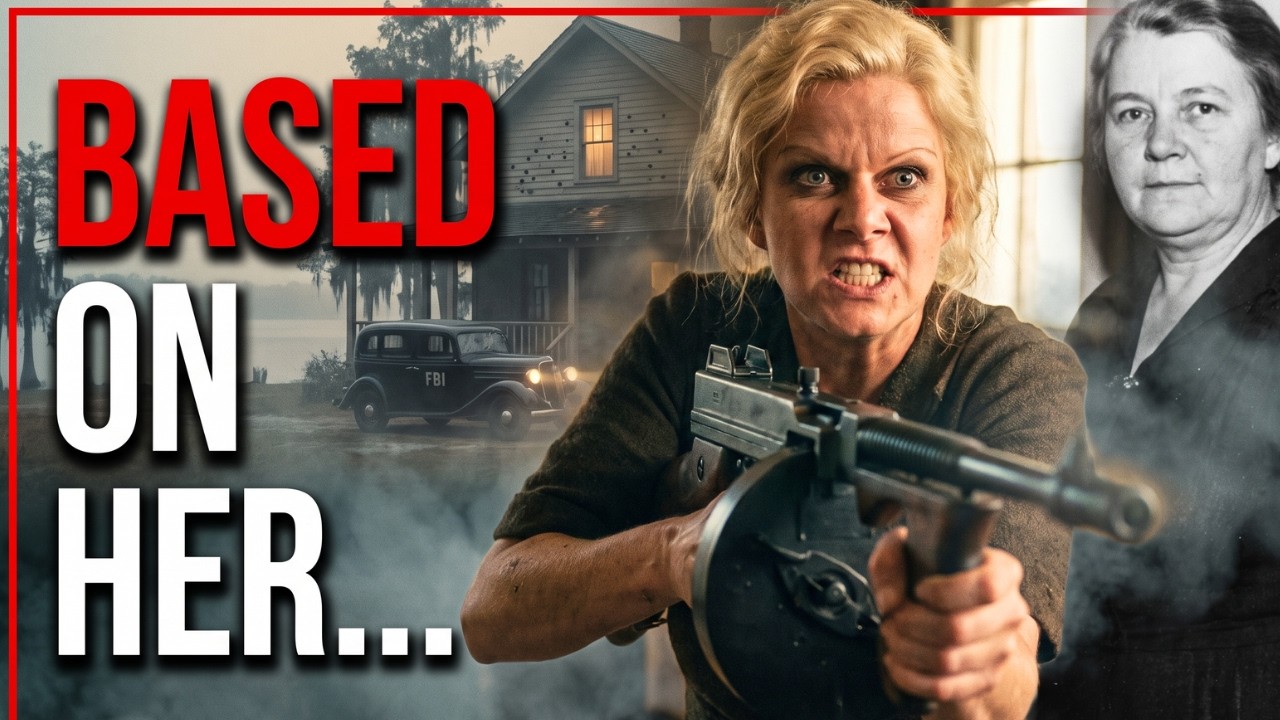
He was carrying a map of Florida with Lake Weir in Marion County circled. That map was all the FBI needed. At five in the morning on January 16, 1935, fourteen federal agents surrounded a rented house on Lake Weir. They believed there were eight to ten people inside, but the only two people in the house were Ma Barker and her son Fred.
Special Agent in Charge Earl Connelly demanded they come out, assuring them no one would be hurt. Ma Barker screamed from an upstairs window. Go ahead. The agents opened fire and did not stop for four hours.
They threw tear gas grenades into the house and fired between two and three thousand rounds into those wooden walls. It was not a gunfight. It was fourteen federal agents with unlimited ammunition ordered to solve a problem. Local residents came from surrounding areas to watch, some bringing food.
People were picnicking while the FBI tore the house apart with gunfire. When the shooting finally stopped at eleven in the morning, agents entered and found Fred Barker, his body torn apart by a hail of bullets. Ma Barker was also dead, but with only one wound. A Thompson submachine gun lay near her body.
No FBI agent was injured. The incident was recorded as the longest gun battle in FBI history, a record that still stands today. This is where the story gets interesting. J.
Edgar Hoover had a problem. His agents had just killed a sixty-one-year-old woman from the Ozarks who liked puzzles and radio programs, and the American public was not likely to feel proud about that. Hoover activated what historical records politely call the Bureau’s propaganda machine, which was nothing less than a disinformation campaign. He declared that Ma Barker was the most vicious, dangerous, and intelligent criminal mastermind of the past decade.
He claimed she ran a criminal school for her sons and planned every robbery and kidnapping from start to finish. None of that was true. Ma Barker had never been arrested or charged with a crime. She was completely unknown to law enforcement until that morning when she told them to go ahead.
Alvin Karpis, who actually ran the gang, called Hoover’s story the most ridiculous thing in criminal records. He described Ma Barker as just a traditional Ozark housewife, saying she was superstitious, naive, simple, and quarrelsome, and generally law-abiding. Harvey Bailey, a professional bank robber who worked with the gang and knew the family as well as anyone alive, wrote in his autobiography that Kate Barker could not even plan a breakfast. Even her estranged husband George said she never let me do what I should have done with them, which sounds like every Thanksgiving argument ever, not a criminal conspiracy.
But Hoover’s version stuck. Hollywood made films about Ma Barker as a criminal mastermind. Books were written, and the myth was repeated so many times that it became fact. The real woman spent her days listening to country music and solving puzzles, following her youngest son wherever he went because she had nowhere else to go.
That real person faded under the weight of the legend. The surviving gang members did not fare much better. Doc Barker ended up in Alcatraz. On January 13, 1939, he attempted to escape on a foggy morning with four other prisoners.
A guard spotted them and opened fire, wounding Doc fatally at age thirty-nine while he waded in the water because the raft would not inflate. Karpis was sent to Alcatraz in 1936 after Hoover personally arrested him in New Orleans. Karpis served twenty-six years at Alcatraz, the longest sentence of any prisoner in the institution’s history. He was paroled in 1965 and deported to Canada.
He moved to Spain in 1973 and died there on August 26, 1979. The house on Lake Weir still stands. It was actually moved across the lake by barge to Carbin Island, the kind of solution Florida arrives at because it does not do things the ordinary way. Bullet marks remain on the walls, and the furniture remains exactly as it was on the morning of January 16, 1935.
In January 2025, a ninetieth anniversary memorial ceremony was held at the site, though attendance was by invitation only. FBI agents from Jacksonville described the shootout as ending the gangster era in America and unveiled a commemorative plaque. Ma Barker is believed to be the first woman ever killed by the FBI. She was sixty-one years old, doing nothing of consequence, and died because her sons were criminals, because she was unlucky enough to be in that room, and because she provoked a confrontation.
Then the FBI director of the time called her the most dangerous criminal of that decade, because the alternative was admitting that his men had shot an elderly mother.