The road outside the Tunisian town of Sbeitla lay silent in February 1943, carrying the smell of burning oil and scorched rubber. On both sides sat the blackened hulks of American armor—Stuart tanks with twisted turrets, and brand-new M4 Shermans abandoned with their ignition keys still in place and fuel gauges showing full. Their crews were gone. Some lay dead.
Others stumbled westward in dazed columns, having discarded their weapons. Officers were missing. The rest were being marched east into three years of captivity. This was not a fighting withdrawal.
It was a mass rout. Above the wreckage, German soldiers moved casually among the ruins, collecting souvenirs—American cigarettes, coffee, and chocolate ration bars they had not seen in a year. One officer of the Tenth Panzer Division wrote in his diary that it looked as though the Americans had wanted to gift them an entire armored corps. The world would later call this the Battle of Kasserine Pass, but the name was misleading.
What happened on that ground was not so much a battle as a diagnosis—a judgment delivered by veterans of the Afrika Korps on an army they had never fought before. That judgment, brilliant and confident, would travel back to Berlin in intelligence reports and shape German thinking for the next sixteen months. It would help destroy an entire German army group, because the man who carried this victory with him, Erwin Rommel, was about to make the most consequential error of his career. Not on the battlefield, but in his mind.
Three months earlier, in November 1942, the war in North Africa had shifted. At El Alamein, Bernard Montgomery finally broke Rommel’s line and sent the Panzer Army Africa retreating westward. Almost simultaneously, a huge Anglo-American fleet landed on the beaches of Morocco and Algeria in Operation Torch, the largest amphibious assault in history up to that point. The strategic pincers were closing.
Rommel realized at once what was coming. He would be squeezed between Montgomery’s Eighth Army from the east and the fresh Anglo-American forces from the west. The German response was swift. Hitler ordered a new command formed in Tunisia.
Fresh panzer divisions were flown across the Mediterranean. To lead them came the Prussian aristocrat General Hans-Jürgen von Arnim, a cold, precise veteran of the Eastern Front. He landed in December 1942 with orders to hold the north while Rommel held the south. Two commanders, one shrinking pocket.
They did not like each other. Above them sat Field Marshal Albert Kesselring in a villa outside Rome, tasked with coordinating two entirely different generals toward the same goal. He would fail at that task in ways no one yet anticipated. From the west, the Americans were coming.
The ports from Casablanca to Oran unloaded an endless flow of new tanks, new trucks, and new soldiers, most of whom had never heard a shot fired in battle. Their commander in North Africa was a former staff officer named Dwight Eisenhower, who had never led men in combat. He had a talent the war needed more than any other: he could hold the alliance together where British and American generals clashed. By winter, he needed a corps commander for the American forces advancing toward Tunisia.
The choice was Major General Lloyd Fredendall. Fredendall was fifty-nine, bald, gruff, and a failed West Point graduate who had returned to the army through the back door. His superiors adored him. His subordinates were about to learn why they should not trust him.
He had led the Central Task Force during Operation Torch, capturing Oran with reasonable efficiency against obsolete French weapons, and that success made him Eisenhower’s choice to lead II Corps. Under his command, on paper, stood one of the best units in the US Army: the First Armored Division, led by Major General Orlando Ward, a quiet, hardworking soldier who had spent years thinking about how tank battles should be fought. Ward believed armored power had to be concentrated or it would be destroyed. His division would be split into small groups across a front of a hundred miles.
The order came not from Fredendall but from above him—from the entire British First Army commander, Lieutenant General Kenneth Anderson, who rated American troops low and trusted them with concentrated armor even less. Ward protested loudly and repeatedly. His objections were overruled. By early February 1943, the First Armored Division existed only as isolated combat commands, each too small to face a real German panzer division and too far apart to help one another.
Between them gaped dozens of miles of open ground held by inexperienced infantry battalions on isolated hills. One of those hills was Djebel Lessouda, defended by a task force under Colonel John Waters—a tall, blond, popular cavalryman who was also the son-in-law of George S. Patton. His father-in-law, three thousand miles away in Morocco, did not yet know what was about to happen.
Fredendall commanded from a hole in the ground. Nine miles southeast of the walled city of Tebessa, in a dark ravine reachable only by a winding dirt road, he had planted his II Corps flag. His officers called the place “Speedy’s Valley. ” His soldiers called it “Lloyd’s Last Redoubt.
” More than seventy miles behind the American front line, Fredendall summoned the Nineteenth Engineer Regiment not to build bridges or clear minefields but to carve two massive U-shaped tunnel complexes into the rock face, complete with reinforced walls and offices wide enough for desks. While young American soldiers slept in shallow holes with no barbed wire, mines, or artillery, Fredendall’s engineers sculpted a bombproof palace into a hill no German plane would bother visiting. He also ordered an armored Cadillac, like Eisenhower’s, and repeatedly berated his subordinates for its delay. From the depths of his ravine, he issued orders in a bizarre private language full of code names that confused his own commanders more than the enemy.
He never visited the front. He directed the coming battle from map coordinates read to him by staff officers seventy miles from the sound of the guns. Across the mountain passes, a different kind of soldier sat in a different headquarters. Erwin Rommel, fifty-one years old, had been at war almost without pause since 1914.
He had won the Iron Cross as a young lieutenant in the Alps, made his name at Caporetto in 1917, led the Seventh Panzer Division through France in 1940 with such speed that his own headquarters could not track him, and came to North Africa in February 1941 to rescue the collapsing Italian ally. By February 1943 he was a sick man—desert sores, stomach problems, chronic exhaustion—yet he still commanded from a forward Kubelwagen or a light Storch aircraft, flying low over his divisions to see the ground with his own eyes. He was, in every physical and moral sense, the opposite of Lloyd Fredendall. But he did not like the man sent to share the theater with him.
Von Arnim, a Prussian nobleman of the old school, thought Rommel a self-promoting adventurer whose reputation exceeded his talent. Rommel thought von Arnim a rigid staff officer who would never adapt to desert war. They fought over supplies, over reinforcements, over the new fifty-four-ton Tiger tanks. They coordinated through Kesselring in Rome because the two field marshals found it difficult to speak to each other directly.
The offensive that began at dawn on February 14, 1943, is almost always described as Rommel’s plan, Rommel’s attack, Rommel’s victory. It was not. It was two separate operations by two separate armies under two separate generals who did not agree. The northern operation, called Spring Wind, was von Arnim’s—the Tenth and Twenty-First Panzer Divisions striking west through Faïd Pass to destroy the exposed American armor around Sidi Bou Zid.
The southern operation, called Morning Air, was Rommel’s—his forces pushing northwest from the Mareth Line to seize Gafsa and threaten the American rear. Theoretically, they were to close like a hinge. In practice, the two commanders barely spoke. Kesselring tried to arbitrate over a bad telephone line.
The battle remembered as a one-man masterpiece was actually crippled at the command level, divided into two axes of attack against the enemy because of German disagreements before a single shot was fired. At four in the morning on February 14, as Stuka dive bombers screamed down on American communications and command posts, German tanks emerged from the dust. The Tenth Panzer Division, with about 110 tanks, flowed like water around the American hill positions, isolating them rather than attacking directly. The Twenty-First Panzer did the same.
Within hours, both American positions, Djebel Lessouda and Djebel Ksaira, were islands in a sea of German steel. By late afternoon the situation on Djebel Lessouda was hopeless. Colonel Waters ordered his men to hold as long as possible and try to break out after dark. He was captured himself within twenty-four hours, along with nearly 1,400 of his men.
The son-in-law of the man who would soon be sent to fix this catastrophe was now a prisoner of war. The catastrophe had only begun. On the night of February 15, Lieutenant Colonel James Alger led his battalion of fifty-four brand-new Sherman tanks east across open ground toward Sidi Bou Zid. German tanks appeared on the horizon, fired a few shots, seemed to stumble, turned, and withdrew.
It looked like the start of a rout. Alger pressed forward in pursuit, straight into a killing zone. Concealed 88mm anti-aircraft guns opened fire at 2,000 meters, punching straight through the Sherman’s frontal armor. Tank after tank exploded into columns of black smoke.
In less than an hour, fifty of Alger’s fifty-four Shermans were destroyed or disabled. Alger was captured, wounded, before sunset. In two days, the First Armored Division lost more than one hundred tanks and thousands of men killed, wounded, missing, or captured. The survivors walking west in the darkness would not stop until they had covered fifty miles.
Standing in the dust of Gafsa on February 15, reading reports of the American collapse, Rommel saw that the war in North Africa might still be winnable. If he moved fast and struck deep through Kasserine Pass toward Tebessa, he could break the entire Allied flank in Tunisia and buy the Axis months. He formulated a plan. On February 19, the answer came from Rome.
Kesselring had approved the attack—but he had divided it. One column would strike through Kasserine toward Thala, another further north through Sbeitla. Rommel’s spearhead was split in half, then split again. He wrote in his diary that the decision was a catastrophe.
Dividing a panzer force at the moment of breakthrough guaranteed neither wing would reach its objective. But the order came from above, and there was no time to protest. So he committed his tanks to a plan he did not believe in. That moment, not the later American recovery, was when the possibility of an Axis strategic victory in Tunisia died.
The German attack through Kasserine Pass began on the night of February 19. An Italian colonel named Luigi Bonfatti led the first breach; his Bersaglieri stormed the American line in a vicious night battle, and he died at the head of his regiment, never seeing the pass fall. Through the gap poured the panzers. Over the next three days, fighting spread across rocky hills, dry riverbeds, and small stone farmhouses that changed hands two or three times a day.
A hastily assembled British battle group under Brigadier Cameron Nicholson held the road to Thala. An American brigadier named Paul Robinett secured the road toward Tebessa. On February 22, Eisenhower made a decision that revealed what he thought of Fredendall: he did not fire him, not yet, but he sent Major General Ernest Harmon, commander of the Second Armored Division, with instructions to serve as deputy corps commander. In practice, Harmon would bear the real burden of the corps’ operations.
Arriving at Sbeitla on February 23, Harmon entered the tunnel complex and found Fredendall in his private quarters. Fredendall handed him a note authorizing Harmon to take command of II Corps. Then Fredendall went to sleep. Harmon spent the next seventy-two hours running the battle in Fredendall’s name while Fredendall remained functionally absent.
Under Harmon’s steady hand and the resistance at Thala and Sbeitla, Rommel’s attack lost momentum. His supply lines stretched. His fuel dwindled. The tanks spread across three axes, as Kesselring had demanded, could not mass a decisive force at any single point.
On February 22, Rommel met Kesselring at Kasserine itself. He told him the attack was over. That night, the tanks began to withdraw. By any meaningful measure, the Axis had won.
Ten thousand Allied casualties, six thousand of them American. Nearly two hundred American tanks destroyed, six hundred vehicles lost, two hundred artillery pieces gone. Axis losses were fewer than two thousand. It was one of the most lopsided tactical defeats the American army would suffer in the entire war.
It was also the beginning of a German catastrophe. Because a defeat this brutal, this public, this humiliating, could not be absorbed by an army that intended to fight for four more years. It had to be answered. And in the answering, something was forged in the American army that the Germans did not yet believe possible.
On February 25, Eisenhower flew to the front. He drove his own jeep to the wreckage of II Corps. He saw abandoned equipment, burning Shermans still smoking on the plain, talked to soldiers who could not tell him where their officers were, to officers who could not tell him where their units were. He visited Speedy Valley and inspected Fredendall’s tunnel complex with an expression his aides later said they never saw again and hoped never to see again.
He returned to Algiers and wrote the message that ended Fredendall’s field career. On March 6, 1943, he replaced him. The man who arrived at Speedy Valley that morning was Major General George S. Patton Jr.
, fifty-seven years old, arrogant, impulsive, foul-mouthed—exactly what the situation required. He found Fredendall still eating breakfast. The change of command was quiet. Fredendall packed, left Tunisia, left the war.
Patton walked through the tunnels once in silence, then ordered the II Corps headquarters moved forward out of the mountain into tents where the sound of artillery could be heard. That night he wrote in his diary: “I never saw anything so lacking in order or discipline. I can’t see what Lloyd did to justify his existence. ” The next morning, he began to rebuild II Corps.
The fixes came like machine-gun fire. The mess hall closed at 7:30; miss it and you stayed hungry. Every soldier in II Corps wore his helmet at all times. Every officer wore a tie.
Violations cost twenty-five dollars, nearly half a private’s monthly pay. Soldiers who had just survived a brutal fight did not understand. Discipline, Patton believed, was a habit. If a soldier could not be trusted to wear his helmet in Tebessa, he could not be trusted to hold his position at Sbeitla.
He was not trying to make his men look like soldiers. He was trying to make them soldiers by forcing them to act like soldiers until the act became real. In other parts of the theater, other machines were being fixed. Air-ground cooperation, embarrassing at Kasserine, was rewritten.
Frontline air controllers were trained and deployed down to battalion level. Artillery was centralized under corps command with observers pushed forward. At Kasserine, an American infantry commander wanting artillery support waited an hour if he was lucky. Now, he would wait four minutes.
The Germans watched but did not see the truth. They looked at the same men and the same divisions and concluded nothing important had changed. They thought they were watching a losing army. They were watching an army learning.
On March 9, 1943, three days after Patton took command of II Corps, Rommel, exhausted and disillusioned, flew from Sfax to Hitler’s headquarters in Rastenburg. Officially he was going on sick leave. In reality, he went to argue for evacuating Tunisia to save the panzer army. Hitler refused to listen.
He raged that his most famous marshal had abandoned his post, and ordered Rommel never to return to Africa. Command passed entirely to von Arnim. Rommel would spend the following months recuperating, then in November 1943 he was assigned the task that would bring the story of Kasserine back to him: inspector of coastal defenses, later commander of Army Group B in France. He carried with him from the hills of Tunisia a picture of the American soldier.
He would trust that picture. He would build an entire strategy around it. And he would die because of it. Weeks after Rommel’s departure, the American army he believed he had broken attacked.
The place was called El Guettar, a dusty crossroads village eighteen miles southeast of Gafsa. On March 17, the First Ranger Battalion under Lieutenant Colonel William Darby seized the town in a precisely executed night assault. Behind them came the First Infantry Division, the “Big Red One,” now veterans, survivors of Kasserine, and angry. At six in the morning on March 23, the Tenth Panzer Division—the same division that had annihilated Alger’s battalion at Sidi Bou Zid—came down from the eastern hills.
Its commander had been briefed, based on intelligence reports still reflecting the Kasserine diagnosis, that the American infantry in his path would collapse under armored pressure. They did not. The Big Red One dug in deep, sowed mines, pushed anti-tank guns and artillery observers forward. When the panzers entered the valley at dawn, they entered a killing zone.
The 601st Tank Destroyer Battalion fought and died to buy time, losing twenty-one of its thirty-one vehicles in less than an hour. Then the American artillery opened fire. The corps artillery, working through fire direction centers that had not existed a month earlier, poured the full weight of its 105mm and 155mm howitzers onto the German armor. In less than an hour, nearly thirty panzers were destroyed or disabled.
The attack broke before it even completed. Von Arnim withdrew, reorganized, and tried again in the late afternoon. The result was the same. The American line did not move.
For the first time in the North African campaign, a major German armored attack against American forces failed decisively. Patton, watching from his command post, wrote in his diary that the American soldier had matured. The after-action reports sent through von Arnim to Kesselring and then to Berlin intelligence told a different story. They called El Guettar an exception.
They noted the stubbornness of the Big Red One but attributed it to the unusual quality of that particular division. They described the concealed artillery as luck. In their files and doctrinal documents they kept the picture drawn at Kasserine. The intelligence branch responsible for this diagnosis was called Foreign Armies West.
Its chief analyst for American forces was a colonel named Alexis von Roenne, a religious, stern aristocrat known for cold precision. He believed in his data. He selected the reports that confirmed the Kasserine picture for his desk. The reports that complicated it, like El Guettar, were filed, archived, and largely forgotten.
A lie born of a real defeat and sustained by intellectual laziness hardened into doctrine. Meanwhile, in the United States, the man whose failures had produced the Kasserine disaster was welcomed home as a hero. Fredendall returned to America in the spring of 1943 to a hero’s welcome. The American public was never told what really happened.
He was not disgraced, not court-martialed, not sent behind a desk. To preserve home-front morale and protect the reputation of the officers who had promoted him, the army promoted him instead. He was raised to lieutenant general and given command of the Second Army in Memphis, Tennessee, where he spent the rest of the war training young Americans to fight a war he himself had proven unable to wage. By mid-May 1943, the Axis position in Tunisia was finished.
More than 250,000 German and Italian soldiers, trapped on the Cap Bon peninsula, laid down their arms in the largest mass surrender the Wehrmacht had yet suffered. Von Arnim was captured. The Afrika Korps ceased to exist. Yet in Berlin, in the file cabinets of Foreign Armies West, in the memoranda circulated in Wehrmacht staff colleges, something strange happened.
The loss was treated as a logistical accident, a failure of supply, a Mediterranean tragedy. What remained, what was preserved, what was transmitted, was the diagnosis. The Americans are fragile. The Americans cannot coordinate combined arms.
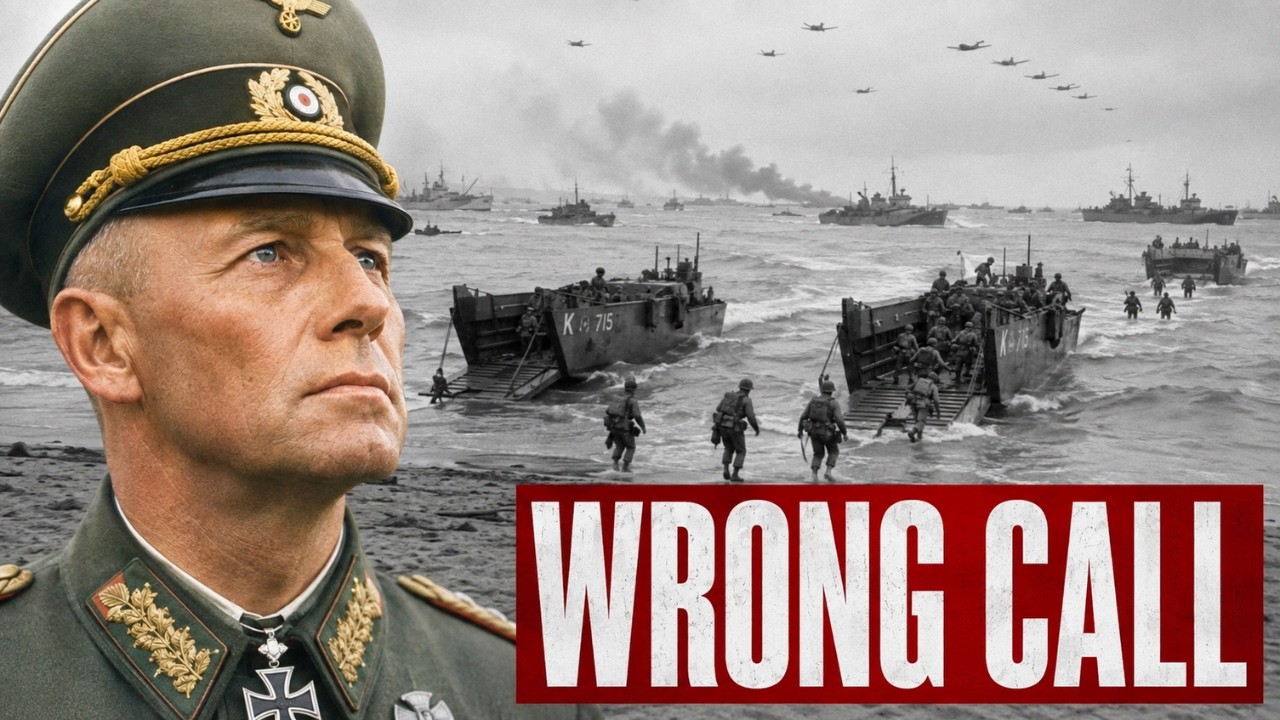
The Americans will collapse under a strong first blow. This was the picture that traveled west with Rommel when he took up his new command on the coast of France. It shaped every mine laid, every bunker poured in concrete, every panzer division positioned during the year of preparation before the great Allied invasion. In November 1943, Rommel walked the beaches of Normandy.
He was fifty-two years old, with less than a year to live. He inspected what others had built and shook his head. The Atlantic Wall of 1943 was a fraud, a propaganda film—a few strongpoints of concrete separated by miles, beaches without mines, cliffs without barbed wire, fortresses without interlocking fields of fire. He had been sent to defend a wall that did not exist.
So he began with the enormous energy that always possessed him at the start of any project. He ordered four million additional mines laid by spring 1944. He designed beach obstacles that would pierce landing craft at high tide, slanted stakes that became known as “Rommel’s asparagus. ” He ordered low-lying fields flooded to drown paratroopers.
And in every conversation with subordinates, every argument with superiors, he returned to one conviction he carried west from the hills of Tunisia: the invasion must be defeated on the beaches in the first twenty-four hours. He told them the American soldier was materially vast but morally fragile. If he could be struck hard and fast enough at his weakest moment, while wading through the surf, his morale would shatter. He did not use the word “Kasserine.
” He did not need to. Every officer in the room knew what he meant. The argument that consumed German command in France in early 1944 was not about whether to defeat the invasion on the beach. Everyone agreed on that.
The argument was about how. Rommel wanted the panzer divisions held forward, a few hours from the coast, ready to strike the moment the first landing craft touched sand. He had learned in the desert what Allied air power did to armored columns moving in daylight. His superior, Field Marshal Gerd von Rundstedt, and the commander of mobile forces, General Leo Geyr von Schweppenburg, wanted the panzers held in depth, in a vast reserve to be launched in a coordinated counterattack once the main Allied direction was known.
Rommel called this an illusion. Von Rundstedt called Rommel’s plan a waste of effort. They could not agree. They could not even speak seriously.
In the spring of 1944, the dispute was referred to Hitler. As always, he refused to choose. Rommel was given control of three panzer divisions near the coast. Von Rundstedt kept four in reserve, but those four could not be moved without Hitler’s personal authorization.
Hitler crippled both plans at once. Every armored division in France on the morning of June 6, 1944, would be in the wrong place. On June 6, 1944, the sky over Normandy was not empty. Eleven thousand aircraft filled it.
The Luftwaffe could not compete, could not drive them off, could not even see them coming until they were overhead. The Allies had achieved something the German army had never faced in three years of war: absolute air superiority. The moment a panzer division moved in daylight, it died. The Twelfth SS Panzer Division Hitlerjugend, sent forward late, took heavy losses on the roads before reaching the fight.
The Panzer Lehr Division, the elite formation drawn from German armored schools, was bombed and strafed every mile of its march to the front. Its commander was a familiar name, a man who had once stood beside Rommel in Tunisia and watched the Americans burn: Fritz Bayerlein. He had served under Rommel as chief of staff of the Afrika Korps in 1941 and 1942, commanded the Afrika Korps in the final weeks of the Tunisian campaign, and was now fighting what many considered the best panzer division in the Wehrmacht. He believed what he had learned.
He believed the Americans he had crushed at Kasserine were the same ones he would meet in Normandy. On July 25, 1944, near the town of Saint-Lô, the US Army taught him what it had learned. The operation was called Cobra. Nearly 1,500 American heavy bombers, followed by about 400 mediums, dropped almost 4,000 tons of high explosives onto a strip of the German front four miles wide and a mile deep.
The target was Panzer Lehr more than any other formation. Within three hours, it ceased to exist as a coherent military unit. The bombing did not just destroy tanks and men. It destroyed the ground around them.
Craters swallowed other craters. Roads vanished. Communications were crushed. When American infantry and armor advanced through the smoke, Panzer Lehr could not even organize a coordinated retreat.
Bayerlein reported to Field Marshal Hausser that his division had been completely annihilated. The former student of Rommel, the man who had once helped write the diagnosis of American weakness at Kasserine, was now erased from the war by American industrial firepower—by system, by machine, by the methodical, unromantic kind of warfare the German army had spent eighteen months training itself to regard as inferior to the true art of war. Rommel was not there to see it. On July 17, 1944, nine days before Cobra, his staff car was spotted on a country road near the village of Sainte-Foy-de-Montgomery by an Allied fighter.
The car swerved and overturned. Rommel was thrown out with a skull fracture and severe facial injuries. He was taken to a hospital, then to his home in Herrlingen, the small Swabian village where his family lived. Three days later, a colonel named Claus von Stauffenberg carried a briefcase into a conference room at Hitler’s headquarters.
The briefcase contained a bomb. The bomb exploded, the conspiracy was exposed, and the resulting vengeance killed nearly 5,000 people. Rommel’s name was mentioned by the conspirators under torture. Whether he knew the full details of the plot remains debated eighty years later.
What is not debated is what happened on the afternoon of October 14, 1944. Two generals from the Wehrmacht personnel office arrived at his home. They offered him a choice: take a small vial of hydrogen cyanide, and receive a state funeral with his family protected—or refuse and face the People’s Court, losing everything. He said goodbye to his wife Lucie and his son Manfred.
Then he put on his greatcoat and went with the generals in the back of a staff car, driven a few hundred meters into the woods outside the village. He took the poison. He was fifty-two years old. The Third Reich buried him with full military honors two weeks later, telling the public he had died of his wounds from the air attack in Normandy.
The truth was not officially revealed until after the war. The Desert Fox, the last German general his enemies genuinely respected, was killed on Hitler’s orders on a quiet October afternoon. Because at Kasserine he believed he had seen the true face of the American soldier. He carried that belief west to the coasts of France.
He built an entire strategy on it. He built a fortified wall on it. He gambled the outcome of the war on it. He was wrong.
So what exactly was Rommel’s greatest error? It was not a battlefield error. Tactically, he was brilliant—almost the best soldier of his generation. The mistake was intellectual.
It was in what he chose to believe about his enemy. Rommel and the men around him looked at a defeated American army and drew a conclusion that seemed brutally justified at the moment. The Americans were poorly trained. Their officers were poorly chosen.
Their coordination of combined arms was childish. All of this was true. All of this was documented. The error was in treating that fleeting moment as an eternal truth.
The error was in believing that an army which failed once, publicly and catastrophically, could not learn how to succeed. The assumption was not that the Americans were bad soldiers on February 20, 1943, but that they would still be bad soldiers on June 6, 1944. Rommel, who had every reason to know otherwise, who had watched armies transform in the crucible of war for thirty years, never questioned that assumption. He absorbed it.
He built on it. He carried it into France. He transmitted it to the men who would fight and die under his command in Normandy. He was not the author of the Kasserine diagnosis.
But he was its most credible promoter. When the Desert Fox himself agreed the Americans could be broken on the beach, no subordinate officer could object. That was the error. And here is the strangest part of the story, the part that gives it its terrible symmetry: the Americans did not make that mistake.
They looked at what happened to them at Kasserine and did not console themselves with talk of warrior spirit. They did not blame the weather or enemy genius or bad luck. They exposed their bones and looked at what was inside. They saw what was rotten, and they excised it.
They wrote new combat doctrine. They fired their generals. They rebuilt their training. They centralized their artillery.
They coordinated their air and ground forces. They took the humiliation of Sidi Bou Zid and Kasserine and systematically turned it into the machine that crushed the panzers at Saint-Lô. The Germans won the battle so completely that it confirmed everything they already believed. And being confirmed in their beliefs, they became intellectually lazy.
The Americans lost the battle so completely that they were forced to question everything they thought they knew. And in questioning what they thought they knew, they became something new. There is an old, harsh truth buried in this story. Sometimes the most dangerous thing that can happen to an army, a nation, or an individual is to win an argument too clearly, to have your prejudices confirmed, to finish a battle so completely that you never bother to ask what the other side might have learned.
That was the error Erwin Rommel made in the winter of 1943. He was too skilled a soldier to fail to see American weaknesses. He was ultimately not wise enough to imagine that those weaknesses could be repaired. So from the wreckage of Kasserine, two entirely different roads led forward.
One led to Herrlingen in the autumn of 1944, via a capsule of cyanide in the back of an official car. The other led to Saint-Lô in the summer of 1944, where a panzer division was erased from the face of the earth by an army the Germans had once dismissed as amateurs. Rommel’s greatest error was not that he lost at Kasserine. He won at Kasserine.
His greatest error was that he did not win enough to fear the enemy who was learning on the other side of the wreckage.