In the autumn of 1891, a logger named Otis Fenimore discovered that his animals had stopped behaving like animals. Every morning at first light, his goats, his mules, his rooster, all of them stood perfectly still, facing north toward the deepest, darkest stretch of the Appalachian ridge where he lived. They did not move for roughly five minutes. Then they resumed their normal routines as though nothing had happened.
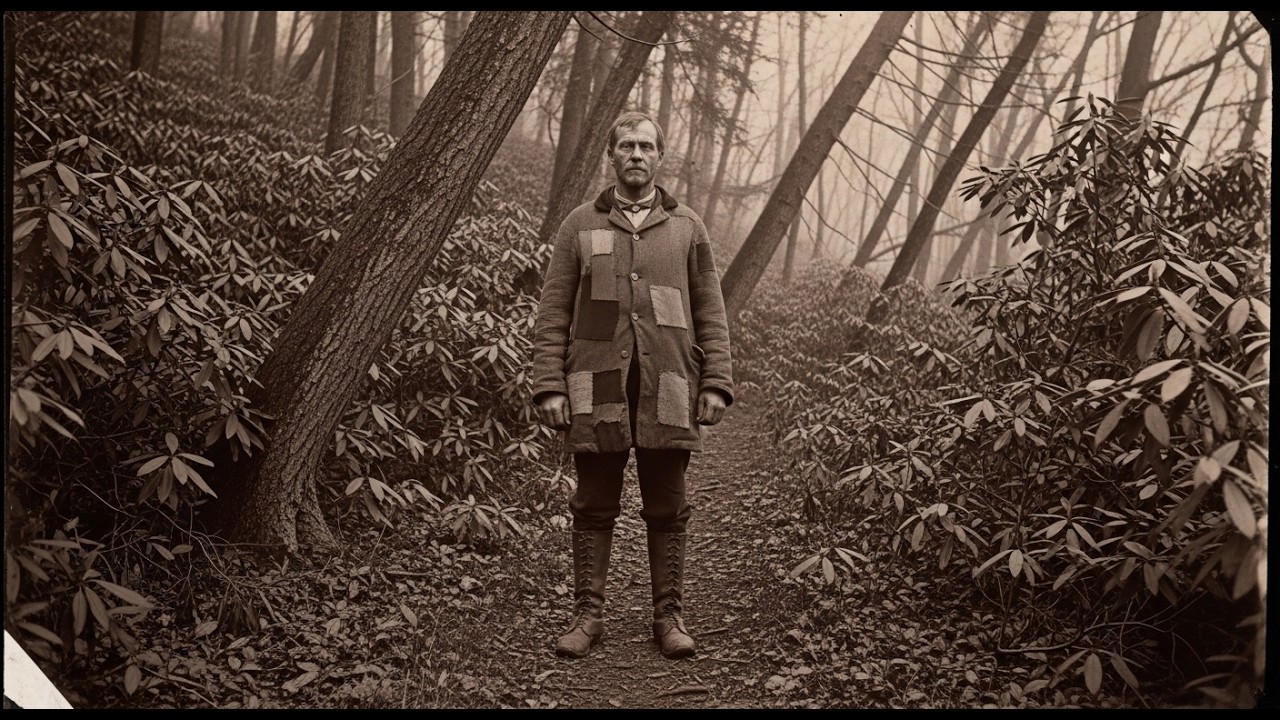
This repeated each day for a week, and Otis became convinced that whatever was holding them in that frozen state was lingering somewhere in the woods north of his homestead. So he took his axe and went to find it. The region was a remote fold of the Appalachians so isolated that even the postal service had abandoned it years before. The nearest town, Grinders Hollow, sat in a narrow valley where the sun touched the main road for only four hours a day.
The mountain people who lived there had long held an unspoken belief that there were places on those ridges where a person should not go. Otis was not a superstitious man. He trusted what he could see and touch and cut. He had spent twenty-three years logging those slopes, living alone since the death of his wife, Dorina, some six years earlier.
When Otis reached the source of the disturbance, he found a clearing that should not have existed. He knew the terrain well enough to know that no open ground belonged in the North Woods. Yet there it was, a near-perfect circle of clean, bare earth surrounded by towering hemlocks that leaned inward, as if bent permanently toward the center. In the middle stood a dark stone, roughly the size of a man’s torso, smooth and faintly gleaming.
Otis did not step into the clearing. Every instinct warned him that what he was looking at deserved a greater distance than the width of the circle itself. He turned and walked home without telling anyone. Five days later, his nearest neighbor, a retired railroad surveyor named Prentiss Cahill, arrived at his door looking as though he had not slept in a week.
Prentiss had found the same clearing while tracking a wounded deer. The blood trail had stopped at the edge of the bare earth, as if the animal had simply ceased to exist there. He described the stone, the silence, the pressure in his ears, and something else. From inside that circle, he had felt a pull, almost a voice pressed into his skull, drawing him toward the stone.
It was not a sound, but a steady, overwhelming pressure to step forward, to cross the boundary into the clearing. He had wanted to obey. He had wanted it more than anything he could remember wanting in his life. They returned together at dawn.
The walk felt wrong. Landmarks Otis had known for decades seemed to have shifted, and a creek that had always run west ran east. Prentiss’s surveying compass drifted and spun, refusing to settle on any reliable reading. When they reached the clearing, the stone had moved from where Otis remembered it, leaving a smooth groove in the packed earth as though it had been dragged across the ground by something patient and deliberate.
Carved into the surrounding hemlocks, at head height and facing inward, were patterns neither man could identify. Prentiss recognized the work as systematic, deliberate, the markings of someone who had spent a long time studying this place. The name that surfaced was Harston Mullanax. He had been a recluse who arrived in the mountains around 1870 and lived alone on the North Ridge.
When he was found dead in the spring after a harsh winter, his cabin had been covered in tiny, unreadable writing, thousands of pages scattered across the floor. Witnesses later said he was found curled on his side, his hands pressed flat against the floorboards. The pages were burned without anyone reading them, and the cabin was left to the forest. Otis and Prentiss found what remained of that cabin.
Inside, the walls were carved with the same lines they had seen on the trees, but far more complex, spiraling and branching until they converged on a single shape above the hearth. Prentiss studied the patterns for a long time and then delivered his conclusion. Mullanax had been mapping something underground. An enormous cavity, miles across, located beneath the clearing.
The clearing sat above a void in the earth, and the stone marked the highest point of whatever lay below. Prentiss reconstructed his own map from the carvings and his compass readings. What he produced looked like a hand, but not a human hand. The proportions were wrong, the fingers too long, the palm too broad, and there were seven of them, radiating outward from a central mass directly beneath the clearing.
The stone was positioned above the highest point, a fingertip pressing upward against the underside of the earth. Warmth was coming up through cracks in the ground. The thing beneath the mountain, Prentiss said, was pushing through. That night, Otis heard a knocking at his door.
Thirteen slow, deliberate knocks. When the silence returned, it was heavier than before. In the nights that followed, the pattern repeated, thirteen knocks, each time closer, each time followed by a longer and more oppressive silence. Then came a presence that Otis could not name.
He sat at his table, gripping the edge until his knuckles went white, while something that was neither sound nor voice filled his mind with a feeling of invitation: come down, come home. Prentiss came to him at dawn, packing to leave. He had heard footsteps on his porch in the night, slow and heavy, circling the cabin. Looking through the window, he had seen nothing.
But he was certain something out there could see him through the wall and knew what he was doing. He begged Otis to come with him. Otis refused. He needed to understand in his own way.
The next day, Otis gathered salt, kerosene, and rags and went to burn the clearing. The forest let him pass without resistance. The trail was clear, the landmarks were in their proper places, and the creek ran in its proper direction. The easy passage felt like permission, like the woods were eager for him to arrive.
When he reached the clearing, the cracks in the earth had widened and warmth rose from them, carrying a smell like something ancient and mineral and alive. The moment he stepped inside the circle, everything changed. He collapsed with his hands pressed flat against the warm ground. Beneath him, through the soil and the rock, he felt the thing that had been waiting there longer than the mountain existed.
It was not asleep and it was not dead. It was aware of him in a way that was vast and impersonal and overwhelming, and it welcomed him. It would be easy, he understood, to lie down. To let the earth open and be taken into that darkness, to dissolve into something infinite and lose the weight of being a man.
In that moment, Otis did something he had never done. He prayed, not to a god, but to Dorina, the memory of her face, the sound of her voice, the small details of her presence. He held onto those memories until they outweighed the invitation. Slowly he stood and walked out of the clearing without looking back.
Prentiss had warned him of what would happen to anyone who stayed too close. Otis left the ridge that same day, packed light, locked his cabin behind him, and said goodbye at his wife’s grave in silence. He caught up with Prentiss at the boarding house in the Hollow. Over a night of burning lamps and bolted doors, he described what he had felt in the circle.
Prentiss believed him. He concluded that Harston Mullanax had spent years mapping the thing below the ridge, recording its slow wearing away of his mind, and that when they found him with his hands pressed to the floorboards, he was not fighting. He was answering. He was saying yes.
They left the Hollow the next morning. Prentiss went east to the lowlands, Otis went south. He spent the rest of his life moving, never staying in one place long enough to call it home, keeping the clearing and the stone and the thing beneath the ridge entirely to himself. Twenty years later, in October 1911, a geological survey team camped at the base of the eastern ridge.
A young surveyor named Sedgewick Parrott used his day off to explore the North Woods. His journal recorded his discovery of a remarkable clearing, perfectly circular, bare of vegetation, with a dark, warm stone in the center and cracking ground radiating from its base. He noted the significance of the place, a geological formation he intended to study, and a quality he found difficult to articulate in scientific terms, a sense of significance, of being expected. The entry was dated October 14, 1911, exactly twenty years after Otis Fenimore first found the clearing.
Sedgewick Parrott returned the next morning and was never seen again. After eight days of searching, his colleagues found his pack at the edge of a clearing that appeared on none of their maps. They found his compass, its needle spinning, his jacket folded neatly, his boots standing side by side at the edge of the circle. They did not find Sedgewick.
One member of the search party later included a personal note in the official report. He wrote that when the men entered the clearing, they all felt a warmth from below and a sense of welcome. One of them, a man whose name was later redacted, had to be physically restrained from lying face down on the ground to press his ear to the cracks, because he said, with calm certainty, that he could hear something down there. Something breathing.
Something patient. Something that sounded like it was smiling. Otis Fenimore died in 1929 in a small Virginia town, as far from the mountains as he could get without reaching the sea. The woman who ran his boarding house remembered him as quiet and polite, a man who spent his evenings staring out the window to the north.
Near the end, she asked him once what he was looking at. He answered that he was making sure it was still far away. Prentiss Cahill died in 1931. In his final days, he spoke often of mountains and maps and patterns in the earth, and once, in the middle of the night, he sat up in his hospital bed and said clearly that he could still feel it, that it had never stopped reaching.
The ridges remain. Every year, hikers disappear into deep Appalachian woods without trace. Some silences are not empty.
Some silences are full.