In the autumn of 2023, a retired teacher in Taos, New Mexico, paid one dollar for a used book at a library sale. Her name was Iris Sandoval, she was 74 years old, and she had been waiting more than half a century for the name on the cover. The author was Francis Aldermore, an 85-year-old regional painter whose memoir, published in 2019 by a small press in Albuquerque, had sold modestly and been reviewed twice. Chapter fourteen was eleven pages long.
Its title was simple: “A Night in the Desert. ”
What Iris Sandoval read in that chapter, over two evenings at her kitchen table, was the confession of a murderer concealed inside literary description. She read it once. She read it again.
Then she drove to Santa Fe and laid the book and an old case file on the desk of a state police sergeant. The file had been in her closet for years. The chapter, she told the officer, described a night outside Taos in the summer of 1967 with enough geographical precision that anyone familiar with the terrain would recognize the location immediately. She was right.
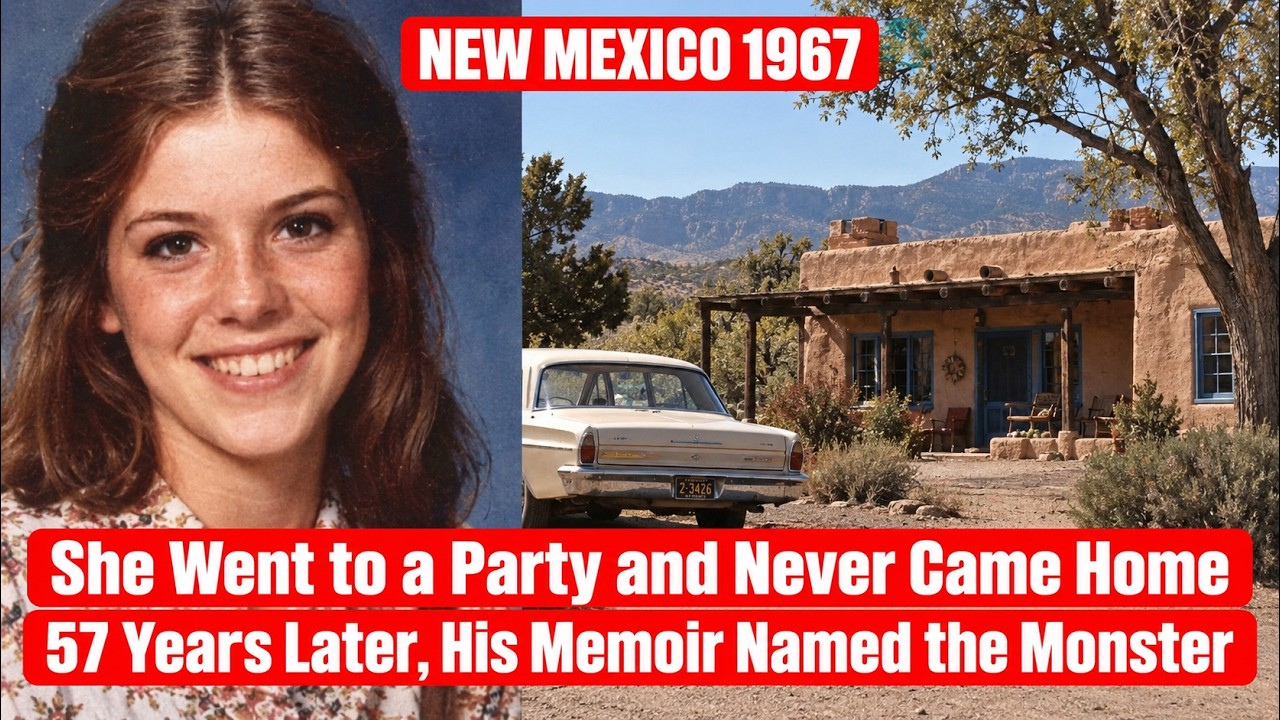
The girl at the center of the story was her older sister, Elena Sandoval. In July 1967, Elena was seventeen years old, a senior at the high school in Taos, working a summer job at a tourist shop on the plaza to save money for a nursing program she planned to start in September at the University of New Mexico. She was fluent in Spanish and English, was teaching herself French from a library book, and had a habit of asking questions that went further than others thought necessary. She was the oldest of four children.
Their father, Vincente, ran a small shipping business. Their mother, Rosa, taught at the elementary school. The family had lived in the valley for three generations. On the evening of July 14, 1967, Elena worked the evening shift at the tourist shop.
The plaza stayed busy through summer nights, and she had agreed to meet a friend afterward for a drive to watch the moon rise over the mountains. She closed the shop at 9:30. A shopkeeper across the street saw her walking north from the plaza. Another local resident noticed her a few minutes later because her dress was bright, coral-colored, a dress she had sewn herself that summer.
Then nothing. At 11:45 that night, the friend she was supposed to meet called the Sandoval home to ask whether Elena had changed her plans. Rosa Sandoval said she had assumed Elena was already with her. There was silence on the line.
Before midnight, Vincente drove the route between the house and the plaza. He stopped at every intersection, got out, and searched. The shop was locked properly, the lights off. Back at the plaza, he asked two men sitting outside a restaurant whether they had seen a young woman in a coral dress.
One had seen her, heading north, about an hour and a half earlier. At 12:30 a. m. , Vincente called the Taos police.
An officer arrived before 1:00 and drove the northern road himself. At the edge of the residential streets, where the road turns west toward remote property, he found one object: a canvas bag Elena carried to work, lying at the roadside. Inside were her house key, a paperback novel, and the day’s earnings from the shop in a coin purse she took home to give to her mother, as she always did. The bag had been placed, not thrown or dropped in a struggle, but placed carefully.
It was the kind of detail that meant nothing, then suddenly meant everything. The investigation expanded by morning. Volunteers combed the northern roads, arroyos, and empty land at the town’s edge. The New Mexico State Police were notified.
The case was assigned to Deputy Martin Salazar of the Taos County Sheriff’s Department, a 34-year-old native of the valley who knew its geography the way only a local investigator could. Salazar worked three lines at once: plaza contacts, remote properties to the north, and a survey of newcomers who had arrived in the area during that spring and summer. Taos had been an artist colony for decades, but 1967 had brought a younger, stranger wave of people seeking something they could not always name. Francis Aldermore surfaced in this survey.
Aldermore had come to Taos in June 1967. He was 29 years old, from Boston, trained in fine arts, and had rented a studio on the north side of town. People who met him described him similarly: educated, opinionated, quick to share his views. He had visited the shop where Elena worked once, to look at tourist pottery, and had spoken at length about why the commodification of indigenous art was a cultural problem while Elena rang up his purchases and said nothing.
He was also seen on the plaza on the evening of July 14, between 8:30 and 10:00. He was driving a dark station wagon registered to a rental company in Albuquerque. He spoke to Taos police twice in the following week, both times cooperative and polite. He said he had not seen Elena after leaving the plaza around 9:30.
A note was entered in the case file: interviewed, no further action. Salazar did take a third interview, longer than the first two. Aldermore, according to Salazar’s case notes, was cooperative in a way the deputy described as “contrived,” a word he used without elaboration, the way investigators do when they have a hunch they cannot yet prove. The rental company confirmed that the station wagon was returned on July 16, two days after Elena disappeared.
The car had been cleaned at a wash facility south of town before return, which the rental agent noted as unusual. Most renters do not clean the car. The car was back in service by the time the note reached Salazar. Aldermore left Taos in late July.
A follow-up letter was forwarded to a Boston address that turned out to be a friend’s apartment. By September 1967, he no longer had a fixed address the county could track. Elena’s body was never found. Without physical evidence, without a body, without a solid suspect, the case settled into the official category the law provides for people who leave but cannot be mourned formally.
Vincente died in 1982. Rosa lived until 2004 and never stopped leaving a light burning at night. She called it a habit. The family knew what it was.
Iris Sandoval was twelve years old in 1967. She grew up carrying the shape of her sister’s absence the way children do. When she retired from teaching in 2015, she requested a copy of the case file through a state records request. She read it over a full summer.
She found Deputy Salazar’s note about Aldermore. She found the word “contrived. ” She wrote it in her own notebook and looked at it for a long time. By 1975, Aldermore had moved from Boston to New York, then, in the late 1970s, to property outside Santa Fe, where he built a studio and established himself gradually as a painter of regional landscapes, high desert light, the long shadows of afternoon in the Rio Grande valley.
He exhibited at Santa Fe galleries. He sold modestly. He married a ceramicist in 1980. They had no children.
He was a minor but distinct figure in the regional art community, a man with opinions about art and landscape and the nature of light. In 2019, he published his memoir. The chapter on Taos described a summer of 1967. Chapter fourteen described a night in the high desert north of town, written as an aesthetic event: the quality of the darkness, the air temperature, the sound of the desert at night, an encounter with a young woman, and what happened as a result, in language that was literary and precise.
He wrote it as an experience that had happened to him, because it had. He treated the passage of 52 years and the choice of a literary frame as if it had turned the event into something that could be published, shelved, reviewed, and forgotten. He was right for four years. Then Iris Sandoval paid a dollar for the book.
The state police cold case unit received Iris’s call on a Monday morning in October 2023. The detective who took the call, Sergeant Valera, asked Iris to bring the book and her case file to the office. Iris drove from Taos to Santa Fe that evening. She put both on the desk and waited while Valera read.
Valera looked up partway through chapter fourteen and said only, “Stay here. ” She brought her supervisor. Ground-penetrating radar teams were sent to the area north of Taos described in the memoir within ten days. Within two days, the surveys identified a significant anomaly at a location consistent with the description.
Forensic excavation began in November 2023 and continued into early December. The remains were identified through DNA matching with a reference sample from Iris Sandoval and with biological evidence preserved from the original 1967 case file. Elena Sandoval had been there for 56 years. Francis Aldermore, now 85, was still living at his studio property outside Santa Fe.
On the morning of November 4, 2023, two state police investigators knocked on his door. He opened it himself and was, by their account, polite. He offered them tea. He sat at a covered table and looked at the investigators with the expression of a man who had maintained a certain idea of himself for a very long time and was now watching that idea meet the truth.
He did not ask why they were there. The memoir was of exceptional evidentiary value, not because it was a legal confession. It was not written in the language of confession, and Aldermore’s lawyers were quick to argue that the narrative’s literary nature created ambiguity. But the precision of the location description, combined with the physical evidence found there, and the original case notes from Deputy Salazar’s 1967 investigation, the rented car, the cleaning, the sighting on the plaza, the word “contrived,” built a case that the district attorney’s office in Santa Fe found sufficient to charge.
Aldermore was arrested in January 2024. He was charged with first-degree murder. He was released on bail given his age and health. In September 2024, he accepted a plea deal to second-degree murder.
He was sentenced to time served plus a term of supervised release, on the condition that he fully cooperate with investigators in providing an official account of the events of July 14, 1967. He was 86 years old. The Santa Fe art community expressed shock at the arrest. People who had attended his exhibitions and bought his paintings said they had not known.
Several, pressed by reporters, said they had found him difficult, opinionated, prone to long speeches, with something in his manner suggesting he had decided he belonged to a different category of human being than others. They had attributed it to artistic vanity. It was something else. Elena Sandoval’s remains were returned to the family in the spring of 2024.
She was buried in the valley cemetery where her parents already lay. The coral dress she sewed herself was never found. It was described in chapter fourteen in the same affected literary manner he used for everything else. Iris read that passage twice.
Both times her hands lay flat on the table, pressing down. She was 74 years old. She was twelve when her sister walked north from the Taos plaza and did not come back. She had lived with that absence for 62 years, first as a child who did not fully understand, then as an adolescent who understood too well, then as an adult who built her life around its margins.
She was the one who kept the case file. She was the one who wrote Martin Salazar’s words in a notebook. She was the one who paid one dollar for a book at a library sale.
Justice for Elena Sandoval came after 57 years.