On the afternoon of January 23, 1973, a doctor entered a room at the Red Cross hospital in Athens and told the richest man in the world that the machines could now be switched off. There was nothing left inside the bandages to save. Aristotle Onassis was sixty-six years old. He owned more ships than the Greek navy.
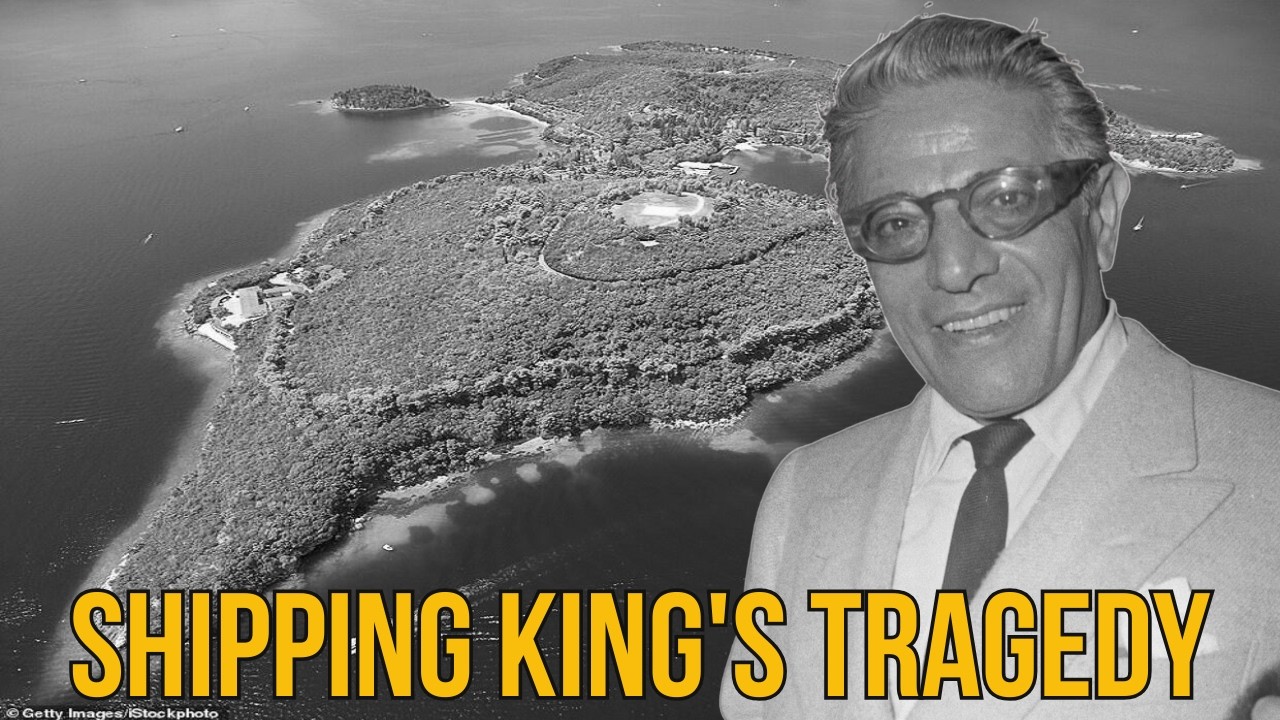
He had married the widow of a president on a private island that bore his name. He had kissed Maria Callas on the deck of a yacht longer than an apartment building before half of Europe’s photographers, and the image had sold across the continent in a single morning. He had two children, a son and a daughter. One died in a small white plane on a Tuesday afternoon in Athens, at the age of twenty-four, with his father holding his hand.
The other was found fifteen years later, face down in a marble bathtub in a country house outside Buenos Aires, the water still warm. The story of Aristotle Onassis usually begins with money, but it begins earlier and more quietly, with a fire. When he was sixteen, in September 1922, the Turkish army entered Smyrna, the city on the coast of Asia where he had been born the son of a small tobacco merchant. By September 13, the Greek and Armenian quarters were burning.
His uncle was hanged. His father was arrested and sent to a labor camp. His grandmother died in the fire. The quiet street and the neighborhood that had stood for two thousand years simply disappeared.
On the docks, 150,000 Greek residents watched warships from three foreign fleets refuse to come ashore. Onassis, with the last of the family’s hidden gold, bribed a Turkish officer and got his father out of the camp. He reached Piraeus in the fall of 1922 with only the clothes he wore. Two years later, with sixty borrowed dollars in his pocket, he sailed for Buenos Aires.
That day on the docks of Smyrna fixed the decision that governed the rest of his life. He would never be the ordinary man waiting for a foreign fleet to save him. He would own the fleet. He would own the ships.
If it took sixty years, he would own the sea itself. He began in a telephone exchange in Argentina, working the night shift and listening to international calls. By twenty-five he owned six cargo ships. By thirty, a fleet larger than most nations.
By 1946 he was forty and still unmarried. He set his sights on Tina Livanos, the seventeen-year-old daughter of Stavros Livanos, head of one of the oldest Greek shipping families. Her father refused, saying the elder daughter must marry first. Onassis said he had no objection, so long as he got Tina later.
The elder daughter was married off quickly to a rival shipowner, and Onassis married Tina in New York on December 28, 1946. He was forty. She was seventeen. A son was born thirteen months later, on April 30, 1948, and named Alexander after Alexander the Great.
Two years later, on December 11, 1950, a daughter was born. A nurse handed the baby to her father in the corridor, and he looked at her small face for nearly a full minute without speaking. Then he said her name, the only one he had chosen months earlier: Christina. He handed her back and returned to his office.
That year he was closing the deal that would make him the largest independent shipowner in the world within five years. By 1955 he had a hundred ships, an airline, Olympic Airways, and an island, Skorpios. He owned a yacht named Christina, four hundred feet long, with a pool that became a dance floor and a crew of sixty. In the summer of 1959, he hosted a cruise that covered newspapers on three continents as if it were a state funeral.
Winston Churchill, aged eighty-four, was aboard. Maria Callas was aboard with her husband. Tina Onassis was aboard with hers. By the end of that cruise, neither marriage was intact.
Tina filed the first divorce in the modern history of the Greek shipping families. Alexander was eleven. Christina was nine. There is a photograph from the summer of 1960 that the family kept away from all approved biographies for fifty years, taken on the deck of the yacht off Skorpios.
Tina is not in it. Onassis sits in the center, a cigarette in his left hand. Maria Callas sits at his right, leaning toward him. Alexander, twelve years old, stands three feet behind the chair, arms crossed, looking at the deck.
Christina, nine years old, sits on the deck, back against the railing, knees drawn to her chest, her face turned away from her father, away from the woman who had been introduced to her by name. She is the only person on deck who, according to her own account, refused to be in the same photograph with the woman who was replacing her mother. She would refuse for the rest of her life, in one form or another. She would lose every round.
She would never stop refusing. Throughout most of the 1960s, Alexander lived between two countries that no longer spoke. His mother remarried an English aristocrat. He spent the school year at a boarding school in Surrey, acquired an English accent and a taste for tweed jackets, and spent the summers in Greece, collected at the airport by a driver and delivered to Skorpios, where his father kissed him on the forehead, a steward offered water, and he was sent to his room to dress for dinner.
Maria Callas sat at the other end of the table. He did not call her by her first name, ever, in any of those summers, but “madame” when he addressed her at all. By the fall of 1971, two things happened. Onassis announced his marriage to Jacqueline Kennedy, widow of the assassinated president, a marriage he had already conducted privately on Skorpios on October 20, 1968.
Alexander detested it. And he met a woman named Fiona Thyssen-Bornemisza, a former model and a Swiss baroness’s ex-wife, sixteen years older than him, with two children. He fell deeply in love. His father, who had married twice and carried on the most famous affair on the continent for a decade, refused in three separate dinner conversations to allow his son to marry her.
By late 1972, Alexander had decided to defy him and marry in the spring. The last six weeks of Alexander Onassis’s life were the busiest of his life. He ran the day-to-day operations of Olympic Airways on his father’s behalf. He slept four or five hours a night.
In early January 1973 he was anxious about a particular plane, a Piaggio amphibian registered SX-BDC, an ageing aircraft used for short island hops. Two minor mechanical incidents involving the aileron controls had occurred in previous months, and no one in the maintenance hangar could fully explain them. Alexander submitted an internal memo in December recommending the plane be grounded for a full inspection. The recommendation was not acted upon.
On the evening of Tuesday, January 16, 1973, Alexander called his mother in Paris and spoke for nearly an hour. He told her three things. He was marrying Fiona in May, whether his father approved or not. He was tired in a way he could not quite describe from being the son of his father.
And in the final minutes of the call, he told her that for nearly two weeks he had been dreaming the same dream. He was in a small plane that would not climb. The ground was approaching too fast, and he could see the trees clearly at the end of the runway, and he could not do the one thing that all the operating manuals required. He could not raise the nose of the aircraft in time.
He laughed at the end of the call and said in Greek: “Mother, don’t worry. I’ve flown a thousand times. A dream is just a dream. ”
Six days later, on the afternoon of January 22, 1973, Alexander Onassis was piloting the Piaggio amphibian on a routine training flight at Athens airport, with an American instructor in the adjacent seat and an Olympic Airways captain observing.
The aileron controls had been reversed during a recent maintenance check. Pushing left rolled the aircraft right; pushing right rolled it left. He had about four seconds at fifty feet to register the reversal and correct. He could not.
The aircraft veered right, its right wing struck the ground, and it crashed at the edge of the runway. The instructor was thrown clear and survived with serious injuries. Alexander was pulled from the cockpit with severe brain trauma and rushed to the Red Cross clinic in central Athens. The surgeons operated through the night, but they could not save his brain.
His father arrived from New York at six that morning, went straight to the hospital, and stood beside his son’s bed for nearly six hours. At 3:35 in the afternoon, he gave the order to disconnect the life support. He was holding his son’s hand when the machines were switched off. Aristotle Onassis never recovered from that afternoon.
The man who had survived the fire of Smyrna at sixteen, who had built a global shipping empire from sixty borrowed dollars, who had married the widow of an American president on a yacht in the Ionian Sea, could not survive the death of his son. He believed from the first hours that the crash was not an accident. He commissioned three private investigations and brought in American aviation experts at his own expense to examine every remaining piece of the wreckage. By the end of February, he believed the reversed ailerons were not a maintenance error but sabotage by an enemy he could not name.
The Greek inquiry ultimately concluded that the cause was a maintenance error during a recent inspection. The American investigators could produce no other evidence. Onassis was not convinced. He spent the next eighteen months, by estimate, half a million dollars on private investigators chasing false leads, and in the fall of 1973 offered a million-dollar reward for information identifying the saboteur.
No one claimed it. What he was doing, in the only way he knew, was refusing to accept that his son had died of an ordinary mistake made by an ordinary mechanic on an ordinary January afternoon. Christina Onassis was twenty-two when her brother died. She had been, from the beginning, the wrong child.
Born in 1950 into a family that had wanted, above all, a son, she grew up in Skorpios and the apartments of Paris and the houses of New York as a small, dark, intelligent girl who could see with painful clarity that the family’s wealth was being spent on the boy at the end of the hall. She was the dark-haired one her father did not love. She was the heavier one her father did not understand. At ten she began a long, desperate war with her weight, gaining and losing it in slow cycles that no one in her family knew how to speak about openly.
She adored Alexander. He was the only person in the family who looked at her without comparing her to anyone. On the dock at Skorpios in the summer of 1972, he told her quietly that whatever happened, she was not lesser, as their parents believed, and that she would be the one to run the company after things settled down. Five months later he was dead.
She did not recover from it, in any way, ever. In the eighteen months between her brother’s funeral and her father’s death, Christina began a series of decisions about men, marriage, her body, and her capacity to be loved that did not stop until she was found in that marble bathtub in Argentina. She married four times. The first, at twenty-one, a California real estate broker twenty-seven years older, lasted nine months and ended when her father used every commercial lever available to him to break it.
The second, at twenty-five, four months after her father’s death, was a Greek shipowner of her father’s generation; it lasted thirteen months. The third, in 1978, was a Soviet citizen who worked in the Ministry of Merchant Marine; it lasted seventeen months. The fourth, in 1984, was a French pharmaceuticals executive named Thierry Roussel, tall, blond, handsome, and, by all accounts, unfaithful to her even during the engagement. She married him anyway, knowing it.
By 1985 she had been married four times. She was thirty-four. Aristotle Onassis died on March 15, 1975, at the American Hospital in Paris, of bronchial pneumonia compounded by myasthenia gravis, twenty-six months after his son’s death. He had been ill through most of 1974.
By the fall, he could not keep his eyelids open without small strips of surgical tape. By January 1975 he could not walk unaided. He was flown from Athens to Paris in late January because he refused to die in Greece. He was convinced, in his last year, that Greece itself had killed his son, that the maintenance error at Athens airport was not an administrative failure but a national one, and that the country he had loved had taken from him the one thing his money could not replace.
He could not die there. He died in Paris early in the morning. His wife, Jacqueline, was not in the room; she had flown back to New York on the assumption that there were several more days. His daughter Christina was in the room.
She had not left the hospital for nearly ten days. She held his hand the moment he stopped breathing. She did not cry. According to the nurse on duty, she sat in the chair by the bed for about two hours afterward, silent.
When she finally stood, she said one sentence in Greek to no one in the room. The nurse asked a member of the staff to translate it. It was: “Now there is no one left who knows my name. ”
The following morning, Christina went to the offices of the family’s law firm.
She began work at twenty-four, with no business training and no relative in the company older than herself. She ran the Onassis shipping operations for fourteen years, efficiently, by all accounts of those who worked with her, and without happiness, because she had no other choice. On January 29, 1985, in a hospital in Lausanne, Switzerland, Christina Onassis gave birth to a daughter. The birth was difficult.
Three doctors had advised her, given her medical history, not to attempt pregnancy at all. She insisted. When the child was born, healthy, Christina looked at her small face and said in French: “I will keep this one alive. ” She named her Athena, after her grandmother.
Her marriage to Thierry Roussel had collapsed during the pregnancy. In her seventh month she had discovered he had been having an affair with a Swedish woman for three years, a woman who already had a child by him. Christina did not divorce him cleanly. She kept him at the margins of her life, paid him a monthly allowance, let him visit Athena, allowed him to stay in her houses during some of the most painful months, and told a close friend in 1987 that she could not cut him off entirely because if she did, Athena would grow up as she herself had grown up, with a father who visited twice a year.
She said she would do almost anything to prevent that. She did, in fact, do almost everything. By 1988 she was taking, according to one of her doctors, thirty to forty diet pills a day, sleeping pills at night, and small doses of antidepressants in the morning. She had been treated for five years in three Swiss clinics for what was then politely called exhaustion and weight gain, a euphemism for the slow chemical war she had been waging against her own body since the age of ten.
In the fall of 1988, Christina traveled to Argentina. She had close friends there, a family named Roussel, no relation to her former husband, who owned a country house outside Buenos Aires called Tortugas. She brought her three-year-old daughter, Athena, and a small staff. She packed, in the bottom of one of her suitcases, the small bottles of medication her Swiss doctors had asked her to leave at home.
She did not leave them at home. She arrived in the third week of November. The first days were quiet. She swam, read, watched Athena play in the garden, talked long-distance to her office in Monte Carlo.
On the evening of November 18, she called her cousin Marina in Athens and spoke for about forty minutes. At the end of the call, she said in Greek: “Marina, I’m so tired. I think I finally want to stop. Stop what?
” her cousin asked. Christina laughed and said it was nothing. She said she had been in the pool all afternoon and her arms ached. She said goodnight.
Her cousin hung up. She did not understand what her cousin meant until the funeral. On the morning of November 19, 1988, a maid carried a breakfast tray to Christina Roussel’s bedroom door at Tortugas. At about ten, the door was not locked.
The maid knocked. No answer. She knocked again. No answer.
She opened the door very cautiously, the way servants of important houses have opened bedroom doors for centuries, and looked inside. The bed was empty, the covers thrown to the floor. The bathroom door was closed. She set the tray down on a small table near the door, crossed the room, knocked on the bathroom door, and got no answer.
She knocked again and turned the handle. Christina Onassis was in the marble bathtub, face down in the warm water. The water was still warm, with a light foam and bath oil on the surface, the kind she had always traveled with. The maid screamed, the household came running, the doctor arrived within twenty minutes and pronounced her dead.
The official cause of death, confirmed by autopsy, was pulmonary edema. The lungs had filled with fluid, the result of an acute episode that the forensic doctors, in a precise report in Spanish, linked to her long history of medication and her chronic heart condition. The verdict was death by natural causes. The family accepted it.
The press accepted it. Almost no one who knew her in her final year believed the verdict was the whole story, and almost no one dared to say so publicly for the next thirty-seven years. There is one testimony that no major biography has included. It is the testimony of the maid who carried the breakfast tray on the morning of November 19, 1988, a young woman from the village near the estate, who spoke only Spanish and a little English, who had been working at the house for two days when Christina arrived.
On the night of November 18, Christina asked her to bring a small pot of tea to her bedroom. The maid brought it at about nine in the evening. Christina was sitting at a writing desk by the window, wearing a robe, a small framed photograph on the desk in front of her. The maid set down the tea and turned to leave.
Christina said, in a quiet voice in English, a sentence the maid did not understand then and would only understand later, at the funeral, when the family priest read the prayers for the dead in Greek and then in Spanish. The sentence Christina said to the maid was: “Tell my daughter when she grows up that I tried. ” The maid did not know what to say, nodded, and left the room. She told no one what Christina had said to her until the day of the funeral.
By then, of course, it no longer seemed to matter. Athena Roussel was three years and ten months old when her mother died. She did not see the body, kept in the garden by her nanny through the morning of the doctor, the priest, and the Argentine paperwork. She was told, by her grandmother, that her mother had been very tired and gone to sleep and would not wake up.
She would come to understand the sentence gradually over the next few years, the way children of dead parents do, by noticing the small absences season after season: the voice on the phone before bed, the hand brushing her hair before school, someone in the next room on a Sunday afternoon. She grew up in Switzerland, raised by her father and his Swedish mistress, the same woman who had been having the affair with him during her mother’s seventh month of pregnancy. She called the woman “Mama” at every public occasion. She grew up in an elegant Swiss country house, surrounded by horses, educated in private schools, with quiet bodyguards, which was always necessary for a family with the Onassis fortune.
Her mother tongue was French, her second Swedish, her third Greek, learned from private tutors during summer visits to the small island her grandfather had bought sixty years earlier. She inherited the bulk of the Onassis fortune at eighteen, estimated by the press at between half a billion and a billion dollars. She gave no public statement on her eighteenth birthday. She married a Brazilian show-jumping rider in December 2005, when she was twenty, a marriage that lasted twelve years and produced no children.
She continued to compete at the highest levels of her sport, including representing Greece at the Olympics in 2008, 2012, and 2016. In forty years of life, she has given almost no interviews about her mother, and none at all about her grandfather. There is one more part of the story that rarely appears in any biography. It is told by a night nurse at the American Hospital in Paris, who worked the night shift on the floor where Aristotle Onassis was dying in March 1975, and who told the story once, in her old age, to a French journalist writing a long piece about the family, which was eventually dropped by editors who found the material too painful to publish.
It is the story of what Aristotle Onassis did alone on his last night, and the small photograph on the pillow beside his head. He had been losing and regaining consciousness intermittently for nearly a week. The myasthenia gravis had reached the stage where his diaphragm could no longer fully support breathing without mechanical assistance, and he had been receiving supplemental oxygen for nine days. On the evening of March 14, 1975, the night before he died, Christina finally agreed, after gentle urging from the staff, to return to her hotel room and sleep for a few hours.
She left the room at around eleven. The night nurse entered the room at about two in the morning to check the oxygen. Onassis, who had been unconscious through most of the evening, was awake. He was lying on his back, eyes open, holding in his right hand a small framed photograph, perhaps four by six inches, taken off the small table beside the bed where his personal effects had been kept since his admission.
The nurse quietly asked him in French if he wanted her to take it and return it to the table. He shook his head. He asked her, in French, to bring it closer. She moved the photograph to the pillow beside his head, turned so it faced him.
The photograph, she later said, was small, old, and creased. It showed two children, a dark-haired boy maybe six years old, and a younger dark-haired girl maybe four, standing on a stone step in summer clothes in front of a white wall. The boy was holding the girl’s hand. Onassis looked at the photograph for nearly a full minute without speaking.
Then he said, very quietly, in Greek: “I had two. I had two. ” Then he closed his eyes. He did not open them again until he died at 6:30 the next morning.
The photograph remained on the pillow until the morning staff prepared the body. It was returned with his other personal effects to the family. Christina took it with her to Greece. No record of it appears in any family archive that any researcher has been able to find.
When Christina died in Argentina in November 1988, the family sorted her personal effects. Most of her papers went into the Onassis Foundation archive in Athens. Some small pieces were given to her cousins. Some items, according to all accounts, went into a small box to be delivered to Athena when she came of age.
Perhaps the photograph was in that box, and perhaps not. Athena Onassis Roussel has never confirmed or denied whether she has in her possession a photograph of her uncle and her mother on a stone step in Greece before a white wall. If she does, which her carefully built private life suggests is likely, she is the third generation of her family to keep it. She is the first generation, by all available evidence, to know how to keep it without being destroyed by it.
That is the quiet long ending of this story. It is the only ending there is. The story of Aristotle Onassis is usually told as a story of money, but it is not. It is the story of a sixteen-year-old boy who watched a city burn and spent the rest of his life making sure the fire would never reach him again, and built, in the process, a wall so great that when his son struck it on a Tuesday afternoon in January 1973, the wall did not save him.
It is the story of a daughter who adored her older brother, lost him when she was twenty-two, and spent the next fifteen years marrying men who did not love her in a long, quiet search for the one person who had loved her without comparison, who could not, in the end, be replaced. It is the story of a granddaughter, three years old in November 1988, who spent the rest of her life trying, in her own quiet way, to be the sole survivor of a family that had nearly extinguished itself. She competed in the Olympics. She married once, quietly.
She kept her fortune in the legal machinery of inheritance. She did not start a fashion line, or launch a perfume, or open a hotel. She has lived most of her adult life in Brazil, the country her grandfather himself moved to in 1924 when he was eighteen with sixty borrowed dollars and the smell of Smyrna’s smoke still in his clothes. The parallel is almost certainly not a coincidence.
She chose, in the slow careful way one chooses anything great, to live, as much as a woman of her means could, the small private life that her mother and her uncle were ultimately not permitted to live. That choice is the ending of the Onassis story. That choice is what Christina, in her Argentine bedroom, with the small framed photograph on the writing desk, was asking the maid to pass on to her three-year-old daughter when she said, in her quiet exhausted English: “Tell my daughter when she grows up that I tried. ” She tried.
She did not ultimately survive what she was trying to resist. But her daughter, by every account available in the public record, did.