In the spring of 1984, an appellate court in Maryland was asked to answer a question that the psychiatric profession had spent decades avoiding: what happens when a prestigious hospital refuses to treat a patient with medicine that works, because its doctors believe their own method is superior? The case was Osheroff v. Chestnut Lodge, and at its center was a psychiatrist who had been walked, talked, and drugged back to health in three weeks—after seven months at one of America’s most respected psychiatric institutions had left him forty pounds lighter, barely able to use his hands, and with feet so ulcerated they required medical attention. Chestnut Lodge began as a mistake.
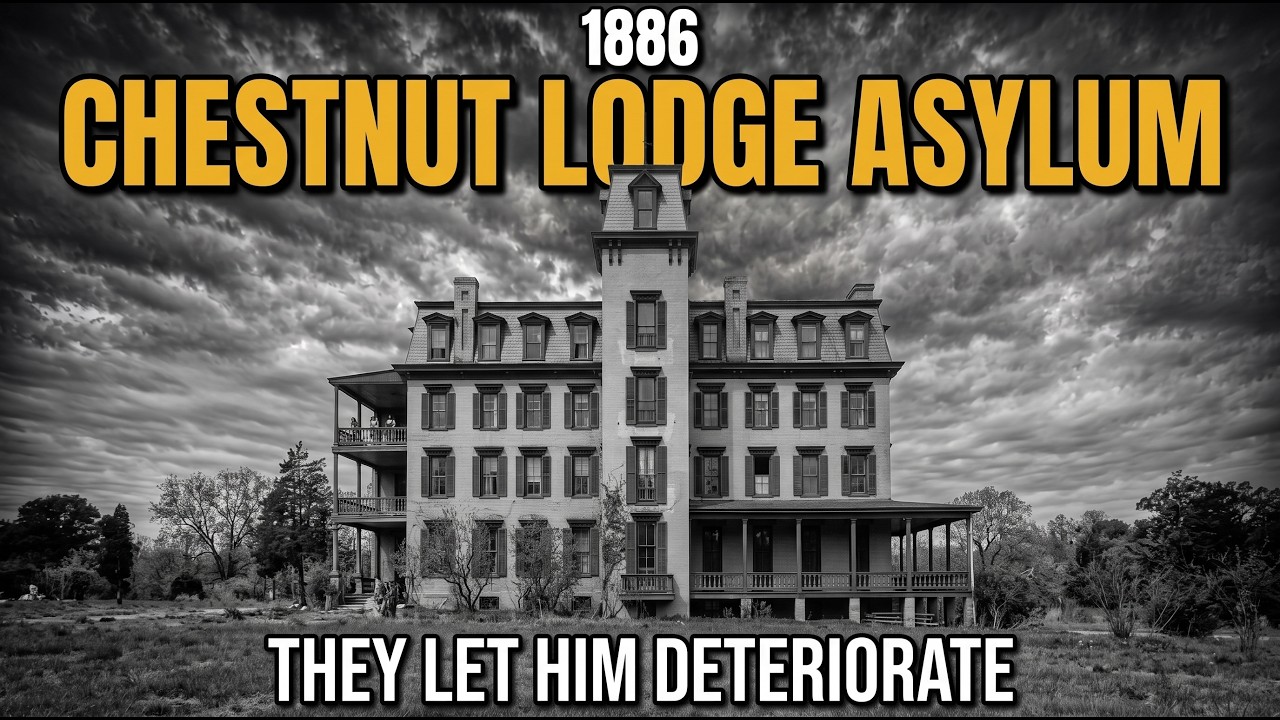
In 1886, a man named Charles G. Wilson started building a four-story brick hotel on five acres of farmland west of Rockville, Maryland, intending to cash in on wealthy Washingtonians escaping the summer heat. He ran out of money, went bankrupt, and left the structure half-finished in the woods. Two buyers purchased the shell for six thousand dollars, completed it, and opened Woodlawn Hotel in the spring of 1889.
It was a success—forty guest rooms, electric bells, gas lighting, a stable, and advertising that promised delicious cold water, no malaria, rare mosquitoes, and ozone-rich air. The pitch worked: come to the countryside, recover your health, return home. That last promise would not survive the century. A string of economic crises in the 1890s killed the American resort trade, and by 1906 the property was sold at auction.
The buyer was Dr. Ernest Luther Bullard, a Milwaukee surgeon and professor of psychiatry and neurology. He renovated the hotel and reopened it in 1910 as a sanatorium for nervous and mental diseases, naming it for the 125 chestnut trees on the grounds. For the first years, he was the only physician on site.
When Bullard died in 1931, his son Dexter took over clinical care, and Dexter’s wife Ann ran the hospital administratively. The family built a Tudor Revival home about a hundred feet from the main building, close enough to see the ward windows from the porch. Three generations of the same family would run the place for more than seventy-five years. Under the Bullards, Chestnut Lodge stood on the humane side of an inhumane era.
Their philosophy was that mental illness could be treated through psychoanalysis and occupational therapy rather than restraint and confinement. By 1934, it was described as the only mental hospital in the world specializing in psychoanalysis of psychotic patients. The belief, then, was that psychoanalysis could not work on psychosis—that it required a cooperative relationship which psychosis destroyed. Dexter Bullard bet that everyone was wrong.
To make that bet real, he needed someone who could actually do the work. In June 1935, Frieda Fromm-Reichmann arrived. Born in Karlsruhe, Germany, in 1889 to an Orthodox Jewish family, she had been one of the first women in Germany to study medicine. During World War I, she ran a clinic for soldiers with brain injuries.
In 1924, she opened her own psychoanalytic sanatorium in Heidelberg. When Germany became impossible for a Jewish analyst, her ex-husband financed her escape to France and then to America in 1934. She joined Chestnut Lodge in June 1935 and never left. She lived in a cottage on the grounds, equipped with therapy space, meaning she slept a minute’s walk from her patients.
She spoke to people no one spoke to—catatonic patients, patients screaming in private languages, patients three hospitals had already abandoned. Her assumption was that behavior meant something and that the task was to discover what. Her reputation turned a small family-run sanatorium into a training ground for the country’s best analytic minds: Harry Stack Sullivan, Otto Will, David Rioch, Harold Searles. If you were an ambitious young psychiatrist in the 1940s and wanted the hardest cases, Chestnut Lodge was the destination.
There was something else about Fromm-Reichmann, and its impact would be felt for decades. Erich Fromm, one of the most widely read psychoanalysts of the twentieth century, had been her patient before he became her husband. She had crossed the hardest boundary in her profession, and the profession absorbed it. She went on to spend twenty years treating the most vulnerable people in the country, and her field treated her as a moral authority.
That same culture would later decide it did not need controlled trials. Her method was built on a generous and courageous idea. During the first half of the twentieth century, enormous numbers of people diagnosed with schizophrenia were warehoused, drugged, restrained, and treated as furniture. Chestnut Lodge said: sit, listen, there is a person in there.
An entire generation of doctors learned that a psychotic patient is someone you can build a relationship with. But the belief in something beautiful is hard to abandon, and everything that went wrong at Chestnut Lodge over the next fifty years happened because no one there could let go of it. In 1948, a teenager arrived. She was Joanne Greenberg, and she would become the institution’s most famous success.
She had a private world with its own geography and language, the exact profile for a dire prognosis and a long stay. Instead, she got four years with the most respected psychoanalyst in the country. Fromm-Reichmann told her, as Greenberg later wrote: I believe you and I can beat this. She left without any psychiatric medication.
She went on to live a long life. On April 16, 1964, Greenberg’s novel was published under the pseudonym Hannah Green. The patient was called Deborah Blau, the private world the Kingdom of Yr, the therapist Dr. Fried.
The book sold slowly at first, then entered school and college curricula around 1969. By 2014, sales approached six million copies. A film followed in 1977, a play in 2004, and the title detached from the book entirely to become a phrase people used without knowing its source. For a generation of readers, it became the image of what mental illness was and how it could be cured: a woman sitting in a chair asking good questions.
No drugs, no shock therapy, no restraint. For Chestnut Lodge, it was the best advertising any psychiatric hospital in America ever had, and they did not have to write a word of it. But controversy arrived almost immediately. Two psychiatrists who reviewed the novel’s depiction of the character concluded she had not been schizophrenic at all—they argued she suffered from severe depression and psychosomatic illness.
Staff who had been at the sanatorium during her stay questioned whether her invented language was a genuine delusional system or something she had created, and at least one psychiatrist called her at home repeatedly to tell her she had been misdiagnosed. You cannot diagnose a person from a novel; the book is not a medical record. But the critics were pointing at a real problem larger than one book: diagnosis in American psychiatry in the 1940s and 1950s was loose, and schizophrenia was a wide net cast over many people who would not carry the label today. The institution had built its entire identity on treating schizophrenia, and its most famous success story may not have been one.
That same year, 1948, Fromm-Reichmann published a paper that gave a name to something fateful: the schizophrenogenic mother. Her formulation held that the patient suffered from distrust and resentment due to early rejection by a mother who was both rejecting and overprotective. The claim did not stop at bad parenting—the mother caused the disease. The idea spread through the 1950s and 1960s, expanding to entire family systems.
Across the country, psychiatrists sat with parents whose child had just had a psychotic break and began by assuming the parents had caused it. A mother brings in her nineteen-year-old son who hears voices, and she is told in the consultation room, plainly, that her personality caused his condition. Then she is invited to participate in therapy whose working hypothesis is her own failure. She returns home and examines every memory of raising that child, looking for the moment she broke him.
Families carried that weight for decades. Australian psychiatrist Gordon Parker published a review in 1982 that concluded there was no evidence behind it at all. The theory had been losing ground since the mid-1970s; Parker’s review is generally cited as the end. Thirty-four years from theory to formal discrediting, and no one ever went back to those mothers to tell them the truth.
Chestnut Lodge also produced some of the field’s most honest insights. The 1954 book The Mental Hospital: A Study of Institutional Participation in Psychiatric Illness and Treatment, by psychiatrist Alfred Stanton and sociologist Maurice Schwartz, documented that patient disturbance correlated with disagreements among staff. When two doctors secretly disagreed about how to handle a patient, the patient deteriorated. When the staff conflict was resolved, the disturbance faded.
The ward itself was an active ingredient. But the insight could curdle into a paradigm that explained everything and admitted no counter-evidence. A psychiatrist in a Manhattan state hospital in the 1960s, whose supervisor had fully absorbed the framework, was attacked by a patient. The supervisor’s interpretation was that the patient was discharging unresolved tension between two doctors over treatment approach—the patient had attacked him because the doctors disagreed.
If you accept that every event in the ward carries hidden meaning about relationships, then no event can count as evidence against you. The patient improves: therapy is working. The patient deteriorates: therapy is working, it is bringing things up. Nothing can refute that.
In 1948, a man named Raphael Osheroff, a nephrologist with his own practice, became depressed. For about two years, he was treated as an outpatient with tricyclic antidepressants. He grew severely agitated and anxious, and his doctor referred him to Chestnut Lodge. The hospital diagnosed him with manic-depressive illness, later revised to agitated psychotic depression.
Some case accounts also record that the staff settled on a diagnosis of narcissistic personality disorder, regarding his physical symptoms as unimportant. He stayed seven months. He received individual psychotherapy four times a week. That was the treatment—no antidepressants, no antipsychotics, no electroconvulsive therapy.
The hospital’s position was that his depression was a character problem, and that medication would mask the work that needed to be done. The therapy was confrontational rather than supportive. He was told he was symbolically dead and would spend the rest of his life on a locked ward. He was in a locked ward with eleven other patients, ten diagnosed with schizophrenia.
He had no telephone access and, by case accounts, no visitors. Agitated depression is not the quiet bedridden version most people imagine. It is a motoric restlessness that makes stillness impossible. The record describes a man who paced a corridor twelve to eighteen hours a day for months.
He lost forty pounds. He could not use utensils. He did not sleep. He walked until his feet swelled and ulcerated so badly they required medical care.
The hospital treated his feet—the records show wound care—and returned him to the corridor. The institution’s prevailing theory was that the pacing was material for therapy. His family watched and begged for drugs. The staff held their course.
This was not neglect. Neglect is cheap and quiet. This cost a fortune in resources: four hours a week of senior clinical attention at the finest address in American psychiatry. The harm came from effort, from a group of intelligent, committed people applying a treatment they believed in deeply to a man it could not help, reading his deterioration as evidence that the treatment simply needed more time.
After seven months, the family stopped asking. They removed him and transferred him to Silver Hill in Connecticut. Silver Hill looked at the same man and wrote down a different diagnosis: psychotic depressive reaction. Then they did exactly what Chestnut Lodge had refused to do for seven months.
They started him on phenothiazines and tricyclic antidepressants together. Within three weeks, he improved. Within three months, he was discharged. Seven months of the best talking therapy money could buy, and he emerged forty pounds lighter with damaged feet.
Three weeks of medication, and he was himself again. But the damage medication could not repair had already been done. His private practice had collapsed while he was inside. He lost his standing and his time with his children.
You cannot retrieve a seven-month gap from a physician’s life. In 1982, Osheroff sued Chestnut Lodge for malpractice. His claim was precise: a hospital diagnosed him with a serious mood disorder, watched him deteriorate for seven months, refused to provide medication or electroconvulsive therapy while his family begged for change, and that fell below the standard of care. The case moved through Maryland’s arbitration system, which produced an award of $250,000.
It then went to the appellate court, which reversed a dismissal and sent the case to trial. In October 1987, the most respected psychoanalytic hospital in the United States was scheduled to stand before twelve ordinary Maryland jurors to explain why it had left a physician to suffer for seven months. That trial never happened. The parties settled.
The settlement left no verdict, no recorded judgment, no binding law. That is exactly why the case became a war fought in scientific journals. In 1990, Gerald Klerman took the case in the American Journal of Psychiatry and turned it into a principle: the patient has a right to effective treatment, and treatments with proven efficacy have priority over those without. There was evidence from controlled trials in 1979 supporting medication for acute depression, and there was no such evidence for intensive psychoanalytic psychotherapy for Osheroff’s condition.
Alan Stone took the other side: making Klerman’s principle a legal standard would hand courts the power to decide what psychiatry is. Today the antidepressants win; tomorrow, any treatment lacking a trial record becomes a lawsuit waiting to happen, including most of what helps people whose problems are too complex for trials. While the two men argued in print, the thing they fought over was already being settled elsewhere by insurance companies. A model built on years of residential care and multiple sessions per week only survives if someone pays for it, and in the 1980s and 1990s that someone stopped existing.
Historian Eric Caplan later argued that almost everyone misread what happened. Osheroff’s claim was not a referendum on drugs versus therapy. He had been diagnosed with a mood disorder, denied both established treatments for that condition for seven months while clearly worsening, and no one changed course. You could keep every word of psychoanalytic theory intact and still lose that case.
The case became drugs versus therapy because both camps wanted it: the biological camp treated it as a founding victory, the analytic camp as a martyrdom. Between them, a narrow case about one hospital’s refusal to reconsider became the story of an entire century of psychiatry. Osheroff returned to his practice and practiced medicine until his death in 2012. He married and divorced more than once, and by his own account never had another life-threatening depression.
And then there is the part that serves no one’s argument: he remained in psychoanalysis for three decades. The man whose name became the weapon used against analytic psychiatry kept undergoing analysis for the rest of his working life. He wanted drugs and therapy both, and believed he deserved both. And in 1999, when depression returned, he voluntarily checked into a hospital and chose electroconvulsive therapy—the treatment Chestnut Lodge had refused him twenty years earlier.
Chestnut Lodge continued operating for another fourteen years after the settlement. What ended it was money. In 1996, a group called Community Psychiatric Clinic acquired it; the combined entity became CBC Health. The Bullard family sold their stake in 1997.
What had been a private hospital for wealthy families became a 132-bed licensed provider serving about three thousand patients through inpatient, outpatient, and supported-living services, relying on government reimbursements that covered only about 80 to 85 percent of the actual cost of care. In October 2000, CBC Health filed for bankruptcy with eleven million dollars in debt. The county council refused a three-million-dollar rescue plan. On April 27, 2001, after ninety-one years, Chestnut Lodge closed its doors.
The hospital had been doing something nearly extinct: following the same patient from a locked ward to outpatient care to supported housing as a continuous relationship over years. No one ever proved that model was bad. It simply stopped being something anyone wanted to pay for. The building sat vacant.
In September 2006, Wayne Fenton, a researcher who had spent more than fifteen years working at Chestnut Lodge and was known for doing something senior researchers had largely stopped doing—interviewing patients directly—was killed in his Bethesda office by a nineteen-year-old patient he was treating for schizophrenia. The great majority of people diagnosed with schizophrenia will never harm anyone. One death does not describe a class. But the founding idea at Chestnut Lodge was proximity: get close, stay in the room, treat the person as a human being.
Everything good the hospital produced came from that, and so did the exposure to risk. Fenton was still working that way at the end. The property changed hands repeatedly. In December 2003, it passed to a company called Chestnut Lodge Properties.
In 2006, Rockville’s city council approved a forty-five-million-dollar redevelopment plan: single-family homes plus conversion of the main building into apartments, preserving the brick and re-populating it. On paper, a happy ending. On the ground, the place sat as a four-story Victorian hotel, empty in the woods, no heat, no electricity, board over the openings, at the end of a residential street where every teenager knew exactly what that building had been. Around 3:00 a.
m. on Sunday, June 7, 2009, fire broke out in the main building. The original Woodlawn Hotel, the building Wilson bankrupted himself building in 1886, burned and collapsed. The building was vacant.
No one was hurt. What burned was the physical record of the place: the wards, the corridor Osheroff paced, the rooms where Fromm-Reichmann sat with catatonic patients in the 1930s and 1940s. Fire investigators were specific about what they wanted: they asked about a group of young people or teenagers seen in the 500 block of West Montgomery Avenue late Saturday night and early Sunday morning. They ran an anonymous arson hotline and distributed flyers across Rockville.
A year later, the arson investigation was still open, and no cause had been publicly identified. No public verdict, no charge, no named suspect appears in the record. A vacant historic building on a redevelopment site burned in the middle of the night. The fire department went looking for a group of kids.
As far as anyone knows, no one was ever publicly held accountable. The building took its own record with it. Go to Rockville now, and there is still something to see. The 1927 Tudor Revival house Ernest Bullard built for his son still stands, as do the old stable and ice house from the hotel days.
Fromm-Reichmann’s cottage was transferred to a preservation group in 2007, restored, and designated a National Historic Landmark in 2021. The city turned more than six acres of the campus into a public park. Where the main building stood, there is now nothing. Greenberg lived a full life.
She taught at the Colorado School of Mines, worked as an emergency medical technician, and wrote more than fifteen books on topics unrelated to any of this. She spent decades insisting on her own account of what happened to her against doctors who wanted to take her diagnosis away and doctors who wanted to use her as a trophy. The numbers Chestnut Lodge itself produced have been published since the 1980s. Between 1977 and 1983, researchers tracked down 163 patients diagnosed with schizophrenia who had left the hospital between 1950 and 1975, evaluating them on average fifteen years after discharge.
Six percent had recovered. Eight percent were in good condition. Twenty-two percent were fair. Twenty-three percent were deteriorating.
Forty-one percent were continuously disabled. The group’s average score on a standard clinical rating scale was 37—within the range of major impairment in all areas: work, relationships, mood, all damaged at once. That was the midpoint of the group, not its worst case. Who were those 163 patients?
They were chronic, severely ill people, mostly ones who had not responded to medication elsewhere before arriving. They had come to a tertiary-level private hospital, referred after other places had tried and failed, wealthy because only the wealthy could afford it. So, did the 6 percent prove that psychoanalytic treatment for schizophrenia was useless? No—there was no comparison group.
You would need the same kind of patients at the same stage of illness, treated differently, counted the same way. That study was never done. What the 6 percent proves is that a group of chronic, severely ill patients, most of whom had failed other treatments, mostly remained ill—which is close to what you would expect no matter what anyone did for them. Did it allow the law to pass judgment?
No. But the hospital marketed itself as the place that reached the hopeless cases. That was their entire brand. Generations of families sold their homes or emptied their trust funds to get someone in there on the promise that this hospital could do what other hospitals could not.
Their own follow-up results say that, most of the time, they could not. The claim was extraordinary. The result was ordinary. That gap is the essence of the accusation, and it does not require you to believe that talking to psychotic patients is useless.
Chestnut Lodge funded the study that produced those numbers. A private hospital whose status depended entirely on its ability to help the sickest people in America paid for a research operation that tracked down its own discharged patients fifteen years later and honestly recorded their condition. Most institutions would prefer not to know. Chestnut Lodge published the results.
Then, for the next forty years, the debate about Chestnut Lodge proceeded without citing those numbers at all. Supporters used a novel about a character whose diagnosis two other psychiatrists doubted. Opponents used a lawsuit that settled without a verdict, about a doctor with depression rather than schizophrenia. One book and one case.
Two stories about individuals, repeated endlessly, in a subject where the hospital had gone to the trouble of producing real numbers about 163 people. No one wanted the numbers. Numbers are more complicated than victory. They do not give you a villain or a miracle.
They simply describe a difficult illness afflicting people in a beautiful building at enormous cost for a very long time. When an institution defends itself with one person’s testimony while its aggregate results go uncited, you are watching the same film. Chestnut Lodge is distinct because it measured itself, announced the result, and then everyone, including the people who worked there, kept telling the story instead. The building is gone.
The land is a public park. When it was still standing, Frieda Fromm-Reichmann came from Germany and slept a minute’s walk from her patients, and she became the healer who spent her entire American career in a cottage on that property, speaking to people no one else would speak to. The statistics remain in the journals, where anyone can read them and where they have been all along: 6 percent recovered, 41 percent continuously disabled after fifteen years.