On the morning of January 19, 1981, a 22-year-old woman walked to a building on the East Side of New York City and stepped from a loft window. In her diary, she had written one final sentence: “I invented a language so that people could see. ” Her name was Francesca Woodman. At the moment of her death, almost nobody knew her name—not editors, not galleries, not the art world she had spent her entire short life trying to enter.
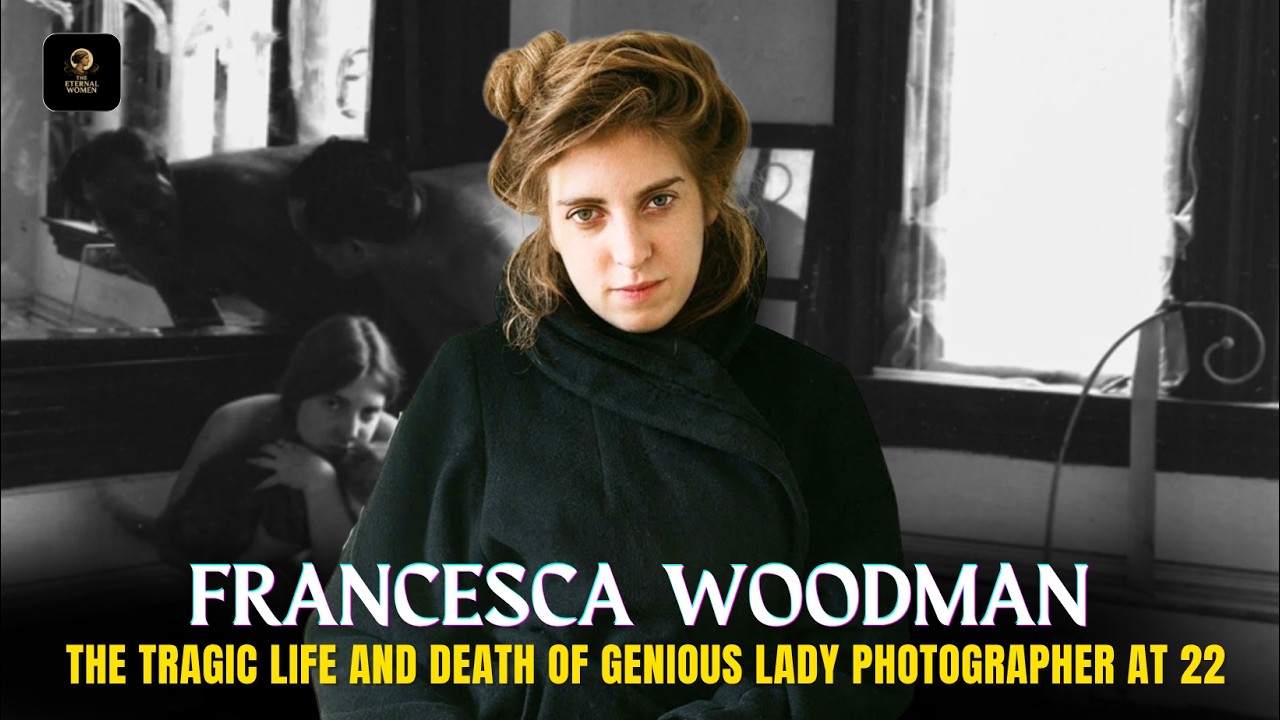
She died convinced she had failed, that her work meant nothing. Within five years, her photographs hung in major museums. Within a decade, critics called her a pioneer. Today, her work sits in the permanent collections of the Museum of Modern Art, the Whitney, the Metropolitan Museum of Art, and the Tate Modern in London.
Francesca Woodman was born on April 3, 1958, in Denver, Colorado. Her father, George Woodman, was a painter and photographer who taught painting and the philosophy of art at the University of Colorado Boulder. Her mother, Betty Woodman, was a ceramicist who would become one of the most celebrated ceramic artists in American history. Her older brother, Charles, became an associate professor of electronic art.
In the Woodman household, art was not a hobby; it was the operating system, the language everyone spoke. The family home functioned as a creative hub for Boulder’s entire art community, and Francesca grew up surrounded by her parents’ work, absorbing the vocabulary and standards of art before she was old enough to understand what she was absorbing. When Francesca was 10, the family purchased a 17th-century farmhouse in Antella, just outside Florence. From then on, summers meant Italy every year.
She learned Italian so fluently that by her teens she moved through the language with complete ease, walking through Tuscany past buildings that housed Renaissance masters, absorbing the light that had shaped 500 years of Western painting. At 13, Francesca enrolled at Abbot Academy, a private boarding school in Andover, Massachusetts, where she met photographer and educator Wendy Snyder MacNeil. MacNeil introduced her to photography not as a tool for recording the world but as a language for exploring the deepest questions of the self. Her father had given her her first camera, a 2¼-inch Yashica she would use for most of her career.
She took her first self-portrait at 13. She graduated from Boulder High School in 1975, a full year ahead of schedule, at 16 years old. She had already found her subject, her medium, and was already producing work beyond what most art school graduates ever achieve. In autumn 1975, Francesca enrolled at the Rhode Island School of Design, or RISD, one of the most prestigious art schools in the United States.
Within weeks, she moved out of the student dorms and into her own live-work studio at Pilgrim Mills, a rundown industrial space. She worked constantly, with an intensity her classmates found both impressive and alarming. People who knew her at RISD described her as deeply dedicated, fiercely intelligent, and emotionally fragile. She worked in black and white, producing square negatives with her Yashica, and her prints were deliberately small, most no larger than 8 by 10 inches.
She didn’t want spectators; she wanted witnesses. The photographs she made during her years in Providence became the core of her artistic legacy. The House series, created between 1975 and 1976, shows her body in dialogue with the architecture of decaying empty rooms, her figure merging with walls and floors until neither is entirely distinct from the other. Polka Dots, from 1976, shows her crouched beside a crumbling wall, her patterned dress splitting at the seam, her body dissolving at its edges into the surface behind her.
She was 18 years old when she made it. In 1976, she had her first major solo exhibition at the Addison Gallery of American Art in Andover, Massachusetts. In 1977, Francesca was selected for RISD’s European Honors Program, a prestigious opportunity to spend a year studying in Rome. She spoke fluent Italian and arrived not as a tourist or exchange student but as someone who genuinely belonged in the city.
She formed friendships with Roman artists, writers, and intellectuals, and immersed herself in surrealism and symbolism. In March 1978, she had her first European solo exhibition at Libreria Maldoror, a bookstore and gallery that served as a gathering place for avant-garde art. She was 19 years old. Rome transformed her work profoundly.
The Self-Deceit series introduced mirrors as a central element, photographs in which reflection and reality become indistinguishable. The Angel series posed figures as winged beings suspended between the earthly and the celestial. She returned to Providence in autumn 1978 for her final semester. For her thesis exhibition, she installed large-scale photographs at the ceiling and baseboards of RISD’s Woods-Gerry Gallery, wrapping the entire room in her world.
She graduated from RISD in 1978 at 20 years old. Then she went to New York, because New York was where careers were made. Francesca moved to New York City in 1979. She arrived with a portfolio that should have stopped people cold, but the response was silence, or polite rejection, or the gentle suggestion that her work was too personal, too experimental, too strange for commercial application.
She was methodical, persistent, and strategic. She sent portfolios to fashion photographers, agencies, editors, anyone in the professional photography world who might conceivably open them and look. The industry didn’t have space for her. It didn’t know what to do with her.
In the spring of 1980, there was a small breakthrough. Her monumental work, Temple Two, was included in the exhibition Beyond Photography 80 at the Alternative Museum in New York City. That summer, she was awarded a fellowship as an artist in residence at the MacDowell Colony in Peterborough, New Hampshire, where past residents had included Thornton Wilder, Aaron Copland, and James Baldwin. She worked productively there, making strong photographs.
She returned to New York in autumn 1980 with renewed energy. Then everything fell apart at once. A significant relationship ended. The professional recognition she had pursued with relentless intensity had not come.
The portfolios were still going unanswered. Then came the news that her application for a grant from the National Endowment for the Arts had been rejected. For someone in a different psychological state, a grant rejection might have been absorbed as a manageable setback. For Francesca, already worn thin by two years of professional invisibility, already fraying from the ended relationship, already carrying a depression that had been building for some time, the NEA rejection landed like a verdict, not just on the grant application, but on her entire body of work.
Her father would later suggest that this rejection was the final blow. In autumn 1980, Francesca attempted to take her own life for the first time. She survived, began therapy, and went to live with her parents in Manhattan. She seemed to stabilize.
The crisis appeared to have passed. In the first days of January 1981, something happened that should have felt like triumph. Francesca’s artist book, Some Disordered Interior Geometries, was published by Synapse Press in Philadelphia. It was a 24-page work constructed on pages from an Italian geometry exercise book, with 16 of her photographs attached and her own handwriting and white correction fluid layering images over geometric diagrams.
It was extraordinary, fully original, and it was the only book of her photographs published during her life. It arrived weeks before she died. On the morning of Monday, January 19, 1981, Francesca Woodman wrote her final diary entry: “I invented a language so that people could see. ” Then she stepped from a loft window.
She was 22 years and 9 months old. For four years after her death, publicly nothing happened. The photography world that had largely ignored her while she lived continued to ignore her. Her parents became the custodians of her entire estate—over 10,000 negatives and more than 800 printed photographs.
The vast majority of her life’s work sat unseen. The turning point came from a single act of attention. In 1981, Ann Gabhart, the director of the Wellesley Art Museum, visited the Woodman family home and saw Francesca’s photographs for the first time. She organized an exhibition.
Between 1986 and 1989, Francesca’s photographic work toured to institutions across the United States. The art world, encountering her work for the first time, was stunned. Here was a body of work fully formed, deeply intelligent, and visually unlike anything being made by photographers of comparable age. The critical and institutional response was swift.
Within years, her photographs were acquired by the Museum of Modern Art, the Whitney Museum, the Metropolitan Museum of Art, the Art Institute of Chicago, the Tate Modern in London, and the Guggenheim. In 2025, 44 years after her death, her work was featured at the Albertina Museum in Vienna. Francesca Woodman did not give up. She kept making photographs until the very end.
She kept sending portfolios. She kept applying for grants. She had a book published weeks before she died. She was still working.
The world just wasn’t ready for her yet. The recognition came. The museums came. The critics came.
All of it came. Just not in time. She died in the gap between what something is worth and what the world currently recognizes it as worth. She invented a language so that people could see.
Now, we see.