On July 1, 1862, a 22-year-old farm boy from North Carolina stepped onto a killing field at Malvern Hill. Peter Crawford Earnhardt, a private in the 20th North Carolina Infantry, was about to charge across an open slope into the teeth of the finest artillery concentration the Union Army had yet assembled. Men around him would have their heads torn off by cannon fire, their legs shredded by case shot, their bodies ripped open beside him. By the close of that day, Confederate attackers would be shattered along this ridgeline, their assault a bloody failure.
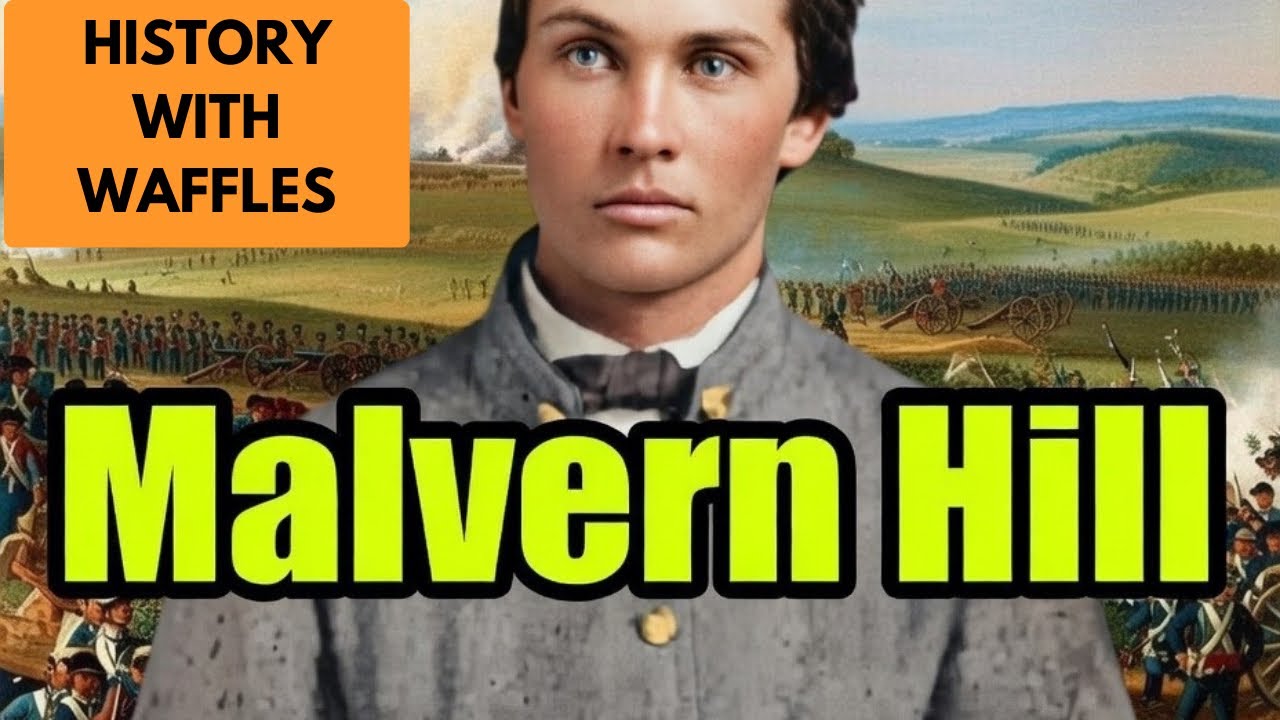
Earnhardt survived. In fact, across four years of war, across dozens of major engagements, through Gettysburg and the Wilderness and the long retreat to Appomattox, there is no record of this man ever being wounded or captured. He was one of only 72 men of his regiment to surrender at Appomattox Court House. And those 72 were all that remained of more than a thousand who had mustered in.
What makes the story matter far beyond the battlefield is what came of that survival: the Earnhardt family would one day produce a NASCAR dynasty, with Dale Earnhardt and his descendants becoming legends of American racing. Had Peter Crawford Earnhardt fallen on this field, that future would never have existed. Born in February 1839 to a farming family in Cabarrus County, North Carolina, Earnhardt enlisted in 1861 at age 22 and joined the 20th North Carolina. The regiment eventually made its way north to serve in the Army of Northern Virginia.
He survived the Seven Days Battles, which brought him to this field at Malvern Hill. The ground itself was unforgiving. The Confederates formed at a distant treeline and began their advance down one slope, through a shallow valley, and up a rise toward the Union artillery. What looked like a simple open field was actually a series of rolling folds, and at the lowest point in the valley, a line of brambles and brush offered the only cover.
Soldiers huddled there, hugging the earth while projectiles screamed overhead. One soldier wrote about lying flat while shells passed so close he believed he could have reached up and touched one if he dared to stand. The Union guns were positioned along the ridgeline with a commanding view of the entire field. Artillery commander Henry Hunt and General Fitz John Porter arranged their batteries to deliver overlapping fire across every approach.
The Confederate soldiers faced not only the cannons directly ahead but also crossfire from either flank. And overhead, three Union gunboats on the James River fired massive projectiles into the Confederate ranks. The gunboat shells did limited physical damage, but their explosions sent flames and debris through the air and hammered at the morale of men already walking into a slaughterhouse. The 20th North Carolina came forward at roughly one or two in the afternoon, and the fight ground on until dark.
Union gunners fired shell and canister into the advancing lines. Canister, a shotgun-like blast of iron balls at short range, was the most devastating of all. The sign marking the position of the Fifth U. S.
Artillery records that on the afternoon of July 1, that battery alone fired 1,392 rounds. The Confederate infantry melted away under the barrage. No Southerners reached the guns. One battery was commanded in part by Adelbert Ames, who decades later would be the last surviving Union Civil War general.
His gunners stood at their pieces as wave after wave of Confederates came up the slope and broke short of the line. Earnhardt’s regiment came closest in the area of the Thomas J. West house, the focal point of the entire attack. They pushed forward to roughly the length of a football field from the Union cannon before they could go no farther.
Some men made it to the road that cut across the field and used it, along with old slave quarters, as shelter. They laid flat in depressions, frozen in place. If they stood, they were cut down. Even lying down, they were not safe, because shells bursting overhead drove shrapnel down into their backs, heads, and legs.
The terrible uneven ground worked against them in other places. General Couch, commanding a section of the field, recognized that the rolling terrain made artillery less effective and chose to push infantry forward of the guns, placing brigades under Abercrombie, Howe, and Palmer to stop the Southerners before they could stage a successful assault. Some Confederate units actually got close, but none managed to seize the artillery line. Robert E.
Lee spent much of the day trying to arrange his army in a broad arc for what became one of the war’s largest frontal assaults. Jackson’s men were far off in the woods, tangled in the poor communication and sluggish movement that would plague him that day. D. H.
Hill’s division, which included the 20th North Carolina, waited in the woods and ravines behind the field. The Confederates attacked in piecemeal waves rather than one coordinated mass. They kept coming until darkness finally ended the slaughter. Some men could not retreat and were captured on the field.
Others lay out among the wounded and the dead until night allowed them to crawl back under cover. The Union dead were eventually reinterred at Glendale National Cemetery; the Confederates were likely moved to Richmond. Two Confederate soldiers discovered buried in a shallow grave on the field were removed and given proper burials after the war. No one knows for certain who they were, but they rested in the very ground where D.
H. Hill’s men, including the 20th North Carolina, had formed for battle. After the fight, the Union generals gathered and agreed they had the Confederacy in trouble. The Southern army was disorganized, reeling, and beaten.
One officer believed a hard push the next day would knock open the door to Richmond. But General George McClellan, for reasons of his own, ordered the army instead to Harrison’s Landing, pulling his forces out of the fight. Confederate defeat on the field was followed by Union withdrawal, one of the strangest outcomes of the war. The Seven Days Battles were over, and the Army of Northern Virginia, though bloodied and beaten at Malvern Hill, remained in the field.
For Earnhardt, the war was far from over. The 20th North Carolina fought at South Mountain, Antietam, Fredericksburg, Chancellorsville, and then Gettysburg. By the time the regiment reached Gettysburg in July 1863, its numbers had dwindled to perhaps 300 or 400 men, and it suffered about 56 percent casualties on that field. It was after Gettysburg that the regiment earned a mention in Robert E.
Lee’s dispatches for its bravery and tenacity, including the capture of an enemy flag. The regiment fought on through Bristoe Station, Mine Run, the Wilderness, Spotsylvania, North Anna, Cold Harbor, Monocacy, Third Winchester, Fisher’s Hill, Cedar Creek, Third Petersburg, Fort Stedman, Sailor’s Creek, and dozens of smaller actions. In total, the regimental historian listed 39 separate major engagements. In April 1865, at Appomattox Court House, the 20th North Carolina surrendered.
Of the 1,012 men who had originally enlisted, 72 remained. Only nine of them had weapons. Peter Crawford Earnhardt was not among those nine armed survivors. Somehow, through 39 major battles, through open charges against canister at Malvern Hill, through the slaughter at Gettysburg, through years of campaigning in Virginia and Maryland, he had never been wounded and never captured.
He simply refused to die. He went home to North Carolina and built a family. Generations later, his descendants became synonymous with stock car racing. Dale Earnhardt, Sr.
, won seven Winston Cup championships. Dale Earnhardt, Jr. , carried the name into a new era of the sport. Every one of those victories traces back to a single young man who somehow crossed a field at Malvern Hill while the men beside him were torn apart, then survived four more years of the bloodiest war America ever fought.
On that open ridge above the James River, the future of an entire family, and an entire sport, hung in the balance with every step he took.