In the dust-covered garrison town of Los Angeles, on the night of June 15, 1861, a group of U. S. Army officers gathered in an adobe house near Camp Fitzgerald for what everyone understood would be their final meeting. A woman sang the farewell ballad “Kathleen Mavournin,” a song without promise of return.
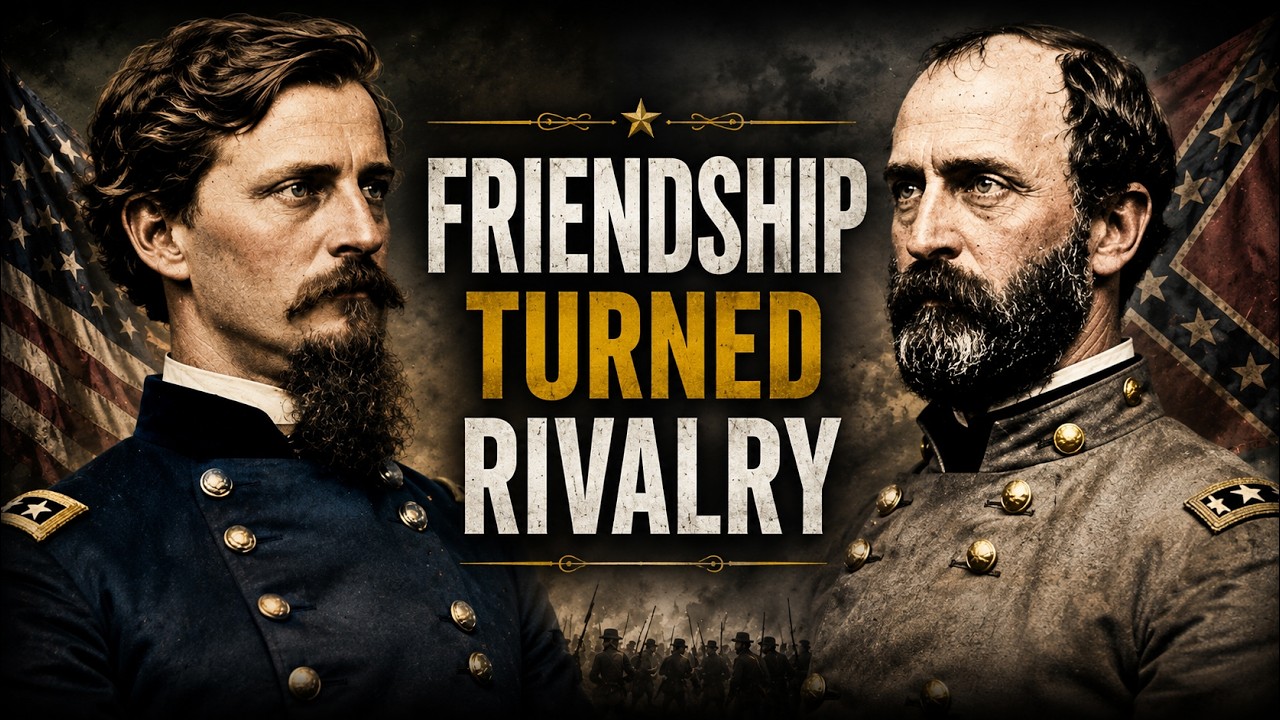
The hostess, Almira Hancock, would remember that night for the rest of her life, and more than a century later historians would debate whether she remembered it exactly as it happened. What is not in dispute is the outcome. Within three days, some of the officers in that candlelit room would resign from the U. S.
Army and ride east to fight for the Confederacy. The others would stay. And two of them, a quartermaster named Winfield Scott Hancock and a widower named Lewis Armistead, would spend the next two years moving toward the same three square miles of Pennsylvania farmland without fully realizing it. Winfield Scott Hancock graduated from West Point in 1844, an average student in a class of average men, and took the path of most junior officers in a peacetime army: he became a quartermaster, the officer responsible for supplies, transportation, and the unglamorous work of keeping an army fed and moving.
It was a competent posting for a competent young lieutenant. Lewis Armistead’s road had been harder. He came from Virginia military aristocracy, but after a trivial mess-hall quarrel ended with him breaking a plate over the head of a cadet named Jubal Early, he was expelled from the academy. He won a commission through direct appointment instead and spent the next two decades as a frontier officer.
The two men met in the small prewar army, served in the same infantry regiment, and became friends. Then life did to Armistead what war had not yet managed to do. In 1851, his first wife died of disease at a Texas frontier post. He remarried, had a son, and seemed to have been given a second chance.
Then his second wife died as well. Between 1851 and 1856, by the time he was thirty-nine, Armistead had lost two wives and two of his three children to the illnesses that swept through the frontier garrisons. His surviving son was sent east to be raised by relatives, because a frontier post was no place to raise a child alone. The friends who knew him before and after described a changed man: harder, quieter, lost in long silences.
The only constants left in his life were the army and his fellow officers. That is why the friendship that resumed between Armistead and Hancock in California in the late 1850s mattered differently than other friendships. Hancock was married with children, a man who had built a stable family life inside a profession that rarely allowed it. Armistead had buried two wives and sent his only living son across the continent.
They were an odd pair on the surface, but behind them stood thirteen years of shared history, including the Mexican War, where they had served side by side. And when the war came, the split was not abstract. It was happening at their own dinner table. Henry Heth, another officer who knew them both, remembered simply that Armistead, Hancock, and he had been messmates, and that there had never been a happier mess.
By the spring of 1861, southern officers were resigning one by one to return home and fight for their states. Armistead was among them. Virginia was his country. What we know for certain is that a farewell happened, that Armistead left California to join the Confederacy, and that he left something in Almira Hancock’s keeping for safekeeping, possibly a Bible or prayer book, with instructions not to open it until his death, and with it likely words of faith and courage.
The romantic accounts, preserved in novels and films, put Armistead in that candlelit room, tearfully embracing Hancock and declaring he would rather God kill him than ever raise his hand against his friend. Historians who have checked troop records and reports find that version almost impossible: not all the men named were in Los Angeles that spring. But when Hancock’s departing southern friends questioned his loyalty, he answered without ambiguity: “I cannot give you any advice, for I will fight for the Union that is whole and undivided. ”
The next two years transformed both men in ways their prewar careers had not predicted.
Hancock rose to command a brigade, then a division, and then the Second Corps of the Army of the Potomac, one of the largest and most important commands in the Union army. He fought at Antietam and Fredericksburg and in every major engagement, and his personal courage under fire became part of his reputation. Soldiers and the press called him “Hancock the Superb,” a nickname given after Williamsburg that stuck for the rest of his career. His gift was the ability to remain calm while men were dying around him, and that calm shielded others from breaking.
Armistead’s rise was quieter but no less real. He commanded a brigade in Pickett’s division of the Army of Northern Virginia, building a reputation as a hard, reliable commander, an officer other officers wanted guarding their flanks, a man whose men trusted him completely because he never asked them to do anything he was not willing to do himself. In the summer of 1863, Robert E. Lee decided to move the war out of Virginia and into the farmland of Pennsylvania.
Neither Hancock nor Armistead thought they were moving toward each other. But every road of that campaign bent toward the crossroads town of Gettysburg. The battle began almost by accident on July 1, when a Confederate division looking for shoes collided with Union cavalry west of town. By day’s end the Union army had been pushed through the streets of Gettysburg onto high ground shaped like a fishhook south of town.
Hancock arrived that evening with orders to take charge of the field and lay out the defenses, and more than any other officer he decided the Union army would stand on that high ground. That decision placed him at the center of everything that followed. July 2 was chaos on both flanks—Little Round Top, the Wheatfield, the Peach Orchard, Culp’s Hill—a brutal day of fighting that pushed neither army back. That night, Lee made the decision that would define the battle in American memory: he would attack the center of the Union line on Cemetery Ridge with roughly twelve thousand men, across a mile of open ground under heavy fire, hoping a massive coordinated assault would break the Union army before it could recover.
Chosen to lead that attack was Pickett’s division, and within Pickett’s division was Armistead’s brigade. The ground they were targeting, Cemetery Ridge, was defended by the Union Second Corps. It was Hancock’s line. In the hours before the attack, several of Armistead’s fellow officers remembered that he spoke of Hancock on his own.
He knew, or strongly suspected, whose corps held the field before him. He was not walking toward the guns of a stranger. He was walking toward the line of his oldest friend, with full knowledge of who stood behind the stone wall and who was leading the men he would have to kill to reach it. That knowledge did not stop him.
He had made his choice in California two years earlier, and in the logic of nineteenth-century military honor, a word once given was not bent by personal sorrow. On the night of July 2, Armistead prepared the way professional officers do when they expect death. He gave away his personal belongings to comrades and told them to send them home if he did not survive. The attack had not yet been ordered.
He did not need to see the field to know the cost of a mile of open ground against a fortified ridge. He had been a soldier for more than two decades. Hancock spent the same night preparing his army, walking his artillery positions, checking ammunition, maintaining the calm his staff remembered. He expected the attack.
He spent the night making sure that when it came, it struck the strongest part of the ridge. The morning of July 3 opened with fighting no one had expected, a Union attack that drove Confederates off Culp’s Hill. By early afternoon the field fell quiet. Then, around one o’clock, the Confederate artillery opened the largest bombardment their army had ever assembled, roughly 150 to 170 cannon firing nearly simultaneously, intending to destroy the Union line before the infantry advanced.
For nearly two hours the ridge disappeared in smoke and noise. Union guns answered, except those held back on Hancock’s specific orders to save ammunition for the infantry assault, a ruse that convinced the Confederates their bombardment had done more damage than it had. Throughout it all, Hancock rode his lines on horseback. His subordinates begged him to dismount, to take cover, to stop making himself a target.
He refused, believing his men needed to see him calm and steady while their world was being torn apart, and that the psychological damage of an invisible commander was worse than the physical risk of a visible one. It was the kind of decision that had built his reputation over two years, and it was about to put him in death’s path. Around three o’clock the bombardment stopped and the Confederate infantry emerged from the trees on Seminary Ridge. Nearly 12,500 men advanced in a line about a mile wide, walking across three-quarters of a mile of open fields toward a ridge occupied by Union infantry and artillery waiting for exactly this moment.
They walked slowly, not charging, keeping their ranks under fire as they had on the parade ground, because discipline demanded it. Fences had to be crossed. The Emmitsburg Road had to be crossed. Its low ground and post-and-rail fences broke the orderly lines that had held for the first half mile.
Armistead’s brigade was in the second wave. Before the attack, as he did before any important fight, he placed his black felt hat on the point of his raised sword so his men could always find him in the smoke. The Union artillery opened immediately, first with long-range shot, then as the distance closed, with canister, essentially giant shotgun blasts that could drop a dozen men at once. The Union infantry along the stone wall held their fire until the Confederates were within a hundred yards, then poured volley after volley into a force that had nowhere to hide.
The mile-wide wave narrowed as officers on the flanks tried to bend their lines toward a low point in the stone wall called the Angle, where the defensive line turned and left a gap. It was the weakest point on the entire ridge. Toward that gap, Armistead and the survivors of his brigade now walked, shoulder to shoulder, taking fire from three directions. Just before the wall, a bullet struck the pommel of Hancock’s saddle, driving a bent iron nail, wood splinters, and the bullet into his thigh.
With his staff applying a tourniquet made from a pistol barrel and leather straps, he continued issuing orders. When they begged him to leave the field, he refused, and before being carried off he wrote a message to General Meade about the condition of the attack. He believed, and evidence suggests correctly, that remaining visible was more important to holding the line than immediate treatment of his wound. A few hundred yards away and closing fast, Lewis Armistead reached the stone wall.
In the next minutes he crossed it with perhaps 150 to 300 of his surviving men and entered the Union position, the only Confederate unit that day to break the main line in an organized manner. He reached the abandoned guns of Cushing’s battery, whose commander, Lieutenant Alonzo Cushing, had been killed by a bullet to the face at that same moment while holding his own wounds closed with his hand. Armistead, his hat still on his sword, called to his remaining men, inviting them to follow him and to give the enemy cold steel. He placed his hand on one of the captured Union cannons.
For perhaps sixty seconds it was the deepest Confederate penetration of Union ground that day, which is why the spot is still called the high-water mark of the Confederacy. Then Union reinforcements counterattacked through the gap, and the moment collapsed as suddenly as it had formed. Armistead fell near the captured gun, hit in the arm and the leg, wounds that were not individually considered mortal. He lay on the ground a few dozen yards inside the defensive line commanded by his dearest friend, at the very moment his dearest friend was being carried off the field with a nail embedded in his thigh.
Two men, two wounds, a few hundred yards and maybe ten minutes apart. Neither knew what had happened to the other. What happened next comes from a witness with no reason to exaggerate. Captain Henry H.
Bingham, a member of Hancock’s staff, was, like Armistead, a Freemason. Freemasonry was one of the few institutions in the nineteenth century that recognized an obligation across military lines: a Mason in danger who received the sign from another Mason had to be helped, regardless of uniform, rank, or circumstance. It was a loyalty older than the Confederacy, older than the Union, with its own language, its own hand signs, and its own signals of distress. In the chaos after the Confederate attack broke, Bingham saw a wounded Confederate general among the dead and dying near Cushing’s battery and recognized the Masonic distress signal.
He identified himself as a Union officer and a fellow Mason and asked if he could help. Armistead asked who was in command of that part of the line. When Bingham told him it was General Hancock, Armistead’s reaction was not surprise but deep sorrow. He already knew.
Then he learned that Hancock himself had been severely wounded on the same field. According to Bingham’s account, Armistead handed over his watch, chain, ring, pocketbook, and whatever papers he had, the calm and careful inventory of a man who had accepted he would not leave that field. And then, weakening from his leg wound, he asked Bingham to take a message to his oldest friend, a message historians have debated for a hundred and fifty years because its true meaning died with the man who spoke it. He asked Bingham to tell General Hancock that he would carry the remorse for the serious wrong he had done him and all of them for as long as he lived.
Armistead was taken to a Union field hospital at Spangler’s farm. His wounds were not initially thought fatal, but infection set in. He lingered for nearly two days and died on July 5, 1863, two days after the attack that made him famous, at the age of forty-six. His father claimed the body and had it taken to Baltimore, where it was placed in the Armistead family vault at Old St.
Paul’s Cemetery, because transporting a Confederate general’s body through Virginia in July of 1863 was not safe. He is still buried there. Of the roughly fifteen thousand men who had crossed that field in Pickett’s Charge, fewer than half returned unharmed to their own lines. Hancock survived.
His thigh wound never fully healed. The nail, wood splinters, and cloth embedded deep in his muscle caused recurring infections and pain for the rest of his life. He missed months in the field and the injury reawakened for years, sometimes without notice. He recovered and served as one of the Union’s most important field commanders for the rest of the war.
He was present at Appomattox. After the war he was trusted with sensitive duties, including command at the trial and execution of the Lincoln assassination conspirators. In 1880 he ran for president as a Democrat and lost to James Garfield by one of the smallest popular vote margins in American history. He spent his postwar years commanding the military division of the Atlantic from Governors Island in New York Harbor.
He died in 1886 at fifty-four, still in uniform, twenty-three years after the battle, with the nail still in his thigh. According to his own account and his doctors, the wound never let him rest. In 1993, more than a century after Gettysburg, a monument was erected where Armistead fell. Called the Friend to Friend Masonic Memorial, it commemorates no victory or defeat but the stranger who recognized a dying man’s distress and helped him.
The two men who had stood in that room in Los Angeles in 1861, who by all accounts genuinely loved each other as friends, never spoke again after July 3, 1863. There was no reunion, no deathbed reconciliation, no final letter or message exchanged. There was only a wounded man’s message, carried a few hundred yards across a Pennsylvania field soaked with the blood of both their armies, delivered by a stranger.
It was the last message either ever sent the other.