For fifteen years, from 1910 to 1925, the Queen of the United Kingdom lived in a modest building called York Cottage on the Sandringham estate in Norfolk. There she raised six children beside a husband who governed the British Empire from a cramped study. A short distance away stood Sandringham House, the great mansion that royal custom reserved for the sovereign himself. It was occupied by an elderly widow who planned to die there.
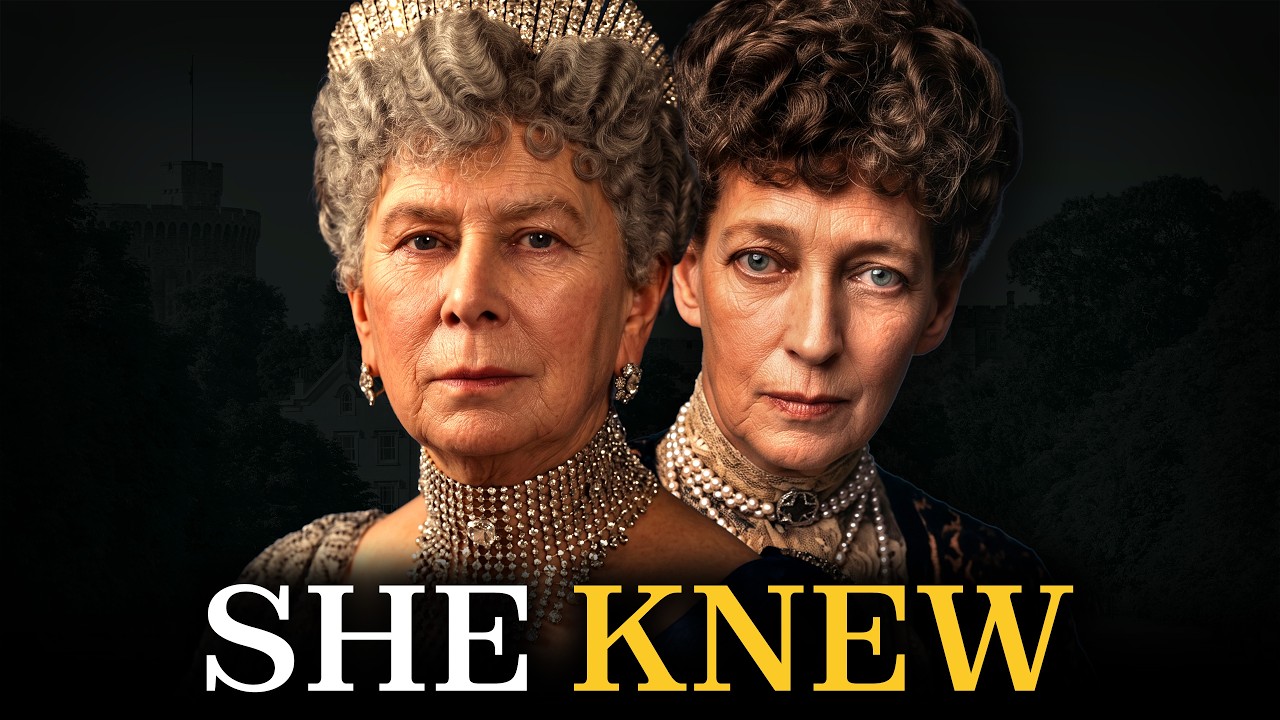
No one in the family had the courage to suggest an alternative. That widow was Queen Alexandra, the king’s mother. The woman confined to the smaller house was Queen Mary. The arrangement defied expectation.
A queen consort of the British Empire, crowned and bedecked in jewels, photographed and bowed to across half the world, returned every night to the lesser residence on her husband’s estate because her mother-in-law preferred not to move. The obvious question imposes itself. Did Mary hate that woman? Not politely, not with quiet resentment, but with genuine grinding hatred for the woman who settled into the grand house and kept the smaller one crowded for a decade and a half.
The documented record offers a timeline that reads harshly on its own. Mary married the future George V in July 1893 and then waited seventeen years to reach the throne. She entered her husband’s family as a stranger and remained one for a long time. Alexandra adored her children with an intensity that left no emotional space for anyone who entered their lives later.
Her sons called her Motherdear and continued using that name until her death in 1925, long after they had married. One of those sons was the king and emperor. When Edward VII died in May 1910, everything changed on paper in an instant. The crown passed to his son, and the woman beside him became queen consort with all the residences and precedence the role carried.
In reality, the British royal transition of 1910 involved far more than an exchange of titles. The palaces entered the picture, one of them left to the widow by name, and the jewels followed. Some pieces belonged to the institution and some were personal property, with the dividing line between them drawn loosely. Above all hovered precedence, the unglamorous mechanism of who entered a room first and who wore what.
Alexandra, now the queen dowager, showed persistent reluctance to surrender any of it. She delayed her departure from Buckingham Palace, leaving Mary in an administrative vacuum, unable to establish her household in the building built for exactly that purpose. The closest thing this story has to Mary’s own voice comes indirectly in a letter that complains of nothing. Corresponding with George V during that transitional period, she described feeling strange and lonely without him and the children, lost in her new surroundings, before arriving at the phrase biographers return to again and again.
She missed Marlborough House more than anything else. A woman who had just become queen of the United Kingdom, standing on the threshold of the greatest promotion available to any woman in the country, wrote to her husband about missing her old address. Sandringham provided the long version of the same problem. Edward VII left Sandringham House, the big house, to Alexandra for life, a documented arrangement.
That gave her the right to remain there until her death. Against that right stood the royal tradition that the reigning monarch occupies the principal residence, because the residence exists for the king, not for anyone attached to him. The matter landed on George V’s desk. His father’s wishes pointed one way, centuries of practice pointed another, and his mother stood at the intersection.
He chose his mother and explained that choice to his court in a single sentence. It is my mother’s house. My father built it for her. The practical result placed the king and queen of the United Kingdom and their six children in York Cottage, a far smaller property elsewhere on the same grounds, for the next fifteen years.
Not in a different county, not even at a polite distance. The family lived within sight of the house that custom had assigned to them for a decade and a half. From 1910 to 1925, six children grew up in an auxiliary dwelling while the main house held one widow, her staff, and a monarch who ran an empire from a building that might embarrass a provincial banker. One detail prevents this from becoming a simple story of a difficult mother-in-law.
Alexandra never needed to win this dispute because it never became a dispute at all. George V removed even the possibility of confrontation by conceding before anyone raised the subject. Alexandra occupied the house. Her son handed it to her twice, first in the public submission of that sentence about his father, then in fifteen years of silence on the matter.
The jewels turned reluctance into an open statement. Certain pieces in the royal collection were official rather than personal, meaning they belonged to whoever held the office of queen consort. When the office changed hands, the pieces should have followed. Alexandra proved unwilling to give up that kind of jewelry after 1910.
Then came the piece that turned hesitation into declaration. She kept the small diamond crown of Queen Victoria even after her widowhood, and in 1913 she wore it publicly at the wedding of Prince Arthur of Connaught. Think about what a wedding meant in this context. Half the extended royal family gathered in one room, along with every courtier in the country trained from birth to note precisely which woman wore which item.
Alexandra entered that room three years after her son took the throne wearing Victoria’s crown. Mary entered too and saw it. No confrontation occurred because confrontation was never an available option for either of them. Mary submitted to Alexandra’s status publicly without exception, and both women maintained a united front that never cracked before any audience, however small.
The 1913 wedding gives the clearest surviving picture of the entire relationship. A queen dowager wearing something she had no right to wear, and a queen consort watching silently without comment. Whether Alexandra meant to send a signal or simply loved the crown and saw no reason to give it up remains beyond what the sources can confirm. Both explanations fit the evidence, but only one fits a headline.
The angry version of this story ignores an entire book. Georgina Battiscombe published her biography of Alexandra in 1969, ten years after James Pope-Hennessy gave the world his portrait of Mary as patient and suffering. Her reading of the same behavior takes a completely different direction, based on a physical fact rather than psychological speculation. Alexandra suffered from severe otosclerosis, a condition that gradually destroyed her hearing.
By the time of her widowhood she could barely hear at all. Deafness at the royal court was more than an inconvenience. Court life ran on conversation, on the quick exchanges across the dinner table that told you who held influence at that moment. Being cut off from it, hearing nothing in that environment, removed a woman from the room while leaving her body inside it.
Alexandra clung to her sons, her houses, and her royal status because those things resisted an illness that could not be repaired. The palaces stayed in place whether she heard a word or not, and the crown stayed on her head regardless. Her sons, who had called her Motherdear long before the deafness began, never stopped. Through that lens, the fifteen years at Sandringham cease to look like territorial aggression and begin to look like survival.
The behavior of an isolated elderly woman holding on to a few markers of significance her condition could not erode. The cost fell directly on her daughter-in-law. This is an interpretation as well. Battiscombe cannot prove Alexandra’s motive any more than Pope-Hennessy can prove Mary’s resentment.
Both authors had a professional stake in the sympathy of their subject. Set the two accounts side by side and the result is better than either alone. The same documented actions are interpreted twice, reasonably, in opposite directions. The Cullinan diamonds destroy the simple version.
Edward VII privately bought the Cullinan VI and VIII diamonds for his wife, placing them in a different legal category from pieces attached to the office of queen consort. They were hers personally. With no custom or precedent obliging her to surrender them to anyone, after his death she gave them to Mary. She did not sell them, nor were they seized by a campaign of courtiers.
The woman who refused to vacate Buckingham Palace on schedule, who wore Victoria’s crown at a family wedding, handed them to the daughter-in-law waiting in the smaller house. Mary set those stones into the Delhi Durbar parure, one of the most distinctive sets in the collection. The diamonds Alexandra donated ended up defining Mary’s image as queen. A woman who guarded her status obsessively and held on to her possessions past the point where custom dictated surrender then voluntarily transferred two personally owned diamonds to the person most affected by all that guarding.
Generosity sits in the record and fits hatred in neither direction. The documented records confirm a state of frustration. Administrative and domestic frustration lasting from 1910 to 1925, caused by Alexandra’s refusal to surrender her position as the maternal center of the monarchy, resting on her delayed departure from Buckingham Palace, fifteen years in York Cottage, the retention of jewels, the crown at the 1913 wedding, and Mary’s own letter about missing Marlborough House. But the records do not support explosive hatred.
Nothing in them suggests deliberate sabotage or a dispute managed through intermediaries. No evidence of open war survives, and no public scandal attached to the relationship because both women held greater respect for the institution than they felt for each other. Hatred works as a passing event. It flares, a door slams, and eventually someone apologizes or dies and the story ends.
What Mary lived instead was a condition lasting fifteen years, in which nothing dramatic happened and nothing improved for the woman living inside it. She deferred in public and wrote almost nothing in private, raised six children in the wrong house on the right estate, while her husband gently explained why the situation could not change. You could call it patience, as Pope-Hennessy did, or duty, the word Mary herself might have chosen. Neither description survives one observation.
Over thirty-two years, the woman never once got a chance to lose her temper, which seems strange for anything you could call a choice. Alexandra died in 1925. The fifteen years ended the only way they could have ended. Her sons still called her Motherdear to the very end.
She kept the houses and the jewels because holding on to things was her language of love, and that language worked on her children in a way it never worked on Mary. For Mary, the obstacle disappeared only after it had consumed the years it was meant to consume. By then her children were adults. The reign stretched on for three and a half decades, and whatever the great house at Sandringham might have meant to a young queen consort in 1910, it meant far less to the woman who finally outlived its claimant.
No record survives of Mary celebrating or settling any accounts. That silence matches the preceding thirty-two years of a woman who married into the family in 1893 and spent every year since refusing to put her grievances on paper. The tensions remained exactly where both women had kept them for a decade and a half, private and unresolved, never disturbing the smooth running of the monarchy. So did Queen Mary secretly hate Queen Alexandra?
Not in the sense the phrase usually carries. No letter survives in which Mary poured out her heart. No witness described a shouting match. No evidence points to sabotage from either side.
And the documented generosity flows in the other direction in the form of the Cullinan diamonds that Alexandra owned outright and gave away. What the evidence supports looks like this. A woman who waited seventeen years to become queen, then waited fifteen more to live as queen while the previous title-holder stayed in the great house, kept the crown, wore it at a family wedding, and was called Motherdear by the king who could have ended the whole matter with a single sentence but spent his time defending her instead. Mary’s reply lies in one letter about missing Marlborough House.
Two biographers examined the same facts and reached contradictory conclusions about the inner lives of these two women. One sees a patient victim of a domineering mother. The other sees a frightened, broken widow clinging to the last things her illness could not take from her. Both interpretations survive the evidence, and neither can be proven conclusively.
That leaves the version no one prints as a summary. Two women who may never have hated each other at all, imprisoned by an institution that for thirty-two years gave them no way to resolve anything, and one house fewer than there should have been.