By April 1945, the war in the West had stopped making sense to almost everyone still fighting it. Bavaria’s backroads were choked with columns retreating toward towns that had already surrendered days earlier, and orders arriving by courier described units and supply depots that no longer existed except on paper. The cold had loosened its grip, but the fields on either side of the roads were churned to mud by traffic that never seemed to stop, moving toward an ending nobody could quite name. The women swept up into American custody that spring came from every corner of a system dissolving faster than anyone could process it.
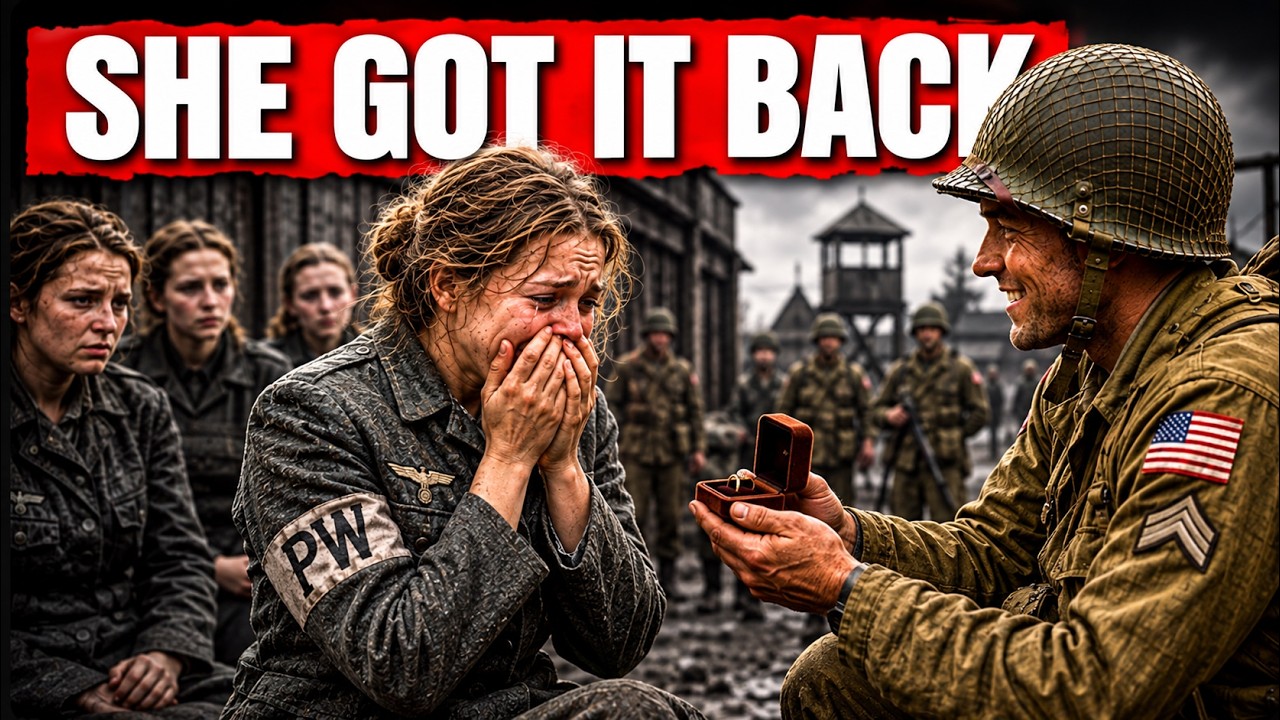
Luftwaffe auxiliaries who had spent the winter reading radar screens for incoming bomber formations. Teleprinter operators who had relayed messages for headquarters that had already been overrun. Field nurses separated from hospitals that had displaced three or four times in as many weeks. Kitchen and laundry conscripts pulled in when the pool of men finally ran dry.
Some had been in uniform for two years; others had been handed one only that winter, with no training beyond a week of instruction on paperwork and procedure. Most surrendered without a shot fired, in groups that formed and reformed as officers vanished ahead of them or simply walked off into the countryside. The camp that absorbed one such group in the second week of April had been an agricultural cooperative before the war. A low complex of storage barns and a brick administration building, requisitioned by advancing engineers and strung with wire in the space of a single afternoon.
It was not built to hold people. The barns smelled of grain dust and diesel long after the grain had been moved out. The administration building had two working rooms and a hallway lined with folding tables where processing happened in shifts, day and night, because more prisoners kept arriving than there was staff to receive them. Processing meant paperwork, questions relayed through an interpreter when one happened to be available, and a search.
Every prisoner had her belongings laid out, itemized, and in a great many cases confiscated. The women had been warned about this more specifically than almost anything else they had heard about American captivity. Their own retreating officers had said it plainly more than once. The Americans loot.
They take watches, jewelry, cameras, anything with value or novelty, and they file it as confiscation while they mean souvenir. Hide what you can carry. Expect to lose the rest. For most of the women, what they carried was not valuable in any way that would interest a soldier hunting a trophy.
It was smaller than that, and it mattered more. A photograph gone soft at the corners from two years folded into a coat lining. A ring that had belonged to a mother killed in a bombing raid the previous autumn, too small for the daughter who wore it on a cord around her neck instead of a finger. A letter still sealed, addressed to a fiance stationed somewhere on a front that no longer existed as a coherent line on any map anyone was still drawing.
These were the things they had protected through weeks of marching, through searches conducted by their own officers, through nights spent in barns and roadside ditches. They arrived at the folding tables already braced to lose them. The soldier working the third table that afternoon was a staff sergeant from a quartermaster unit, temporarily reassigned to intake duty. A job nobody in his outfit had wanted, and that he had inherited mainly by being nearby when the assignment came down.
He had been processing prisoners for six straight days by the time this group came through, and he had watched the same small ritual repeat itself dozens of times an hour. A woman would set her belongings on the table, watch his hands the way a person watches something they expect to have taken from them, and wait. When the woman with the ring on the cord reached his table, she did what the others had done. She set everything down together, a folded coat, a tin cup, the photograph, the ring, and stepped back half a pace without meeting his eyes.
He went through the pile the way he had gone through everything else that day, logging the coat, logging the cup, writing details into the ledger open in front of him. When he reached the ring, he stopped writing. He picked it up, turned it once toward the light from the window behind him, and set it back down on top of the folded coat instead of in the tray where confiscated items were collected. He said something short, a word she didn’t recognize, and pushed the whole pile back across the table toward her.
She didn’t move for a moment. Years of dealing with authority that punished hesitation had taught her not to ask for clarification when something failed to match what she expected. She looked at the pile, then at him, and he made a small motion with his hand, pushing the air toward her. Unmistakable in any language.
Take it. She picked up the ring first. Word of it moved through the barn before she had fully processed what had happened herself. Not as any announcement, nobody made a speech about it, but the way information travels in a place where everyone is quietly watching everyone else for signs of what’s coming.
By the time the last of the group had been through processing that evening, several of the women had noticed the same pattern repeated at more than one table. Watches logged and handed back. Photographs barely touched, glanced at and returned. One woman carrying a small prayer book had it opened page by page by a soldier checking for anything hidden inside the binding.
Then it was closed and returned to her hands without a word about the German inscription on its cover. It was not universal, and none of the women mistook it for policy. Cameras were taken without exception, logged as possible intelligence material, and moved to a separate table nobody expected to see anything come back from. A soldier at the first table confiscated a pair of field glasses without a second look.
One guard elsewhere in the yard was reported, in a complaint an officer noted but never fully resolved, to have pocketed a watch himself. A detail some of the women later cited when asked whether they were describing kindness or simply a rule they hadn’t understood at first. The system was not built around sentiment, and it did not behave consistently table to table. But the specific category of things that carried no value to anyone except the person holding them, letters, photographs, small religious items, a child’s drawing one older woman had kept folded inside her identification papers, kept coming back into the hands that had carried them there.
According to postwar interviews gathered decades later as part of an oral history project on female internment in the European theater, this was not the generosity of one sympathetic sergeant but something closer to an informal, unwritten habit that had taken hold among several processing units operating through Bavaria that spring. US Army military government files from the period make no explicit distinction between personal and valuable effects where female prisoners are concerned. But veterans interviewed afterward described an understanding that had developed among the enlisted men running intake, one nobody issued as an order and nobody needed to. You logged and held what might matter to an investigation.
You left alone what only mattered to the person standing across the table from you. The woman with the ring spent that first night in a converted grain barn with straw laid over concrete. She told an interviewer years later that she didn’t so much sleep as lie there with her hand closed around the ring, turning over what had happened at the table. She had been ready, she said, for the ring to become one more entry on a long list of things the year had taken from her.
Instead, it became something she didn’t yet have language for. She was careful not to inflate it into more than it was. The sergeant hadn’t smiled at her. He hadn’t said anything she understood.
He had looked at a small ring on a cord, decided it belonged to her and not to the United States Army, and moved on to the next item on the table. In the days that followed, the cooperative filled further as more groups arrived from the last collapsing pockets of resistance scattered through the region, and the pattern held with roughly the same inconsistency, imperfect from table to table and soldier to soldier, but present often enough that the women began cautiously to adjust what they expected from it. A woman who had lost a glove somewhere in the final days of marching asked, through the single interpreter assigned to the barn, whether she might write to a sister whose last known address now sat inside territory advancing toward the Soviet zone. She expected a refusal or a shrug or no answer at all.
The interpreter carried the question to an officer who said that correspondence for prisoners of war fell under Geneva Convention provisions and that Red Cross channels would open once the camp’s backlog cleared, probably within the week. It was not a fast answer. It was not a warm one. But it treated the question as legitimate, and that alone was unfamiliar enough that she mentioned it specifically more than three decades later.
What the women found themselves reconciling over those first ten days at the cooperative was not one dramatic act of mercy but an accumulation of small refusals to take what didn’t need to be taken. A sergeant who could have pocketed a ring and chose to log it for return instead. An officer who answered a question about mail rather than dismissing it. A folding table where the difference between a camera and a photograph was treated, without anyone saying so aloud, as a moral distinction and not merely an administrative one.
This ran against nearly everything they had been told to expect and against a great deal of what they had lived inside their own military structure, where personal possessions were routinely requisitioned in the name of the war effort and questioning that requisition invited suspicion rather than an answer. The system they had served for years operated, several of them would later say, on the assumption that an individual’s attachment to any object or any small comfort was a weakness the war could not afford to indulge. What they found at the cooperative was a system running on something closer to the opposite assumption, one that treated a ring on a cord as worth the extra thirty seconds it took to look at it and decide it wasn’t contraband. None of this erased the larger facts of where they stood.
Food at the cooperative was basic, sometimes thin. News from home arrived rarely and unreliably. Many of the women would not know for months whether their families had survived the bombing that had leveled entire districts of the cities they came from. The uncertainty didn’t lift because a sergeant had handed back a ring, but something else had shifted.
They had expected the war’s ending to strip away everything, including whatever remained of who they had been before it started. Instead, a stranger who couldn’t pronounce their names had looked at the smallest, least strategically significant object they owned, and treated it as theirs. Years afterward, when the cooperative’s buildings had long since returned to agricultural use and the war had receded into history taught in classrooms rather than lived through, a handful of these women gave interviews to researchers documenting the experience of German women in Allied captivity. Almost none of them led with the ring, or the letter, or the answer about the Red Cross.
Those details surfaced later in the conversation, offered almost as an afterthought, the way people mention the thing that mattered most only once they’ve decided the listener can be trusted with it. What they led with instead was the same observation, phrased differently by each of them but circling the same point. They had been told the Americans would take everything.
What they found, in a series of small, unremarked decisions at a folding table in a requisitioned grain barn, was an army that had decided, without ever announcing it, that some things simply weren’t theirs to take.