In the spring of 1986, a night nurse named Elvir Gozin was caring for a woman in a townhouse at 4 Rue du Champ d’Entraînement in the Bois de Boulogne, Paris. When Gozin later described those final years to a biographer, two phrases came out: the Duchess had become a prisoner in her own home, and she had died in a slum. The person controlling that house was not a rival or a court enemy. It was Wallis Simpson’s own lawyer, a French attorney named Suzanne Blum, who had begun as a trusted professional and spent roughly a decade dismantling everything Wallis had left.
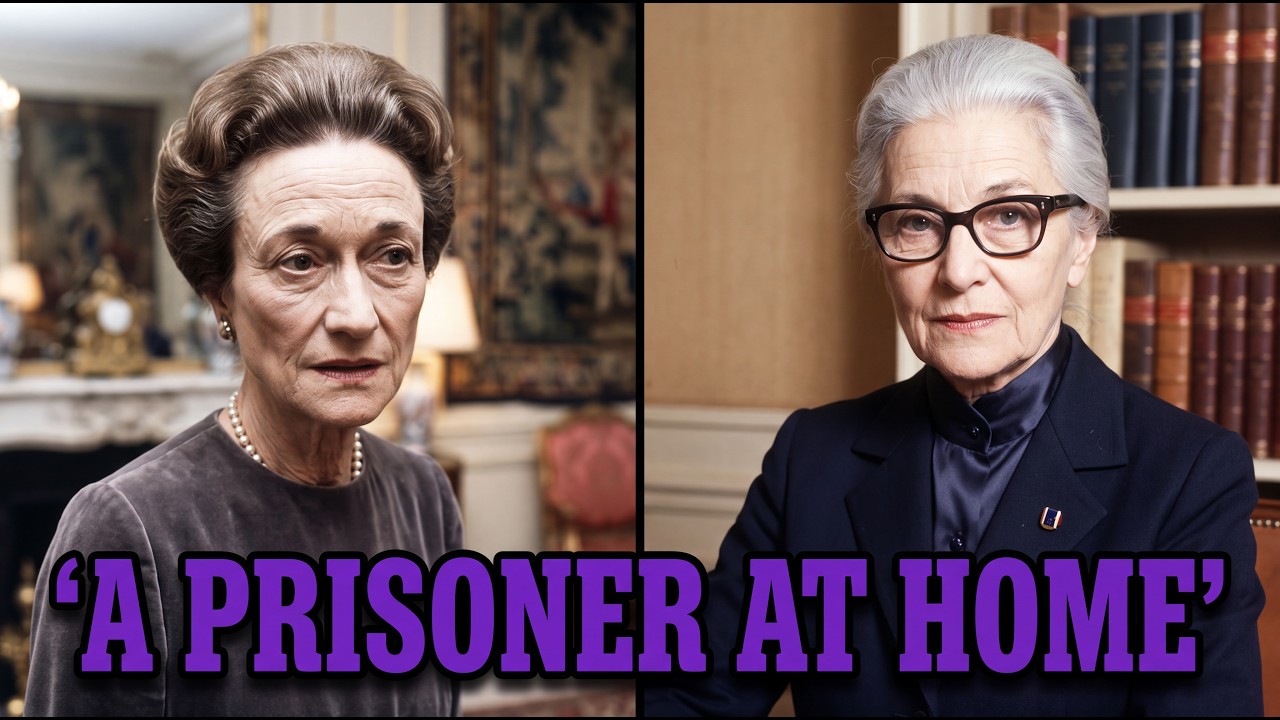
In September 1943, Blum had written to an American diplomat: “The best way to keep someone as a prisoner is to surround him with love, affection, and friendship. ” By 1986, that line read differently than it had in 1943. The story begins in May 1972. Queen Elizabeth II, Prince Philip, and Prince Charles arrived at the house in the Bois de Boulogne.
The Duke of Windsor, the man who had been Edward VIII for less than a year before his abdication in December 1936, was dying of throat cancer. The visit was almost certainly a final goodbye. Ten days later, on May 28th, the Duke died at home. Wallis was flown to London for the funeral, stayed at Buckingham Palace, then returned to Paris.
After the Duke’s death, Wallis had three protections: a rent-free house the French government allowed her to occupy, a voluntary pension of 5,000 pounds a year privately promised by the Queen, and a legal support network across two countries. Sir Godfrey Morley of the London firm Allen & Overy managed English affairs. For French matters, there was the firm built by the late Paul Weil, the Duke’s Paris attorney since 1952. Weil had died in 1965.
His widow was Suzanne Blum. She had been inside the Windsor orbit for years. The question was how far she would go once the Duke was gone and no one was watching. Suzanne Blum had impeccable credentials.
She was admitted to the Paris bar on January 22nd, 1924, when women had held the right to practice law in France for only a few years. She specialized in entertainment contract law and represented clients like Rita Hayworth, Warner Brothers, and Walt Disney. She also wrote crime novels under a pseudonym. During the German occupation, she and Weil, both Jewish lawyers, fled to New York.
She kept practicing, kept accumulating honors, and was by 1972 a commander of the Légion d’honneur. The trust she had built was exactly the mechanism she used to protect herself. According to documents recounted by biographers, Blum told Wallis the French government might evict her from the rent-free house unless her estate was arranged in ways the French authorities would find satisfactory, insisting she would have to bequeath everything to the Louis Pasteur Institute. Those close to the Duke attested he had stated in his will that after Wallis’s death, everything, money, jewelry, paintings, artifacts, should return to Britain.
Blum was not simply managing the estate. She was redirecting it. The first casualty was Sir Godfrey Morley. Blum told Wallis that Morley was trying to get her money.
Wallis, widowed and increasingly reliant on the people physically present, believed it and signed a letter naming Blum as her sole legal representative. That was 1973. It happened during a hospital stay. Wallis had fallen out of bed at Christmas 1972.
When doctors confirmed in the new year that she had broken her hip, she was 76 years old. The hospitalization for surgery gave Blum the opening she needed. Vickers is explicit: it was while Wallis was in the hospital, away from her English lawyers, away from her support staff, unable to consult anyone who might advise against it, that Blum had her sign away Morley. Later, after reviewing the files, Vickers concluded: it was while the Duchess was in hospital with a broken hip that Blum effected this coup.
Wallis recovered physically from the surgery. The legal outcome was catastrophic. Before the fall, she was frail but still capable of independent decision-making. After Blum’s coup, she had signed that world away, and no one who might have challenged it was left in the room.
Then the household began to go. The English chef, the concierge, the chauffeur, the hairdresser. Each was dismissed, each replaced with staff of Blum’s choosing. Financial papers were burned, locks were changed.
Staff who remained were pushed out. Blum prevented the Duchess from leaving her room and barred friends from visiting. Around 1973, Wallis fell again in a bathroom, striking the bathtub hard enough to break several ribs. Then, in November 1975, a severe intestinal hemorrhage sent her to the American Hospital in Paris in critical condition.
Her longtime companion Johanna Schutz had been planning that same year to take Wallis to live in New York at the Waldorf Towers, well outside Blum’s reach. Schutz said later: we were all set to go, then the Duchess suffered a perforated ulcer because Blum had worried her so much. That’s when all her troubles started. After that, she was too ill to travel or impose her wishes.
By 1978, Wallis was a total invalid, unable to speak or move, spoon-fed by nurses. By 1981, one of her doctors described her as a vegetable. Multiple sources note her medical and nursing care was outstanding. Whatever was being taken from her, physical suffering in the narrowest sense wasn’t part of the calculation.
The cruelty was more deliberate than that. The legal mechanism that made all this possible was the power of attorney Blum had secured. The exact date is contested in the sources, but the practical effect is not. By the mid to late 1970s, Blum had authority to sign contracts, sell property, and conduct legal correspondence in Wallis’s name.
She could do legally whatever she determined was appropriate, then report the results to a woman who could no longer speak, protest, or seek a second opinion. The paper trail became visible by 1977. On August 30th, 1977, a jonquil diamond ring was sold to cosmetics magnate Estée Lauder for $150,000. The ring had been photographed on Wallis’s finger just six years earlier.
The caption to that photograph is precise: the ring was sold without her knowledge, but with the authority of Blum. Wallis didn’t know it was gone. The most extensively documented jewelry sales took place in January and March 1976. Vickers’s research places the total from those two sales at approximately $470,000.
Then came what Vickers describes as a distribution of spoils. From September 1976 through December 1977, jewelry and precious objects were allocated to a small circle. The Duchess’s doctor received items. Blum received a ring with an oval amethyst surrounded by turquoises and diamonds, an amethyst necklace, a Louis XV gold box, and a gold cigarette box.
The inscription read: “David from Wallis, 1935 Christmas. ” A gift from Wallis to the man who abdicated the following year rather than lose her. Now it sat in the possession of the woman who had inherited control of her affairs. The scale of the loss is visible only when compared to what survived.
Sotheby’s Geneva auctioned the Duchess’s remaining jewelry on April 2nd and 3rd, 1987, a year after her death. The pre-sale estimate was 7 to 7. 5 million dollars. The sale realized approximately 50.
3 million dollars. What was gone before Sotheby’s could assess it can only be estimated from its absence. At the time of Wallis’s death, Blum confirmed that the Institut Pasteur in Paris would inherit the residual estate. Wallis had no documented connection to the institute.
Schutz, who had seen a copy of Edward’s original will, stated it directed that after Wallis’s death, everything should return to Britain. The Duke had stated he never wanted any piece of jewelry he had made for the Duchess to be sold or worn by another woman. They were for her and her alone. What Edward had wanted and what Blum arranged were not the same thing.
Nothing about that arrangement required Blum to have broken any law. She simply had the authority to choose differently. The suppression of the record continued after death. Wallis had wanted certain love letters destroyed.
Blum obtained control of the correspondence and authorized publications using it. Caroline Blackwood, a journalist commissioned by The Sunday Times in 1980 to write about the aging Duchess, described Blum as the most sinister figure she had ever encountered. Blum threatened legal action. The manuscript sat in a filing cabinet, legally suppressed for fifteen years.
Blackwood died before the book came out. The last of the Duchess was finally published in 1995, one year after Blum’s death. Wallis died on April 24th, 1986, of bronchial pneumonia. She was 89.
Five days later she was buried at Frogmore beside the Duke, as they had arranged years earlier. Queen Elizabeth attended. Among those who had known Wallis, the prevailing sentiment at her death was relief. One of her closest friends was reportedly delighted when told the news, wishing only that it had come sooner.
At the burial, the Queen wept. The question Diana Mosley raised in the weeks after the burial was this: do you think we’ll ever know the whole truth? Now, to the final question. A widely shared comment claimed Suzanne Blum ended up blind and paralyzed.
The claim deserves checking. Blum retired from active practice at the Paris bar on December 31st, 1980, six years before Wallis died. She organized the Sotheby’s auction in April 1987 and directed its proceeds to the Institut Pasteur. No court in France, Britain, or the United States ever adjudicated a claim relating to Wallis Simpson’s treatment in her final decade.
No formal complaint was filed against Blum with the Paris bar, which records no disciplinary measures of any kind. She received the Grande Officier of the Ordre National du Mérite in 1989, three years after Wallis died. The French state was still decorating her. Blum died on January 23rd, 1994, in her apartment in the 7th arrondissement of Paris.
She was 95. The Independent’s obituary noted that in her late 80s, Blum had been nearly blind and had retreated from the scene. Nearly blind, not blind and paralyzed. The paralysis in the comment, it turns out, belongs to a different sentence describing Wallis herself: paralyzed and kept in isolation by her ruthless lawyer.
Between that sentence and its retelling in comment sections, the paralysis transferred from the victim to the perpetrator. What Blum never lost while she was alive was her freedom, her legal standing, her professional honors, her Paris apartment, her ability to authorize publications, direct proceeds, and prevent inconvenient books from reaching readers. The books that define her legacy arrived almost entirely after her death. The fifteen years the last of the Duchess sat suppressed is the final exhibit in the case against her.
The mechanism she used to control Wallis’s world, legal threat, legal authority, the power to prevent documentation, she also used to control her own story. She bought herself a clean reputation for the duration of her natural life. Wallis Simpson spent 35 years being described as the most dangerous woman in the world, the one who broke a monarchy. The version that received less attention for decades is the one now fully visible: the same woman spent her last decade unable to speak, cut off from everyone she had ever known, in a house her nurse described as a slum, while the contents of her life were quietly distributed, and her own lawyer never faced a reckoning.
The answer to the comment’s hope is that Blum did not get what she deserved, not legally, not formally, not while anyone could do anything about it. She died at 95, never charged, never investigated, never required to explain herself under oath. The truth about what she did became fully accessible only after she was gone.