In the late summer of 1974, the British royal family was in residence at Balmoral Castle in the Scottish Highlands. On the last Sunday of August, they attended morning service at Crathie Kirk, a small granite church near the estate. Local residents and visitors had gathered along the road, expecting to see a particular young woman accompanying the Prince of Wales.
Reports that summer had linked Prince Charles with Lady Jane Wellesley, the daughter of the Duke of Wellington.
But the woman who arrived with the royal party was someone most reporters did not recognize. She was 23 years old, tall and blonde, and had spent most of her life around horses. Her name was Davina Sheffield.
One biographer noted that Charles could not hide his fondness for her, even in public. Another writer observed something rarer: among the many women linked to Charles in that decade, she was the only one who seemed happy to be photographed with him. Most of the prince’s girlfriends stayed well away from cameras.
Davina Sheffield did not.
In the years that followed, those photographs would sit alongside stories of a very different kind.
Davina Mary Sheffield was born on March 1, 1951, the younger of two daughters. Her father, Captain George Berkeley Sheffield, was an officer in the Grenadier Guards, one of the oldest regiments in the British Army. He was a younger son of Sir Berkeley Sheffield, the sixth baronet, so he inherited no title.
The family was well connected but not royal, not even high aristocracy. Her mother’s side brought newer money. Agnes, her mother, was the daughter of Harry McGowan, the first Baron McGowan, a Scottish industrialist who had led Imperial Chemical Industries, one of Britain’s largest companies.
The family line stretched back to John Sheffield, Duke of Buckingham, who built a grand London residence in 1703 called Buckingham House. The Crown later bought it, and it became Buckingham Palace.
In 1968, when Davina was still a teenager, her father died. Public records say little about the years that followed. What is clear is how she entered adult life.
Girls from families like hers were expected to take part in “the Season,” a series of parties, luncheons, and horse races in London and the country. The Season was where young women met suitable husbands. What a girl was not supposed to have, if she wanted a successful marriage, was a “past.”
Davina took part in the Season as a debutante. In her early twenties, she worked in a clothes shop. She was also an accomplished rider, and photographs of her at country horse races still exist from 1979.
She had a boyfriend named James Beard, a Harrow-educated powerboat racer. Reports later suggested they shared a country house he owned near Winchester in Hampshire for about six months. In early 1970s Britain, unmarried couples living together was becoming more common.
But for a certain kind of bride, it still mattered.
In 1974, Charles met Davina Sheffield at a dinner party hosted by Lady Jane Wellesley, whom he had briefly dated the year before. Charles was in his mid-twenties, serving as an officer in the Royal Navy. Five years earlier, the Queen had invested him as Prince of Wales in a televised ceremony at Caernarfon Castle.
He was the most watched bachelor in the country. Every young woman seen with him became a potential future queen.
In a 1969 television interview, Charles said his future wife would need to be a very special person. He also said people would expect a great deal from her. He told a magazine that he never advised marrying too young.
The press began a countdown.
Davina was not free when they met. She was still with James Beard and was hesitant at first. According to biographer Penny Junor, the prince kept trying, and eventually Davina gave in.
Her relationship with James Beard ended. Charles invited her to Balmoral for the August holiday. Her appearance at Crathie Kirk was the first public sign that she had been invited to join the family.
Balmoral had been bought for Queen Victoria by Prince Albert in 1852. For a new guest, the visit was also a test. Newcomers were watched during meals, on walks across the hills, and on shooting days.
Royal writers even had a name for it: “the test.” Reports said Davina passed. She got up early enough to see off the shooters in the morning.
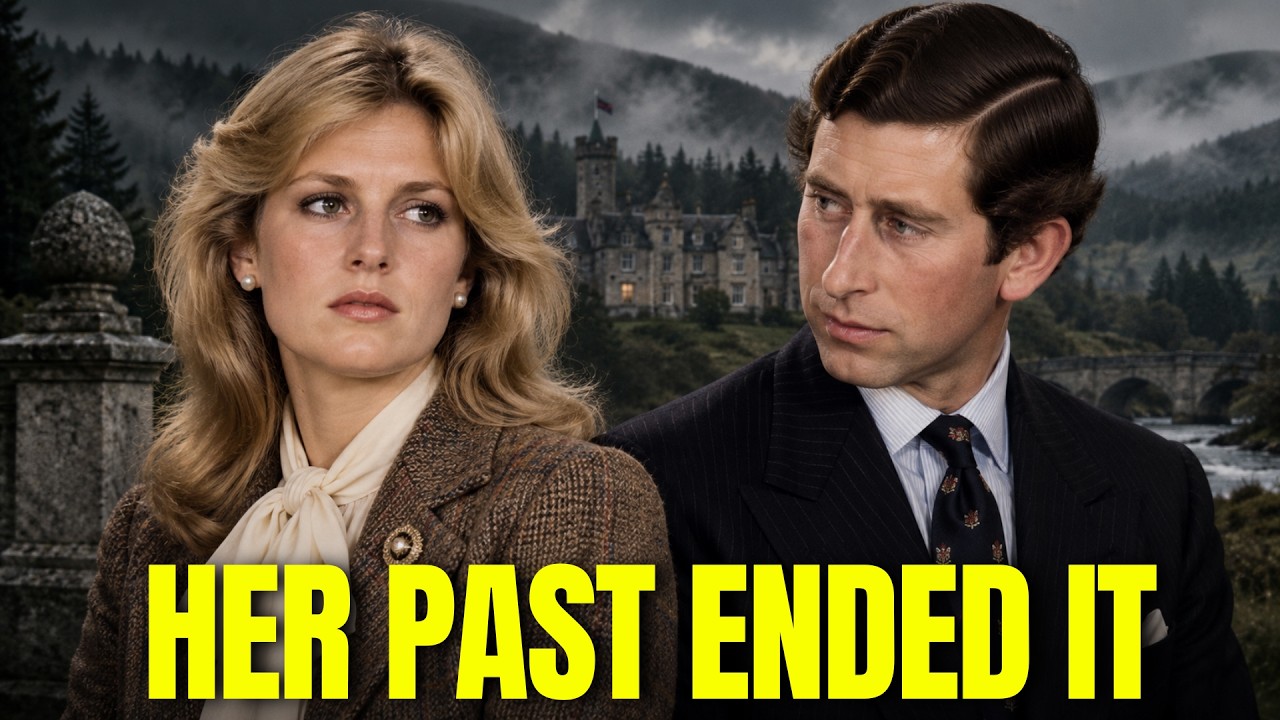
Guests were expected to walk long distances and dress for Highland weather. She was also said to have won the approval of the Queen Mother.
Away from Scotland, she was regularly photographed in the passenger seat of the prince’s open-top Aston Martin, a gift from the Queen for his 21st birthday. The convertible roof meant anyone on the pavement could see who was sitting beside him. They appeared together at equestrian events.
A photograph from those years shows Charles and Davina driving a carriage together at Windsor. One writer described her as a girl from the velvet class, blonde and striking.
The tabloids later borrowed a name from a new American television series and called the prince’s girlfriends “Charles’s Angels.” To the press, Davina looked like the answer to the question they had asked for years: Who would the prince marry? She was well connected, a good rider, and seemed to have his family’s approval.
In theory, she was an ideal choice.
Then, in late 1974, Davina Sheffield did something few young women in her circle would have done. She left for a country at war.
Saigon was hot all year round. The Paris Peace Accords had been signed in January 1973, and by that spring the last American combat troops had gone home. But the fighting between North and South Vietnam had not stopped.
It had simply become a war the West paid less attention to. Years of conflict had left orphanages across the South under immense strain. Davina went to Saigon to volunteer at a home caring for young boys.
Photographs taken by British press photographer Terry Fincher in 1975 show her at an orphanage in Saigon. Months earlier, she had been waking early to see off the shooters at Balmoral. Now she was in a city running out of time.
In early 1975, North Vietnamese forces launched a new offensive in the South. City after city fell within weeks. Her obituary in the Telegraph says the communist advance forced her to leave after only a few weeks.
It says she faced the situation with dignity. In April 1975, American aircraft evacuated thousands of Vietnamese children in an operation known as Operation Babylift. The first major flight crashed shortly after takeoff on April 4, killing more than 100 people on board, many of them children.
On April 30, 1975, Saigon fell. The war was over. According to the timeline in her obituary, Davina had already left the city well before that day.
Back in England, the prince was still part of her life. In 1976, Charles took command of his own ship, the minesweeper HMS Bronington. By the end of that year, he had left the Navy.
In the same year, he founded The Prince’s Trust to help young people in difficulty.
In early 1976, a loss of a different kind occurred. Davina’s mother, Agnes Sheffield, was killed by burglars at the family home in Oxfordshire. She was 62 years old.
Published accounts give almost no details. The Telegraph says Davina turned to the prince for comfort and their relationship grew stronger. Penny Junor later wrote that in 1976, Davina could have been the soulmate Charles was looking for.
That year, the relationship came fully under public scrutiny. The couple was photographed together at the Guards Polo Club in Windsor. Davina was also seen sitting with the Queen and Prince Philip at an equestrian event, a public signal that the family was comfortable with her presence.
Charles took her to a wedding as his guest. By autumn, one account says, they were seen holding hands in public. By October 1976, newspapers were reporting that an engagement announcement was near.
The Queen’s Silver Jubilee was scheduled for the following year. A royal engagement would fit perfectly into a year of celebrations.
Everyone was waiting for the ring.
But a future queen had to pass another test, one that had nothing to do with her personally. In the 1970s, the law placed few restrictions on whom the heir could marry. The Act of Settlement prevented him from marrying a Roman Catholic.
The Royal Marriages Act required the monarch’s consent. Beyond that, it came down to expectations. A future queen was supposed to arrive without a romantic past anyone could point to.

The word that kept appearing then and now was “unblemished.”
The monarchy had reasons to be nervous. In 1936, King Edward VIII had abdicated to marry Wallis Simpson, an American divorcée. In 1955, Princess Margaret announced she would not marry Group Captain Peter Townsend, a divorced man.
Both events had taught the palace to fear any hint of scandal around a royal marriage.
Penny Junor put the rule plainly later. At the time, she said, it seemed there was a need for his bride to be a virgin. She added that the bride was also expected to be aristocratic and a member of the Church of England.
Those expectations had already touched the prince’s life once. Junor said Camilla Shand had not met many of these conditions. Camilla married someone else while Charles was at sea.
A private letter written to the prince himself makes the rule clear. In February 1974, Lord Mountbatten, the last Viceroy of India and the most influential mentor in Charles’s young life, wrote to his great-nephew. The letter was later quoted in Jonathan Dimbleby’s authorized biography.
Mountbatten wrote that before settling down, a man in Charles’s position should have as many relationships as possible. As for the wife, he advised choosing a suitable, attractive, sweet-charactered girl before she met anyone else. In the same letter, he noted that a woman with experience would find it difficult to remain on the pedestal of a king’s wife.
The prince was advised to have a past. The woman beside him was expected to have none. Davina had already met someone else.
The man was James Beard. The News of the World, a weekly tabloid founded in 1843 and bought by Rupert Murdoch in 1969, was selling millions of copies every Sunday. In the 1970s, royal correspondents followed the prince to polo grounds, ski slopes, and shooting parties.
Any woman beside him could expect her own past to be examined. Without the prince, Davina’s story would never have been news at all.
Reporters tracked down James Beard. The man who had stepped aside for the prince was the one the reporters went looking for. Published accounts after Davina’s death do not give the exact date of the story.
The Telegraph chooses its words carefully in her obituary. It says Beard was apparently tricked into talking. The paper reported that he and Davina had enjoyed a full relationship while living together near Winchester.
Later coverage called the cottage a love nest. That phrase followed her even into her obituary, published 50 years later.
That was enough. By the conventions of the time, a publicly known past ruled a woman out as a royal bride. It did not matter that the relationship had ended.
Because there was no engagement, the palace had nothing official to confirm or deny. As a girlfriend, Davina had no official status and no press office speaking on her behalf. The story did not say she had done anything wrong.
It simply described a past.
Then Beard said something else: “I think she would make a wonderful wife and a very good queen.” One account offers these words as his attempt to make amends. It was a compliment.
By then, it could not erase what had already been printed. What Davina said, if she said anything, was not recorded.
No engagement was ever announced. Royal correspondents later wrote that the story ended the romance completely. The accounts do not describe how Davina and Charles parted or what was said between them.
They record only the outcome. Davina Sheffield was never betrothed to the Prince of Wales. Whatever she felt about those months, she never seems to have spoken about them publicly or written memoirs.
The same newspapers that tracked the prince’s relationships did not treat his own past as a reason he could not marry.
Decades later, the Telegraph’s obituary described her as the most likely of the prince’s future queens before his marriage. It also noted that, looking back, she may have had reason to be grateful.

For Charles, the search continued. He would not marry for several more years. After Davina, the press linked him to a series of other women, including Lady Amanda Knatchbull, Mountbatten’s granddaughter, and Lady Sarah Spencer.
Mountbatten’s hopes regarding Amanda came to nothing. In August 1979, Lord Mountbatten was killed by an IRA bomb on his boat off the coast of Ireland.
Then came Lady Sarah Spencer’s younger sister. Diana was the daughter of Earl Spencer. Her grandmother, Ruth, Lady Fermoy, was a lady-in-waiting and close friend of the Queen Mother.
When the press found her, she was working as a kindergarten assistant in London. In February 1981, Lady Diana Spencer became engaged to the Prince of Wales. She was 19.
He was 32. She had no known romantic past. Her uncle made sure everyone knew it.
When asked in the engagement interview whether they were in love, Diana said yes. Charles added: “Whatever ‘in love’ means.” They married at St Paul’s Cathedral on July 29, 1981.
Hundreds of millions of people around the world watched on television. The press called it a fairy tale.
Back in 1976, the newspapers had expected a different bride. Five months after the engagement was announced, on December 21, Davina Sheffield also married. She was 30.
Her husband was Jonathan Morley, known as Jake, a commodities broker and Eton graduate in the City of London. He was the son of an army colonel and had two sons from a previous marriage. The wedding was photographed.
After that, Davina largely disappeared from public view.
The couple settled on a large estate in Yorkshire. They had three sons, Thomas, William, and Henry, known at home as Tom, Billy, and Harry. According to the Telegraph, she lived there happily, away from press intrusion.
Her sons grew up in northern England. For four decades, the cameras lost interest.
The rule that ended her romance continued to play out in public. Charles’s marriage to Diana collapsed. They separated in 1992 and divorced in 1996.
A year later, Diana was killed in a car crash in Paris. In 2005, Charles married Camilla Parker Bowles in a civil ceremony at Windsor Guildhall. Both had been married before.
In 2013, Parliament passed a law ending the ban on the heir marrying a Roman Catholic. Two years earlier, Prince William had married Catherine Middleton. The couple had shared a student flat at university, and no one called it a scandal.
In 2022, Jake Morley died. He and Davina had been married for more than 40 years. That same year, Queen Elizabeth II died, and Charles became king at the age of 73, the oldest person ever to ascend the British throne.
In 2023, the woman who had not met the old requirements was crowned queen beside him. The rule was never written down, so no one had to abolish it.
On September 2, 2026, Davina Morley died at the age of 75. Her sons announced her death. It came after a short illness.
She was survived by her three sons and her two stepsons. A celebration of her life was planned for November. For a few days, the newspapers remembered her again.
Most used photographs from the 1970s. The headlines called her the former king’s soulmate and the woman once tipped to be queen.
The photographs remain. A tall young woman beside the heir to the throne. At polo matches.
At equestrian events. In the passenger seat of an open car. Davina Sheffield’s story is not really about a crown she lost.
It is about who had the right to tell her story. She married once. The marriage lasted more than 40 years.