In March 1945, a train carrying one hundred German prisoners of war pulled into a rail spur north of Corvallis, Oregon. These were men of the Afrika Korps, captured two years earlier in the wheat fields of Tunisia and shipped across the Atlantic in the hold of a Liberty ship. They had been told in training that Americans shot prisoners for sport and that surrender was worse than death. They stepped off the train expecting a firing squad.
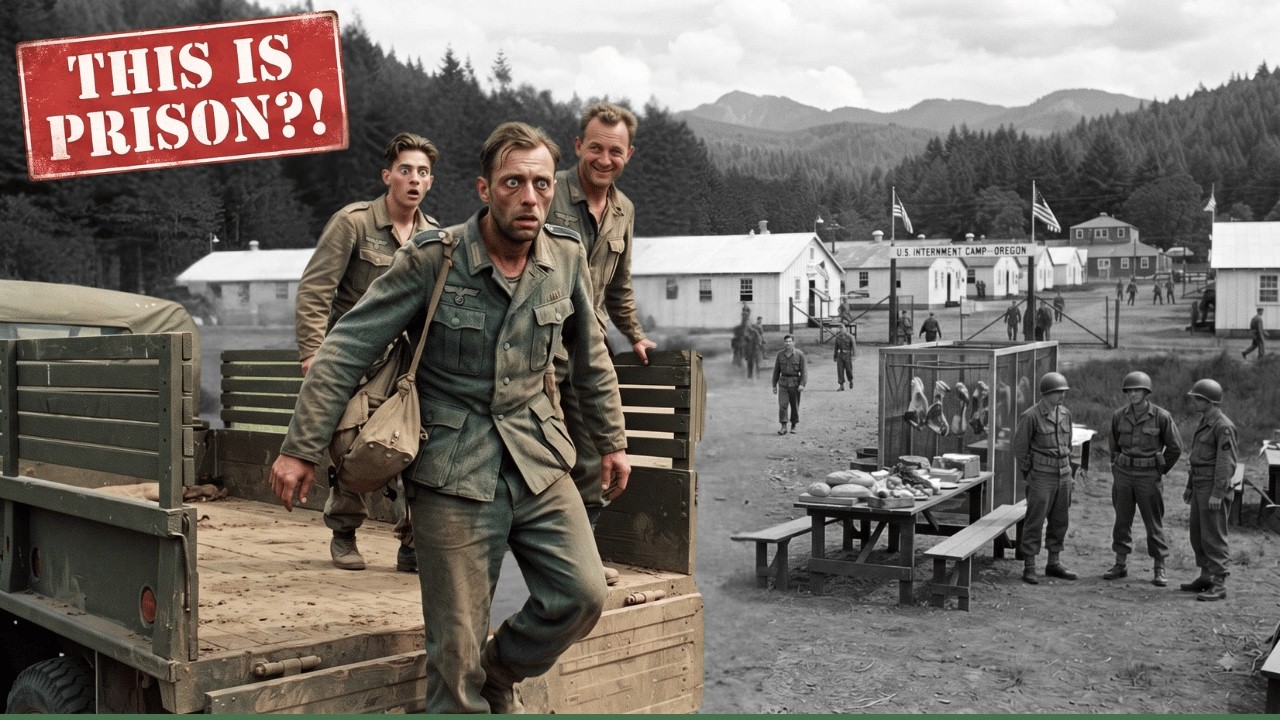
Instead, they found hot stew, a stable mattress, and a country so vast and untouched that they began to doubt everything they had been taught. Decades later, one of them would tell his grandchildren the same sentence again and again: “I thought I had been sent to heaven. ”
The story began in May 1943. Field Marshal Erwin Rommel had been recalled months earlier as Allied bombing collapsed his supply lines.
Fuel, ammunition, and water had run out. The panzer divisions that had once raced the British across the desert now sat immobile in the Tunisian hills. On May 13, a young German sergeant named Willi Gross walked into a yellowing wheat field with his hands raised. Around him, nearly a quarter of a million men in gray-green uniforms were doing the same.
Gross had spent eleven months in North Africa, a war of hunger, thirst, and endless retreat. He had watched men die of dysentery and infected wounds and had seen an eighteen-year-old hang himself from a truck frame because he could no longer stand the fear. As he stood in the wheat waiting to die, a British corporal walked up and handed him a canteen of water and a piece of hard biscuit. When Gross drank half the canteen, the corporal refilled it from a canvas bag and returned it.
That small act of casual mercy was the first thing Gross would remember for the rest of his life. He spent nine days in British holding pens, then was trucked to the port of Oran in Algeria. There the American command had made a decision: rather than send empty Liberty ships back across the Atlantic, they would fill the holds with prisoners. The decision would eventually transport more than 370,000 Germans to camps across nearly every state in the Union, creating the largest prisoner-of-war operation in history.
Gross climbed down into a cargo hold with six hundred other men, expecting a U-boat to sink the ship at any moment. Six hours out of port, American cooks lowered containers of beef stew, boiled potatoes, canned peaches, and white bread. The Germans stared at the food, convinced it was poisoned. Gross was the first to take a bite.
He did not die. He took another, and then the others began to eat. The voyage lasted eighteen days. They were fed three times a day and allowed on deck in small groups.
No torpedoes came. On the eighteenth day, they reached Norfolk, Virginia. The prisoners were showered, photographed, and issued new clothing: two denim work uniforms stenciled with large white “PW” letters, underwear, socks, boots, a wool overcoat, a toothbrush, soap, and a razor. Then came a four-day train ride west.
Gross sat by the window and watched the largest country he had ever imagined pass by. There were no bombed-out cities, no refugees, no trenches. There was only farmland, small towns with white church steeples, cattle under enormous skies, and factories with smoke rising in thick columns that meant production, not destruction. Goebbels had told him American factories were failing.
The train windows told him something different. He was transferred through camps in Louisiana, Texas, and Arizona. In the deep south, Black soldiers guarded him, and Gross, raised on Nazi race theory, watched them do their jobs with a competence and dignity that made him ashamed of every Hitler Youth lecture he had sat through. He picked cotton, learned a few words of English, and was paid eighty cents a day in scrip.
He learned to sleep on a mattress and drink coffee with cream. In early spring 1945, he was loaded onto another train and carried west one final time. The train crossed the Columbia River at Portland at seven in the evening and turned south into the Willamette Valley in the long spring dusk. Gross pressed his face to the window.
He saw green mountains, pine forests, and farmland folding gently between low hills. It looked, in the fading light, exactly like the countryside where he had grown up. He heard American swing music drifting from a farmhouse, music that had been banned in Germany since he was a boy. The train pulled into Camp Adair after nine that evening.
Camp Adair had been built in 1942 as an army training facility. At its peak, forty thousand soldiers had trained there, enough to make it the second-largest city in Oregon. By 1944, the divisions had deployed and the camp had emptied. It was reclassified as a prisoner-of-war facility in July 1944.
Now Gross stepped down from the Pullman car onto a wooden platform. The gates were open, and they would remain open most days for the next two years. The first morning began at six with an American bugle call. Breakfast was oatmeal, scrambled eggs, bacon, toast with butter, orange juice, and coffee.
Gross ate all of it. He would gain fifteen pounds in six months. At seven-thirty, the work details began. The Willamette Valley was starving for labor.
Every able-bodied American man had been drafted, the women had gone to shipyards and aircraft factories, and the Japanese-American families who had once worked the strawberry fields and hopyards had been rounded up in 1942 and sent to internment camps. So the German army did the work. Gross was assigned to a farm east of Corvallis. An American farmer in his sixties demonstrated how to work a bean row with a hoe, then handed the hoe to Gross and watched him make several passes.
He nodded and said one word: “Good. ” It was the first word of English Gross learned on American soil. At lunchtime, the farmer’s wife came out with a basket of sandwiches and cold milk. She spoke to them in careful, uncertain German learned from her own grandmother.
“Guten Appetit,” she said. Gross did not know how to answer. “Danke,” he said. She patted his shoulder and moved on.
The war went on without them. While Gross worked the fields, Allied armies closed in on the Rhine, and the Red Army fought its way toward Berlin. Gross followed the advance on maps in the Portland Oregonian, the black arrows moving east every day. He attended English classes taught by an American lieutenant who had studied philology at the University of Chicago.
He read American paperbacks, including John Steinbeck and books about the Civil War. He read a newspaper editorial that called the sitting president a warmonger and demanded his impeachment. He read it without fear, and he began to understand that this was what freedom looked like: the boring, everyday fact that you could read a magazine that insulted your government and go to sleep afterward without wondering if you would be alive in the morning. Two hundred miles south, at Camp White outside Medford, another young German named Gerd Wagner was learning the same lessons.
He had arrived in April 1944 with sixteen hundred prisoners, all captured in Tunisia. He worked in a pear orchard owned by a family whose sons were fighting in the Pacific. The daughter, Zemenia, was nineteen. She should have hated them.
She could not. They were boys, thin and watchful, wearing stenciled work uniforms. They picked pears, ate her mother’s sandwiches, and slowly began to talk—about the towns they came from, their sisters, their mothers. One afternoon, a prisoner from Dresden began to cry in the orchard.
His street had been destroyed in a bombing raid. His mother had survived; two aunts and four cousins had not. Zemenia sat down beside him on an overturned pear box, and after a while her mother came out with lemonade. The three of them sat and cried together for Dresden and for the boys from Medford who were not coming home.
Not everyone in Medford felt that way. On strict rationing, locals wrote angry letters about prisoners eating roast beef and drinking real coffee. The camp commander read the letters and filed them, feeding his prisoners in accordance with the Geneva Convention because he understood that if Americans starved German prisoners in Oregon, the German army would starve American prisoners in Bavaria. One afternoon, a woman in a black dress came to the fence line at Camp White.
She held a photograph of her eighteen-year-old son, killed in Italy. She came back three more times that summer, always in silence. Not every camp looked like Camp Adair. At Camp Aiken in South Carolina, on the night of April 6, 1944, a young corporal named Horst Günther was pulled from his bunk by two men from his own barracks.
He had said openly that Germany would lose the war and that Americans treated prisoners fairly. Erich Gaus and Rudolf Straub, committed Nazis, took him to a wooded area, strangled him with a rope, and hung his body to suggest suicide. They were convicted by American court-martial. “I am no murderer,” Gaus said.
“I merely fought for the honor of my fatherland. ” They were hanged at Fort Leavenworth on July 14, 1945, two months after Germany’s surrender. In response to such killings, the American command created the Special Projects Division in the winter of 1944, led by a Scottish-born poet named Edward Davidson who spoke no German. From a quiet coastal artillery post at Fort Kearney in Rhode Island, Davidson and a staff of academics produced a German-language newspaper called Der Ruf, written by German prisoners and edited by anti-Nazi intellectuals, including men who would later become giants of postwar German literature.
At its peak, Der Ruf reached more than seventy-five thousand of the 370,000 German prisoners in American custody. Willie Gross read it in his bunk at Camp Adair. He read articles about the concentration camps discovered in Poland, the eyewitness reports, the photographs of bodies stacked like firewood. He remembered a Jewish boy named David from his school class.
David and his family had disappeared, and his mother had said they had moved. He wrote a letter to his mother asking her what she had known. On May 8, 1945, the loudspeakers at Camp Adair announced Germany’s surrender. The prisoners stood in the compound and listened.
They did not cheer or weep. They turned silently to their barracks. The surrender was not a shock; it was an arrival, the confirmation of something they had known for months. The prisoners did not go home that summer.
The American harvest still needed labor, and millions of American soldiers were still overseas. The prisoners worked through the harvest of 1945, pulled potatoes and picked apples. The mood in the compound changed. Some men broke quietly in ways that did not show up on camp records.
A man stopped speaking for six weeks. Another began wetting the bed. A third walked the compound at night, doing nothing, just walking as if movement were the only thing keeping him alive. In the autumn, the guards began showing films shot by army signal units that had entered the concentration camps in April and May.
The films showed the bodies, the ovens, the mass graves, the living skeletons in striped uniforms. The German prisoners were required to watch. Gross watched all of it to the end. In the morning, the work details assembled and rode out to the farms, and they did not speak about what they had seen because the words for it did not exist in either language.
That autumn, some prisoners working near the Klamath Basin passed within sight of Tule Lake, the largest Japanese-American internment camp. Eighteen thousand American citizens had been held there. The German prisoners noticed that they had more freedom than the Japanese Americans held just across the wire. They could get on a truck and work in the open; the Japanese Americans could not.
It disturbed them, and it should have, because the country teaching them about democracy had at the same time imprisoned tens of thousands of its own citizens on the basis of their race. The repatriation orders came at the beginning of 1946. Gross was in one of the last groups to leave Camp Adair. An American guard gave him a photograph of his family with a note on the back written in careful English.
Gross put it in the inside pocket of his overcoat and would carry it, folded and unfolded a thousand times, for the rest of his life. The train to Seattle left Corvallis on a gray morning in early March. The Liberty ship reached Bremerhaven in April. Gross stood at the rail and looked at the ruins of the port, the blackened steel skeletons of warehouses, the twisted dockyard cranes, the streets cleared just enough for military vehicles to pass.
An American occupation officer processed the returning prisoners at a table on the pier. He did not smile or shake hands. Gross made his way home over three weeks, through transit camps and the ruins of railway stations. He shared a boxcar with a former Wehrmacht sergeant who had spent two years in a British camp in Wales.
The two men compared notes on the enemies who had turned out not to be enemies at all. The sergeant said something Gross would remember for the rest of his life: “We lost the right war. ”
He found his mother living in one room of a ruined building. His father had been killed in a bombing raid on the factory where he had been forced to work.
She wept and kept saying his name. That night, she asked him where he had been. He told her about the pear orchards, the bean fields, the country that had fed him three meals a day while she had lived on turnip soup. He showed her the photograph.
She said, “I do not understand. ” He tried to explain. Gross rebuilt his life in western Germany, married, and raised a family in the democracy that the Special Projects Division had labored to prepare him for. He stayed in touch with the American guard for the rest of his life.
When his son was born in 1949, he named him after the guard. When his daughter was born in 1953, he named her after the guard’s wife. He told his children the truth: that he had served in the army of Adolf Hitler, that he had believed things a decent man should not have believed, and that a chance in Oregon had saved him. Gerd Wagner returned to Germany in 1946 but could not settle in a country ground into rubble and shame.
He immigrated to the United States in the early 1950s, settled in California, and raised a family. When an Oregon historian tracked him down decades later, he answered with the words that would come to define the entire program: “We had a lot of fun. ” Another prisoner, Hines Bertram, returned to Medford, Oregon, and opened an upholstery shop in a wooden building that had been physically moved from the grounds of Camp White after the camp was dismantled. He spent the rest of his working life repairing furniture inside the same walls that had once held him as a prisoner of war.
He became a citizen, raised a family, and was buried in the Rogue Valley under a headstone bearing his German birth date and his American death date. Zemenia stayed in the Rogue Valley all her life. Interviewed by Oregon Public Broadcasting in 2015 at age ninety, she was asked what she remembered about the German prisoners. She thought for a long time and then said: “They were just people like us.
”
Camp White was closed in 1946, sold off as surplus, and became a wildlife area. Camp Adair was demolished the same year. The factory at Fort Kearney was closed, and its editors went home to Germany, where they founded the most important literary movement in postwar German history. Edward Davidson went back to his poetry and teaching.
He died in 1970, and most of his obituaries said nothing about the year and a half he had spent editing a secret newspaper for the enemy. The story was declassified slowly over the decades. Very few Americans have ever heard of it. The 370,000 German prisoners who had been held in the United States went home to a country that no longer existed and helped rebuild the Federal Republic of Germany into one of the most stable democracies in postwar Europe.
Most of them never spoke publicly of their years in captivity, and most Americans who had guarded them never spoke of it either. It was a quiet story, the story of what happens when a nation chooses, in the middle of the largest war in human history, to feed its prisoners instead of starving them, to pay them instead of working them to death, and to teach them instead of breaking them. When Willie Gross was an old man, he would say that the year he arrived in Oregon was the year he understood that a country could be strong without being cruel. He thought he had been sent to heaven.
He was wrong. It had not been heaven. It had been something better.
It had been America.