On the morning of May 19, 1836, thirty-four people stood inside a small timber stockade on the Texas prairie. They were men, women, and children, including an infant asleep in his mother’s arms. The fort, built by the Parker family with their own hands, was supposed to be their guarantee of safety. Then the tree line moved.
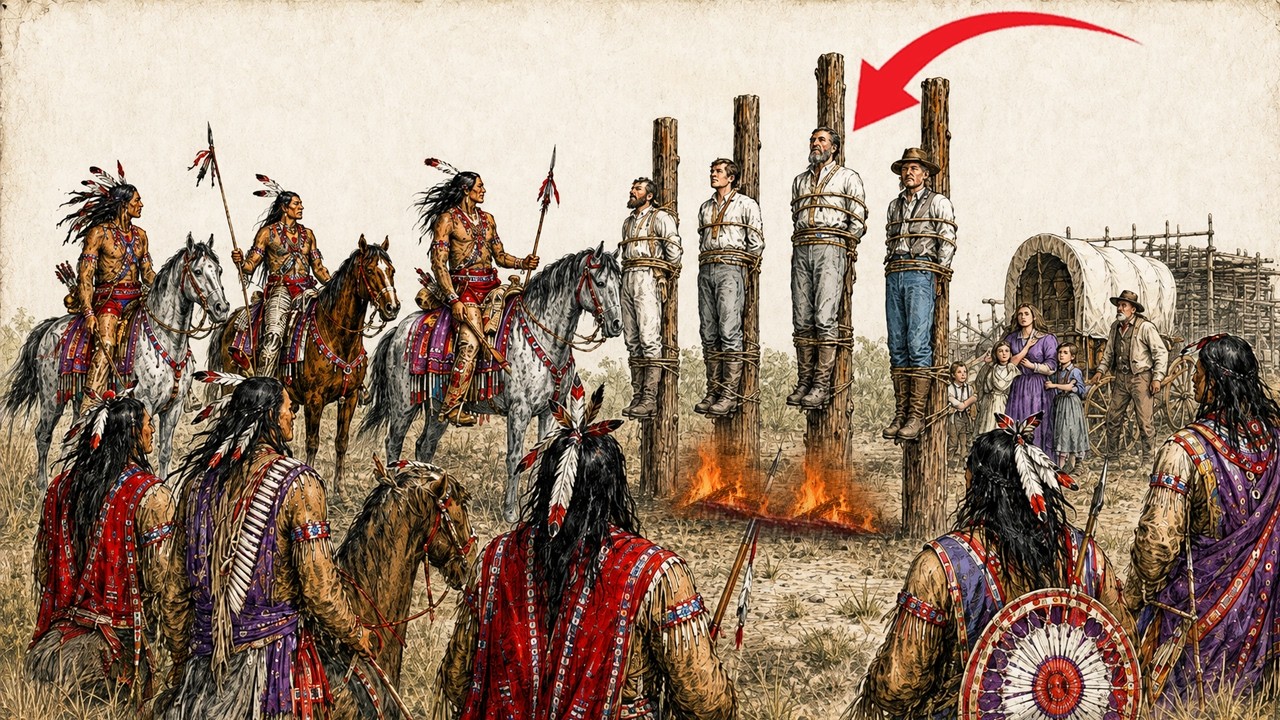
Not a breeze in the timber, but a shape, then another, then hundreds. Comanche riders emerged at a full gallop, painted horses, bows, lances, and muskets. In less than an hour, five people inside the fort would be dead. Five more would be taken alive, dragged across the prairie and into a world none of them had ever seen.
Among those taken was a seventeen-year-old mother named Rachel Parker Plummer, whose fourteen-month-old son James Pratt clung to her. Her nine-year-old cousin, a quiet child named Cynthia Ann Parker, also stood inside the walls. Within twenty-four years, when the Texas Rangers finally found Cynthia Ann, she would not want to come home. She would have a Comanche husband and Comanche children, and one of those children would grow up to lead the last free Comanche band on the plains.
The Comanche who rode toward the fort that morning were not a random war band. They were the dominant military power of the Southern Plains, the finest light cavalry in the Western Hemisphere. A Comanche boy learned to ride before he could walk properly. By ten, he could shoot arrows from beneath the neck of a galloping horse.
By fifteen, he rode in raiding parties. Their composite bows could fire twenty arrows in the time a settler could reload a rifle once. Their tactics were centuries old: move at speed, strike where the defenders were weakest, take horses and goods and captives, kill the men who fought, and leave before help arrived. There was no help coming for Fort Parker.
The nearest settlement lay miles away across open prairie. A small group of riders detached from the main body and approached the gate slowly, raising a hand in the sign language of the plains. They wanted a parley. Elder John Parker, the sixty-eight-year-old patriarch of the family, had spent his adult life on frontiers and trusted his ability to read another man’s face.
If he rode out to talk, he reasoned, perhaps the day would end without bloodshed. If he refused, the fort would certainly be attacked. He walked out through his own gate, unarmed or lightly armed. As soon as he was in the open, he was cut down.
In the moment his body hit the grass, the riders at the gate and the hundreds waiting in the timber became one single wave. The fort’s most experienced defender was dead. The gate was left open. From the moment Elder John Parker walked through the gate to the moment his family’s world ended was less than five minutes.
Rachel tried to run. She later wrote, “I tried to make my escape, but alas, alas, it was too late as a party of the Indians had got ahead of me. Oh, how vain were my feeble efforts to try to run to save myself and little James Pratt. ” She was seized, stripped, beaten with whips and bows, and dragged by her hair across the prairie while made to carry her son.
The Comanche made deliberate decisions about who lived and who was taken. Adult men who fought were killed. Some women were killed. Five were kept alive by choice: Rachel, her son James Pratt, Cynthia Ann, Cynthia Ann’s six-year-old brother John Richard Parker, and Rachel’s aunt Elizabeth Kellogg.
Roughly twenty-three of the original thirty-four escaped in the chaos, fleeing into timber and creek bottoms. They would carry news of the attack to the outside world. The raiders rode hard, punishing on purpose. They stopped only briefly for water, knowing they had perhaps a day before any pursuit could be organized.
Rachel, half-naked and bleeding, was forced to keep pace. Beatings came when she stumbled, when she asked for water, when she looked at her son on the other horse. Somewhere on the second or third day, they crossed into the Comancheria, the heart of Comanche territory, a country the size of France that no American force controlled. Once the raiding party dispersed, Rachel entered the second phase of a captive’s life.
She was assigned to a Comanche family, made to gather firewood, dress hides, cook, carry water, and pack and unpack the camp whenever the band moved. She was beaten for slowness, beaten for defiance, subjected to sexual violence, starved, and forced to run gauntlets between rows of women and children armed with sticks. And yet, not every Comanche in her life was cruel. Older women slipped her food.
The same warriors who had cut down her family were in camp as kind fathers. The Comanche were not a monolith. They were a people, and the world inside their camps held both those who would hurt her and those who would not. Rachel was not the only captive on the frontier.
Some were traded between bands. Some were adopted outright. Some were ransomed. Some never returned.
Her son James Pratt did not survive captivity. Rachel watched the beginning of that ending with her own eyes, seeing the infant held between two Comanche women who were, in their own way, caring for him, hearing him cry, unable to reach him. She endured twenty-one months of captivity before a party of Comancheros trading with the Comanches purchased her back in February 1838 and put her on a horse pointed east. When she returned to her husband Luther, she was emaciated, scarred, and her body carried injuries that would never fully heal.
She wrote her captivity narrative in early 1839, and within months of finishing it, she died. She was twenty years old. Elizabeth Kellogg was ransomed within months by Delaware Indians paid by Sam Houston, and returned to her family. John Richard Parker was returned years later, restless, and eventually rode back to the plains on his own.
But Cynthia Ann Parker vanished entirely from the perspective of her Anglo family. She grew up Comanche, took the name Naduah, and married Peta Nocona, one of the most feared war chiefs on the Southern Plains. She bore him three children, including a son named Quanah. In 1860, twenty-four years after the raid on Fort Parker, a company of Texas Rangers under Sul Ross attacked a Comanche camp on the Pease River.
They found a woman with blue eyes, clutching a small daughter, trying to flee. They realized who she was and took her back. Cynthia Ann did not want to be there. She tried repeatedly to escape.
She begged in Comanche to be returned to her husband and sons. She was never reunited with them. Her small daughter died of illness within a few years, and Cynthia Ann, broken by grief in a language nobody around her spoke, died in 1870. Her Comanche son, Quanah, grew up to be the last free war chief of the Comanche people.
He led the Quahadi band, one of the last hostile bands on the plains, and fought the United States Cavalry. In 1875, out of horses, out of buffalo, out of options, Quanah Parker rode into Fort Sill and surrendered. He spent the rest of his life as a rancher, a politician, and a bridge between worlds. He is buried in Oklahoma.
His mother, taken from Fort Parker at nine, is buried beside him. The raid on Fort Parker did not end the settlement of Texas. It hardened it. It produced the Texas Rangers as an institution and a generation of frontier men whose politics on Comanche matters could be summarized in a single word: extermination.
It produced a fear of the Comanche moon, the summer full moon bright enough to raid by, that persisted in Texas households for generations. The historical count of the massacre is often exaggerated. Five people were killed outright. What made Fort Parker terrifying was not the death toll but the taking: twenty-four years of Cynthia Ann’s life spent as a Comanche woman, and the fact that when the Rangers found her, she did not want to come home.
For the children taken under ten, the Comanche did not merely hold them. They absorbed them, adopted them, gave them names, married them, loved them. When Cynthia Ann was pulled back to Anglo Texas in 1860, she was not being rescued. She was being taken a second time from the only life she remembered as her own.
The Comanche world did not last. By the 1870s, the buffalo were gone, the plains were fenced, and the bands were driven onto reservations. The finest light cavalry in North America was ended not primarily by defeat in battle, but by the destruction of the ecology that made it possible. Rachel Parker Plummer stood at the gate of Fort Parker on a warm May morning, watching the timber move.
She did not know she was at the beginning of the most famous captivity story in Texas history. She just knew what she saw. She described it in five words: “More Indians than I dreamed possible. ” That failure of counting was the first sensation of a Comanche raid, not fear but confusion, the mind hitting a number it could not process before the arrows began to fly.
That is what it was like to survive such a morning. It was not surviving. It was being changed forever in the first few seconds by more than a person’s mind was built to hold.