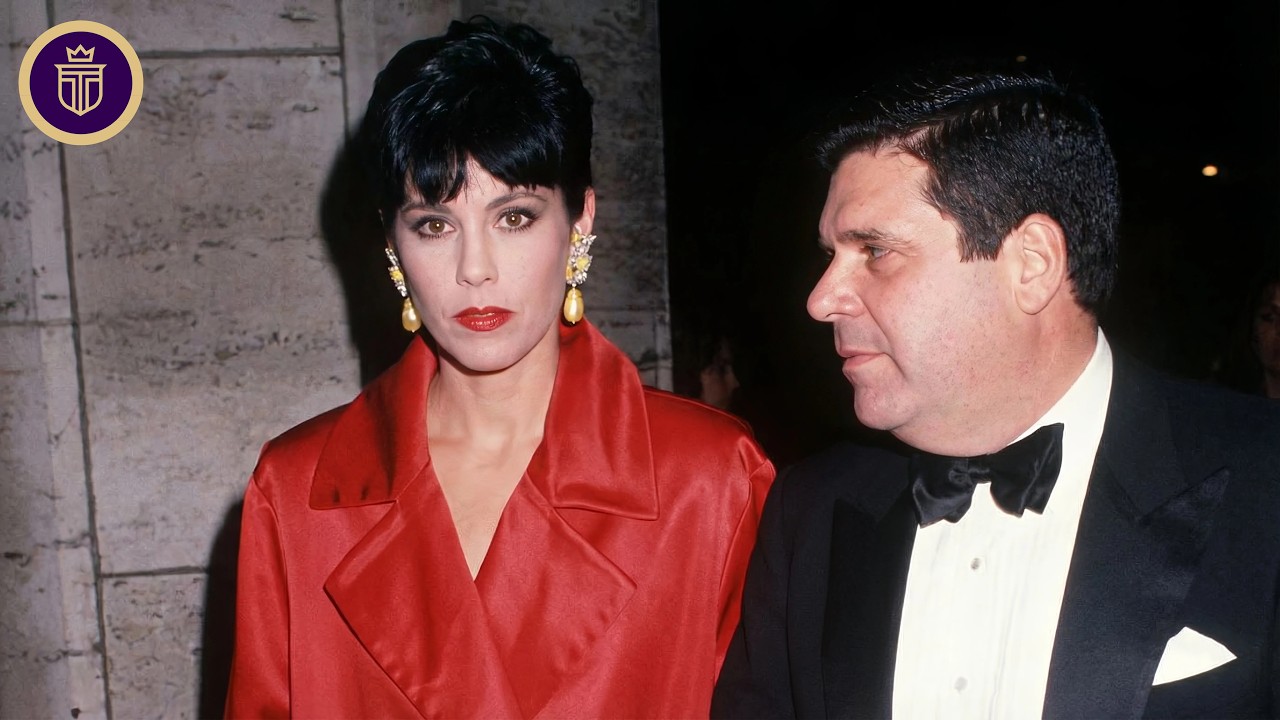
Gayfryd McNab was born in 1950 in Vancouver, the daughter of Ross McNab, a telephone company clerk, and his wife Margaret. The family circumstances were deeply ordinary. By 1989, however, she had engineered one of the most audacious social ascents in New York history, culminating in a birthday party for her second husband, the financier Saul Steinberg, that cost an estimated one million dollars. The event featured ten living tableaux vivants recreating old master paintings, including a live nude posed as Rembrandt’s Danaë.
Oriental rugs had been laid on the lawn to keep guests’ feet dry. Identical twins dressed as mermaids frolicked in the swimming pool. Five hundred citronella candles in terracotta pots surrounded the perimeter. A five-tier cake embellished with gold and silver leaf was presented on a platform flanked by children dressed as cherubs.
Two hundred fifty guests consumed pounds of beluga caviar beneath six-foot flower arrangements inside a replica of a vast Flemish drinking hall constructed from scratch inside a tent erected over the tennis courts. Vanity Fair called it a state-of-the-art party and crowned the hostess a capitalist conga queen. Within two years, the symbolic excess of that evening had curdled into an omen. Within a decade, the entire empire had collapsed.
The 34-room triplex at 740 Park Avenue had been sold. The old masters had been auctioned at Sotheby’s. Saul had suffered a stroke, and Gayfryd had retreated from public life so completely that her friends described her as barely speaking to anyone outside her family. She spent the next two decades caring for the man whose birthday she had celebrated with a million-dollar recreation of the Dutch Golden Age.
Gayfryd’s origins gave little hint of what was to come. At twenty, she dropped out of the University of British Columbia to marry a metallurgy engineer, relocating with him to South Africa. The marriage ended in the mid-1970s, and within a month of her divorce, she married Norman L. Johnson, a Louisiana businessman connected to the insurance industry who owned a mansion on St.
Charles Avenue in New Orleans. By 1982, Johnson had been charged with evading taxes on approximately seven million dollars of personal income, and in February 1983 the IRS issued a jeopardy tax assessment against him in the amount of 7. 5 million dollars. Federal agents physically entered the mansion and removed the chandeliers from the ceilings, disconnecting internal house wiring to extract the fixtures.
Gayfryd was caught directly in the legal maelstrom. On June 22, 1983, the IRS levied a jeopardy assessment against her in the amount of 4. 8 million dollars, targeting her jewelry, artworks, and other possessions. Her artworks were placed in storage at the New Orleans Museum of Art.
Her jewelry was inventoried and lodged in a safety deposit box at the Hibernia National Bank. Rather than accepting the assessment passively, she hired the formidable New York law firm Willkie Farr and Gallagher and filed suit in federal court. Her lawyers were up against Rudolph Giuliani, then United States Attorney for the Southern District. The government capitulated before the case reached adjudication, stipulating to abate the assessment against her property on September 27, 1983.
When the government failed to comply fully with the stipulation, continuing to hold her possessions in what the court found amounted to contempt, she pursued the case further, and the court awarded her counsel fees and costs against the United States. Gayfryd was not charged with any wrongdoing herself. Johnson pleaded guilty to the underlying tax charges and was sentenced in 1983 to a fourteen-month prison term. Gayfryd had already divorced him by then.
Johnson served his sentence and took his own life in 1985. During the Johnson years, Gayfryd had co-founded a steel pipe company called New Era with a friend. Louisiana in the late 1970s and early 1980s was oil boom country, and the business was a serious commercial enterprise. She had made her own way, fought a harrowing financial crisis, and emerged with her assets legally protected.
In November 1982, just as the Johnson legal nightmare was reaching its most acute phase, Gayfryd attended a dinner party in New York given by art dealer Richard Feigen. She was seated next to Saul Steinberg, and the connection was instant. Some accounts note that place cards were rearranged beforehand to ensure the seating arrangement. Saul had been born in Brooklyn in 1939, the son of a manufacturer of rubber bath mats.
In 1961 he had borrowed twenty-five thousand dollars from his father to launch Leasco Data Processing Equipment Corporation, which leased IBM computers at rates undercutting IBM’s own. By 1968, he had used Leasco’s shares to acquire Reliance Insurance Company, a 150-year-old Philadelphia insurer ten times Leasco’s size. He was twenty-nine years old. Forbes named him America’s richest self-made man under thirty.
Through the 1970s and especially the 1980s, Steinberg refined the tactics of the corporate raider. His approach was to acquire a substantial stake in a target company, make aggressive noises about a full takeover bid, then wait for the target’s board to buy him out at a premium, a practice known as greenmail. His most celebrated raid came in 1984, when he launched a tender offer for 49 percent of Walt Disney Productions. Disney ultimately paid him approximately fifty-eight million dollars in profit to withdraw.
At its peak, his personal wealth was estimated by Forbes to exceed six hundred million dollars. They married in 1983, the same year Johnson was sentenced and Gayfryd won her legal battle against the government. The Steinbergs transformed the Rockefeller triplex at 740 Park Avenue into a setting that Vanity Fair compared to a Walt Disney Blenheim. The lobby was dominated by wall-to-wall Francis Bacons.
The baronial living room featured 17th-century Dutch and Flemish art, Rubens, Rembrandt, Titian. Rubens’ Death of Adonis graced the drawing room. Decorator Mark Hampton oversaw the interiors. The effect was of a man who had decided that if he could not be born into the aristocracy of old money, he would simply purchase its aesthetic trappings entire.
By the late 1980s, U. S. News and World Report had dubbed Gayfryd the queen of nouvelle society. Vanity Fair, in its 1986 profile, called her the most likely to succeed of the new money socialites.
Unlike many of the wives orbiting the nouvelle society scene, Gayfryd had genuine intellectual credibility. Norman Mailer, who had recruited her for the PEN committee, found her forthright, diligent, and smart. At one of her early PEN fundraisers, Saul raised two hundred thousand dollars in twenty minutes, auctioneer-style. Their social calendar was a permanent state of mobilization.
Four nights a week, minimum, they attended galas, benefits, dinners, and balls. They flew in six thousand flowers from Europe for a single party. In 1988, when Saul’s daughter Laura married Loews Hotels executive Jonathan Tisch, the Steinbergs hosted the event at the Metropolitan Museum’s Temple of Dendur at a reported cost of three million dollars. The Tisch wedding was a rehearsal for the party that would come the following summer.
The 1989 birthday party was designed by Robert Isabel, who had risen from Duluth, Minnesota through Studio 54. The instructions were simultaneously disciplined and extravagant: stick to the budget, but the budget was her year’s income from Reliance Group Holdings stock. The theme was 17th-century old masters, a homage to Saul’s collection. The party took place on August 5, 1989, at the Steinbergs’ beach house in Quogue, on the South Shore of Long Island.
In her speech, Saul’s daughter Laura praised Gayfryd for finally unifying Saul’s family by three marriages. One guest reportedly remarked, would it not have been better to give a thousand dollars each to a thousand poor people. The hostess, Barbara Hower, defended the event. Two weeks later, Malcolm Forbes threw his own legendary seventieth birthday party in Tangier, Morocco, at a cost estimated at two million dollars.
The New York Times later listed both parties together under the heading Wretched Excess, parts one and two, and included them among the ten parties that shook the century. The first domino fell in 1995 when Saul suffered a stroke. The effects on Reliance’s management were significant. Steinberg fired his brother Robert, his long-time business partner, creating a bitter estrangement within the family.
Gayfryd, who had for years been the social architect of the Steinberg operation, now found herself also serving as his primary caregiver. The financial implosion of Reliance Group Holdings followed. The specific disaster that brought everything down was deep involvement in the Unicover Workers’ Compensation Reinsurance Pool. When the pool collapsed in 1999, Reliance was one of the largest exposed parties.
Net losses in 1999 exceeded three hundred million dollars. The company faced over five hundred million dollars in debt repayments due in 2000. Reliance’s stock, which had represented 890 million dollars in market capitalization in December 1999, had fallen to a mere 23 million by mid-2000. In early 2000, the Steinbergs put their 740 Park Avenue triplex on the market.
Stephen Schwarzman bought it for between 30 and 37 million dollars, a record for a Manhattan co-op at the time. Saul had paid 285,000 dollars for the same apartment in 1971. Then came the art. In 2000, sixty-one old masters paintings sold at Sotheby’s for fifty million dollars, followed by an auction of antique furniture, silver, and porcelain that raised approximately twelve million dollars.
Reliance Group Holdings filed for bankruptcy protection on June 12, 2001, listing total assets of 12. 598 billion dollars against total liabilities of 12. 87 billion dollars. The collapse cost policyholders, investors, and others an estimated three billion dollars.
The 184-year-old Reliance Insurance Company was destroyed. In January 2001, Vanity Fair published the definitive account of the Steinbergs’ fall, titled Vanished Opulence. The piece noted that Gayfryd’s friends were reluctant to talk about her. Gayfryd Steinberg, after the auction, just retreated.
She hardly spoke to anyone outside her family. She did not flee. She did not abandon Saul when his health failed and his fortune evaporated. She devoted the next twelve years to his care.
The years from 2000 to 2012 were lived quietly on the Upper East Side. In 2002 the Steinbergs bought a townhouse at 46 East 73rd Street for 5. 3 million dollars. Gayfryd retained her position on the board of the New York Public Library, a role she had held since 1998.
When Saul passed unexpectedly in December 2012, Gayfryd later told New York magazine, when Saul passed unexpectedly, he could have lived many more years. I had not contemplated anything. The story of how Gayfryd came to marry Michael Schnayerson contains a symmetry that only life produces. Schnayerson had written for Vanity Fair for nearly three decades, including pieces about the Steinbergs.
When someone arranged for Gayfryd and Schnayerson to sit next to each other at a dinner party, the echo of the 1982 seating at Richard Feigen’s was almost too neat. The two defining relationships of her life both began with someone rearranging the place cards. Their courtship began as almost an epistolary romance, conducted through correspondence while they traveled separately over a summer. He invited her to his upstate cottage, where he was writing a book.
She was down in the mud basement within a few days doing the laundry. They married in a synagogue in Sag Harbor in August 2015 with a gospel choir singing as they departed. When I want to do it, Gayfryd said afterward, with what sounded like a recovered pride, I can still do it. The lifestyle Gayfryd managed and promoted was funded ultimately by Reliance Insurance Company, which means in part by the policyholders, employees, and investors who trusted the company with their money and who lost an estimated three billion dollars when it collapsed.
The party she threw in August 1989, with the nude Danaë and the mermaids in the swimming pool and the five hundred citronella candles, remains, more than thirty-five years later, one of the ten parties that shook the century.