On the first of May 1986, an elderly lawyer in Paris faced the wire agencies that had camped on the story for a week. She was not holding a press conference in the modern sense. She was answering questions about a document, and her answers were being cabled to newsrooms in London, New York, and Los Angeles, where they would run under headlines that would get the story roughly twenty-three percent right for the next forty years. The document was a will.
The lawyer explained its shape. There were smaller bequests first, to named charities, some British, some private individuals. Then came the residue, everything left after those donations, and she confirmed the jewelry was included. Reporters asked the obvious question: how much?
She declined to give a figure. She would not estimate the value of the collection, and she would not put a number on the estate. On that day, the only people on earth who knew what the bequest was worth were a handful of insurers, and no one in that room. She did name the beneficiary: the Pasteur Institute in Paris, a biomedical research organization.
And she named one condition: the money was not to be used, directly or indirectly, for vivisection. The client had been dead for exactly one week. She had been buried two days earlier at Windsor. Her name was Wallis, Duchess of Windsor, the American divorcee whose affair with a king of England had brought down a throne.
The lawyer was Maître Suzanne Blum, who had controlled the Duchess’s household for more than a decade. The version of the story the world already knew went like this: Wallis Simpson, snubbed by the British royal family for fifty years, denied their title, denied their homes, denied their forgiveness, took her revenge from beyond the grave by handing the world’s most romantic jewelry collection to a French laboratory rather than let a single stone go back to Windsor. The last laugh, the final act of a half-century feud. It was a wonderful story.
It was also a story that required the Duchess of Windsor to have been making her own decisions, and the documented record of her last ten years did not support that at all. She was born Bessie Wallis Warfield on the nineteenth of June 1896 at Blue Ridge Summit, Pennsylvania, into a family with an excellent Baltimore name and, in her branch of it, no money to speak of. Her father died when she was an infant. What followed was the single most load-bearing fact of her life.
She and her mother lived on the charity of her wealthy uncle, Solomon Warfield, support that was grudging, money that arrived and could stop arriving at the discretion of a man who was not obliged to send it. A child raised on discretionary charity learns a specific lesson. Promises are worth what the person making them decides they are worth. Her first marriage tested that lesson and confirmed it.
In 1916 she married a naval aviator, Earl Winfield Spencer Jr. The marriage was abusive and financially erratic, and Wallis responded by holding on to whatever portable valuables she could secure. They divorced in 1927. In 1928 she married Ernest Aldrich Simpson, a shipping broker.
That marriage ended in 1937, for reasons the entire planet already knew. Here is the pattern that ran under her whole life: Wallis Warfield did not treat jewelry as decoration. She treated it as armor, portable, salable, immune to the opinions of relatives, husbands, and institutions. Everything that followed, including the part where it destroyed her, followed from that.
Her relationship with Edward, Prince of Wales, and then King Edward VIII, became a public constitutional crisis in 1936. On the eleventh of December that year he abdicated the throne. On the third of June 1937 they married at the Château de Candé in France. No member of his family attended.
She became Her Grace the Duchess of Windsor, but not Her Royal Highness. Letters patent issued that same year gave the Duke’s style to him and withheld it from his wife. It stayed withheld for the next forty-nine years. The collection came together across the exile years, almost entirely as gifts from her husband.
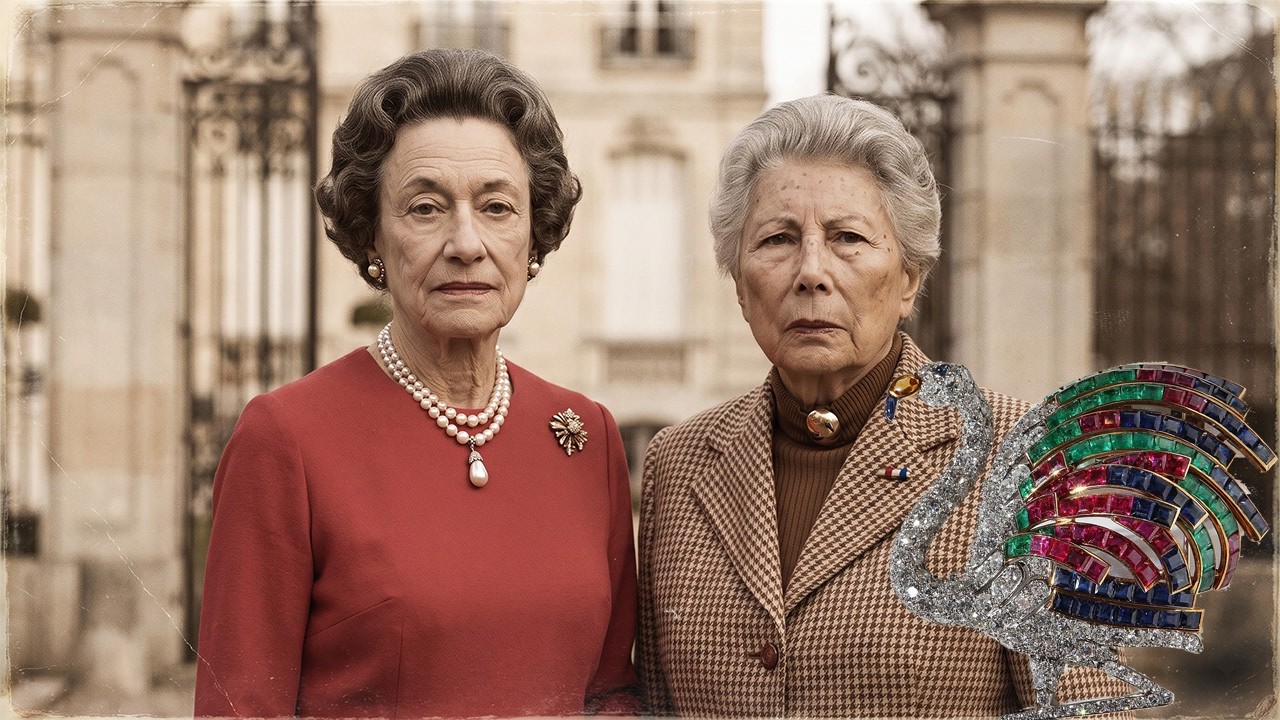
A Cartier flamingo brooch bought in 1940, its plumage set in rubies, sapphires, and emeralds. A gold cigarette case engraved with a map of a holiday route, inscribed David from Wallace 1935, David being what his family called him. Asked by friends why she cared so much about couture and jewels, Wallis gave an answer recorded by Kenneth Rose in his journals: My husband gave up everything for me. I’m nothing to look at, so the only thing I can do is dress better than anyone else.
From 1953 the Windsors’ principal home was a house in the Bois de Boulogne, on a lease from the city of Paris. They never owned it. A lease is a right to occupy for a term. What the Windsors owned inside that house was movable property: furniture, porcelain, paintings, silver, jewels.
Property that can be inventoried, valued, boxed, and sold one lot at a time by whoever has the authority to sign for it. The fortune everybody would eventually fight over was not a great house on a hill. It was contents. It could all be taken out through the front door.
On the twenty-eighth of May 1972, the Duke of Windsor died of cancer at that house. She was seventy-five. The probate figure reported for his estate in England and Wales was £7,845, a rounding error for a former king. The real wealth was already abroad, already movable, and now it was hers alone.
Five weeks after the funeral, an English solicitor wrote down what she said she wanted done with all of it. The memorandum, dated the first of July 1972, recorded that she wanted the residue of the estate dispersed with some thought to Britain, historical papers and objects going where they belong, and the possibility of a charitable foundation in the Duke’s memory. Five days later Lord Mountbatten wrote a letter on the same subject. He had been at the deathbed and had views about where a former king’s things ought to end up.
A memorandum is a note of intention. A letter from a cousin is a letter from a cousin. Neither binds anybody. On the sixteenth of February 1973, with further codicils to follow, the Duchess of Windsor’s will was rewritten.
The repatriation provisions contemplated the previous summer did not survive. Sir Godfrey Morley, the English solicitor, was no longer the executor. The English solicitors were dismissed. The new executor was her French lawyer, Suzanne Blum.
Blum was a French lawyer of formidable reputation, based in Paris, who had acted for the Windsors and who from 1973 held the pen on the Duchess’s estate. The establishment version of what happened is that the Duchess, recently widowed and entirely entitled to change her mind about her own money, had settled on a new arrangement. The 1972 memorandum recorded a passing intention. The 1973 will recorded a settled one, and replacing a London firm with a Paris firm for a Paris estate is not sinister.
It is tidy. The revisionist version goes differently. Johanna Schutz, the Duchess’s personal secretary for years, stated in a 2020 interview that the Duchess’s actual wish was for the assets to go back to Britain, and that Blum applied a specific lever: the threat of eviction from the villa unless the money went to French institutions. Hugo Vickers’s 2011 reconstruction, built from household papers and staff accounts, reaches broadly the same conclusion about who was steering.
Which version is correct? Probably a hard version of the second, with one point in the first that cannot be argued away. The eviction claim rests on a single witness recalling events forty years later. But the pattern, English advisers out, French control in, earlier wishes overwritten, is documented by more than one hand.
And yet a memorandum is not a will. The will is the only instrument that ever existed. Whatever she wanted in July 1972, what she signed in February 1973 is what a court would have to read if a court had ever read it. Nobody ever asked one to.
The household began to thin. John Utter, one of the key figures of the Windsor establishment, retired in 1975. Selected items started leaving the house. Vickers’s reconstruction puts the early 1976 sales alone at something in the region of $400,000.
The jewels, according to that same reconstruction, went into a bank vault for safekeeping. Fifty years of armor, and it was now in a box she could not open. Then came the notary. October 1977.
A car arrives at the house. Blum has brought a notary’s clerk and a document in French. The Duchess is eighty-one. Her hands are deformed by arthritis, which matters more than it sounds because a signature is the ordinary way a person consents to a legal instrument, and hers is no longer reliable.
So the document is read aloud instead. She asks for it in English. The clerk indicates that he cannot adequately provide an English translation. The reading proceeds in French.
Verbal assent is recorded. The power of attorney passes to Suzanne Blum. Nobody was supposed to check. Not automatically.
The Duchess was resident in France, so French rules governed her affairs. A private power of attorney did not by itself trigger anything. The protective measures a French court could impose over an incapable adult had to be applied for. Somebody has to go and ask.
On the available record, nobody ever did. The system had a door for exactly this situation, and the door only opens from the outside. In April 1978 Johanna Schutz left. The English-linked staff had already gone or been retired.
The decline that followed is the least disputed part of the whole story: falls, hip fractures, loss of speech by around 1980, then bed. An oxygen tank stood permanently beside it. Her husband’s estate paid for the household, supplemented by an allowance from Queen Elizabeth II, which is worth noting given how often this is told as a story of total royal abandonment. Access to the house was controlled by her lawyer, and so were the statements made about her.
In 1980 a woman in her fifties sent by a magazine to write a few thousand words about an aging duchess drove out to the Bois de Boulogne and found herself in a much stranger story. The security was heavy. The visitor was not going into that house to see anybody. What she got instead was the lawyer in dark, severe clothing, and a house that was intensely quiet, with the furniture under dust sheets.
Upstairs, unseen, was the most famous private woman of the century. Then the lawyer produced a folder containing the Duke of Windsor’s private letters to the woman lying above their heads, and Blum showed them off to a journalist in a house where that journalist was not permitted to climb a flight of stairs. Asked why nobody may see the Duchess, Blum’s answer was: I will not let her be seen like this. She is a myth.
The visitor’s name was Caroline Blackwood. What she wrote was the book The Last of the Duchess. It was written around 1980 and did not appear until 1995, held up by legal threat. To journalists asking about the Duchess’s condition, Blum’s line was flat.
The duchess is not dead. She said she is perfectly well, while the Duchess lay upstairs unresponsive. The Duchess died on the twenty-fourth of April 1986 at the house in the Bois de Boulogne of bronchial pneumonia. She was eighty-nine.
The body was taken to Britain. On the twenty-ninth of April there was a private funeral at St. George’s Chapel, Windsor. Queen Elizabeth II was there.
The Duke of Edinburgh was there. The Queen Mother was there. The Prince and Princess of Wales were there. It was small, and it was quiet, and it happened.
The same day she was buried at the royal burial ground at Frogmore beside the Duke. The royal family did not refuse her body. A longstanding arrangement existed for exactly this, and it was honored. Two days later in Paris, her lawyer explained the will to the wire agencies.
Specific smaller bequests went to named charities, French and British, and to private persons. Furniture, porcelain, and certain paintings were transferred to the French state, to the Louvre and Versailles, in lieu of death duties, a mechanism, not a gesture. Then the residue, jewelry included, went to the Pasteur Institute. The British legacies were the small ones: the Royal National Lifeboat Institution, Guide Dogs for the Blind, SSAFA, the Honorable Artillery Company.
The amounts have never been published, but their scale relative to the residue tells you everything. Britain got the codicil. France got the estate. The British royal family got essentially nothing.
Eleven months later, everybody found out what essentially nothing had cost them. On the second of April 1987, beside the Beau-Rivage Hotel on the edge of Lake Geneva, Sotheby’s erected a tent because the room they had was not going to hold this. A thousand people, banks of telephones with staff taking bids from those who did not want to be seen bidding. The chief auctioneer’s opening line did not pretend this was a jewelry auction: We are selling the greatest royal romance of the century.
The catalog ran to more than three hundred lots. Eighty-seven of them were Cartier. The pre-sale estimate for the whole collection was seven to seven and a half million. The room did not behave.
A Cartier panther bracelet came up, onyx and diamonds, the animal articulated so that the paws moved and it wrapped around a wrist. Elizabeth Taylor bought a diamond clip in the form of the Prince of Wales feathers. Two days later the total was 50,281,887 Swiss francs, roughly six or seven times the estimate, for a single owner in a tent in two days. Every franc of that went to the Pasteur Institute, under the terms Blum had read out to reporters eleven months earlier, including the condition that the money not be used directly or indirectly for vivisection.
In 1994 the institute inaugurated its scientific information center, funded in part by the bequest. Suzanne Blum had died on the twenty-third of January, eight months before the doors opened. She was ninety-five, and she defended her handling of the estate to the end. So, was it a snub?
The spite version goes like this: denied the title, denied the family, denied fifty years of ordinary human recognition, Wallis Simpson made sure that not one stone went home. She chose France. She chose a laboratory. She chose anyone but them.
The record version goes like this: the residue went to Pasteur under an instrument rewritten in February 1973 and administered by the woman who had held her power of attorney since October 1977. The Duchess had shown no particular public interest in the Pasteur Institute across the decades when she was able to speak about her own affairs. And in July 1972, when she demonstrably could, the intention on the table was closer to the opposite: repatriation, historical papers, a foundation in the Duke’s name. Which version is correct?
The record version, and it is not close. A snub requires a decision maker, and the paperwork that produced this outcome was signed in a house where within a few years the Duchess could not read the language it was written in, then could not sign, then could not speak. That does not make the will invalid. It was never challenged.
So in law it stands as her final word. It just means the last laugh, if it was one, was not hers. Two more corrections. The Alexandra emeralds: the story that crown property was sitting in that collection and got sold in Geneva is denied in the Windsors’ lifetime, denied again by Blum in 1986, and no such pieces appear anywhere in the 1987 catalog.
And Mohamed Al-Fayed did not buy the Villa Windsor. He could not have, nobody could. The house reverted to the city of Paris, which granted him a fifty-year lease on condition that he pay for a substantial restoration. He bought many of the contents from the estate for around $4.
5 million, restored the house, and in 1998 sent some forty thousand Windsor items to Sotheby’s in New York, a sale that raised more than fourteen million dollars. A good number of those objects were later acquired by the royal family, which is its own quiet punchline. They bought back at auction what they had not been left. The case for the prosecution of Wallis Simpson is real and unglamorous.
She was acquisitive. She was hard. She wanted the title and the money and the vindication. The case for the defense is that she was taught to be by a father who died and an uncle whose checks were discretionary and a first husband who was abusive and financially erratic, and that everything she was accused of hoarding was given to her by a man who never once appeared to regret it.
The gravest charge in this story is not against her at all. It is that an old woman was isolated, her advisers replaced, her possessions sold, and her estate redirected by someone who had appointed herself the keeper of the legend. That charge is made seriously and in detail by Caroline Blackwood from her own interviews with Blum, by Hugo Vickers from the household papers, and by Johanna Schutz from inside the house. It has never been tested by any court because nobody ever brought it.
Here are the two ironies as plain fact. They kept the HRH off her for forty-nine years to hold her status down, and her private jewelry drew a bigger price than almost any born royal’s estate in history. A king gave up the throne of an empire for this woman, and the money it all came to rest on went to a research institute in Paris. The armor worked in the end.
It just did not protect her. She spent fifty years turning her security into objects small enough to carry out of a house in a single afternoon, and that is precisely what happened to them. Cataloged, numbered, sold in a tent in two days, and wired to Paris. The last instruction anyone could find in her name was not about her husband or her title or Britain.
It was that the money must never be spent on cutting up animals.