In February 1952, the Duke of Windsor crossed the Atlantic alone to bury his younger brother. His wife was not invited. He sailed on the Queen Mary and arrived in a country where he owned no house, held no position, and could not extend his stay without permission. He walked in the funeral procession at Windsor on the 15th of February, a former king in the uniform of a man with nothing to do.
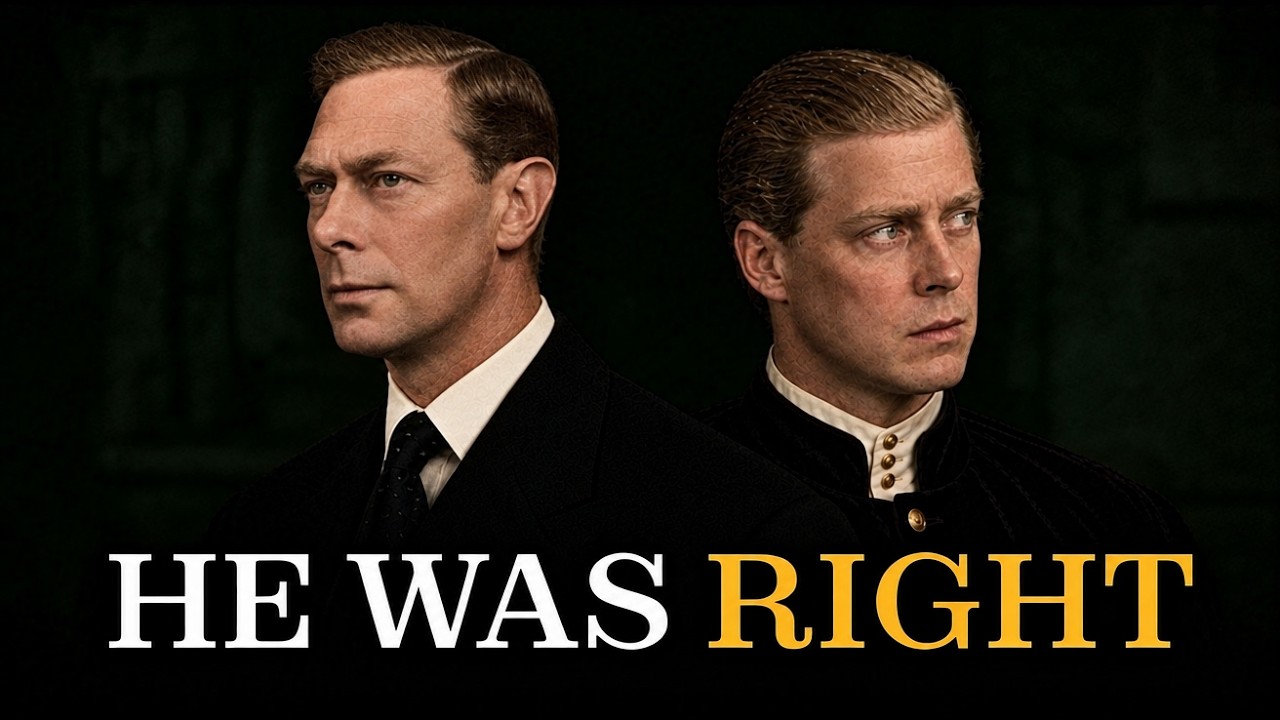
When the service ended, he went back to the continent. The story everyone knows says he gave up a throne for love and that his brother Bertie reluctantly picked it up. What the story leaves out is that for fifteen years, the brother who took the crown controlled his money, his title, his wife’s rank, and whether he could enter England at all. Every year since 1937, the Duke of Windsor’s income had come in substantial part from his brother’s personal account, not from the Treasury or Parliament, but from George VI privately, under conditions.
The most important condition was that Edward stay out of Britain unless invited. So when the Duke arrived in February 1952 to bury him, he was also arriving to find out whether the payments would continue, and from whom, and on what terms. According to letters he wrote back to Wallis from London that month, he described his mother and his sister-in-law in language that has been quoted ever since: “ice-veined,” and worse. He was 67 years old, writing to his wife about two women who had spent fifteen years making sure she never curtsied and was never curtsied to.
What makes this strange rather than merely sad is that the arrangement between those two brothers was not a slow drift. It was administered. There were documents. There were dates.
There were instructions given to household staff about which calls to put through. And it was not the brother most people assume, because the man who ended up holding the money, the invitation, the title, and the rank had spent the first forty years of his life as the dependent one. They called him Bertie. He was the second son, the spare.
And the spare in that family was raised mainly by being shouted at. George V was a naval officer who ran his household like a quarterdeck, and Bertie, forced to write right-handed, nervous at table, collected the worst of it. The stammer arrived around the age of seven or eight and never fully left. It was a wall.
He would stop mid-word and stay stopped, and everyone in the room would wait. The person who made those rooms survivable was David, the family name for the man the world called Edward. Charming, restless, and alarmingly good at the one skill the modern monarchy had just discovered it needed: being looked at. He could walk into a factory or a veterans hall and make people feel personally addressed.
Newsreels loved him. He was, in the commercial sense, the most famous young man alive in the 1920s. And he was kind to his brother. When Bertie was miserable at Osborne and Dartmouth, David wrote to him.
When their father erupted, David deflected it. They shot together, rode together, and went out together in the twenties. In their letters, they were not the Duke of York and the Prince of Wales. They were two men who had survived the same childhood and knew exactly how the other one had earned his damage.
Then came Wembley. In April 1925, at the British Empire Exhibition, the Duke of York had to give a short speech. He opened his mouth and the wall came down in front of a crowd, in front of microphones, with his brother and father listening. What followed is more interesting.
In October 1926, his wife took him to see an Australian speech therapist named Lionel Logue, who had rooms on Harley Street and no medical degree. Logue told him the stammer was mechanical and fixable: breathing, muscles, daily work. Bertie did the work for the rest of his life. Note who took him.
Not his mother, not his brother. Elizabeth Bowes-Lyon had turned him down twice. She refused his first proposal in 1921 and his second in 1922. The reason she gave to friends was blunt enough to be credible: she was afraid of never again being free to think, speak, or act as she felt she ought.
She accepted in January 1923 and married him that April. She married the one member of that family whose whole existence had trained him to be grateful. She brought him confidence in rooms he dreaded, a knack for the press his in-laws lacked, and an opinion. George V, who terrified everyone, liked her, indulged her, and forgave her lateness at dinner, which nobody else got away with.
Meanwhile, the heir had no wife, no children, and a taste in companions that ran almost exclusively to other men’s married ones. By around 1934, it was a Baltimore woman on her second husband named Wallis Simpson. By the mid-thirties, the two brothers were running two different households with two different theories of what the family was for. The Yorks were at 145 Piccadilly and Royal Lodge with two daughters and a routine.
The Prince of Wales was at Fort Belvedere, where he gardened obsessively, drank cocktails, and did his real business. The Yorks went there. That is the detail people forget. They visited, they stayed, the brothers were still brothers.
And somewhere between 1934 and 1936, something in that relationship went cold on Elizabeth’s side specifically. Surviving accounts put the change squarely on Wallis, on her manner with the prince, on the sense that she was arranging his house and his staff. Whatever happened, the effect is traceable. The Duchess of York stopped going.
Then in January 1936, the old king died, and the man everyone had been worrying about became Edward VIII. The legend says Bertie resented being dragged toward a throne he never wanted. What the record shows through most of 1936 is a younger brother trying repeatedly to reach his older brother and getting nothing back. He wrote, he asked to see him.
There were stretches that autumn when the Duke of York simply could not get an answer, weeks in which the heir presumptive was less informed about the king’s intentions than the editors of the American press. Fort Belvedere had become a second government, small, informal, and closed. And the brother locked outside it was about to be handed the bill. The bill was real and itemized.
Sandringham and Balmoral were private property. George V left them to his eldest son. When Edward VIII took the throne, he inherited the two houses and also, under the terms of his father’s will, discovered that the old king had left him no cash. The assumption was that the Prince of Wales had done nicely out of the Duchy of Cornwall for twenty-five years.
He had, in fact, accumulated a private fortune that nobody had audited. The Simpson divorce was heard at Ipswich on the 27th of October 1936, with the decree nisi granted and the final decree six months off. That six-month gap was the clock the entire crisis ran on. On the 16th of November, the king told Prime Minister Stanley Baldwin he would abdicate if he could not marry her.
On the 3rd of December, the British papers broke their silence. And somewhere in that compressed, sleepless stretch, the Duke of York was at last brought inside, not to be consulted, but to be informed that he was about to become king of England. He wrote it down. In the memorandum describing going to see his mother after the decision was final, he wrote that he broke down and sobbed like a child.
He was 41, with a stammer that had taken ten years of daily work to manage. On the 10th of December 1936, at Fort Belvedere, Edward VIII signed the instrument of abdication with his three brothers as witnesses. The Duke of York signed beneath him: Albert. The new king’s diary for that day records that when his brother left, he embraced him and parted as good friends.
Hold on to that, because from here it gets ugly fast. And the ugliness is not about love. It is about a contract. Edward left the country and could not marry Wallis until her decree was made absolute in the spring.
So he had roughly five months of enforced idleness, a telephone, and a brother now responsible for everything. He used the telephone. The former king rang his brother from the continent repeatedly, sometimes nightly, with advice, opinions about appointments, views on how things should be handled, in the tone of a man who had been doing the job eleven months earlier and could not stop. Eventually, the calls stopped being put through.
No one slammed a door. A phone simply rang in a room where no one picked it up anymore. Then the money talks. Edward sold his life interest in Sandringham and Balmoral to his brother for roughly 300,000 pounds, paid as an annuity of about 25,000 pounds a year out of George VI’s private funds, with conditions attached.
The central one: Edward remain abroad and not return without the king’s invitation. The terms of the exile were written into the income. And then the negotiation went wrong in the specific way that poisons families forever. During the talks, conducted largely through Walter Monckton for the Duke and Ulick Alexander for the king, it emerged that Edward had understated what he was worth.
He had claimed near poverty while sitting on a private fortune accumulated from the Duchy of Cornwall, a concealment that Philip Ziegler, writing the official biography of Edward with full access to the Royal Archives, treats as the point at which his brother stopped believing anything he said. George VI had cried when his brother left. He did not cry about the balance sheet. On May 27, 1937, nine days before the wedding, letters patent were issued declaring that the former king would be known as His Royal Highness the Duke of Windsor, and that his wife and any descendants would not hold that style.
Him, yes. Her, no. It was a surgical humiliation, and Edward called it a damnable wedding present. He spent the next thirty-five years trying to get it reversed.
The queen’s position is documented in her own letters, and it was not neutral. Elizabeth regarded the marriage as a disaster inflicted on her husband and never moved from that position. She had watched a man she had spent thirteen years building up get handed a job along with a stammer and an empire. On June 3, 1937, the Duke of Windsor married Wallis at the Château de Candé in the Loire, a house lent to them by a French-American businessman.
Not one member of the family came. The king had forbidden it. Edward chose the date himself: June 3rd, his dead father’s birthday. Three months later, he got on a train to Germany.
The trip in October 1937 was supposed to be a fact-finding tour about housing and working conditions. What it produced was a photograph of the Duke and Duchess of Windsor at the Berghof with Hitler and film of the Duke returning what looks to most eyes like a salute. Before Germany, the case against bringing Edward home was about a woman’s rank. After Germany, it was about risk.
The Duke had demonstrated that when left idle, he would find his own foreign policy with cameras present, and that his wife would be received abroad with exactly the honors she was denied at home. When France fell in 1940, the Windsors went south, then to Spain, then to Portugal. German diplomatic telegrams from that period, later found by Allied teams and published in 1957, record German officials discussing schemes to keep the Duke in Europe and reporting remarks attributed to him about the war being winnable for nobody and about his own possible future role. Historians have argued about them for seventy years.
The honest summary is that the telegrams prove the Germans thought he was approachable, not that he agreed to anything. But Churchill and the palace both wanted those documents buried. The brother in London now had a file, not a rumor. In July 1940, the Duke was appointed governor of the Bahamas.
It was understood by everyone, including the Duke, as a way of putting him three thousand miles from Europe. The Duchess called it their Saint Helena. He did the job competently enough, worked on unemployment and the aftermath of the 1942 Nassau riots, was bored out of his mind, and resigned in 1945. Then he asked for something else.
There was nothing else. That is the flat truth of the next quarter century. He wanted a post, a role. The answer was always no.
In October 1945, he came to London alone and stayed with his mother. Queen Mary received him. She had never received Wallis and never would. He saw his brother, and the visits established a shape that held: he could come briefly, alone, as a private person, and he could not bring his wife into a royal house.
Buckingham Palace was not open to the Duchess of Windsor, not once in thirty-five years. Elizabeth did not need to fight. She only had to decline to make an arrangement. A guest list gets drawn up and a name is not on it.
An invitation is discussed and does not go out. Meanwhile, George VI kept paying the annuity every year. When the Duke pressed for the style for his wife, the king refused. When the Duke pressed for work, the king did not push.
When the Duke wanted to come home, he needed to ask. The contact narrowed year by year until it ran almost entirely through lawyers and secretaries. Then Edward published a book. A King’s Story came out in 1951, ghost-assisted, serialized in Life, and enormously profitable.
It was the first time anyone from inside that family had told the story publicly, and the version it told was his: a modern man thwarted by courtiers, a brother he loved, a wife shabbily treated. The palace had no reply available. Royalty did not answer books. His brother was by then seriously ill.
George VI had undergone lung surgery in September 1951. He saw his daughter off at the airport at the end of January 1952, filmed on the tarmac, visibly gaunt. He died in his sleep at Sandringham on the 6th of February at 56. Sandringham, the house Edward had sold him.
The Duke sailed over. He walked in the procession. He stayed a fortnight, and in that fortnight he did the thing that explains everything about what the relationship had become by the end. He tried to get the annuity confirmed by the new reign.
He raised it with his mother. He raised it with the household. He had been told the payments were his brother’s personal arrangement and might not survive him. He spent the days around the funeral of the man he had known for fifty-seven years attempting to establish whether the money would keep coming.
His letters to Wallis from those weeks are full of it: the money, the coldness, the two women he blamed for all of it. The payments did continue in reduced and altered form, and the arrangements around his finances were quietly resolved over the following years. He was comfortable for the rest of his life. He lived in Paris in a house on the edge of the Bois de Boulogne, leased to him by the city at a nominal rent, with a room laid out as a study and the red boxes of a life he no longer had.
He was a former king with a lease. His sister-in-law lived another fifty years. She outlived her husband by half a century. She outlived Edward, who died in Paris in May 1972, visited eleven days earlier by his niece, the Queen, with the Duchess present, a ten-minute courtesy at the end of everything.
She outlived Wallis, who died in 1986 after years of seclusion. And the official record was assembled under her. She said for the rest of her days that the strain of the throne shortened her husband’s life, and she said it often enough that it became the accepted cause of death in the public mind. Both Windsors are buried at Frogmore in the grounds of Windsor, by permission granted in 1965.
Even the grave required an invitation. So go back to the man on the Queen Mary in February 1952, alone in his brother’s country with no house to sleep in that was his. The version we were sold says he was the one who gave everything up for love, and that his brother was the one who paid the price. Half of that is true.
The price was real, and George VI paid it. But the brother who took the throne also took the two houses, the annuity contract, the terms of exile, the power to invite or not invite, and the pen that wrote his sister-in-law out of the royal style. Bertie had spent forty years needing David to speak for him. He spent the last fifteen deciding whether David could come home.
The telephone stopped being answered in 1937. Nobody ever hung it up. They just stopped picking it up. And one brother kept calling, and the other one had the money, the name, the invitation, and a wife who would outlive everyone and hold the archive.
The Duke of Windsor gave up a throne for a woman he was told he could keep. He was never told what it would cost to keep her, and it took him until his brother’s funeral to find out the price was quoted annually.