Just before five in the morning on March 6, 1836, a 49-year-old man from Tennessee stood behind a low wooden palisade connecting an old stone chapel to the southern wall of the Alamo in San Antonio, Texas. It was the weakest point in the entire fort. Somewhere in the darkness beyond that fence, nearly 1,800 Mexican soldiers were forming into four columns to attack. Behind the palisade stood the Tennessean, a long rifle, a large knife, and about a dozen compatriots from his home state.
Within ninety minutes, he would be dead. Historians still argue about exactly how he died. There were about 1,800 attackers outside those walls and fewer than 200 defenders inside, a ratio of roughly nine to one. Most people already have a picture of this moment in their minds, and there is a good chance John Wayne put it there.
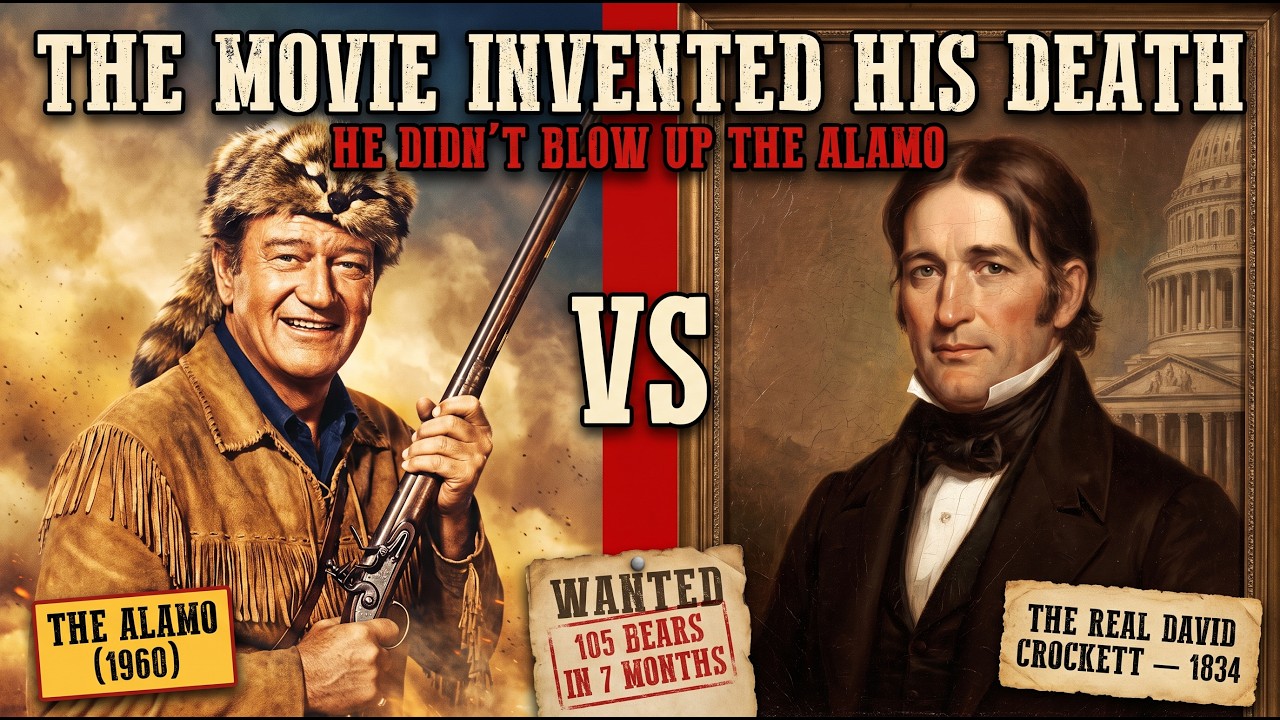
In 1960, Wayne directed and starred as Davy Crockett in The Alamo, an epic three-hour film he had wanted to make for nearly fifteen years and largely financed himself. It was a huge, loud, patriotic picture, just as one would expect from John Wayne. But Hollywood delivered the legend. The real man was named David Crockett.
He signed his name that way most of the time, though the world has called him Davy for nearly two hundred years. People who saw him described a man about six feet tall, roughly 200 pounds, broad-shouldered, and carrying no extra weight. Therein lies the contradiction at the heart of his story: the most dangerous backwoodsman on the American frontier also spent three terms arguing in the halls of Congress, went head-to-head with the most powerful man in the country, and lost his political career because of it. Born on August 17, 1786, in Greene County, Tennessee, Crockett was the son of John Crockett, who ran a tavern on the road to Virginia and was deeply in debt because of it.
When Davy was twelve, his father hired him out to a cattle drover named Jacob Siler to help move a herd to Virginia. When the trip ended, Siler tried to keep the boy against his will. One night, twelve-year-old Davy simply left. He walked alone in the dark, through knee-deep snow, covering about seven miles in two hours to get far enough away from a man who thought he owned him.
Soon after returning home, his father sent him to school. Four days in, a much older and larger boy provoked a fight. Davy beat the boy so badly that he was afraid to go back and face the schoolmaster, so he skipped classes for weeks instead. When his father found out and wanted to whip him, Davy refused the punishment and fled into the woods.
This time he stayed away for two and a half years, working in Tennessee, Virginia, and Maryland as a wagon driver, farmhand, and apprentice hatter, eventually reaching Baltimore before deciding to return home. Along the way he fell ill with a severe fever that left him unconscious for days and nearly killed him. By the time he returned home as a young man, Crockett had become what his years of wandering had made him: a skilled marksman who found comfort in the forests alone and had no interest in taking orders from anyone. In August 1806, he married a young woman named Polly Finley, and the couple started a family on the edge of the frontier, moving deeper into the woods every few years in search of better hunting and cheaper land.
In the summer of 1813, war came to his doorstep. Red Stick warriors of the Creek nation attacked a settlement called Fort Mims in present-day Alabama and killed hundreds of settlers and Creek families inside. Word reached Tennessee, and Davy Crockett joined the militia within weeks. The general in charge was Andrew Jackson, a man on his way to becoming one of the most famous figures in the country.
Crockett served mostly as a scout, using his hunting skills to help feed the militia whenever supply lines failed, which happened often. His service put him at the heart of the war’s darkest moments. On November 3, 1813, Crockett rode with a force of about 900 men who surrounded a Creek village called Tallushatchee and burned it to the ground. By the end of that morning, the men had killed 186 Creek warriors, along with women and children trapped inside the burning buildings.
Crockett later wrote about it himself and did not try to sugarcoat it. He said the men simply shot the Creek warriors down, killing them like dogs. He also described finding a cellar full of potatoes under one of the burned buildings. The hungry men ate them anyway, even though the fat of people who had died in the fire above had seeped down into the earth where the potatoes lay.
Crockett’s ninety-day enlistment ended a few months after Tallushatchee. He returned home rather than staying for Jackson’s greatest victory of that war, the Battle of Horseshoe Bend. In the fall of 1814, he re-enlisted for six more months as a scout for Jackson in the Florida Panhandle against British-backed Creek fighters, but he saw no direct combat against British troops. By the spring of 1815, he was out of the militia for good, while the general he had served under was on track to become a national hero and eventually president of the United States.
Back home, Crockett made his name doing something far less bloody than fighting in a war: he hunted bears. This was not sport. Bear meat fed his family through the winters, and bear fat and hides were the closest thing to cash that existed on the Tennessee frontier. When Crockett and his family moved west in the early 1820s, he hunted relentlessly with a pack of trained dogs that would corner a bear and hold it in place until Crockett could close in for a kill shot.
The number he recorded himself in his 1834 autobiography was 105 bears killed in less than a year, 47 of them in a single month in the spring of 1825, when bears were coming out of their winter dens all at once. Historians generally treat that figure as credible. His largest recorded kill weighed 617 pounds. He did all of this with a rifle that took about a minute to reload after each shot, in dense cane and swamps, while the dogs held the bear and Crockett made the kill at close range.
While hunting built his reputation at home, Crockett was also being drawn into politics almost by accident. He was elected justice of the peace, then a militia colonel. In 1821, he won a seat in the Tennessee legislature representing a district so far out in the canebrakes that a fellow legislator famously called him the “gentleman from the cane. ” Crockett embraced the label and told stories on the campaign trail that made him seem exactly like the sort of backwoods character voters wanted to send to Nashville.
Winning a seat in Congress did not come easily the first time. He lost his first attempt in 1824. While waiting for the next chance, he tried his hand in the lumber business, which nearly killed him in a way no war or bear ever had. He was sleeping under the deck of a flatboat loaded with goods floating on the Mississippi River when water leaked in during the night and the boat began to sink.
He woke up trapped under the deck as the vessel went down completely. He had to fight his way out through the dark water. By the time he reached the surface, his boat, goods, and even his shirt were gone. He came out of that river stark naked, stranded on a sandbar in the middle of the Mississippi with nothing left.
Undaunted, Crockett returned to politics and won a seat in the U. S. House of Representatives in 1827, presenting himself as a loyal supporter of his old war commander. Jackson had just been elected president.
That loyalty did not last long. Crockett broke with Jackson once he reached Washington, mostly over land. He wanted poor frontier settlers, men much like himself, to have the first right to buy the land they lived on, cheaply. Jackson’s followers disagreed.
Then in 1830, Jackson passed the Indian Removal Act. The law forced more than 60,000 Native Americans to leave their lands in the Southeast and drove them west, laying the foundation for what became known as the Trail of Tears. Crockett was the only member of the entire Tennessee congressional delegation to vote against it. He stated plainly that he believed it was wrong and that he would vote according to his conscience whatever it cost him.
It cost him a great deal. Tennessee voters loyal to Jackson removed him from office the very next year. Crockett fought his way back into Congress in 1833 and continued the same battle. By then, cheap books and newspapers in the East had already turned him into a semi-fictional character, a backwoods fighter in tall tales who could supposedly wrestle a bear and ride a bolt of lightning.
Crockett did not appreciate strangers owning his name and reputation, so in 1834 he published his life story in his own words, mostly to set the record straight, and rode a wave of fame through a speaking tour in the Northeast. Some Whig politicians even floated him as a possible candidate against Jackson’s chosen successor. It did not work out. Crockett lost his re-election bid in 1835 by just 252 votes.
The man who beat him was a Jackson-backed lawyer named Adam Huntsman, who wore a wooden leg. Angry and politically finished, Crockett told the crowds back home to go to hell, because he was going to Texas. Texas at that time was Mexican territory filled with American settlers in open revolt against the government in Mexico City. Crockett headed there that fall, and by January 1836 he had joined as a volunteer soldier, not as an officer or leader of anything.
A young Ohio commander named William Harrison, not Crockett, led the twelve Tennessee men Crockett came with. This detail matters because Hollywood, and honestly most of American memory, turned Crockett into the man running the show at the Alamo. He was not. He showed up to fight at age forty-nine without rank and with no intention of getting one.
Crockett and his men reached San Antonio de Bexar in early February 1836 and joined the men fortified inside the old mission called the Alamo under the joint command of a young lawyer named William Travis and a knife fighter named Jim Bowie. One of the people who rented Crockett a room in town in the weeks before the siege was a woman named Susanna Dickinson, the same Susanna Dickinson who would survive the battle and carry its news to the rest of Texas. Three weeks after Crockett arrived, Santa Anna’s army appeared outside the walls. Santa Anna was not simply a cartoon villain, although his story is usually told that way.
He was the president of Mexico and its leading general, a man who had already crushed rebellions across his country. He regarded the Texas revolt as just another uprising to be put down the same way. The Texas side of the fight was also not as simple as freedom versus tyranny: many of the American settlers streaming into Texas brought slavery with them, which Mexico had already banned, and that tension was woven into the revolution as much as any argument over representative government. Travis put Crockett and his Tennessee men right at that low wooden palisade connecting the chapel to the southern wall, the weakest part of the entire perimeter, because he trusted Crockett to hold it more than almost anyone else in the fort.
In a letter written during the siege, Travis said Crockett was everywhere in the place, inspiring the men to do their duty. Other men at the Alamo reported seeing Crockett’s rifle drop five Mexican gunners in succession, one after another. Every time one of them tried to step forward to fire a certain cannon, Crockett picked him off. Some accounts suggested he nearly shot Santa Anna himself, who thought he was standing out of range but was almost wrong.
For thirteen days, Santa Anna’s army bombarded the Alamo with cannon fire and slowly tightened its grip, while fewer than 200 men inside held on, waiting for reinforcements that would never arrive in time. Then, before dawn on March 6, 1836, Santa Anna sent nearly 1,800 soldiers forward in four columns at once. The defenders repelled the first wave, then the second. On the third attempt, the Mexican soldiers finally got over the northern wall.
Once that breach opened, nothing was left to protect the defensive line. The fight turned into room-to-room combat inside a fort no larger than a single city block. Travis died early, shot in the head above the northern wall. Bowie, too sick to stand, was killed in his bed where he had been lying for days.
And somewhere around that small wooden palisade on the southern side, amid the smoke and chaos, Davy Crockett fell too. Here the story splits in two very different directions. Within days of the battle, news spread in Texas that some of the Alamo defenders, possibly including Crockett, had surrendered rather than die fighting. For decades, that account was buried under a more heroic version: Davy Crockett swinging his rifle like a club, fighting to the very end, falling surrounded by the men he had killed.
A former slave at the Alamo named Joe, who followed William Travis and was the only adult Texan male to survive the battle, said he saw Crockett’s body lying there with dead Mexican soldiers scattered around it. A man named Ben, a cook who worked for one of Santa Anna’s officers, claimed Crockett’s body was found surrounded by as many as sixteen dead Mexican soldiers, with Crockett’s knife itself stuck in one of them. That is the version that stuck, and the one Hollywood embraced. But it is not the only documented account.
In 1955, a diary surfaced in Mexico written by a Mexican army officer named Jose Enrique de la Pena, who had been at the Alamo that morning. Translated into English in 1975, it tells a different story: that Crockett was one of six or seven defenders who survived and finally stopped fighting; that he was taken prisoner, marched before Santa Anna, and executed there with swords, despite the objection of at least one Mexican officer who wanted to keep them alive as prisoners. Historians have debated the diary for decades. Some argue it is a twentieth-century forgery, while others subjected it to forensic examination of the paper, ink, and handwriting in 2001 and found it consistent with Mexican military officers’ writing from the 1830s.
One historian who set out to prove it a fake ended up concluding it was genuine. No one has truly settled the argument, and perhaps no one ever will. What is not disputed is that no version of either account describes Davy Crockett being stabbed with a lance and then blowing up a powder room on his way out. Hollywood invented that ending, every detail of it.
After the battle, Santa Anna ordered the bodies of all the defenders burned in a heap, and years would pass before what remained was buried properly. There was one survivor, Susanna Dickinson, who came out alive with her infant daughter. Her husband had been one of the Alamo officers. Santa Anna sent her to Sam Houston with a message about what had happened, hoping the news would frighten the rest of the Texans into giving up the fight.
It had the opposite effect. The Alamo emptied entire towns of settlers who fled for safety, but it strengthened Sam Houston’s army rather than breaking it. Six weeks later, on April 21, 1836, Houston’s army surprised Santa Anna’s men as they rested near the San Jacinto River and swept through them in about eighteen minutes, shouting “Remember the Alamo” as they fought. Santa Anna himself was captured the next day and ended up conceding Mexico’s claim to Texas while held prisoner by the Texans.
Davy Crockett died on March 6, 1836, in San Antonio, Texas, at age forty-nine. Whatever actually happened in those final minutes, everyone there on both sides of that fight agreed on one thing: the man did not surrender easily. John Wayne’s 1960 film gets some things right. The thirteen-day siege happened as the film shows it, with fewer than 200 defenders facing an army outnumbering them nine to one.
The knife fighter and the young lawyer really did bicker. But some aspects of Wayne’s Davy Crockett were invented. The film gives him a romance with a Mexican woman who never existed in the historical record. It places him in a barroom brawl and turns him into a calm mediator between Travis and Bowie.
In reality, Crockett explicitly refused leadership. He came to Texas as a private soldier and never commanded the Alamo. He did not want that role. Then there is the ending.
In Wayne’s film, Crockett is stabbed with a lance and, with his last strength, tosses a torch into a powder magazine, blowing himself up with a room full of enemy soldiers. It is a spectacular cinematic ending, but it appears in no historical account of the Alamo, heroic or otherwise. Wayne did not choose either of the disputed accounts of Crockett’s death for the screen. He ignored both and invented a third, because a defeated, cornered man or a man dragged before a general to be executed would not end a $12 million film the way the director wanted.
Hollywood did not need to invent anything. Crockett did not need a lance or an explosion to be dangerous. Before he ever set foot in Texas, he had killed over a hundred bears in less than a year, survived a war he wrote about in language too honest for any studio to film, and stood in the halls of Congress knowing exactly what defying the most powerful man in the country would cost him.