In 1990, Ronald Reagan’s presidential memoir arrived in bookstores. An American Life ran 726 pages, carrying readers from his Midwestern youth through Hollywood, the Screen Actors Guild, the California governorship, and eight years in the White House. Buried inside that mountain of paper was a nine-year marriage, three children, and one of the most photographed households in 1940s Hollywood. It received a single short paragraph.
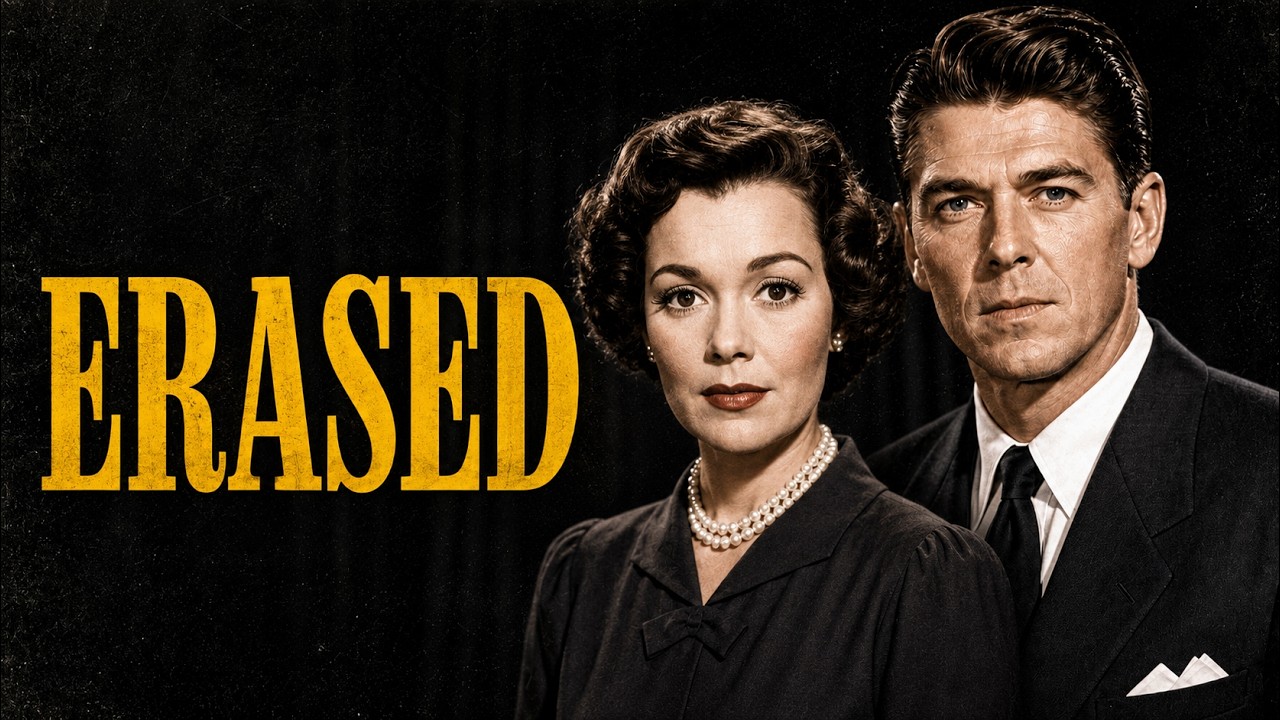
Reagan wrote that the marriage did not work out, noted that it produced two wonderful children, and then moved on almost mid-breath to the woman he married in 1952, closing with a line he would repeat for the rest of his life: sometimes his life really began when he met Nancy. That sentence did deliberate work. If his life began in 1952, then everything before it—including the wife who won an Academy Award and the daughter who lived one day—belonged to someone else’s biography. Yet the paragraph trailed a living witness in California who could have contradicted every word and never did.
From the moment Reagan entered politics in 1966 until his funeral in 2004, Jane Wyman enforced a rule with journalists that bordered on doctrine: one question about him and the interview ended on the spot. Two of the most famous faces of their generation shared nine years of marriage, then spent nearly four decades refusing, in eerie coordination, to describe it. The story began on a Warner Brothers lot in 1938. The studio was shooting a military academy comedy called Brother Rat.
Ronald Reagan was a sincere young Midwesterner working his way up the studio ladder. Jane Wyman, born Sarah Jane Mayfield, was a quick-witted actress stuck in light supporting parts. One complication: Wyman was married to her second husband, a New Orleans dress manufacturer named Myron Futterman. For decades, studio biographies listed Futterman as husband number one, until census records surfaced an earlier union—a brief 1933 marriage to a man named Ernest Eugene Wyman, whose surname she kept for the rest of her professional life.
Before Ronald Reagan ever spoke a word to her, Jane Wyman had watched a husband quietly vanish from her paperwork. She understood better than almost anyone how a biography gets rewritten. Her divorce from Futterman became final in 1938, and the courtship with Reagan accelerated on the set of the sequel, Brother Rat and a Baby, in 1939. Studio colleagues remembered Reagan as genuinely smitten, captivated by Wyman’s energy and wit.
By late 1939, they announced their engagement. They married on January 26, 1940, at the Wee Kirk o’ the Heather chapel at Forest Lawn Memorial Park in Glendale, California. Forest Lawn was a cemetery; Hollywood’s next ideal couple exchanged vows within walking distance of the headstones. The reception took place at the home of Louella Parsons, the gossip columnist who championed the couple in print, doubling as their wedding host.
The marriage arrived half-formed inside the publicity machine, and the machine wasted no time putting it to work. Warner Brothers began aggressively marketing Reagan and Wyman as Hollywood’s ideal young American couple—wholesome, unpretentious, traditionally patriotic. Fan magazines ran regular photo spreads of their custom-built home in the Hollywood Hills, praising their budgeting and domestic harmony. It worked because it matched what audiences wanted their stars to be, and because the couple photographed like an advertisement for marriage itself.
Reagan ranked as the bigger star on the wedding day. His profile climbed with Knute Rockne, All American in 1940 and Kings Row in 1942, while Wyman remained in supporting roles. In January 1941, a daughter named Maureen arrived, and the fan-magazine version of the Reagans gained its final ingredient. The formula came with a shelf life, and a world war stood ready to flip it upside down.
When the United States entered the war, Reagan served in the US Army Air Force’s first motion picture unit in Culver City—a military posting measured in sound stages rather than beachheads, a short drive from his front door. It was genuine work, but it froze his acting career at precisely the moment the war remade everyone else’s. When he returned to civilian work, he found himself typecast, struggling to land the top-tier dramatic roles that had seemed within reach after Kings Row. While her husband’s career idled, Jane Wyman transformed.
She climbed into serious drama with The Lost Weekend in 1945, then earned her first Academy Award nomination for The Yearling in 1946. Critics who had barely registered her years earlier now discussed her as a dramatic actress of the first order. The household grew during those same years. In March 1945, the couple adopted an infant son, Michael, and the magazines kept printing the ideal family spreads on schedule.
But the professional standing of husband and wife was now fully inverted from the day they married. By 1946, awards voters knew her name and casting directors hesitated on his. None of this needed to end a marriage. But in 1947, two events arrived within months of each other.
One private and unbearable, the other public and all-consuming. Together they broke it. On June 26, 1947, Jane Wyman gave birth prematurely to a daughter named Christine. The child died the following day.
Contemporary newspapers barely connected the tragedy to the state of the marriage. Biographers eventually found what the magazines skipped: both Edmund Morris in Dutch and Anne Edwards in Early Reagan identified the loss of Christine as the devastating emotional fracture of this marriage. Wyman sank into deep grief and depression. Her husband, through those same months, kept drifting toward something else—not another woman, but the Screen Actors Guild.
In 1947, Ronald Reagan won election as guild president, and the job swallowed him whole. Hollywood in 1947 was a battlefield of jurisdictional labor strikes and anti-communist warfare, and Reagan stood near the center of it, giving his evenings and weekends to strike fights, ideological combat, and testimony before the House Un-American Activities Committee. To Reagan, the guild fight outranked everything else in his week. To his wife, grieving a daughter while carrying an ascending career, it looked like a husband who had converted their home into a debating society.
Months after Christine’s death, the couple separated. In June 1948, Jane Wyman filed for divorce, citing extreme mental cruelty. Under California’s pre-no-fault divorce laws, a marriage could not simply end; the law demanded a guilty party, and extreme mental cruelty functioned as the conventional statutory ground. Under oath, Wyman told the court: “Finally, there was nothing in common between us.
I think I am a fairly sensitive person and I couldn’t take his endless political arguments. ” Not infidelity, not physical cruelty, just political arguments. The court granted an interlocutory decree on June 28, 1948, and the divorce became final on July 18, 1949. Wyman received custody of Maureen and Michael, and Reagan was ordered to pay $500 a month in child support.
The tidy legend claims Wyman won her Oscar and promptly outgrew her fading husband. The dates say otherwise. She filed for divorce in June 1948, months before Johnny Belinda even reached theaters, and her Academy Award arrived in March 1949—after the interlocutory decree but before the final one. Jane Wyman accepted her Oscar while still legally married to Ronald Reagan.
Rumors of a romance with her co-star Lew Ayres have never climbed above tabloid speculation. And the internet-era claim that Wyman left Reagan over his conservatism is flatly wrong: in 1947 and 1948, Reagan was still a committed New Deal Democrat. Whatever drove her out, it could not have been an ideology her husband still lacked. The remaining picture looks almost mundane: a grieving mother, an absent husband, one career passing another on the staircase, and endless political arguments echoing through a house built for magazine photographers.
The aftermath is where the story turns strange. Reagan’s pattern started early. In his 1965 autobiography, Where’s the Rest of Me? , he recounted the Hollywood years briefly, avoiding any real analysis of the divorce.
A quarter century later, those nine years shrank to a single paragraph. In private, however, the tone ran differently. Reagan rarely raised Wyman’s name on his own, but when biographers asked, what came back sounded like regret rather than resentment. He reportedly told visitors: “Perhaps I should have quit trying to save the world and instead tried to save my marriage.
” For a man famously allergic to self-examination, that sentence conceded the courtroom’s verdict. Wyman swore she could not take the endless political arguments, and Reagan, decades later, quietly agreed. Wyman’s side ran even stricter. From the moment Reagan announced his candidacy for governor in 1966, she instituted a policy and enforced it for nearly four decades.
She would never discuss Ronald Reagan publicly. Interviewers received warnings that a single question about him would terminate the conversation. Her standing line never changed: “I do not comment on Ronald Reagan. ” When she explained herself, she said it was not bitterness or political disagreement—she had always been a registered Republican—but that it was bad taste to talk about ex-husbands and ex-wives.
Reporters ran into that wall for four decades and never broke through it. She broke the moratorium only in the narrowest, most formal ways: private telegrams of congratulation when he won the governorship and the presidency, and then, on June 5, 2004, a single public statement when he died: “America has lost a great president and a great kind and gentle man. ” She attended his memorial mass and then returned to saying nothing at all. Did Reagan want to erase the marriage from history?
The prosecution holds real evidence. Compressing nine years and three children into one paragraph of a 726-page memoir amounts to narrative surgery. And the refrain that his life began when he met Nancy rhetorically deletes the Wyman years from his timeline. Reagan became the first divorced man ever to win the American presidency, and his campaigns drew pointed scrutiny from social conservatives.
His strategists answered by putting the unbroken union with Nancy at center stage. But the defense holds evidence too. Reagan never denied the marriage, and Maureen and Michael Reagan campaigned for their father as prominent, visible surrogates at the White House. The divorce received matter-of-fact coverage in 1980.
And his most serious biographers argue his silence grew out of personal heartbreak and an old-fashioned Midwestern refusal to speak ill of an ex-wife, not a political operation. Then comes the fact that unravels the eraser theory almost by itself: the silence came from both sides. A cover-up run by one side looks like suppression; this looked like a treaty. Wyman’s iron ban removed the marriage from public conversation at least as effectively as anything Reagan’s aides ever managed.
Publishers would have paid handsomely for her version of those nine years, and political opponents would have amplified any grievance she cared to voice. She voiced none of it. A divorced candidate had counted as unelectable, especially with religious conservatives ascending. Reagan diffused the issue not by hiding the divorce but by starving it: no recriminations, no interviews, no dueling accounts, nothing for a scandal to feed on.
The first divorce presidency became possible precisely because both people who lived through the divorce declined to narrate it. The fullest account Jane Wyman ever gave of her marriage remains the sentence she spoke under oath in 1948 about a fairly sensitive person and endless political arguments. Fifty-six years later, her last public words about him ran thirteen words long, called him great, kind, and gentle, and never mentioned the marriage at all. History did not erase the Reagan-Wyman marriage.
The two people who lived it simply agreed, separately and permanently, to stop telling the story. And that is all an eraser has ever required.