On the evening of March 20, 1974, a maroon limousine turned onto the Mall, the ceremonial avenue leading to Buckingham Palace, carrying Princess Anne home. Two hundred yards from the palace gates, a white Ford Escort swerved across the road and forced the car to stop. A man climbed out holding a pistol in each hand. In his pocket was a typed letter demanding £2 million for the princess’s safe return.
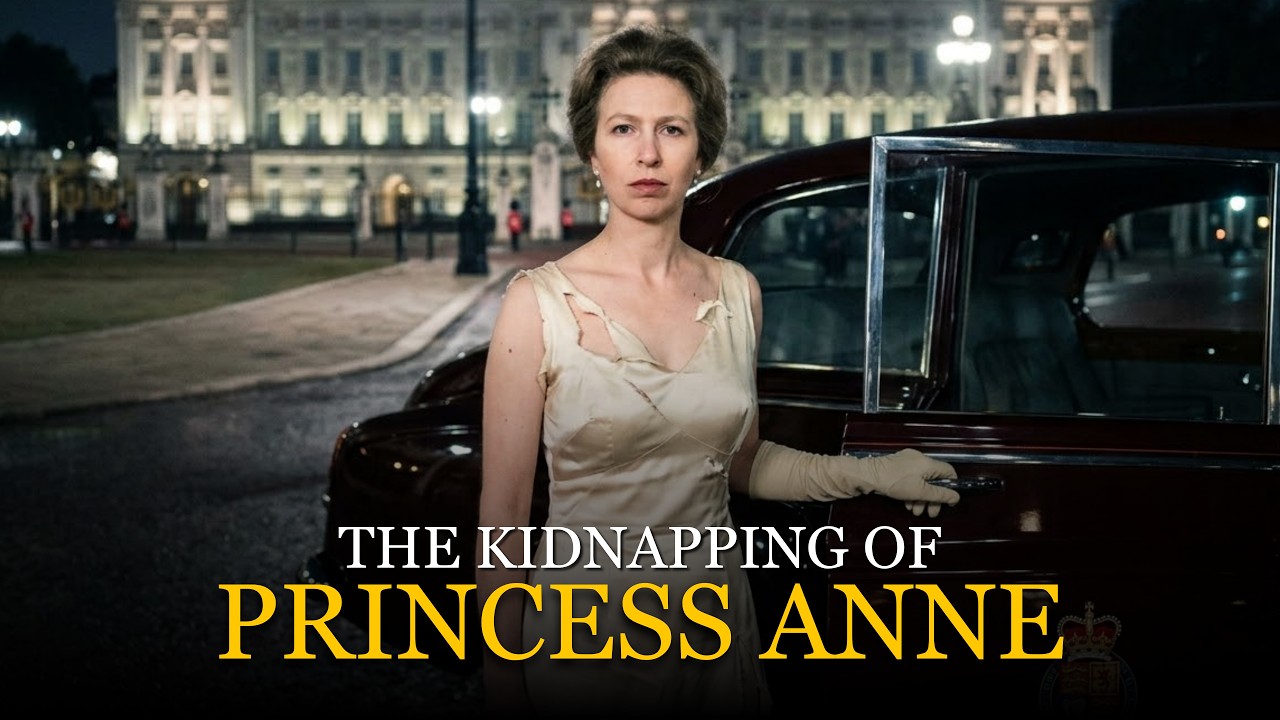
Within minutes, he would shoot four men and seize Anne by the arm. The 23-year-old daughter of Queen Elizabeth II, married barely four months, looked at her kidnapper and gave an answer Britain has never forgotten. For centuries, the monarchy had been guarded by an idea: that no ordinary person would ever dare. Walls and gates helped, but the true shield was belief—the conviction that the royal family was set apart and untouchable.
That belief did the work of an army. On the Mall that night, it failed. Royal protection in the early 1970s rested on trust alone. Princess Anne, an accomplished horsewoman known for her blunt manner, traveled in an ordinary Austin Princess limousine with unarmored glass and doors that opened from the outside.
Her only protection was Inspector James Beaton, a 31-year-old officer with a single pistol and minimal firearms training. There was no convoy, no follow car, no rehearsed drill for a blocked road. The system assumed that no one would ever try what Ian Ball was about to attempt. Ball was a jobless man in his mid-twenties from North London, suffering from untreated mental illness.
He had spent two years planning the abduction. He bought handguns abroad, acquired handcuffs and tranquilizers, hired a flat and a car under the false name John Williams, and typed his ransom demand in advance, addressed to the queen herself. He demanded £2 million in used £5 notes packed into twenty unlocked suitcases placed aboard an aircraft, with some accounts claiming he also required the queen to deliver the ransom personally. He chose Anne because seizing the most watched young woman in Britain would force the nation to look at him—and at his grievance that the health service had failed people like him.
Ball knew the princess was attending a charity film screening on Pall Mall that evening. He positioned his hired car on the Mall, the one road she was certain to travel, and waited. At about 7:45 p. m.
, the royal limousine turned onto the avenue, and Ball cut across its path. The driver braked hard, stopping two hundred yards from the palace. Beaton stepped out to confront the gunman. Ball fired first, hitting him in the shoulder.
Beaton drew his own pistol and managed a single shot before it jammed. He was hit twice more, in the hand and stomach, yet he continued trying to shield the car with his body until he collapsed. The armed defense of the princess had lasted seconds and ended with a wounded officer and a useless weapon. Ball turned to the rear door.
He wrenched it open, seized Anne by the forearm, and told her she must come with him. Her reply has passed into legend: “Not bloody likely. ” She later added that she told him she did not have £2 million anyway. As Ball pulled, Anne and her husband, Captain Mark Phillips, gripped the far side of the door and hauled it back, a grim tug-of-war across the back seat.
Anne’s dress tore in the struggle, but she refused to let go. Her stubbornness anchored the moment, buying precious seconds. Help was already running toward the guns. Constable Michael Hills, 22, heard the shots and charged in.
He was shot in the stomach but managed to radio for help before collapsing, his message first alerting the wider world. Journalist Brian McConnell, passing in a taxi, got out and tried to talk Ball down. He was shot in the chest. Chauffeur Alexander Callender left the wheel and grappled with Ball, taking a bullet in the chest as well.
Four men now lay bleeding on the ceremonial avenue. Ball turned back to the princess. Then Ronald Russell, a former boxer driving past, stopped his car, walked up behind the gunman, and struck him hard on the head. Ball swung his gun toward the new attacker, and Russell hit him again, full in the face.
The blows rattled Ball and broke his nerve. He fled on foot toward St. James’s Park. Detective Constable Peter Edmunds gave chase, ran him down, and arrested him.
The siege was over. Anne climbed out unhurt, her dress torn at the shoulder, more concerned for the wounded men than for her own ordeal. All four men survived, though Beaton’s wounds required a long recovery. The next morning, Britain woke to the news that an armed man had tried to kidnap the queen’s daughter within sight of Buckingham Palace.
It remains the closest anyone has come to seizing a member of the immediate royal family on a public street. In Ball’s pockets, police found the typed ransom letter, more than £300 in cash for his escape, handcuffs, and tranquilizers. He pleaded guilty to attempted murder and attempted kidnapping. He was not sent to prison but detained indefinitely in a secure hospital, spending years at Broadmoor, where he remained for the rest of his life.
From confinement, he sometimes claimed the affair had been a hoax or that he had been framed, statements weighed against the settled facts of the night itself. Six months later, on September 26, 1974, the queen recognized the courage of the Mall. Beaton received the George Cross, the highest award for gallantry a civilian can hold. Russell and Hills received the George Medal.
Callender, McConnell, and Edmunds received the Queen’s Gallantry Medal, and a chauffeur named Glenmore Martin received a commendation for using his own car to block Ball’s escape. Seven recognitions for a single evening on a single road, granted to people who, with one exception, had no duty to be there at all. The attempt exposed how thin the royal armor truly was. A single officer with a jammed pistol, an ordinary car, a predictable route—all of it had nearly cost the crown its daughter.
The review that followed transformed royal protection from the ground up. Officers received intensive close-protection and firearms training. Ordinary limousines gave way to armored cars built to stop bullets and keep moving. Routes became guarded secrets, varied and planned so no watcher could again work out where a royal would be.
A dedicated command for royal protection developed, growing into the specialist unit that guards the family today. The cost was immense, and something was lost with it: the old ease and closeness between crown and public, replaced by a permanent distance security requires. Anne went on to serve as the Princess Royal for decades, her toughness undimmed. Beaton returned to royal protection, eventually holding a senior appointment in the royal household.
Russell lived on as an ordinary man who did an extraordinary thing. Ball simply endured behind locked doors, the world he tried to force to notice him moving past. Everything that now protects the royal family is a monument to that night. But the deeper truth of the Mall is simpler.
When the grandeur failed—the palace useless behind its gates, the guard shot, the gun jammed—what held was a young woman’s grip on a car door. The crown was saved not by its guards or its gold, but by character: a refusal, in two plain words, to let go.