On July 15, 1982, a cemetery worker at Cedar Ridge Cemetery in Blairstown, New Jersey, found the body of a young woman at the edge of a steep embankment bordering the property’s north end. The scene was brutal. The victim was white, estimated to be between fourteen and eighteen years old, about five feet two, and roughly 110 pounds. She wore a red and white print skirt with a peacock design along the hem and a red short-sleeved pullover shirt.
No shoes, no socks, no undergarments. No purse, no wallet, no identification of any kind. The medical examiner determined cause of death as multiple skull fractures from blunt force trauma. Her face had been beaten beyond recognition, an attack aimed not only at taking her life but at erasing her identity.
Defensive wounds showed she had fought. Her right hand had red painted nails; the left was bare. She wore blue eye shadow. Her left ear was double pierced.
A gold necklace with a cross pendant was tangled in her hair. Investigators had no name, no missing person report to search, no family or friends to interview. They had nothing but a girl who had died among strangers. Lieutenant Eric Krantz of the Blairstown police felt a deep responsibility for the victim.
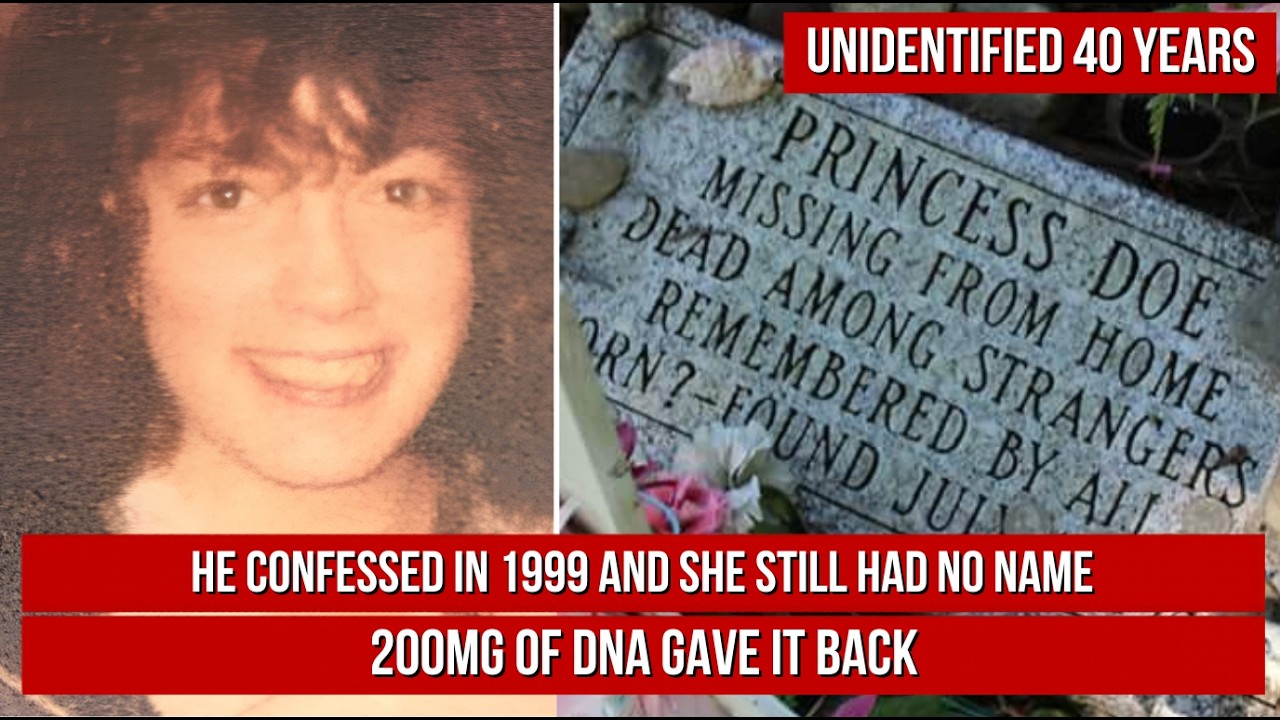
He began calling her Princess Doe, and the name stuck. The community raised funds for her funeral, coffin, and burial in the very cemetery where she was found. She was interred on January 22, 1983, five months after her discovery. Her headstone, reading “Missing from home, dead among strangers, remembered by all,” became a local landmark.
The case was featured on national television programs, where forensic artists produced sketches and reconstructions that generated waves of tips, all of which led nowhere. Decades later, the Smithsonian Institution used a CT scan of her skull to produce the most accurate composite image ever made of her face. But the investigation never closed. In 1983, Princess Doe became the first unidentified murder victim entered directly into the FBI’s National Crime Information Center database by the FBI director himself.
Her case helped establish the national protocol for tracking unidentified dead and became a textbook study taught at the FBI Academy in Quantico, Virginia. The physical evidence from 1982, her clothing and biological samples, was meticulously preserved. In 1999, investigators exhumed her remains to extract samples from her femur for early DNA testing in Baltimore, Maryland. The technology of the time could not produce a workable profile.
She was reburied in the same grave. But the preservation effort mattered. The technicians who processed the original scene understood that evidence is only useless until science catches up to it. Then, in 1999, the case produced a turn that was both stunning and deeply frustrating.
The Warren County Prosecutor’s Office received a confession from Arthur Kinlaw, a man already incarcerated in a New York prison serving a life sentence for two separate homicide convictions. His wife, Donna Kinlaw, also confessed. Together, they told authorities about a young girl Arthur had brought back to their home one day, a girl they had attempted to pull into their sex trafficking operation, which spanned seven states during the 1980s and included robbery, forgery, burglary, and multiple murders. The girl refused.
Donna told investigators she had witnessed Arthur commit the murder at the location where the body was found. She said afterward he burned his clothing, cleaned his vehicle, and threatened her never to speak of it. In 2005, Kinlaw went further. He began sending letters to the Warren County Prosecutor’s Office and provided a written affidavit reaffirming that he was physically responsible for the death of the unidentified female found in the cemetery.
It should have been the break the case needed. It was not. The confession presented a paradox. Investigators had a credible suspect, a convicted killer who claimed responsibility, corroborated in part by his wife, but they still had no victim.
Prosecutors noted the critical problem plainly: without an identity for Princess Doe, there was no way to connect the dots. They could not definitively place her with Kinlaw, establish a timeline, a motive, or the probable link between perpetrator and victim that a murder prosecution requires. Belief is not sufficient in a court of law. Despite the confessions, the case remained cold.
For another seventeen years, the two halves of the story, the killer and his victim, remained disconnected. By the late 2010s, a new forensic discipline was beginning to resolve the nation’s most intractable cold cases: investigative genetic genealogy. The process is precise. A DNA profile from an unidentified person is uploaded to public genealogy databases.
Genealogists search for distant relatives who have voluntarily submitted their own DNA, build family trees across multiple generations, triangulate backward to identify a common ancestor, then trace every line of descent forward until a candidate emerges. The obstacle was the biological evidence from 1982. It was severely degraded. Forty years of time had done what violence alone could not finish.
The case almost did not have that moment. It took four decades, a confession that went nowhere, and a 200 milligram tooth root. But the people of Blairstown had done something quietly extraordinary. They did not know her.
She was a stranger without a name found at the edge of their cemetery. Yet they paid for her coffin, tended her grave, and for forty years kept a promise to someone they never met. In May 2021, the National Center for Missing and Exploited Children partnered with the Warren County Prosecutor’s Office to apply the latest generation of forensic DNA science to the case. The biological evidence from 1982 was sent to Astria Forensics, a specialized laboratory in California.
The entire hope rested on what could be extracted from a molar root weighing 200 milligrams and a single eyelash. Astria’s technicians succeeded in piecing together a whole genome SNP profile, the specific type required for genealogical database matching. By February 2022, forty years after her burial, science had finally advanced far enough to give Princess Doe a digital fingerprint. The profile was handed to Jennifer Moore, CEO of Innovative Forensics Investigations, a genetic genealogist who agreed to perform the work entirely pro bono.
She uploaded the file to GEDmatch and FamilyTreeDNA and found distant familial matches, second, third, and fourth cousins spread across multiple family lines. Using only publicly available records, Moore constructed a sprawling family tree, tracing branches back through generations, identifying common ancestors, then following every descending line forward, eliminating possibilities, narrowing geography, closing in on a name. She needed only two days of intensive genetic genealogy to conclude that Princess Doe was a teenage girl from Long Island, New York, who had gone missing in the summer of 1982. Her name, Moore believed, was Dawn Olanick.
On February 22, 2022, she contacted investigators. They traveled to West Babylon, New York, and met with Dawn’s brother, who confirmed that his sister had been asked to leave their mother’s home around June 24, 1982, and had never been seen or heard from again. Dawn’s sister then provided a reference DNA sample, profiled by multiple laboratories and forwarded to the University of North Texas Center for Human Identification. On April 29, 2022, the official confirmation came through.
The DNA was a match. After thirty-nine years, nine months, and fourteen days, Princess Doe had her name back. She was Dawn Rita Olanick. The public announcement was made on July 15, 2022, exactly forty years to the day her body was discovered.
At a press conference at the Blairstown Municipal Building, officials finally connected the two halves of the story. Arthur Kinlaw, already serving life for two other murders, was formally charged with the first-degree murder of Dawn Olanick. Donna Kinlaw, who had confessed to witnessing the killing, had been separately convicted on a manslaughter charge years earlier and had since been released. Dawn Olanick was born on August 5, 1964, and grew up in West Babylon, Long Island.
After her parents divorced, she lived in Bohemia, New York, with her mother and sister and had just completed her junior year of high school. She was seventeen years old. She was a daughter and a sister. At the press conference, her cousin addressed the town that had carried her for four decades: “This is a very big deal for my family.
I’d like to thank Blairstown for treating my cousin like she was one of their own. It touches our family deeply. ”
The identification of Dawn Olanick is a landmark in American forensic history, a victory for the persistence of investigators like Lieutenant Eric Krantz, who gave a nameless girl a name in 1982 and spent decades ensuring the case never disappeared. It proved that evidence, if preserved with discipline and patience, will hold its secrets until the science is ready to unlock them.
A 200 milligram molar root and a single eyelash. In the end, it was enough. For four decades, a headstone in New Jersey read, “Missing from home, dead among strangers, remembered by all. ” Now the world knows her name.
She was and is Dawn Rita Olanick.