Deadwood, South Dakota, was never supposed to exist. In the 1870s, the Black Hills region where it stood belonged to the Sioux under the 1868 Treaty of Fort Laramie, which barred non-native settlement. That legal shield held until 1874, when General George Armstrong Custer led an expedition through the hills and announced the discovery of abundant gold. Prospectors poured in anyway, legally trespassers, and a town materialized in a chaotic, informal burst.
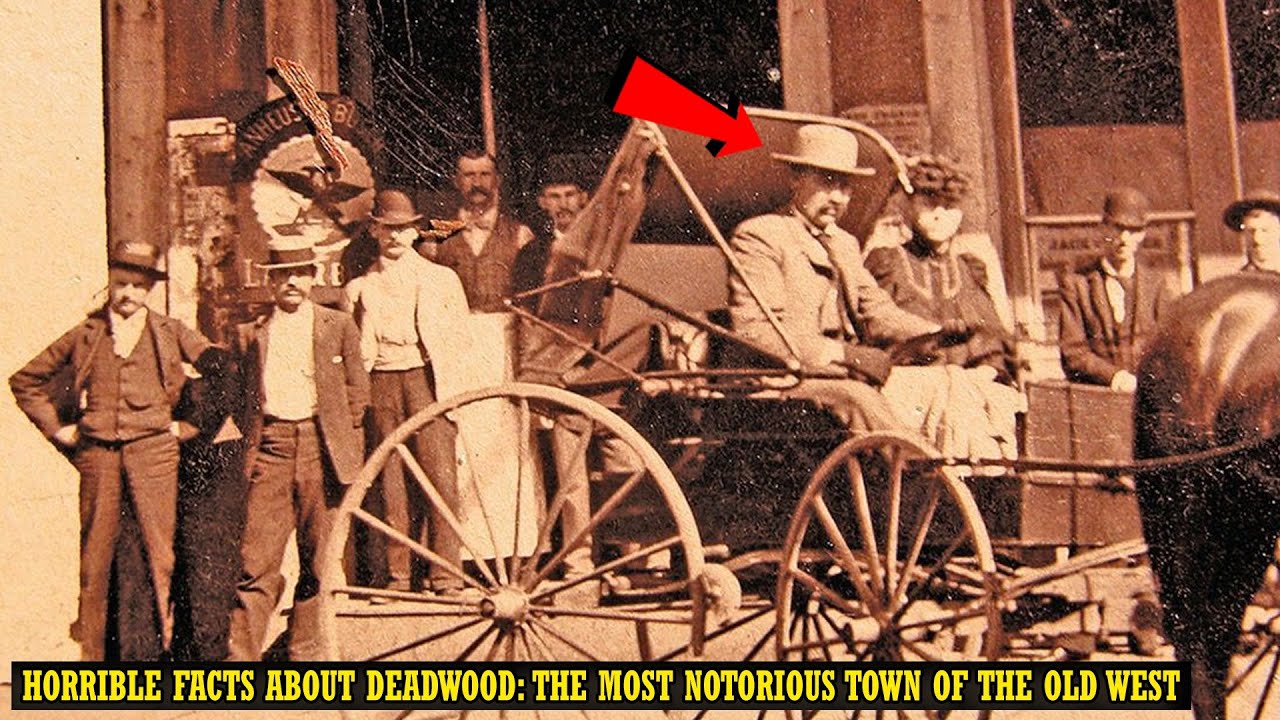
The federal government, unwilling to formally sanction a settlement born of treaty violation, left it to govern itself. That vacuum of authority defined Deadwood from the start: a place built on defiance and the lure of gold, where law arrived late and order was always fragile. Among the first to profit from that chaos was Al Swearengen, the real man behind the notorious owner of the Gem Theater. Unlike the layered, oddly sympathetic character portrayed in television dramas, the historical Swearengen was a far starker figure.
He opened the Gem in 1876, a saloon that doubled as a brothel, and built his reputation on a relentless drive for power and profit. The women who worked for him faced harsh conditions: limited healthcare, poor living quarters, and the social stigma of their profession. Many struggled with illness and substance dependency, and records indicate that numerous women met tragically early ends. Where the fictional version hints at fairness or reluctant kindness, the historical Swearengen showed little regard for anyone’s well-being but his own.
Order eventually arrived in the form of Seth Bullock, who came to Deadwood not as a lawman but as a businessman. He intended to open a hardware store with his partner, but the settlement’s rapid growth and growing notoriety created a pressing need for authority. After the death of Wild Bill Hickok, the shaken community looked for someone to restore stability. Bullock, who had served as a county sheriff in Montana, was uniquely qualified.
He became the town’s first lawman and set about bringing structure to a place that operated on the edge of chaos. His most persistent adversary was Swearengen, and the two men often clashed, yet both understood the practical need for cooperation. Over time, Bullock’s efforts made Deadwood safe enough that his wife and daughter could join him. Later, he built a ranch nearby and developed a friendship with Theodore Roosevelt, who appointed him a U.
S. Marshal when he became vice president. His career marked the slow transition from frontier lawlessness to a more structured society. The event that shook Deadwood in the first place centered on Wild Bill Hickok, a figure whose legend often outran the truth.
Hickok’s habit of blurring fact and fiction extended to his own biography. When someone marveled at how he survived a perilous encounter, he would quip, “I didn’t. ” Claims that he had killed hundreds of men in quick-draw duels were wildly exaggerated. His actual gunfighting career was shorter and more complicated.
While serving as town marshal in Abilene, Kansas, he inadvertently shot and killed his own deputy during a confrontation with an outlaw. The accident unsettled him deeply, and he left law enforcement and firearms behind to pursue a quieter life as a gambler. It was in that phase of his life that Hickok crossed paths with Jack McCall in Deadwood. The two men were hardly equals.
Hickok, focused on his card game, paid little attention to McCall even after soundly defeating him at the table. In an act of unexpected kindness, he reportedly offered McCall money to buy a meal, a gesture the humiliated McCall took as an insult. The next day, McCall returned to the saloon seething. Hickok, who had a well-known rule of never sitting with his back to the door, found no other seat available and reluctantly took the one facing away from the entrance.
McCall walked in and shot him dead with a single bullet. McCall claimed the killing was vengeance, alleging that Hickok had murdered his brother years earlier in Abilene. No records support that story, and it was likely a flimsy excuse for a rash act of violence. A local crowd quickly apprehended him, and the trial was held at McDaniel’s theater, not in Swearengen’s saloon as some dramatizations suggest.
The ad hoc jury acquitted him, citing a lack of solid evidence. McCall left town immediately, but his own boasting undid him. He bragged about the killing in various settlements until Colonel May, not Seth Bullock, tracked him down in Wyoming and alerted local authorities. In a second, more formal trial, McCall’s defense collapsed under the weight of his shifting stories.
At various points he claimed Hickok had killed his brother, that he had been paid to commit the murder, that he had been too drunk to remember the event, and finally that he was not Jack McCall at all. By March 1877, he was sentenced to death and executed. The case highlighted just how tenuous frontier justice could be, and every summer, actors in Deadwood still reenact both the shooting and the trial, a tradition stretching back to the 1920s and one of the longest-running theatrical productions in American history. The Gem Theater itself seemed to carry a curse.
It burned down three times. The first fire, in 1879, swept through much of Deadwood and destroyed the establishment. Swearengen rebuilt it on the same spot. A second fire in 1894 devastated the town again, and again he rebuilt.
Then in 1899, a third fire engulfed the Gem, and this time the firefighters who arrived found their equipment had been deliberately sabotaged. They were powerless to save the building. The Gem was reduced to ashes for good, and Swearengen’s attempts to resurrect his empire failed. Deadwood’s boom years attracted figures whose presence seems almost too remarkable to be coincidence.
One of the most significant was George Hearst, father of the newspaper magnate William Randolph Hearst. Arriving in 1877, Hearst quickly acquired mining claims, most notably the Homestake Mine, which grew into one of the richest gold deposits in American history. His ambitions extended beyond mining into politics, and he eventually became a U. S.
senator. In 1880, he purchased the San Francisco Examiner and brought his son into the business. Under William Randolph Hearst, the paper grew rapidly in influence, setting the stage for a vast media empire built on sensationalist journalism that would shape much of twentieth-century American culture. The scale of Deadwood’s boom is easy to underestimate.
At its peak in 1876, the settlement held about three thousand permanent residents and nearly two hundred businesses, with a constant flow of transient miners passing through. That influx drove the construction of more substantial buildings, including the first brick-and-mortar structures in town. But it was not until a catastrophic fire in 1879, one that started in a bakery on Sherman Street and destroyed much of the business district, that Deadwood truly transformed. Residents rebuilt, but this time they mandated fire-resistant materials, effectively banning lumber in new construction.
The shift marked the town’s evolution from a chaotic mining camp into a more permanent, organized community. Deadwood’s Chinatown grew alongside the boom, a district typical of many Western settlements where Chinese immigrants established businesses, opened shops, and supplied vital goods. They took on critical roles in mining and railroad construction, helping sustain the town during rapid growth. Relations between Chinese immigrants and other residents were likely more cooperative than adversarial, and claims of gruesome acts against them, such as bodies being fed to pigs, are not supported by historical evidence.
Together, these diverse communities forged shared opportunities in a challenging environment, a legacy often underappreciated in popular portrayals of the West. One enduring question about Deadwood is whether its people really spoke with the profane intensity seen on screen. Linguistic experts have noted that many specific insults used in the show were not common in the 1870s and 1880s. The creator of the drama, David Milch, pushed back, arguing that dictionaries of the time would not have recorded profanities that were already in widespread popular use.
“I’m not publishing a dictionary,” he said. The debate captures the difficulty of accurately depicting historical speech. What is certain is that the raw, gritty language of the show was meant to reflect the nature of life in Deadwood, a place where social norms were pushed to their limits and survival was never guaranteed.