On February 23, 1946, General Tomoyuki Yamashita was hanged at Los Baños Prison Camp in the Philippines. Four years earlier, he had been one of the most celebrated commanders in the Japanese Empire, the architect of a stunning victory that shocked the British Empire. Now he stood on a gallows platform, convicted of war crimes not for killing anyone himself, but for failing to stop soldiers under his command from doing so. His trial established a legal principle that continues to shape international law today.
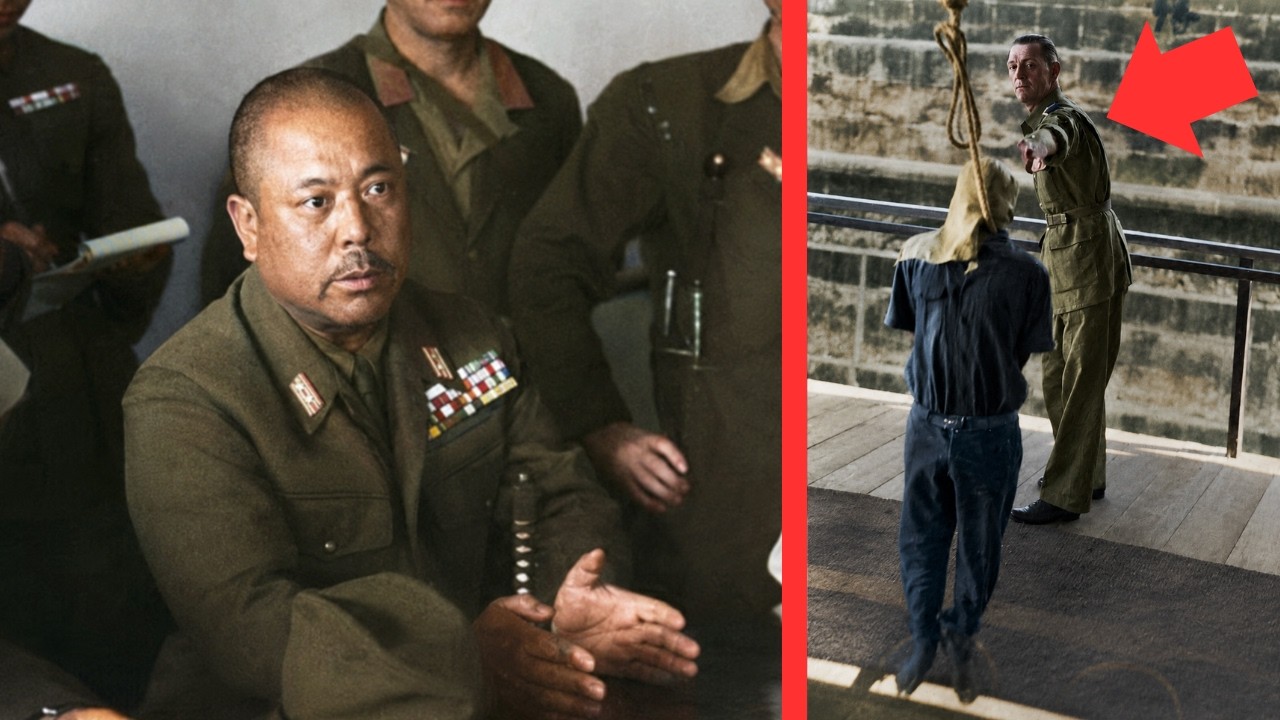
Yamashita earned his fame in the opening months of the Pacific War. Leading the Japanese invasion of Malaya, he drove his forces south through difficult jungle terrain with a speed that astonished military observers. In February 1942, his army captured Singapore, forcing the surrender of a British garrison that outnumbered his own forces. Newspapers around the world gave him the nickname “Tiger of Malaya.
” It was an extraordinary feat of arms, and it made him a symbol of Japanese military prowess. But by late 1944, that reputation meant little. Japan was losing the war. American forces had fought their way across the Pacific, seizing island after island and drawing steadily closer to the Japanese home islands.
In October 1944, General Douglas MacArthur made good on his famous promise to return to the Philippines, launching a massive invasion of Leyte Island. Tokyo needed an experienced commander to organize the defense of the archipelago, and Yamashita was given command of the Fourteenth Area Army in the Philippines. From the moment he arrived, Yamashita faced what was effectively an impossible task. He commanded roughly 260,000 soldiers, but they were scattered across numerous islands and rugged mountain terrain.
American aircraft and warships controlled both sea and sky, making communication and supply nearly impossible for Japanese units. Radios failed constantly. Telephone lines were severed. Many units lost contact with headquarters entirely, sometimes for weeks at a time.
Yamashita quickly concluded that defeating the Americans was out of the question. Instead of defending every city, he planned to pull most of his army into the mountains of northern Luzon, where they could fight a prolonged defensive campaign and delay the Allied advance. He hoped this strategy would preserve his forces rather than waste them in hopeless urban battles. One of his greatest problems was that not all Japanese forces in the Philippines followed his orders.
Throughout the war, the Imperial Japanese Army and Navy had often operated independently. In Manila, Rear Admiral Sanji Iwabuchi commanded thousands of Japanese naval personnel. Rather than comply with Yamashita’s withdrawal plan, Iwabuchi chose to defend the city to the last man. Historians continue to debate how much authority Yamashita actually controlled these naval forces, but there is broad agreement that once communications broke down, he struggled to enforce his commands.
The result was one of the worst atrocities of the Pacific War. During the Battle of Manila, fought between February and early March 1945, Japanese troops carried out mass killings of civilians. Men, women, and children were rounded up and shot. Others were bayoneted, burned alive inside buildings, or killed with grenades.
Hospitals, churches, and schools became scenes of terrible violence. Many women were assaulted before being killed, and doctors, nurses, priests, and patients numbered among the victims. Historians estimate that around 100,000 Filipino civilians died during the battle, though estimates vary. Many were killed by Japanese forces, while others died in the heavy fighting and American bombing of the city.
Most historians agree that Japanese troops were responsible for the vast majority of deliberate killings, making Manila one of the largest atrocities committed by Japan during World War II. The violence was not confined to Manila. Across the Philippines, prisoners of war and civilians were killed during the final months of the Japanese occupation. Villages were destroyed, hostages were executed, and suspected supporters of the guerrillas were frequently killed without trial.
By the time the fighting ended, investigators had gathered extensive evidence describing atrocities committed by Japanese forces throughout the islands. After Japan surrendered in August 1945, Yamashita was placed in American custody. The United States decided to try him before a military commission in Manila. Unlike many later war crimes trials, the prosecution did not claim that Yamashita personally killed civilians or directly ordered any massacres.
Instead, they argued that he had failed in his duty as a commander to control the troops under his authority, specifically in failing to declare Manila an open city. The prosecution argued that the crimes committed by the Japanese were so widespread and so brutal that no competent commander could have remained unaware of them. Even if Yamashita did not personally order the killings, they maintained that he failed to prevent them or punish those responsible. As commander, they said, he bore ultimate responsibility for maintaining discipline within his army.
Yamashita denied issuing any orders to commit atrocities. His lawyers argued that he had done everything realistically possible under impossible conditions. They pointed out that communications had collapsed entirely as American forces advanced and that many Japanese units were isolated. They also argued that Admiral Iwabuchi’s naval forces were not under Yamashita’s actual operational control and that they had ignored his order to leave the city.
The defense insisted that Yamashita could not be held criminally responsible for crimes committed by forces he did not control or of which he had no actual knowledge. No commander, they argued, could supervise hundreds of thousands of soldiers spread across islands while under constant attack from overwhelming Allied forces. The military commission rejected these arguments. On December 7, 1945, Yamashita was convicted and sentenced to death by hanging.
His lawyers appealed, and the case reached the United States Supreme Court in a historic decision. In February 1946, the Court upheld his conviction. It ruled that military commanders are legally obligated to take reasonable steps to control their troops and prevent violations of the laws of war. That ruling became one of the pillars of what is now known as the command responsibility doctrine.
Under this doctrine, military commanders can be held criminally accountable if they knew, or should have known, that their subordinates were committing war crimes, and yet failed to take reasonable measures to stop them or punish those responsible. Although earlier examples of command responsibility existed, the Yamashita case became one of the most influential precedents in modern international law. It has since shaped the course of prosecutions before international war crimes tribunals. Despite its importance, the trial remains deeply controversial.
Many historians and legal scholars believe it would not meet today’s standards of justice. The defense was given only limited time to prepare despite the enormous volume of evidence, and some testimony accepted by the military commission might not be admissible in a modern courtroom. Critics also argue that the prosecution never proved Yamashita was aware of the many atrocities being committed throughout the Philippines. Others believe the conviction was justified.
They argue that commanders cannot escape responsibility simply by claiming ignorance when crimes occur on such a scale. Military commanders have a duty to maintain discipline and protect civilians and prisoners of war. Allowing commanders to avoid responsibility whenever communications broke down, they contend, would create a dangerous loophole in the laws of war. With all avenues of appeal exhausted, the death sentence was carried out.
Witnesses reported that Yamashita remained composed before his execution and continued to insist that he had never ordered the terrible crimes committed by Japanese troops. His final words were said to be apologetic and gracious toward his American captors, and finally toward the men who were sentencing him to death. Today, General Yamashita remains one of the most controversial figures of World War II. His brilliant victories in Malaya and Singapore made him famous, but his command in the Philippines ended in tragedy.
Historians continue to debate whether he could realistically have prevented the atrocities committed as Japanese resistance collapsed. What is not in doubt is that his trial changed international law forever. The command responsibility doctrine established by his case continues to influence war crimes prosecutions around the world, ensuring that military commanders can be held accountable not only for the orders they give, but also for their failure to prevent crimes committed by those under their command.