On a snowy December night in 1963, a nineteen-year-old sat in his underwear finishing a room service chicken dinner when someone knocked on his hotel door claiming to have a delivery. Within seconds he was blindfolded, bound, and driven away into the darkness. Three hundred miles south, his famous father waited by a phone with pockets full of loose change, terrified he might miss the call that would decide whether he ever saw his son again. The young man’s last name was Sinatra.
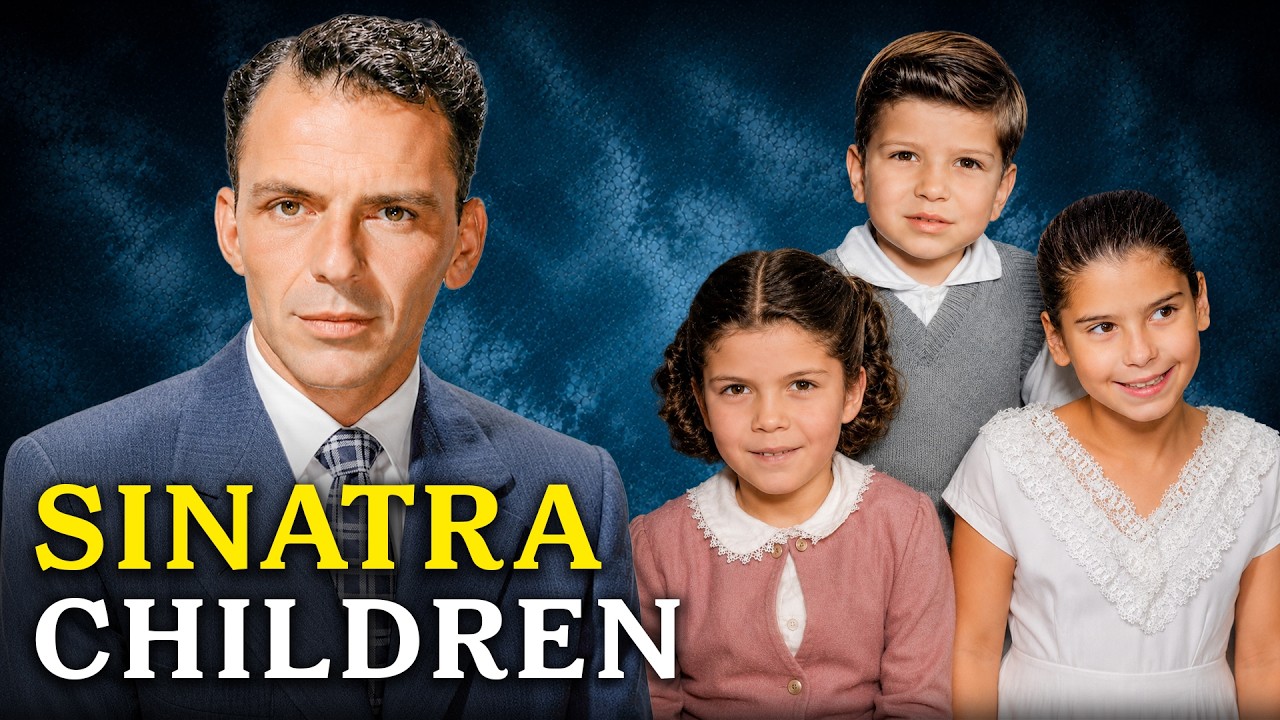
The family had begun in a Jersey City walk-up. Frank Sinatra and Nancy Barbato had grown up together in Hoboken and married in 1939, when Frank was still years from stardom. Money was so tight that he worked as a singing waiter and she as a secretary while he chased gigs around New York. Their first child, Nancy Sandra, was born in June 1940.
Their son Francis Wayne arrived on January 10, 1944, though everyone called him Frank Jr. , even though his father’s actual middle name was Albert, not Wayne. By then Frank Sinatra’s career was exploding. He had become one of the most popular singers in the country, adored by crowds of young female fans who screamed and fainted at his concerts.
The family relocated to California to chase Hollywood’s opportunities, and in 1948 their third child, Christina, called Tina, was born. On the surface it looked like the perfect American success story, but the very success that lifted the family out of poverty placed enormous strain on the marriage. Frank’s relationships with other women became increasingly public throughout the 1940s, culminating in a very public affair with film star Ava Gardner. Nancy was reportedly aware for some time before deciding she could no longer hold the family together.
The couple divorced in 1951, and within weeks Frank married Ava, a turbulent relationship that ended in divorce by 1957. For the children, the divorce meant their father, already frequently absent because of relentless touring, became an even more distant figure in their daily lives. Nancy Sr. took on primary responsibility for raising the three children and never remarried, keeping a stable home in California even as photographers lingered nearby.
By December 1963, Frank Jr. was nineteen years old and trying to carve out his own path touring with the Tommy Dorsey Orchestra, performing at Harrah’s Club Lodge near Lake Tahoe. On the evening of December 8th, just days after President Kennedy’s assassination, two men in their early twenties named Barry Keenan and Joe Amsler arrived with a plan months in the making. Keenan, who had once attended high school alongside Frank Jr.
‘s older sister Nancy, had fallen into serious financial trouble after a car accident left him addicted to painkillers. He had trailed the young singer from city to city for weeks, abandoning two earlier attempts, one when timing failed and another in the emotional aftermath of the assassination. Around nine that evening, the men knocked on the door of the hotel room where young Sinatra was relaxing with his friend and bandmate John Foss, finishing a room service dinner before that night’s show. Pretending to make a delivery, they forced their way inside, brandished a handgun, bound and blindfolded Foss, and hustled the shocked young singer out through a side door into a waiting car.
Foss managed to free himself within minutes and alerted hotel security. Law enforcement scrambled to establish roadblocks throughout the region, and word reached Frank Sinatra Sr. almost immediately. He flew straight to the area to coordinate with FBI agents who took charge of the investigation.
The FBI advised Sinatra to wait patiently for a ransom demand, pay whatever was asked, and allow investigators to track the money afterward. On December 10th, one of the kidnappers, John Irwin, who had been recruited because of his ability to sound intimidating over the phone, made contact with the elder Sinatra and instructed him to await further directions from a payphone. The kidnappers insisted on communicating exclusively through payphones scattered around Los Angeles, and Sinatra grew genuinely afraid he might run out of coins at exactly the wrong moment, potentially costing his son his life over spare change. The ransom demand came through at $204,000.
Sinatra had initially offered as much as a million dollars, but Keenan insisted on the smaller figure in what investigators later described as a calculated show of restraint. Sinatra gathered the cash, the FBI photographed and recorded the serial numbers on every bill, and the money was dropped between two parked school buses at a filling station in Sepulveda in the early hours of December 11th. As Keenan and Amsler retrieved the ransom, Irwin, left alone guarding the hostage, lost his nerve and released Frank Jr. before the operation was fully complete.
In the middle of the night, a private security guard patrolling an upscale Bel Air neighborhood came across a young man walking alone through the streets, dazed but unharmed. It was Frank Sinatra Jr. , safely returned. The experience left a permanent mark on the elder Sinatra.
From that day forward, for the rest of his life, he carried ten dimes in his pocket at all times, a small unwavering habit born entirely out of his fear of ever again being caught without the change needed to make an emergency call. Within days of the safe return, the FBI traced marked ransom bills, followed phone records, and interviewed witnesses. By December 14th, just three days after the ransom drop, investigators arrested Barry Keenan at his brother’s home in San Diego. Amsler and Irwin were apprehended shortly afterward, and the vast majority of the money was recovered.
The trial in early 1964 captivated the public. All three men were convicted. Keenan and Amsler initially received life imprisonment plus an additional 75 years, while Irwin received 75 years on his own. Keenan was later found to have been suffering from a serious psychiatric condition at the time of the crime, a diagnosis that led to a dramatic reduction in his sentence.
He ultimately served only about four and a half years before being paroled, while Amsler and Irwin each served less than four years. Perhaps even more painful than the crime itself were the vicious rumors that the kidnapping had been staged as a publicity stunt to boost Frank Jr. ‘s fledgling career. The allegations were thoroughly investigated and definitively proven false, yet the whispers persisted for years.
For a teenager who had spent days blindfolded in an unfamiliar house, having his trauma casually dismissed as a marketing scheme added an entirely separate layer of pain. In 1988, an opportunity arose that fundamentally reshaped Frank Jr. ‘s professional life. His father, now well into his seventies, asked his son to step away from his solo career temporarily and serve as musical director and conductor for what became known as the farewell tours.
Frank Jr. agreed, and what began as a temporary arrangement defined much of the next decade of his working life. He oversaw arrangements, cued the orchestra, and made countless small decisions night after night to ensure his father’s performances sounded exactly as audiences remembered. The role brought the two men closer together than they had been in decades.
After his father’s death in 1998, Frank Jr. continued performing his father’s music, eventually launching his own touring show built entirely around his father’s songbook, and making guest appearances as himself on The Sopranos and Family Guy. On March 16th, 2016, while preparing for a scheduled performance at the Peabody Auditorium in Daytona Beach, Florida, Frank Sinatra Jr. suffered sudden cardiac arrest and could not be saved.
He was 72 years old. His eldest sister Nancy had carved out her own genuinely successful career. In 1966, “These Boots Are Made for Walkin'” became an enormous international hit and transformed her into a genuine pop culture icon. She and her father recorded a duet in 1967 called “Somethin’ Stupid,” which became one of the most recognizable father-daughter musical collaborations in American pop history.
She had two marriages and two daughters, and increasingly took on the role of family historian and advocate for her father’s legacy. Tina, the youngest, worked primarily as a producer, serving as executive producer on projects connected to her father’s legacy. But her most painful public role emerged from the battle she and her siblings fought during their father’s final years. Frank Sinatra married for a fourth time in 1976 to Barbara Blakeley Marx, and according to Tina’s candid 2000 memoir, My Father’s Daughter, that marriage introduced a slowly widening wedge between the children and their father.
Tina described arguments over medical decisions and disputes about access during his declining health. When Frank Sinatra suffered his fatal heart attack on May 14th, 1998, according to accounts from Tina and Nancy, they were not even informed their father had been hospitalized until a doctor called to notify them he had passed away. His funeral took place on May 20th, 1998 at the Church of the Good Shepherd in Beverly Hills, drawing hundreds from the pinnacle of American entertainment. The church overflowed with white roses and cherry blossoms, and the casket was covered with roughly a thousand gardenias.
Before the casket was closed, his children slipped in deeply personal items: Tootsie Rolls, cherry LifeSavers, a pack of Camel cigarettes with a Zippo lighter placed by Frank Jr. himself, and a small bottle of Jack Daniel’s whiskey tucked in by Nancy. Mia Farrow also placed a small ring into the casket. And Tina placed a roll of ten dimes into her father’s pocket, honoring the small private habit he had carried faithfully for the final 35 years of his life.
It was a small quiet detail buried within an enormous star-studded farewell, but it captured something essential about the entire Sinatra family story. Behind the fame remained an ordinary family shaped by absence and closeness in equal measure, marked by a genuine crisis that had once terrified them all, and ultimately united, even amid real and painful conflict, by their shared love for the complicated man at the center of it all.