On the night of September 12th, 2004, Karen Aldridge, a 34-year-old emergency department nurse, punched out at 11:47 p. m. from Mill Haven Community Hospital in the hill country of eastern Kentucky. She said goodnight to two colleagues, stopped at her locker, and walked into the parking lot.
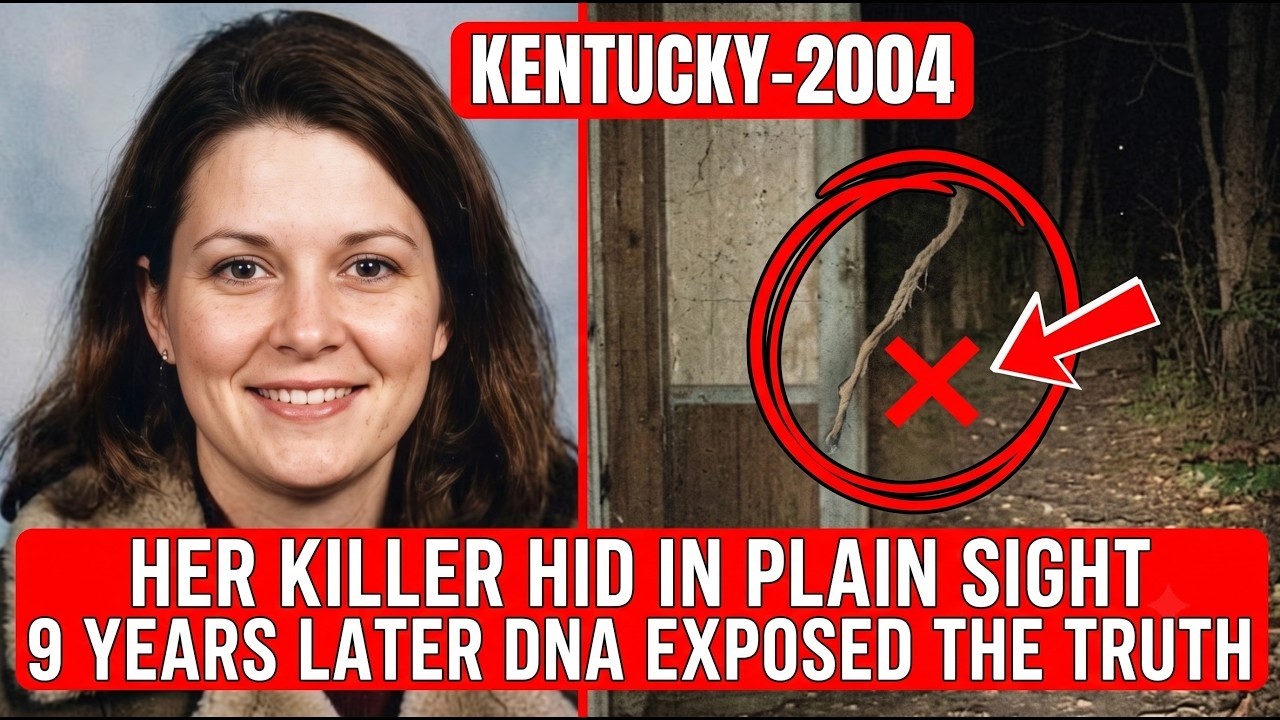
She never came home. Her Pontiac Bonneville was discovered the next morning in a gravel lot of a closed farm supply store on Route 9, less than a mile from the hospital. The engine was off, her keys were on the seat, and her purse was gone. Karen left behind her 7-year-old daughter Maya, who still slept with a stuffed rabbit named Peanut, and a mother, Ruth Aldridge, a retired school librarian who called Karen every Sunday without fail.
Karen had lived in Mill Haven her whole life. She grew up three streets away from the modest two-bedroom house she eventually bought, a home with a porch swing that once belonged to her grandmother and a flower bed she had grown from seedlings started on her kitchen windowsill every February. She had worked in the hospital’s emergency department for eight years and had twice turned down supervisor positions because the floor was where she wanted to be. “That’s where the people are,” she told her best friend Donna Perkins, a fellow nurse she had known since nursing school in 1994.
Ruth Aldridge, 62, became the one to care for Maya. She packed a bag without being asked, drove over, and was there when Maya came home from school that Monday. She raised her granddaughter without complaint because the alternative was unthinkable. Donna raised the alarm.
When Karen failed to show for their morning carpool, Donna called twice, got no answer, and drove to Karen’s house. She found Maya sitting outside in her school clothes, backpack on her lap, waiting for a mother who was not coming. At 7:55 that morning, Donna called the police. Deputy Sheriff Marcus Webb of the Grant County Sheriff’s Office, a 41-year-old local man known for keeping handwritten timelines on yellow legal pads, took the lead.
The parking lot offered a partial story. Gravel held no footprints, but investigators found two things: a tire impression from a vehicle wider than Karen’s that had parked beside her, and a single dark navy button, the kind that belonged on a jacket. Both were bagged and logged into evidence. Webb developed two early persons of interest.
The first was a former patient involved in a workplace dispute who had threatened hospital staff. His alibi was solid; three witnesses and a credit card receipt placed him 40 miles away until nearly midnight. The second was a downstairs neighbor whose unrequited interest in Karen had been noted, but fourteen relatives confirmed he had spent that Sunday at a family gathering in the next county. His DNA did not match a trace sample recovered from the inside collar of a jacket found four days after Karen disappeared, discarded in a creek bed half a mile off Route 9.
That jacket became the most significant physical evidence in the case. It was a men’s size large dark wool coat, the kind sold in department stores across a dozen states. One navy button was missing from the right cuff. The button from the parking lot matched it in size and thread pattern.
The DNA from the collar went into the state database and into CODIS, the national system. Nothing came back. Webb chased a third possible thread for nearly a year: a hospital lab technician who had worked the same Sunday shift as Karen and whose timeline after clocking out at 10:30 p. m.
was never fully accounted for. He cooperated initially, then retained an attorney. When his DNA sample came back in early 2005, it did not match the jacket. He moved to Ohio, and the investigation ran out of leads.
Webb pushed anyway. He requested hospital records, interviewed former patients, canvassed businesses along Route 9, and drove the route between the hospital and the farm supply lot twice looking for anything missed. He found nothing. By the end of 2005, the case had gone officially cold.
But Webb did not close the cabinet where he kept his files. He retired in 2010 at age 57 and took the Karen Aldridge case file home in a banker’s box, placing it on a shelf beside his service commendations. When his wife asked if he would ever let it go, he told her probably not. She said she hadn’t thought so.
Meanwhile, Ruth Aldridge was doing her own work. She kept a notebook, recording every name that surfaced and every detail that seemed to matter. She was a school librarian and knew how to organize information; she knew the right detail is often invisible until enough others have been cataloged around it. She kept writing.
Years passed. The house next door to Karen’s gained new occupants who never knew her. Her flower bed survived two winters before the new family, not knowing what it was, turned it over and planted grass. By 2007 the case appeared as a single paragraph in a state police cold case summary, about two hundred words that captured nothing true about Karen.
Ruth read it and said nothing. The reward poster in Patsy’s Diner had faded until its ink was bleached out, but Patsy left it up. In 2011, Kentucky allocated funding to a cold case unit, and forensic genealogy was changing what was possible. The technique, uploading crime scene DNA to public ancestry databases and tracing distant relatives back to a single unknown contributor, was producing results across the country.
Webb read about it at his dentist’s office. He put the magazine down, sat for ten minutes, then picked it up and read the article again. He went home and called the cold case unit that same afternoon. He was retired.
He had no standing to push the case. He pushed it anyway. It was a Tuesday morning in March 2013 that analyst Claire Voss at the state crime lab received a match alert from the genealogy database where the Aldridge DNA profile had been uploaded. The trace DNA from the jacket collar had found a partial family match, not the contributor himself, but a distant relative who had voluntarily submitted DNA to a genealogy website.
Analysts built outward through a family tree, following branches and narrowing candidates by age, gender, and geography, until one name rose to the surface. His name was Douglas Fenwick. Fenwick was 48 years old and had lived in Mill Haven his entire life. He was a deacon at First Baptist Church on Cedar Street, the same church Karen’s family attended.
He had been at her memorial service. He had spoken to Ruth Aldridge and told her he was sorry for her loss. In the weeks before Karen disappeared, he had volunteered at the hospital as part of a faith-based patient visitation program. He knew the parking lot.
He knew what time second-shift nurses finished. He had never once appeared on the investigation’s radar. The jacket had belonged to a colleague. Fenwick had borrowed it at a church event two weeks before Karen disappeared, said he had forgotten to bring it back, and kept it.
Investigators obtained a DNA sample covertly from a discarded coffee cup at a shop Fenwick visited three mornings a week. It matched the collar. It matched the parking lot. It matched nine years of unanswered questions.
Douglas Fenwick was arrested on a Thursday afternoon in April 2013 at his home on Poplar Street, three blocks from the house where Karen had grown up. A neighbor across the street watched him come out without incident and said later that he looked like he had been waiting for it. The community’s response was what it always is when the answer turns out to be someone trusted, someone seen, someone who folded his hands in prayer beside you on Sunday mornings. First disbelief, then a slow, terrible rearranging of memory.
People began recalling small things they had noticed and dismissed, comments that struck them as odd and were forgotten. Fenwick was charged with first-degree murder and entered a not guilty plea. At trial in the spring of 2014, the DNA evidence formed the cornerstone of the prosecution’s case, supported by the jacket, the matching button, the colleague’s testimony, and cell tower records placing Fenwick’s phone within a quarter mile of the farm supply lot on the night Karen disappeared. Fenwick never took the stand.
The jury deliberated for six hours and returned a guilty verdict. He was sentenced to life in prison without the possibility of parole. He has made no public statement since. Ruth Aldridge was 69 when the verdict came in.
She sat in the third row of the courtroom wearing a gray wool coat Karen had given her one Christmas, with Maya, now 18, beside her. When the verdict was read, Ruth reached over and took her granddaughter’s hand. In a later interview, she said simply: “I always knew the truth was somewhere. I just had to outlast the waiting.
” She thanked Marcus Webb by name. She thanked Claire Voss by name. She thanked the people at Patsy’s Diner who never took the poster down. Karen Aldridge was 34 years old.
She made careful lunches for her daughter every weekday morning while the Today show played in the background. She tended a flower bed with quiet stubbornness. She was the kind of nurse you wanted beside you when the world was frightening. And then someone took her from the people who loved her and stood at her memorial with his hands folded and his head bowed.
The truth waited in a jacket collar through nine winters until science caught up with what had been done. It took a retired detective who had no obligation to keep pushing and a distant relative who never knew their family tree would help close a murder case. Justice did not move quickly.
But it moved.