On an October night in 1948, three Harlem clubs went dark at once. Over two hundred workers lost their wages before sunrise. Not because of fire or raid. Court seals did the job.
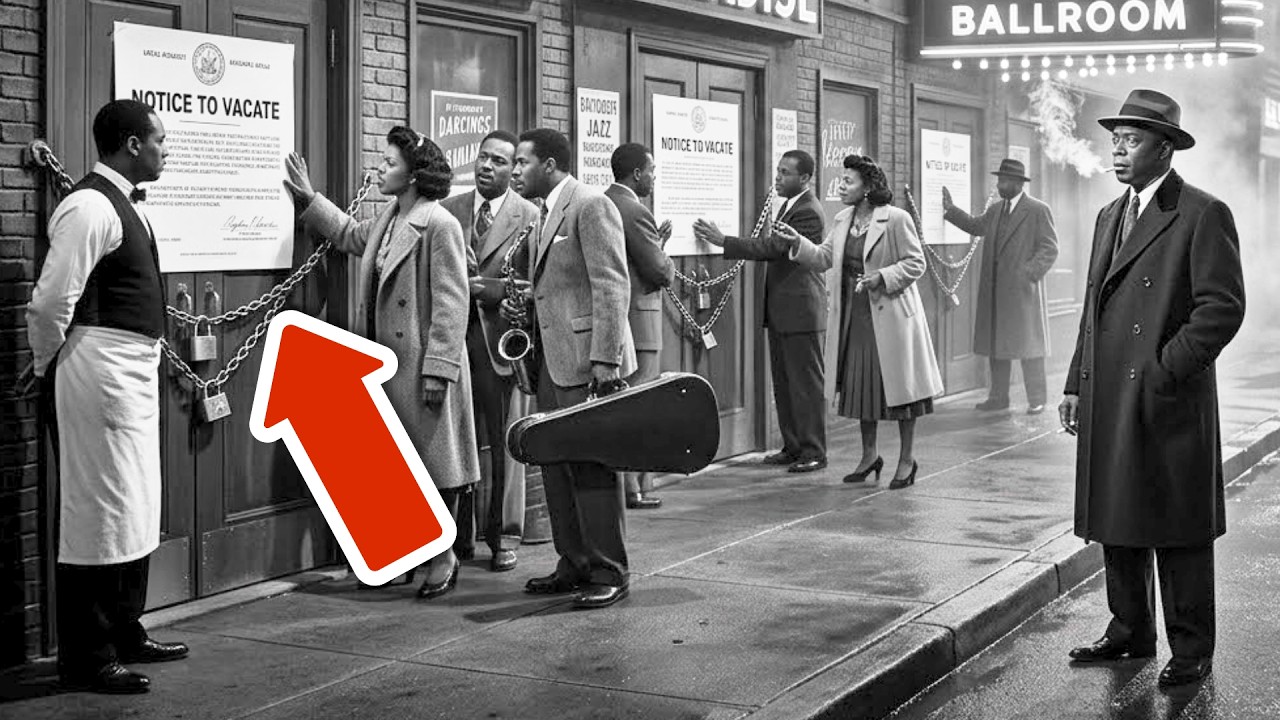
Padlocks, paper, and a stamped order dated three days earlier. Someone had been carrying that document while Mamie’s saxophone player was still warming up his reed. Bumpy Johnson stood outside Mamie’s Corner at half past midnight and read the notice twice. Then he walked.
Two blocks north, the bartender at the Starlight, a man named Curtis, was still sitting on a stool. He had worked that bar for eleven years. That night he sat with his hands flat on the bar top. Two men in suits and a uniformed officer had arrived at nine.
The suits had folders. Violation of municipal code forty-seven B. Unlicensed gambling on premises. Failure to maintain an approved entertainment permit.
Curtis said he had not run a gambling table in four years. They knew that. One of the men, Hargrove, had left a card and said there were options available to responsible business owners. He was very polite.
That was what scared Curtis most. Bumpy spent four hours walking Lenox Avenue. He talked to doormen, coat check girls, and the man who collected cover charges at the Blue Door. Every story was the same in different voices.
Before the padlock, a stranger in a suit. Before the stranger, a uniformed officer making notes. Before the officer, a quiet suggestion from someone the owner half recognized, someone who mentioned that smart men made arrangements before things got difficult. The pattern was identical across all three locations.
That was not coincidence. That was choreography. Someone had studied ownership records, license renewal dates, outstanding fines, and the weakest point in each property’s legal standing. That kind of preparation did not come from a precinct captain looking for extra cash.
That came from someone who thought of Harlem not as a neighborhood but as an acquisition target. Rain came the next morning and stayed. Bumpy spent the day in a back room above a barber shop on 133rd Street with four men he trusted. He needed names.
Not the judge who signed. Not the officer who delivered. He needed the people in the middle, the ones who carried the folders and scheduled the inspections and collected the responses. Those men could be talked to.
A judge could not. By noon his people had three names. By two in the afternoon, one of them had agreed to a conversation. His name was Delbert, forty-one years old, thin in the way that men who skip meals get thin.
He delivered documents. He picked up sealed envelopes from a law office on Chambers Street and drove them uptown. Eleven or twelve envelopes in the last thirty days, all Harlem, mostly. The name on the door changed, three different names in two years, but the same two men were always inside.
When he delivered to the precinct, Lieutenant Pharaoh asked no questions. He put the envelope in his desk drawer and offered bad coffee. He had been doing that since at least 1946. After Delbert left, Bumpy sat alone and thought about the real estate brokers.
Three different names had come up in the past week, men quietly inquiring about Lenox Avenue properties and mentioning that current owners might be looking to sell given recent circumstances. The clubs shut on a Tuesday. By Thursday the inquiries had started. Someone had lined up buyers before the padlocks went on.
The closures were not the point. They were the pressure mechanism. The point was the transfer of ownership. Someone wanted to own the nightlife economy of Harlem outright and had decided the cleanest way was to use the court system as a weapon and wait for desperation to do the rest.
Bumpy paid for his coffee and walked back into the rain. A name had come up once, six months earlier, in a fragment of a conversation he had filed away without knowing why. Frank Costello. Bumpy began with the court calendar.
A clerk named Edgar brought him seven weeks of records, hearing dates, inspection orders, suspension notices, license review appointments. The pattern was visible once you knew to look. The same cluster of violations appeared across unrelated properties in intervals of eight to twelve days. The same inspector badge number appeared on site visit reports.
Three different judges had signed the orders, but the orders were nearly word-for-word identical. This was not individual corruption. Individual corruption was sloppy and inconsistent. This was a template.
Someone had written a master document, had it approved at the source, and was running copies through the system like a factory. A man named Walter, who had once studied law for two years, examined the documents. The citation language was verbatim from a 1941 municipal code amendment that most judges had never read. Inspector Gerald Mack, assigned to the 28th, had filed seventeen site visit reports in nine weeks, roughly three times the normal caseload.
Three of the reports were filed on the same day as hearings in two different courtrooms simultaneously. One man could not physically be in both places. The documents were fraudulent in the particular careful way of someone who expected no one would ever look closely enough to notice. Bumpy sent three men to watch the property managers making acquisition inquiries.
Within four days they had photographs of two meetings. He also sent someone to a woman named Dora, a transcriptionist from the Chambers Street law office who had arrived one Monday morning to find the doors locked and two weeks of pay missing. She had kept her own shorthand notes, pages of names, dates, telephone numbers, and fragments of conversation. Some of the names matched what Bumpy already had.
Two of them were judges. He sat alone and thought about Costello. Costello was not a man who used violence as a first resort. He was known for preferring influence over force, for building relationships with politicians and lawyers and judges over decades.
That meant he would not respond well to soldiers in the street. He would respond to the thing he valued most being threatened, his reputation for clean hands and his belief that the system he had built was invisible enough to be untouchable. Bumpy went to see Roosevelt Hines, who owned the Red Canary on 134th Street. His club had not been touched.
Someone had fed Costello’s people a list with specific information that lived in maybe four places in the neighborhood. Roosevelt was one of those places. A young man had come to see him six weeks earlier, well-dressed, talking like he went to college, claiming to represent a business association working with the city on regulatory compliance. He asked general questions that were specific enough that honest answers would reveal exactly which properties were vulnerable.
Roosevelt had answered them. He was not the leak. He was the door someone else had walked through. Bumpy ran a controlled operation.
He told four different people four different pieces of false information, each traceable to only one source. On the fourth day an inspection order was filed for one of the properties, citing the exact violation Bumpy had described to only one person. That person was Gerald Webb, a bookkeeper who had worked for three different Harlem business operations over the past decade. Gerald had been paid a figure that was not large, which was almost the worst part of it.
A man named Hargrove had approached him, said it was information gathering, said nobody would get hurt. Gerald knew that was not true by the third month. He kept going anyway. Bumpy looked at him and said he was not going to hurt him.
Gerald was going to help fix what he broke, starting that night. A plain manila envelope arrived on a Thursday morning, left at a pharmacy counter by a middle-aged woman in a gray coat. Inside were internal records, meeting notes, handwritten margin annotations, and telephone logs. One name appeared repeatedly, always initialed.
H. P. Judge Harold Prentice. He sat on the district bench and had a reputation for being incorruptible.
One article had called him the conscience of the district court. According to the documents, he was not a judge who had been bought. He was directing which properties got flagged for inspection, which violations got prioritized, which attorneys received advance notice of hearing dates. He had been in business with Costello for at least three years.
The second finding was worse. The documents contained a list of properties with dates and notations. Four of them were marked protected. Those four were still open, still operating.
They were under Bumpy’s informal protection, and the man who compiled this document knew it. Costello’s operation had deliberately avoided those four properties while stripping everything around them. Bumpy had been used as an unwilling architect of his own neighborhood’s dismantling. The businesses he protected survived not because Costello feared him but because the operation had been careful enough to leave his assets alone.
He stood at the window and thought about the cost of using the legal system. Every light he turned on over that network would also illuminate his own shadow. The alternative was letting Harlem be purchased one padlock at a time by a man who had never set foot on Lenox Avenue. He would use the story instead of the law.
Bumpy had a reporter named Marcus Webb receive a sealed envelope containing a summary of the inspection pattern, copies of two telephone logs with identifying information removed, and a note saying the closures on Lenox were connected and the connection had a name. Webb published his first story nine days later. It did not name Costello or Prentice. It described the statistical anomaly of nine properties cited in six weeks, all sharing identical citation language, all processed by the same inspector badge number, all resulting in inquiries from the same cluster of real estate interests within seventy-two hours.
The story ran on page four. Within a week it was picked up by two other papers. Bumpy also went to Reverend Aldous Crane, who led the largest congregation on 136th Street and did not particularly like him. Bumpy did not ask for sympathy.
He gave the reverend the names and addresses of the workers who had lost their shifts, real people from his congregation, and asked for one thing, a sermon about what was being done to the neighborhood and by what method. Crane understood that standing up in public for this would mean standing up for something with Bumpy’s fingerprints on it. He agreed anyway. Within two weeks the closures on Lenox Avenue had become a public conversation in places where Frank Costello did not want his name to appear.
Three of the targeted club owners agreed to speak, not on record, not by name, but in ways that allowed the narrative to move. Their testimonies described the same sequence, the stranger in the suit, the polite suggestion, the inspection that followed refusal, the order calibrated to the weakest point in their paperwork. The first sign the machine was losing pressure came from the bottom. A collector named Tito disappeared from his Thursday route.
A property manager named Sills filed paperwork transferring his license to another county and disconnected his telephone. Costello was releasing the visible pieces. He had survived other cities by knowing exactly when a position was no longer worth holding. In the meantime Curtis had been closed for six weeks.
His bar refrigerator died in the second week. His wife pressed other people’s shirts at six in the morning to cover rent on a home above a bar that sat dark and locked below them. Every morning Curtis walked into his closed club and sat on a stool for an hour because the smell of the place helped him remember what he was still fighting to recover. Bumpy gave him an envelope covering two months of expenses and did the same for four other owners.
The money came from his own reserves. He was spending down income earned through years of protection arrangements to repair damage caused by a man who had never set foot on Lenox Avenue. Then the telephone log came out. Marcus Webb received it on a Friday and published the connection between Prentice’s private number and the Queens address registered to Costello’s intermediary the following Wednesday.
The story ran above the fold and was picked up by a wire service before the afternoon edition. Judge Harold Prentice requested a medical leave of absence from the bench the next morning. It was granted the same day. The inspection orders flowing through his chambers went dry.
The light returned the way it always does after a long cold. A sign above the Blue Door flickered on at 7:15 on a Tuesday morning. The man who threw the switch was a bartender named Thomas who had spent the past six weeks doing day labor at a construction site on the West Side to keep his family’s heat on. He stood at the breaker box for almost a full minute before he threw it.
Curtis reopened the Starlight on a Thursday, his saxophone player in by eight, a full room by nine thirty. Bumpy sat at a back table for forty minutes, ordered one drink, spoke quietly to the people who approached him, and left before midnight. His presence said what it needed to say without a word about the preceding six weeks. The other clubs opened across the following two weeks.
Not all of them. Two owners had accepted buyout offers during the worst of the closure period and were not coming back. Their properties were held by a holding company whose paperwork pointed in several directions before arriving at anything resembling a name. Bumpy recorded that as a permanent loss in his own accounting of what the operation had cost Harlem.
The workers returned. Two hundred people recovered their income in ten days. Frank Costello did not mark the withdrawal in any visible way. He redirected his attention.
That was all. But Bumpy understood that a tactical retreat was not a permanent conclusion. The reasons Costello had wanted Harlem had not changed. The tools he had used, the inspectors, the legal templates, the judges willing to participate, did not disappear when one operation ended.
They dispersed and waited and became available to the next person willing to pay for them. A young woman named Alicia, who worked coat check at Mamie’s Corner, found Bumpy near the end of the first week of reopenings and asked him directly whether it was finished. He said the specific people who ran this operation had backed away. The appetite for what the neighborhood generates had not changed.
What changed was the arithmetic. Right now, taking another run at Harlem costs more than it returns. That arithmetic is not permanent. She asked what they did about that.
Watching without blinking, he said. That is the entire job. The old order did not fall to gunfire. It fell to its own reflection.
The judges stepped back. The collectors disappeared. And Bumpy Johnson remained standing in the middle of Harlem, the shield and the shadow occupying the same body on the same street. The official record looked, from a sufficient distance, like routine regulatory disputes in a changing neighborhood.
Harlem kept a different record, passed through the people who had been present, held in the specific memories of men and women who remembered which nights the lights went out and which morning they came back on and exactly what it had cost to close the distance between those two moments. The new order that settled over Lenox Avenue belonged to Bumpy Johnson in the way that anything belongs to the person who paid the highest price to keep it standing. Not justice in any formal definition. Not freedom in any complete sense.
But the doors were open. The music was playing. The avenue smelled like it was supposed to smell at night. In Harlem, in 1948, that was not a small thing.
It was the only thing that mattered.