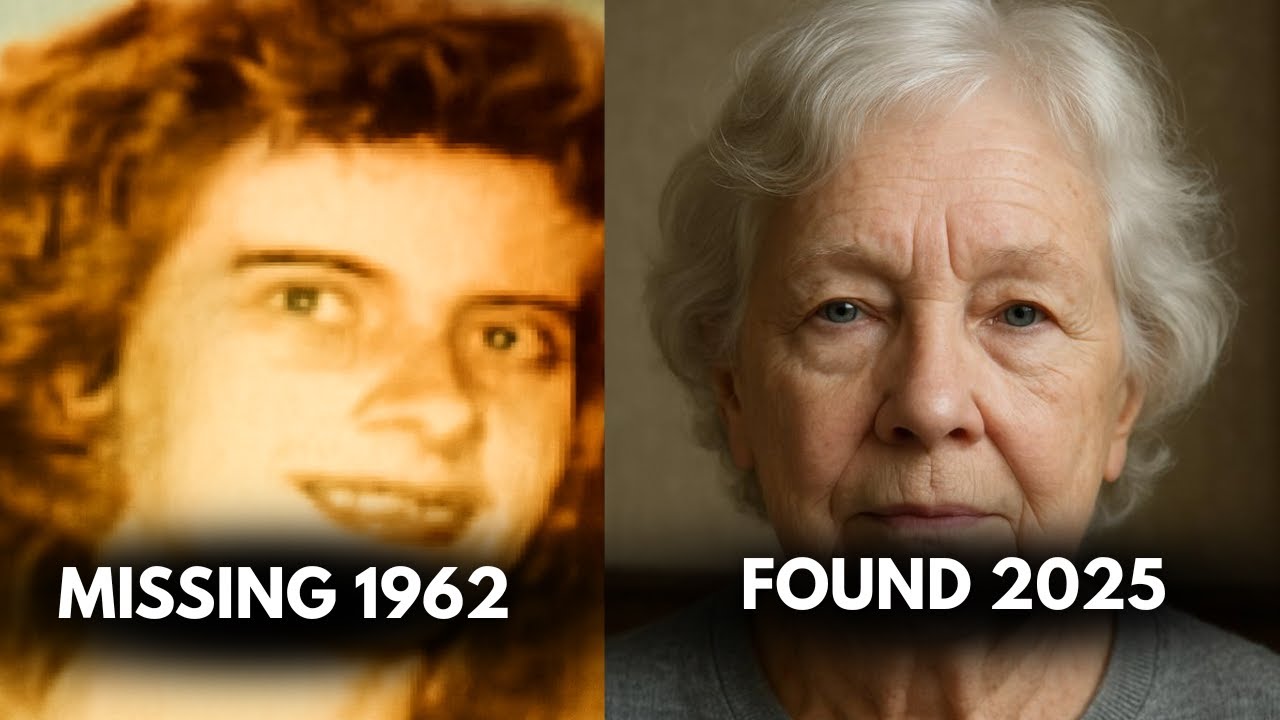
In July 1962, Audrey Bakaberg walked out of her home in Reedsburg, Wisconsin, and vanished from the lives of everyone she knew. The 20-year-old mother kissed her two children goodbye, told a friend she was going to collect her paycheck from the woolen mill, and left. She never came back. No call, no note, no body, no trace.
For more than six decades, the question of what happened to her remained frozen in a single thin file at the Columbia County Sheriff’s Office. The search for Audrey began within hours. She was known and liked in the small community, and her disappearance made no sense to those around her. She had a home, a job, and two small children.
Her husband, Ronald Bakaberg, told authorities he had no idea where she had gone. He said she had seemed upset earlier that week but would not say why. Police checked hospitals, bus stations, and phone records, following the standard procedures of the time. In 1962, there were no centralized databases, no DNA tracking, and no coordinated missing persons system.
The trail went cold almost immediately. But the people closest to Audrey knew the situation inside her home was not peaceful. She had been married at fifteen, still a child when she became a wife. By twenty, she was already a mother of two with no high school diploma, no driver’s license, and almost no independence.
Ronald Bakaberg presented himself to the outside world as a charming, mild-mannered man, but Audrey described a different reality behind closed doors: explosive outbursts, jealousy, control, and constant surveillance. She was not allowed to have friends over without permission. She was not allowed to leave town. A family member later claimed Ronald had once held a gun to her head in front of the children.
In the spring of 1962, just months before she vanished, Audrey did something that took considerable courage under the circumstances. She filed a domestic abuse complaint with the police. It was the final act of a woman running out of options. A few days before she disappeared, she told a teenage babysitter that she feared Ronald might kill her.
She asked the girl to stay for the weekend and said, more than once, that if something happened to her, not to believe whatever Ronald said. On the night she vanished, the same babysitter reported seeing Audrey near a highway, crying but determined. Audrey told her, “I can’t go back. I have to disappear.
” She got into a car and was gone. The case was unofficially labeled a domestic walk-off. The file sat in a box, never closed but never actively worked. Ronald Bakaberg passed a polygraph test, and there was never enough evidence to charge him with anything.
He remarried, raised the children, and lived in the same area for years. Audrey’s sister never stopped wondering, and her mother believed until her death that her daughter would one day walk through the door again. Over the decades, rumors surfaced. In 1985, someone claimed Audrey’s body was buried in a cornfield outside town.
Police searched and found nothing. In 2002, a man said he remembered Ronald digging in his backyard years earlier. Again, nothing was found. No confirmed sighting, no birth certificate update, no death certificate, no fingerprints.
Audrey Bakaberg had simply ceased to exist. The case remained in that state until 2024, when the Columbia County Sheriff’s Office began digitizing its cold case files. Detective Isaac Hansen pulled the sixty-two-year-old folder and read it once, then again. He decided the case was not cold, but unfinished.
He scanned every page of the old file, re-interviewed surviving witnesses including the babysitter, and ran every known detail through new databases: social security records, hospital records, genealogy matches, and fingerprint comparisons. Then came a breakthrough. An arrest record from decades earlier in another state showed a woman who had used a name that partially matched Audrey’s real name. The arrest was minor, and the woman had been released without her fingerprints being compared to the missing person’s file.
The record had gone unnoticed for years, but now it pulled the case open. What Detective Hansen found was that Audrey Bakaberg had built an entire second life. She had remarried decades earlier, taken a new name, and lived quietly and contentedly for over sixty years. There had been no death certificate, no obituary, and no legal name change that connected the woman to the missing mother from Wisconsin.
But the fingerprint on that old arrest record was a match. When the deputy knocked on her door, she opened it calmly. She was in her eighties, gray-haired and sharp-eyed. Asked whether she had ever been known as Audrey Bakaberg, she answered without hesitation.
Yes, she said. She paused, then added that she hadn’t been that person in a very, very long time. She had left Wisconsin with nothing: no money, no legal papers, only her clothes and a decision. She made it clear she had no intention of being found, and when asked why she never reached out to her children or her family, she said simply that she had to choose survival over memory.
If she opened that door again, she explained, she would not have made it. She said she did what she had to do. She declined interviews, asked police to protect her new identity, and did not want to reconnect with her remaining family. Since no crime had been committed and no charges were pending, authorities respected her request.
The case was officially closed. The outcome was not a reunion. One of Audrey’s children had died in 2006, never knowing whether their mother was alive or buried in a field. The other was notified of the discovery, but no meeting took place and no statement was made.
There were no tearful embraces, no cameras, no public reconciliation. There was only confirmation: Audrey Bakaberg did not die in 1962. She was not abducted. She simply left, and for sixty-three years she built a new life on top of the one she was forced to flee.
The mystery was solved, but the answers came far too late to heal every wound. Her story is not one of betrayal but of escape, the account of a woman in 1962 facing abuse without protection, without a system, and without choices, who made the only one she could. She survived, but survival came at a price. The case is now closed, yet it lingers because it challenges the assumption that every missing person is lost.
Some are gone on purpose, and they intend to stay that way.