The only confirmed photograph of Billy the Kid is a small, scratched tintype that sold at auction in 2011 for 2. 3 million dollars, making it the most expensive 19th-century photograph ever purchased. For more than a century, that little piece of metal has been used to support two enormous claims about the famous outlaw: that he was left-handed, and that he was a half-mad killer. Both ideas, according to the evidence assembled by historians and forensic examiners, grew out of a fundamental misunderstanding of how tintype photography works.
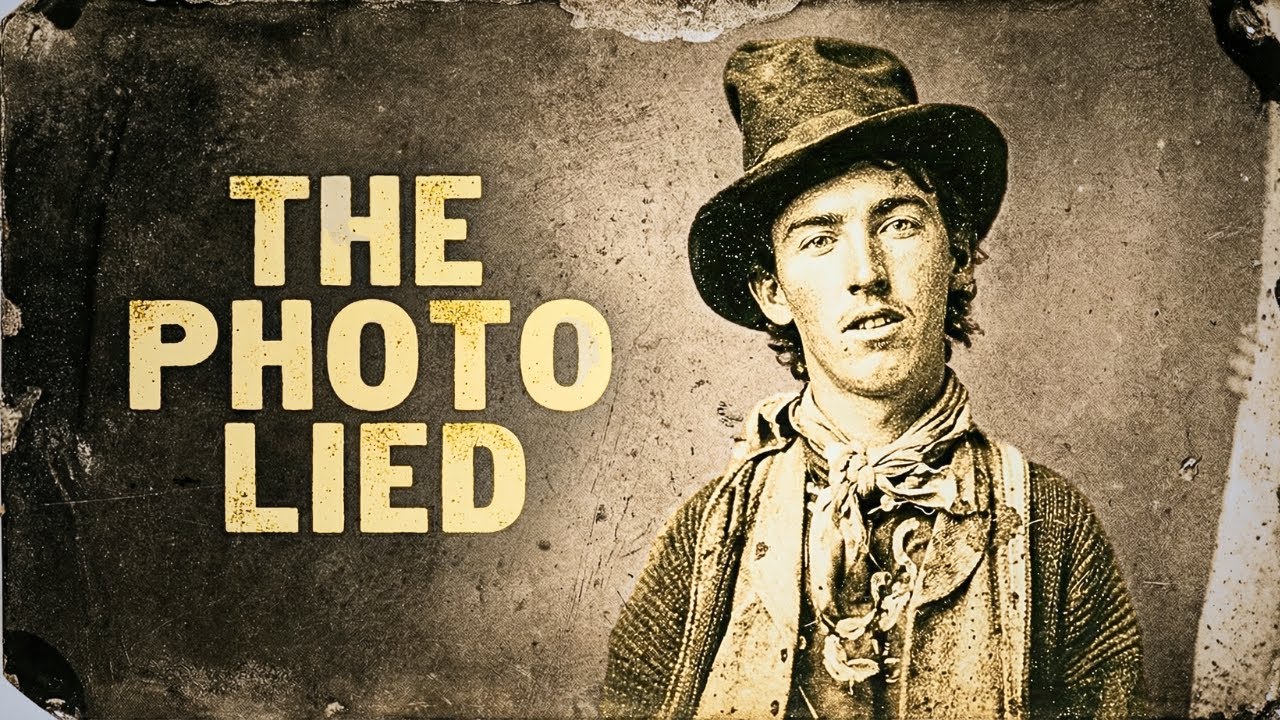
The tintype in question, known today as the Dedrick tintype, stayed in one family for over a hundred years. Billy the Kid gave it to his friend Dan Dedrick, who was reportedly involved in cattle rustling and possibly counterfeiting operations alongside Billy. Dedrick kept the photograph his entire life and passed it on to his nephew Frank Upham when he died in 1938. The Upham family held onto it for decades, occasionally loaning it out for display, and in the 1980s it was briefly exhibited by the Lincoln County Heritage Trust in New Mexico.
It was only in 2011, when the Upham family put the tintype up for auction in Denver, that the world took serious notice. The winning bid came from billionaire William Koch, an Old West enthusiast who outbid every other collector. The photograph measures about two by three inches, a ferrotype captured directly onto a thin sheet of iron coated with dark lacquer. It was the cheapest, fastest form of photography available in the 1870s and 1880s, typically produced by a traveling photographer for a quarter, or fifty cents for multiple copies.
The surface shows scratches, worn-away emulsion, and oxidized metal, evidence that this was not a carefully preserved heirloom but something tossed in a drawer, carried in a pocket, and passed around casually. The central myth attached to the photograph concerns the placement of the revolver. For decades, the image was presented as proof that Billy the Kid was left-handed. The gun appears on his left hip, his right hand rests on the rifle, and his left side is turned toward the viewer.
Hollywood embraced the detail eagerly; a left-handed killer seemed different, memorable, slightly sinister. But tintypes are mirror images. The chemistry of the ferrotype process flipped whatever the camera saw when it was developed onto the metal plate. When the image is reversed, the gun appears on the right hip, and the rifle moves to the left hand, the natural position for a right-handed person.
Even the vest buttons line up correctly once the mirror image is accounted for. The same reversal is confirmed by the rifle itself: Billy holds a Winchester Model 1873, and in the photo its loading gate appears on the left side, but Winchester manufactured Model 1873s with loading gates on the right. The photo must therefore be backwards. Witness accounts support this correction.
People who rode with Billy, fought against him, and jailed him described him as right-handed. Pat Garrett, the sheriff who killed him, said Billy drew with his right hand, and contemporary newspaper accounts never mention left-handedness. Western historians James Horan and Paul Sann stated as early as 1954 that Billy was right-handed and carried his pistol on his right hip. Film historians later confirmed the point by examining the vest buttons and belt buckle, which are visibly on the wrong side unless the mirror image is acknowledged.
The origin of the myth is straightforward: people trusted what they saw without understanding the technology that produced it. Pat Garrett, or someone working with him, circulated the image widely, using an engraving based on the tintype as the frontispiece of his 1882 book, The Authentic Life of Billy the Kid. Billy had been dead for a year by then, and few people who knew him well were left to point out the error. The image was reprinted in dime novels, magazine articles, and early histories of the Lincoln County War, always without any mention that tintypes are reversed.
Through repetition, the mistake became accepted fact. Hollywood cemented it in the 1930s and 1940s, and Paul Newman played Billy as a left-hander in The Left-Handed Gun in 1958. Beyond the gun, the photograph reveals a great deal about Billy’s circumstances when it was taken. His clothing is neither ragged nor wealthy.
He wears layered garments: a shirt, a vest, and what appears to be a cardigan sweater over them, with a bandana tied loosely at his neck, a slouch hat, a serviceable Winchester, a revolver, and a cartridge belt. This was the outfit of a working gunman, someone armed and equipped but not polished. It fits the timeline. According to Billy’s girlfriend Paulita Maxwell, interviewed in the mid-1920s, the photograph was taken by a traveling photographer who passed through Fort Sumner in 1880.
She said Billy posed in the street near Old Beaver Smith’s Saloon and added that she never liked the picture because it made him look rough and uncouth, not the way she remembered him. The individual items of clothing also tell a story. The slouch hat was probably felt, creased in the functional style of working cowboys rather than a show piece. The vest was dark, likely wool, with practical pockets for carrying tobacco, ammunition, or a pocket watch.
The bandana was tied loosely, the way a rider would wear it so it could be pulled over the nose and mouth in a dust storm. During the Lincoln County War, different factions reportedly used different colored items to identify themselves in gunfights. The rifle was a Winchester Model 1873, the famous gun that won the West, holding fifteen rounds and available everywhere. The revolver is harder to identify due to the photograph’s condition, but it appears to be a Colt Single Action Army, the standard sidearm for lawmen, outlaws, ranchers, and soldiers of the period.
This equipment was expensive. A Winchester cost about twenty-five dollars in 1880, a Colt revolver fifteen or twenty more, and with the hat, vest, cardigan, and boots, the total came to roughly seventy or eighty dollars, while a cowboy typically earned about thirty dollars a month. Billy either had savings, was well paid for his work, or was supplementing his income through activities that were not entirely legal. One detail in the photograph is rarely discussed but may be the most revealing of all.
Billy is not looking directly at the camera. His gaze drifts slightly upward, and his expression appears tired and wary, as if he is uncomfortable or distracted. In the 1870s and 1880s, having a photograph taken was a significant event. Subjects had to stand perfectly still for several seconds while the exposure was made, and most people stared straight into the lens because the photographer instructed them to do so.
Billy did not. The photograph was likely taken in early 1880 at Fort Sumner, based on Paulita Maxwell’s account and supporting evidence. By then, Billy had already been involved in the Lincoln County War and had killed at least a couple of men. People were actively trying to kill him, and within months, in December 1880, Sheriff Pat Garrett captured him.
Having a photograph taken while wanted was a considerable risk; the image could be used to identify him, circulated to lawmen in other territories, or used as evidence. The reasons Billy posed are not documented. One theory suggests he wanted to send the image to someone, perhaps Paulita Maxwell, another girlfriend, or family, as a keepsake and proof he was still alive. Another possibility is that he was simply young and vain enough to want a picture of himself despite the danger.
He was only about twenty or twenty-one years old. The photographer was likely an itinerant tintyper who traveled from town to town with his equipment in a wagon. Fort Sumner was small and isolated, so a visiting photographer was an event. According to one account, Billy posed for four identical tintypes that day, produced by a camera with multiple lenses that captured four images on a single metal plate, which was then cut apart.
Of those four originals, the fate of three is known. Billy gave one to Dan Dedrick, the copy that survived and sold for millions. Another went to Pat Garrett, either taken from Billy at his capture in December 1880 or acquired after his death, and Garrett used it for the engraving in his book. A third reportedly went to Deluvina Maxwell, a Navajo woman who worked for the Maxwell family and was a devoted friend of Billy’s; Western author Emerson Hough saw that tintype in Fort Sumner in 1904, but its whereabouts after that are unknown.
The fourth copy has disappeared, likely lost to fire, tossed out with forgotten belongings, or sitting undiscovered in an attic. Despite its humble nature, the tintype survived fires, floods, moves, estate sales, and more than a century of neglect. The evidence that it depicts Billy the Kid is strong: the facial features match contemporary descriptions, including the prominent front teeth and narrow jaw; the dating aligns with Billy’s presence at Fort Sumner; the chain of custody from Billy to Dan Dedrick and through the Dedrick and Upham families is well documented; and people who knew Billy, including Paulita Maxwell, confirmed the identification. The photograph corrects a persistent myth, showing that the left-handed outlaw was a photographic illusion that became accepted as fact because it made a better story and because no one stopped to understand the technology.
It also shows a real young man at a particular moment, not the devil of dime novels or the Robin Hood figure of later romanticization, but a twenty- or twenty-one-year-old who had already killed men and would be dead himself within eighteen months. He does not look evil in the photograph, and he does not look heroic. He looks like someone caught in circumstances he may not fully control, aware that his life is dangerous and uncertain.
That scratched, oxidized piece of metal is the most honest record that survives of Billy the Kid: a young man with no idea that he would still be famous more than 140 years later.