On December 17, 1903, around 10:30 in the morning, a man lay prone on the lower wing of a fragile machine of wood and fabric, facing into a wind blowing at twenty-one miles per hour. He was Orville Wright, and beside him, his older brother Wilbur watched from the sand. The machine moved along a launching rail, lifted, and stayed in the air for twelve seconds, covering a distance of 120 feet. Those twelve seconds ended a question that had occupied humanity for centuries, and they did it so quietly that the world barely noticed.
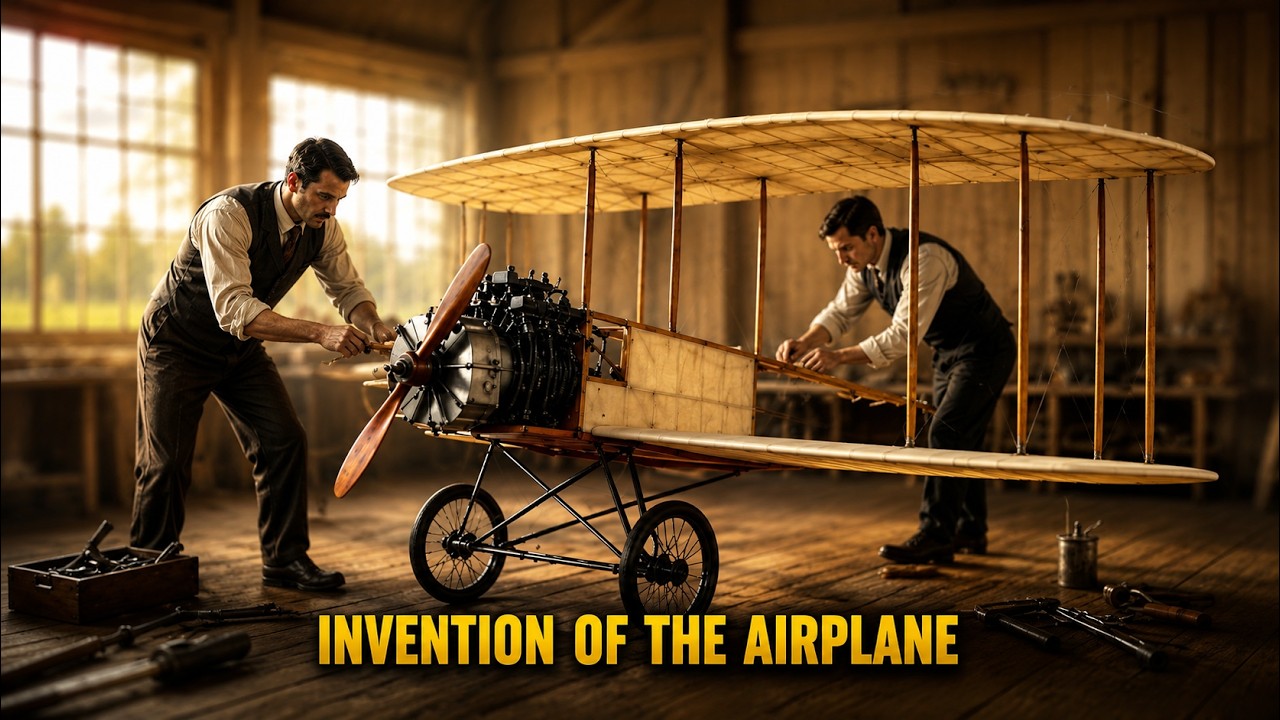
The men who accomplished this were not university-trained engineers. They were not backed by governments or armies. Wilbur Wright was born on April 16, 1867, in Millville, Indiana, and Orville was born on August 19, 1871, in Dayton, Ohio. They were two of seven children in a family where money was scarce but learning was prized.
Their father, Milton Wright, was a priest; their mother, Susan, was an educated woman who nurtured their curiosity. From childhood, the brothers were inseparable, building, playing, and thinking together. To the outside world, they were unremarkable. Inside them, something was waiting for the right spark.
That spark arrived in 1878, when Milton Wright returned from a trip carrying a small toy for his children: a helicopter made of cork and bamboo, powered by a twisted rubber band. Wilbur and Orville were entranced. When it broke, they built another with their own hands. They could not have known then that this small device would redirect their lives.
Wilbur had been the brilliant student, the one with dreams of Yale. Those dreams collapsed in the winter of 1885–86. During a game of ice hockey, another player struck him in the face with a stick. The injury was severe, and its effects reached deeper than the physical wound.
Wilbur withdrew into depression, spending years at home, reading and tending to his ailing mother. When she died of tuberculosis in 1889, the loss struck both brothers hard. The experience could have broken them, but it hardened something in their character instead. In the following years, Orville persuaded Wilbur to join him in business, first a print shop with presses they built themselves, then, in 1892, a bicycle shop.
Bicycles were sweeping America in a frenzy of popularity, and the brothers both repaired and manufactured them. The shop was modest, but it generated the money that would later fund their aviation research, and the mechanical skill they honed there would prove essential. In 1896, news reached them that changed everything. Otto Lilienthal, the German engineer famous for his glider flights, had died in a crash.
His death was reported in newspapers around the world, and the Wright brothers read it all. Lilienthal had left a question behind: could controlled human flight ever be achieved? The brothers decided they would find the answer. In 1899, Wilbur wrote to the Smithsonian Institution, requesting everything written on the subject of flight.
The answers came back as a reading list, and the brothers read it all. What they found shocked them. The accepted scientific data on wings and lift were wrong. Previous researchers had mismeasured or misunderstood the forces involved, which meant the entire body of existing work could not be trusted.
The brothers would have to begin from scratch. It was daunting, but it freed them from the mistakes of the past. Instead of trusting faulty tables, they would gather their own data. They observed birds carefully and noticed that birds bend their wingtips to keep their balance in the air.
That observation produced the idea of wing warping: a subtle twisting of the wing structure that allowed a pilot to raise one wingtip while lowering the other, exactly as a bird does. Others had focused solely on generating lift, on getting a machine into the air. The Wright brothers asked a different question: how to control it once it was there. That question, which everyone else had overlooked, became the foundation of their work.
In 1899, Wilbur built a five-foot biplane kite to test the wing-warping concept. The kite worked, and the first step was taken. The next step required a place with strong winds, soft ground, and no prying eyes. They chose Kitty Hawk, North Carolina, a remote stretch of coastline with reliable breezes and sand dunes that offered forgiving landing surfaces.
The first attempts were failures. Their 1900 glider did not lift as high as their calculations predicted. In 1901, a larger glider made more than 500 flights, but it developed a dangerous new problem: it sometimes rolled over on its side, resisting control. The brothers returned to Dayton disheartened.
Wilbur remarked that the problem of human flight might not be solved for another fifty years. But they did not stop. Instead, they did something unprecedented. In 1901, Wilbur built his own wind tunnel and tested more than 200 different wing designs, measuring and comparing each one.
The work consumed months, but the data it produced were the first accurate measurements of wing behavior ever recorded. Where earlier science had been unreliable, the Wright brothers created reliable science for themselves. In 1902, they built a new glider, this time fitted with a movable rudder. It combined wing warping, an elevator for pitch, and the rudder for yaw.
For the first time, a pilot had complete control over an aircraft in all three axes of motion. Many aviation historians consider this 1902 glider the true invention, because all that remained was adding power. But adding power proved as difficult as everything else. No company would build an engine light and strong enough for flight.
So the brothers built their own with the help of Charlie Taylor, a mechanic from their bicycle shop, and they designed their propeller themselves, relying on no outside assistance. In 1903, they returned to Kitty Hawk and spent seven weeks assembling and testing the machine. Then came the morning of December 17. A coin toss decided that Orville would fly first.
The flight lasted twelve seconds. Then came four flights in all that day: Wilbur flew 175 feet, Orville 200 feet, and in the final and longest flight, Wilbur covered 852 feet in 59 seconds. Five local witnesses watched, and a photograph was taken that would become one of the most famous images in history. That evening, Orville sent a telegram to his father reporting four successful flights.
The telegraph operator misspelled Orville’s name, and the message drew little attention. Most newspapers ran the story as a minor item, and many readers simply did not believe it. For years afterward, skepticism persisted. In 1906 and 1907, the brothers’ claims were still widely dismissed.
Some insisted the flights were a hoax; others argued that European experimenters had done the same first. The Wright brothers had something their doubters lacked: their own records. They possessed wind tunnel data, photographs, witnesses, and a patent approved on May 22, 1906. The proof became impossible to ignore in 1908, when Wilbur traveled to Europe and staged public flights.
He carried journalists as passengers, flew government officials, and demonstrated before crowds who watched in amazement. The brothers were suddenly celebrities, courted by kings and heads of state, featured in newspapers day after day. The achievement the world had ignored two years earlier now commanded the world’s attention. In 1909, the United States Army purchased the Wright brothers’ first military airplane.
The men who had begun with only a bicycle shop now headed the world’s first aviation company. In 1969, when Neil Armstrong stepped onto the moon, he carried with him a piece of the wing and a piece of the propeller from the original 1903 Wright Flyer. Even at the summit of human achievement, the world remembered what they had begun. Wilbur lived only a short time longer, dying of typhoid fever in 1912.
Orville lived until 1948, dying of a heart attack. Both are buried in Dayton, near the streets where they once worked and dreamed. The brothers brought to the problem no university degrees, no government funding, and no approval from the world. They asked their own questions, collected their own data, made their own mistakes, and built their own instruments.
When the science they inherited proved wrong, they replaced it. When no engine could be found, they made one. Their answer to what they possessed that others did not was simple: patience, hard work, and the conviction that for every problem, there was a solution waiting to be found.