At 11:00 p. m. on May 23, 1945, in a drafty interrogation room at 31A Lüneburger Straße in Lüneburg, Germany, a British military doctor shone a flashlight into the mouth of a small, nervous man who had been brought in for a routine physical examination. The man had been captured the previous day at a checkpoint near Bremervörde, carrying forged discharge papers and a pristine passport that stood out among the torn, blood-stained documents of ordinary retreating German soldiers.
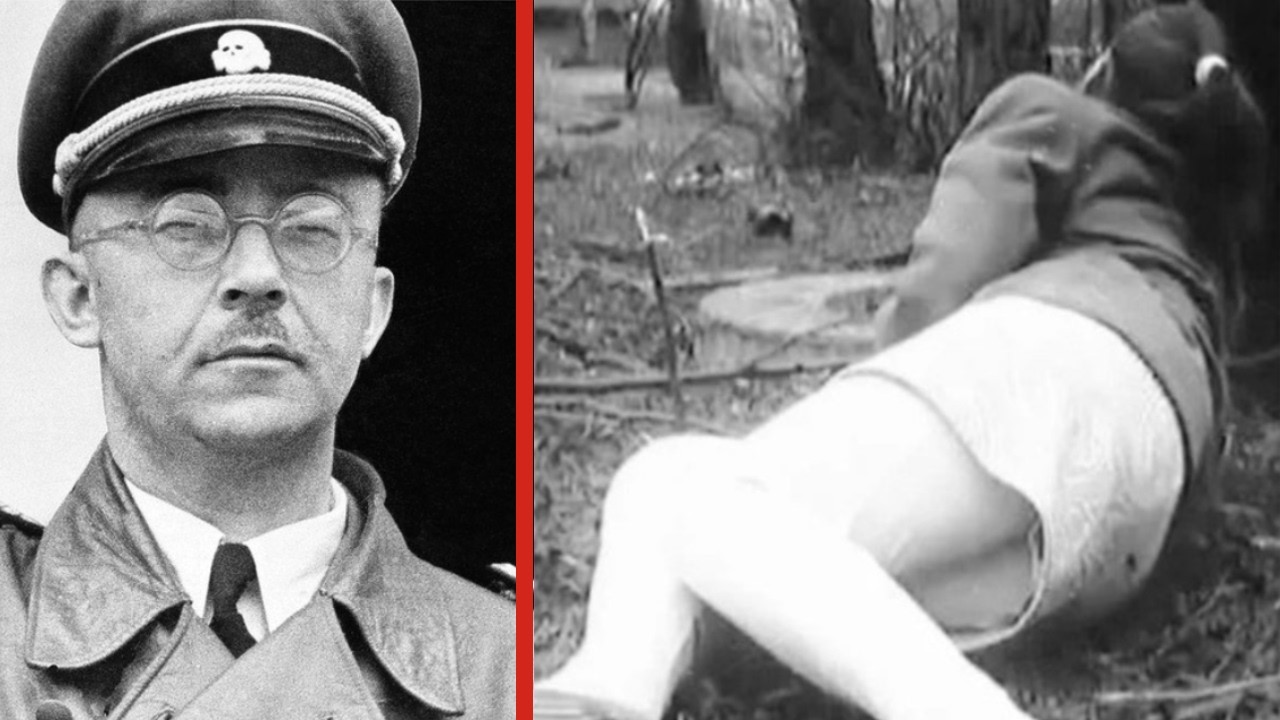
He wore the uniform of a low-ranking sergeant in the Feldgendarmerie, with a black patch over his left eye and no mustache. The British intelligence team had flagged him because his papers were too perfect, freshly stamped and neatly filled out, and because he did not behave like a battle-hardened sergeant. His posture was stiff, his eyes darted erratically, and his story did not hold together under questioning. When the doctor asked him to open wider to check his teeth, the man jerked his head back violently and bit down on something hidden between his molars.
Within fifteen minutes, Heinrich Himmler, the Reichsführer of the SS and the architect of the Holocaust, was dead on the cold concrete floor. A tiny glass vial of potassium cyanide, concealed in his mouth for days, had done its work. There would be no trial. There would be no cross-examination.
There would be no public testimony and no direct justice for the six million Jews systematically murdered under his command. He took his secrets into an unmarked grave somewhere on the Lüneburger Heath, a location deliberately never recorded. To understand the weight of what happened in that quiet room, one must understand the scale of the terror Himmler had set in motion. As Reichsführer of the SS, he controlled the SS, the Gestapo, and the entire concentration camp network.
He turned mass murder into a highly efficient bureaucratic routine. At the Nuremberg trials in 1946, Hermann Göring, Joachim von Ribbentrop, and Ernst Kaltenbrunner were forced to sit in the dock, face the survivors, and look at graphic film evidence of their crimes. Himmler’s chair was empty. By biting down on that capsule, he locked the doors to the archive of his mind before anyone could ask a single question.
The irony is that just weeks before his suicide, Himmler had no intention of dying. In fact, he genuinely believed he had a bright political future ahead of him. By April 1945, the Red Army was systematically flattening Berlin, block by block, and the Third Reich was disintegrating into ash. Yet inside his mobile headquarters, Himmler was busy concocting what might be the most delusional gamble in military history.
Through a Swedish intermediary, Count Folke Bernadotte, he reached out to the Western Allies with a stunningly arrogant proposal. He offered a partial German surrender on the Western Front in exchange for personal immunity from prosecution. He was convinced that the alliance between the United States, Great Britain, and the Soviet Union was about to shatter, and that Winston Churchill and Dwight Eisenhower would view him as a valuable, stable partner to help govern occupied Germany and fight off the communist threat from the East. He even wondered aloud to his aides whether he should salute the Western generals with the Nazi salute or a standard military gesture when they met to negotiate.
He completely miscalculated. Eisenhower and Churchill rejected the overture instantly, refusing to even entertain a conversation with the head of the SS. To make matters worse for Himmler, news of his secret negotiations leaked and reached Adolf Hitler, hiding in the Führer bunker beneath Berlin. It sparked one of Hitler’s final, legendary rages.
Furious at the betrayal by der treue Heinrich, loyal Heinrich, Hitler stripped Himmler of all his titles, expelled him from the Nazi Party, and issued an order for his immediate arrest and execution. Overnight, Himmler became a man without a country, without an army, and without a master. He was hunted by the Allies as a prime war criminal and condemned by his own regime as a traitor. On April 30, 1945, Hitler shot himself, destroying the dark political sun around which Himmler’s entire adult life had revolved.
Himmler did not choose a dramatic final stand. He chose to run. He altered his appearance, shaving off his trademark mustache, slapping a black patch over his left eye, and donning the uniform of a low-ranking sergeant in the military police. He took the name of a real, deceased soldier, Heinrich Hitzinger, and armed himself with freshly stamped, forged discharge papers.
He joined the massive, chaotic human tide flowing through northern Germany, millions of starving refugees, wounded soldiers, and freed prisoners walking the highways. He hoped to blend into the background, slip across the Elbe River, and disappear forever into rural anonymity. The man whose name had terrorized a continent was now just another dirty, hollow-eyed fugitive trudging through the mud. His meticulous nature proved to be his undoing.
On May 22, 1945, a British patrol at a checkpoint near Bremervörde stopped a small group of German soldiers. Among them was the disguised Himmler. When the soldiers handed over their documents, the British intelligence team noticed something strange. Most retreating German soldiers had papers that were torn, blood-stained, or water-damaged.
Himmler’s papers were pristine, neatly stamped, brand new, and perfectly filled out. It was a classic counterintelligence trap. The forgery was simply too perfect. The British flagged him for further interrogation.
He spent the night in a holding cell, entirely unrecognized. The next day, he was transferred to the Second Army Intelligence Headquarters in Lüneburg. As the questions grew more intense, Himmler realized his run was over. He walked up to the camp commander, Captain Tom Sylvester, quietly removed his eye patch, put on his familiar pince-nez glasses, and whispered, “Heinrich Himmler, Reichsführer SS.
” The British were utterly stunned. They had caught the big fish completely by accident. Colonel Michael Murphy, the intelligence chief, immediately took control. He ordered Himmler stripped naked and searched thoroughly to prevent suicide.
They found a small brass cylinder hidden in his clothes containing a glass vial of cyanide. Believing they had neutralized the threat, the guards let their guard down slightly. They did not realize Himmler had a backup capsule tucked away in his mouth, nestled tightly against his gums. A military doctor, Captain C.
J. L. Wells, was brought in to do a standard physical examination. Around 11:00 p.
m. , Wells asked Himmler to open his mouth so he could check his teeth. He shone a flashlight inside and saw a dark object. “Open wider,” Wells said, leaning in.
Himmler knew this was his last exit. He violently twisted his head, bit down hard on the glass capsule, and crunched it between his molars. The room instantly filled with the sharp, overwhelming scent of bitter almonds, the classic signature of cyanide. Wells and the guards reacted immediately.
They tackled Himmler to the floor, forced his mouth open, and tried to scrape the poison out. They turned him upside down, plunged his face toward a basin of water, and tried to force emetics down his throat to pump his stomach. For fifteen agonizing minutes, British soldiers fought desperately to save the life of the world’s most prolific killer. They wanted him alive for a courtroom.
They wanted him to speak. But the poison was too fast. At 23:14, the erratic breathing stopped and the room went dead quiet. The historical contrast of that moment is staggering.
Himmler’s regime routinely executed political prisoners by hanging them from meat hooks with piano wire, filming their slow deaths so senior Nazi officials could watch them later for entertainment. His SS organized massive public executions in camp squares, forcing thousands of starving inmates to watch people swing from gallows just to crush their morale. Yet Himmler himself died completely off camera in a modest, requisitioned house, witnessed by just a doctor and a handful of soldiers. There was no microphone to record his final words, no audience to witness his end, and no grand historical statement.
Just a frantic, messy scramble on a concrete floor. Colonel Murphy wanted to ensure that Himmler’s death would not offer any lingering comfort to his followers. He ordered the body wrapped tightly in standard army blankets and camouflage netting. A few soldiers loaded the corpse into the back of a truck, drove out deep into the forests of the Lüneburger Heath, and dug a hole.
They threw the body in and covered it up. They deliberately chose not to record the coordinates of the grave. To this day, nobody knows exactly where Himmler lies, a deliberate move to ensure his grave site could never become a shrine for future neo-Nazi movements. More than eighty years have passed since that night in Lüneburg.
Over the decades, the geography of Himmler’s immense power has undergone a profound inversion. It has transformed from a landscape of terror into a landscape of memory. The site of his old SS and Gestapo headquarters on Prinz Albrechtstraße in Berlin is no longer an office of terror. It is now the Topography of Terror, a sprawling indoor and outdoor museum that draws over a million visitors a year from across the globe.
Near Munich, the Dachau concentration camp, the very first camp, the blueprint that Himmler personally designed and expanded, is now a permanent memorial site. Every year, hundreds of thousands of people, including thousands of school children, walk past the iron gates and stand on the concrete foundations where his clerks once typed out execution quotas. Yet, despite the museums and the historical archives, a profound sense of frustration lingers over the story of Himmler’s end. Fifteen minutes.
That is what it cost him. Fifteen minutes of panic and choking on a floor, balanced against the scale of six million Jewish lives. Balanced against the millions of others, Soviet prisoners, Roma, political dissidents, and marginalized groups who were systematically worked to death, starved, or gassed under his watch. Balanced against the stolen futures of every single survivor who spent the rest of their lives carrying a blue identification number tattooed into the skin of their forearms.
By biting down on that tiny glass capsule, Himmler pulled off his final escape. He managed to evade a courtroom that would have forced him to listen to his own meticulous bureaucratic records read back to him, line by line, signature by signature. He avoided looking into the eyes of the people he tried to erase from the earth. Ultimately, the story of Himmler’s death offers no clean narrative arc.
It provides no sense of catharsis, no feeling of balance, and no true closure. It leaves the world instead with a permanent moral deficit, a historical debt that we can document down to the very last page, but can never actually collect.