J. Edgar Hoover was fifty-four years old when he began what would become his most controversial campaign, but by then he had already spent three decades shaping the Federal Bureau of Investigation into an instrument of personal power unlike anything American government had ever seen. Born on New Year’s Day 1895 in Washington, D. C.
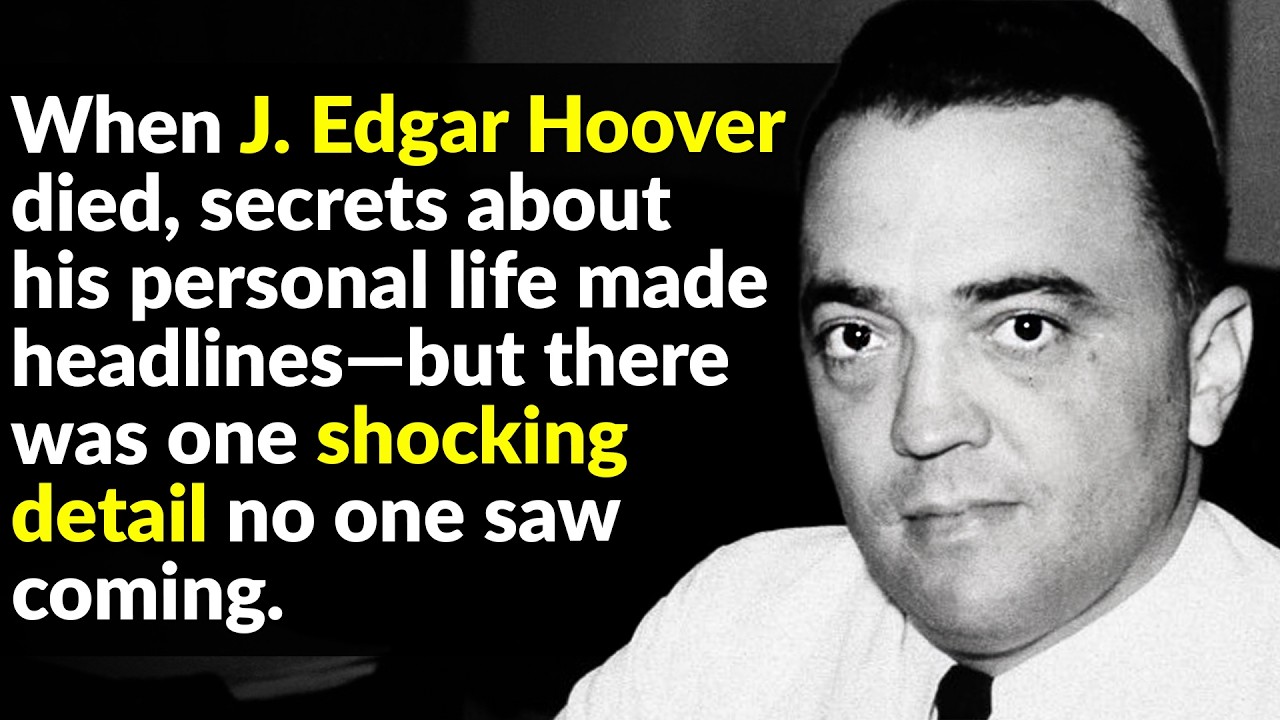
, Hoover did not receive a birth certificate at the time, despite it being legally required, and would not obtain one until he was forty-three, a detail that has long fueled speculation about his origins. Growing up in the capital, he first gained notice as a school debate team member, where his forceful arguments on conservative positions impressed classmates with what one observer called cool, relentless logic. This was no small achievement for a young man who had struggled with a stutter, a source of deep shame that he overcame by teaching himself to speak rapidly, developing the fast-talking style that would later make life difficult for his stenographers. Hoover studied law at George Washington University, graduating with a Bachelor of Laws in 1916.
During his student years he joined a chapter of the Kappa Alpha Order, a fraternity known for its nostalgia for the Confederacy, an affiliation that would shape his conservative worldview and, likely, his later treatment of civil rights activists. His first job out of school was a clerkship in the War Emergency Division, which he began at twenty-two, one day before the commencement of World War I, a position that conveniently exempted him from the draft. He rose quickly, promoted to head the division’s Alien Enemy Bureau, where he received authorization to arrest and imprison without trial any allegedly disloyal foreigners during the national emergency. It was the first of many deeply unconstitutional acts in his career.
Two years later, at twenty-four, Hoover was promoted again to head the Bureau of Investigation’s new General Intelligence Division, nicknamed the Radical Division. His task was to disrupt the work of domestic radicals, and his undemocratic methods against communists helped usher in America’s first Red Scare. He compiled a massive database of over 150,000 names at the start of what would become a lifelong obsession with surveillance. In his spare time he joined the Freemasons, a society of powerful and elite figures, and it is likely the contacts he made there aided his rise.
In 1921 he became deputy head of the Bureau of Investigation, and only three years later President Calvin Coolidge appointed him to lead the Bureau itself, following a scandal involving his predecessor. Hoover now commanded an agency of roughly 650 employees. One of his first major actions as director was to downsize the workforce in the most reactionary way possible. He fired all female agents and banned them from future hiring.
It was only the beginning of what would become many controversial and tyrannical decisions. Hoover was chaotic and unpredictable as a leader, often firing agents for absurd supposed offenses, such as looking stupid. He was also envious, using his power to punish capable agents he felt threatened by. By the 1930s he found himself engaged in highly publicized cat-and-mouse games with some of the Depression era’s most infamous criminals, including John Dillinger and Machine Gun Kelly.
After struggling initially, he doubled his efforts, and the resulting captures of several outlaws boosted his reputation considerably. In 1935 the Bureau of Investigation was renamed the Federal Bureau of Investigation, and the change was more than cosmetic. It was a complete restructuring, one that Hoover helped shape, making his name nearly synonymous with the agency. He modernized the FBI, expanding its forensics laboratory, centralizing fingerprint files, and greatly increasing recruitment.
Surveillance also grew massively when he established the FBI index, a list that helped him track dissidents and, unsurprisingly, his personal enemies. By this time the Mafia had become an established force in the American criminal underworld, yet Hoover refused to pursue it or even acknowledge its existence. The stated reason was that prosecuting organized crime would require excessive effort for few arrests. But some believed the real reason was blackmail.
It was suspected that top mafiosos such as Meyer Lansky and Frank Costello possessed incriminating photographs of Hoover that called into question his intimate preferences. Another theory held that Hoover, an avid horse racing enthusiast who enjoyed gambling, allowed the Mafia to operate in exchange for racing tips. What is clear is that Hoover was driven more by ideology than by a sense of justice, and he was far more interested in stopping communist subversion than anything else. As the Cold War dawned, he redirected FBI resources away from law enforcement and toward anti-communist efforts.
By exaggerating the danger of communist elements in America, he was able to greatly increase his agency’s funding. With these additional resources, he relentlessly pursued his political enemies, violating the civil rights of many he considered sympathetic to left-wing causes. The scope of these abuses was vast, and much of it would not be fully revealed until years after his death. In the 1950s Hoover grew frustrated with the checks being placed on the Justice Department’s ability to prosecute people for their political opinions.
To get around them, he formalized unlawful covert methods under a program called COINTELPRO. Its main target was originally the Communist Party USA, but over the next decade its scope expanded dramatically. The methods used against political dissidents included infiltration, unlawful wiretaps, planting forgeries, and spreading false rumors. It was even alleged that the program incited riots and carried out assassinations.
Hoover amassed an extensive collection of information on private citizens through unlawful surveillance, and his targets included notable figures such as John Lennon, Malcolm X, Martin Luther King Jr. , and Muhammad Ali. By this point his actions were blatantly unlawful, violating even the FBI’s own policies and the very laws the agency was charged with enforcing. President Truman himself thought Hoover had transformed the FBI into his own private force.
Hoover’s power grew to the point where he could intimidate high-ranking officials in Washington if they did not align with his vision for America. His influence reached the White House itself when he approved the surveillance of President Nixon and kept sensitive recordings on his private life. Nixon later stated he would not fire Hoover for fear of reprisal. Conspiracies deepened when Hoover became personally responsible for the FBI’s investigation into the assassination of President John F.
Kennedy in 1963. The Warren Commission, a separate investigation, later criticized him for being reluctant to consider the possibility of a conspiracy, leading many to believe he may have been involved in some kind of cover-up. Hoover remained FBI director until he died in 1972 at the age of seventy-seven. Immediately after his death, his lifelong and loyal secretary Helen Gandy reportedly began a massive shredding operation, destroying his most sensitive files before the public could see them.
Between his time leading the Bureau of Investigation and the FBI, Hoover spent forty-eight years in that role, serving under eight different presidents. For nearly half a century his influence on American politics was arguably greater than that of most presidents themselves. After his death, revelations about his unlawful behavior led the FBI to implement ten-year term limits on future directors. Among the most scandalous claims about Hoover was that he was secretly gay.
He always denied the allegations and allegedly hunted down and threatened anyone who alluded to his rumored homosexuality. There were signs, however. For much of his life he was very close to FBI agent Clyde Tolson, whom he frequently called his alter ego. They spent countless hours together for work and pleasure, even vacationing together.
Many suspected they were lovers, while others said they were simply close friends. After Hoover died he left his entire estate to Tolson, which strongly suggested they were more than co-workers. When Tolson passed, he was buried mere yards away from Hoover. The shocking details continued to emerge.
Hoover allegedly kept a large collection of photographs, films, and other lurid materials featuring celebrities and other famous figures. Some believed he used them for his own private excitement; others suspected they were held for blackmail purposes. Many sources also claim that Hoover had a secret affinity for dressing in drag, reportedly at private all-male parties in the 1950s, unusual behavior for a steadfast conservative of the era. His legacy remains deeply controversial, filled with abuses of power, secretive behavior, and unanswered questions.
What is certain is that he left his mark on America and shaped the FBI into the agency it remains today.