In 1970, during the height of the Vietnam War, a young American sailor stepped off a helicopter into the dusty haze of a small coastal town in South Vietnam. His name was Michael Madrid, a US Navy sailor in his twenties, carrying the quiet weariness of a man who had already seen too much. After a long day, he went to eat at a small place called the Cam Jo Hotel, and there he met a girl about ten years old. Her right arm was missing, ending in a clean line where it should have continued.
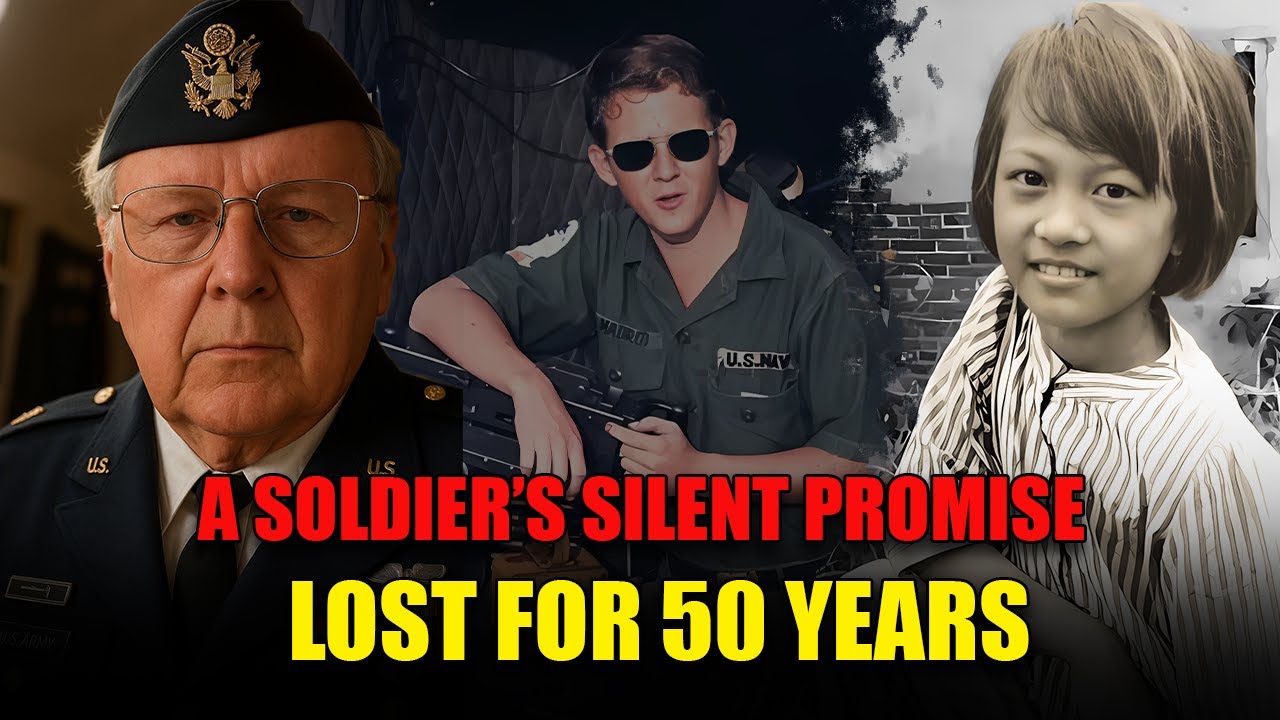
She stood shyly beside an older woman, her dark eyes wide with a quiet, innocent wonder. Michael did not know her name, and he did not speak her language, but when their eyes met, something passed between them. A shared recognition of humanity in the middle of a brutal war. The next day, the girl returned.
And the day after that. She would wait near the helicopter landing zone, watching the machines rise and fall. Sometimes she smiled. Sometimes she simply sat beside him in silence, tracing shapes in the dirt with her one small hand.
Through gestures and fragments of words, Michael learned her story. Her father, a soldier in the South Vietnamese Army, had been killed in combat. Her mother was gone as well. She lived with her aunt, scraping by on whatever they could find.
The war had taken nearly everything from her, except a quiet resilience that Michael found himself drawn to. He began to look forward to her visits. She reminded him of his niece back home, or perhaps of the child he hoped to have one day. Her name, as best as he could remember, sounded like Die or Nigh, but the exact word escaped him.
Her presence never would. One day, while she played near the helipad, Michael watched her struggle with simple things, tying a ribbon, holding a toy. He made a decision that would change both their lives. He spoke to his fellow sailors, and together they pooled what little money they had.
They arranged for the girl to be flown by helicopter to a hospital, where she was fitted with an artificial arm. When she returned, she beamed with pride, raising her new arm for everyone to see. For a moment, Michael believed that perhaps something good could come out of the suffering around them. But the war had other plans.
A few weeks later, he heard the news. The girl’s aunt, desperate and starving, had sold the prosthetic arm. When Michael saw the girl again, her face told the truth. She was ashamed, her eyes lowered to the ground.
He did not grow angry. How could he? War forced people into impossible choices. Selling that arm was not cruelty; it was survival.
Still, his heart broke in ways he could not explain. After that, Michael tried to help in smaller ways. He brought her fruit from the market. He fixed her broken sandals.
And sometimes, when the sun dipped low over the rice fields, they would sit together, two souls from opposite sides of the world finding peace in each other’s company. In May 1971, his orders came. It was time to leave Vietnam. On the morning of his departure, the girl came running to him, her small figure framed by the rising dust of the helicopters.
She was crying silently, clutching his sleeve with her one hand. Michael knelt and took her hand in his. He wanted to say something, anything, but no words came. He whispered only, “Be strong.
” She looked up at him, tears streaking her dusty face, and without a word, she placed a small flower into his palm. That was their last goodbye. The helicopter rose into the sky, carrying Michael away. Below, the girl grew smaller and smaller until she vanished into the haze.
With her, a piece of his heart was left behind, buried in the soil of a country he never truly understood but could never forget. Years passed. Michael returned home, built a life, served on ships across the Pacific. But Vietnam never left him.
At night, he would dream of her standing by the helipad, her hair fluttering in the wind, her missing arm a reminder of everything war destroys and everything it cannot. He never saw her again, but he never stopped wondering about her. Half a century later, time had carved its lines into Michael’s face. His hair had turned silver, his hands trembled slightly when he held his morning coffee.
But the memory of that girl had not faded. In his twilight years, he decided to return. In 2020, he stepped once again onto Vietnamese soil. The world had changed.
The war was long over, and the cities were alive with light and laughter. Yet somewhere deep inside, he carried the same ache from 1971. He traveled to Rach Gia, walking the narrow streets he once knew. The Cam Jo Hotel was still there, renamed and repainted, but somehow familiar.
He spoke with locals, showed them an old photograph of the helicopter landing zone, and asked about a girl with one arm. Most shook their heads. Some thought they might have heard a story like that once long ago, but no one knew for sure. He returned again in 2022 and in 2023.
Each visit became a pilgrimage, not of religion, but of remembrance. He searched orphanage records, visited hospitals, talked to old villagers who might have known a child like her. Each time, he left without answers. Still, he refused to stop searching.
For Michael, this was never simply about finding a lost friend. It was about something deeper, redemption, healing, the hope that somewhere out there, that little girl had grown into a woman who had survived. Maybe she had a family now. Maybe she told her children about the kind American sailor who once gave her an arm and a reason to smile again.
Or maybe she was gone, one of countless lives swallowed by the silence of war. Whatever the truth, Michael knew this much: she had changed him. She had taught him that compassion could exist even in the heart of destruction, and that one small act of kindness could echo across generations. Even as his body weakened, he kept returning.
Love, the kind born from humanity rather than romance, does not fade. It waits. It endures. In the end, Michael never found her.
Not her name, not her home, not even a trace. Yet somehow she was never truly lost. She lived on in his memory, in the quiet corners of his heart untouched by war. Whenever he stood before the sea, he saw her again, a little girl beneath the Vietnamese sun, smiling through the dust, her laughter echoing with the sound of rotor blades.
On his last visit to Vietnam, Michael whispered to the wind, “I hope you’re safe. I hope you lived a good life. ” The sun dipped low over Rach Gia, painting everything in gold.
No answer came, but he felt a quiet warmth, a peace long overdue, because maybe, across time and memory, she heard him.