Nearly thirteen thousand years ago, the Ice Age was ending. The glaciers were retreating, and forests were spreading north for the first time in tens of thousands of years. In the Levant, people had begun building permanent stone villages. In Europe, others painted animals on cave walls and hunted reindeer across open grasslands that were slowly turning to birch and pine.
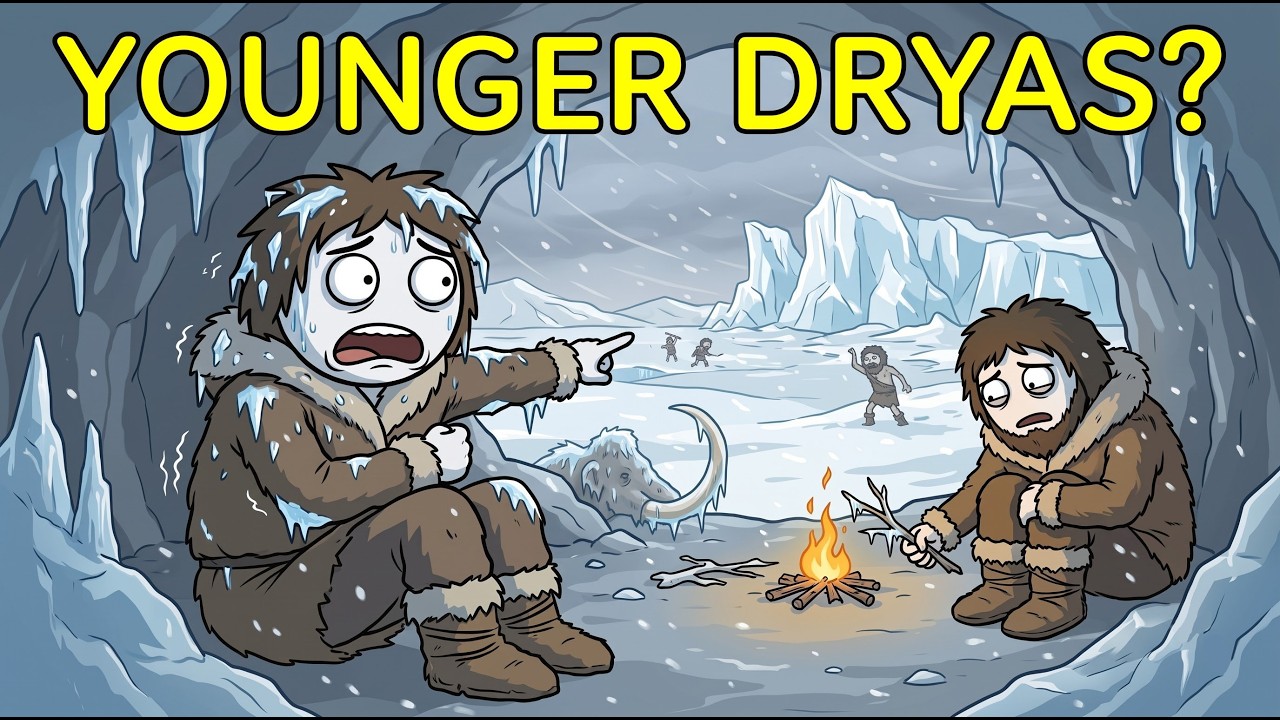
The world was warming, and it had been warming for roughly two thousand years. Then, within a single human lifetime, temperatures collapsed. It was not a gentle cooling or a gradual decline; it was a complete breakdown. In parts of the Northern Hemisphere, temperatures fell by ten degrees Celsius or more within a few decades.
Snow that used to melt in spring stopped melting. Rivers that flowed freely began to freeze. The forests that had taken centuries to reclaim the land retreated south again. The Ice Age had returned, quickly enough that a person born into a warm world could watch its end before dying.
That event is called the Younger Dryas, named after a small white polar wildflower whose pollen reappeared in European lake sediments during this period, signaling the return of tundra conditions to places that had been turning green. It lasted from roughly 12,900 to 11,700 years ago. Twelve hundred years is longer than the span from the fall of the Roman Empire to the European Renaissance, and it struck at the worst possible time, because humans had just begun to change their way of life. The warm period before the Younger Dryas is called the Bølling-Allerød, lasting from about 14,700 to 12,900 years ago.
Ice core data from the North Greenland Ice Core Project shows that temperatures in central Greenland rose by ten to fifteen degrees Celsius at its start, and the warming happened within decades. In Europe, birch and pine forests spread north across landscapes that had been barren tundra for thousands of years. Wildlife expanded with the habitats: elk, wild boar, and horses moved into regions that had been dominated by ice for generations. The Magdalenian culture, the people who created the great cave paintings of Lascaux and Altamira, flourished across western and central Europe.
They made sophisticated stone tools, carved bone and antler into harpoons and needles, and hunted the reindeer herds that followed the retreating ice edge. Life was not easy, but it was improving, and it had improved long enough that people began planning their lives on the assumption that it would continue. In the Levant, the improvement was even more dramatic. Oak and pistachio forests expanded across hills that had been dry steppe.
Wild wheat and barley fields grew densely enough to harvest. A culture called the Natufians did something almost no human group had done before: they stopped wandering. They built permanent villages with stone foundations, circular houses, and storage pits for grain. They ground wild cereals using heavy stone mortars and pestles.
They hunted deer and fished from nearby streams. At the site of Ain Mallaha in northern Israel, archaeologists found the grave of a woman buried with a puppy, an intentional and careful placement suggesting emotional bonds between humans and animals that went far beyond utility. The Natufians were not primitive foragers scraping by. They were building a new kind of human life, rooted in place, supported by an environment they understood deeply, and organized around resources they expected to be there next season.
That expectation was about to shatter. Around 12,900 years ago, the warming stopped, and it did not stop gradually. A 2008 analysis of the NGRIP ice core by Jørgen Peder Steffensen and colleagues, published in Science, showed that the transition into the Younger Dryas in Greenland occurred within one to three years for certain climate parameters. Wind patterns changed almost overnight, and full glacial conditions returned within a century.
What caused it remains one of the most debated questions in earth science. The leading explanation involves a lake most people have never heard of. Glacial Lake Agassiz was one of the largest freshwater bodies in Earth’s history. Located in what is now central Canada, it was trapped between the retreating Laurentide ice sheet’s southern and western edges.
At its maximum extent, it covered about 440,000 square kilometers, larger than the five Great Lakes combined, holding thousands, possibly over 100,000 cubic kilometers of meltwater that deepened as the ice dam holding it thinned. During most of its early existence, Lake Agassiz drained south through the Minnesota River valley into the Mississippi and on to the Gulf of Mexico, which posed no threat to the ocean circulation patterns keeping the Northern Hemisphere warm. But around 12,900 years ago, the drainage path changed. The ice dam broke, and water flowed somewhere it had never gone before.
In 1989, Wallace Broecker of Columbia University’s Lamont-Doherty Earth Observatory published a landmark paper in Nature proposing that a catastrophic diversion of Lake Agassiz’s floodwaters from the Mississippi to the St. Lawrence River pushed a massive amount of freshwater into the North Atlantic. That pulse, he argued, disrupted the Atlantic Meridional Overturning Circulation, the vast ocean conveyor belt that pulls warm tropical water north along the surface and returns cold, dense, salty water south along the ocean floor. This circulation is the engine that keeps Europe and the North Atlantic region far warmer than their latitudes would otherwise allow.
London sits at the same latitude as southern Labrador; the reason it is not buried under permanent ice is this circulation. Freshwater is lighter than saltwater. When a huge amount of it floods the North Atlantic, it sits on the surface as a lid. Warm, salty water from the tropics can no longer sink, the conveyor stops, heat flow toward the north shuts down, and the Northern Hemisphere cools rapidly.
Broecker called this the thermohaline circulation hypothesis, and it remains the most widely accepted explanation for the Younger Dryas among climate scientists. A 2010 paper by Julian Murton of the University of Sussex and colleagues in Nature offered evidence that the catastrophic drainage may have initially gone northwest through the Mackenzie River into the Arctic Ocean rather than east through the St. Lawrence, suggesting the disruption affected ocean circulation from a different angle. The exact path remains debated.
The fundamental mechanism, a massive freshwater pulse stopping the Atlantic circulation, is not. An alternative explanation has been proposed, far more dramatic. In 2007, Richard Firestone, Allen West, and twenty-four co-authors published a paper in PNAS suggesting that an extraterrestrial impact or airburst over the Laurentide ice sheet triggered the Younger Dryas. They pointed to nanodiamonds, microspherules, and platinum anomalies found in the Younger Dryas boundary layer at sites across North America.
In 2018, Wendy Wolbach, James Kennett, Allen West, and colleagues published a two-part paper in Geology arguing that widespread biomass burning at the onset of the Younger Dryas was consistent with a cosmic impact. When a team led by Kurt Kjær of the Natural History Museum of Denmark announced in 2018 in Science Advances that they had found a 31-kilometer-wide impact crater beneath the Hiawatha Glacier in northwest Greenland, it briefly seemed the impact hypothesis had found its smoking gun. It did not. In 2022, a study by Gavin Kenny and colleagues, also in Science Advances, dated the Hiawatha crater to about 58 million years ago, in the Paleocene.
Roughly fifty million years too old to have anything to do with the Younger Dryas, the impact hypothesis remains controversial. Critical assessments by Mark Boslough of Sandia National Laboratories and Nicholas Pinter of UC Davis argued that the proposed impact markers have other explanations, and no confirmed crater of the right age has ever been found. The meltwater mechanism remains the scientific consensus, though the debate continues. Whatever the cause, the effects are not disputed.
In Europe, the Younger Dryas erased two thousand years of environmental recovery in less than a century. Pollen records from lake sediments across the continent tell the same story. At Gerzensee in Switzerland, high-resolution samples show an abrupt replacement of forest pollen with cold steppe indicators, grasses, and the pollen of the Dryas flower itself. The birch and pine forests that had been creeping north retreated to their southern refuges.
Tundra returned to central Europe. Glaciers reformed in the highlands of Scotland, Scandinavia, and the Alps. The Magdalenian culture, which had dominated western Europe for thousands of years, collapsed. What replaced it was the Azilian culture, named after its type site at Mas d’Azil in the French Pyrenees.
The contrast between the two tells you everything about what the Younger Dryas did to human life in Europe. The Magdalenians made large, sophisticated stone blades and some of the most magnificent art in human history. The Azilians made small, simple backed points. The Magdalenians painted bison, horses, and deer on cave walls with pigments they ground, mixed, and applied with deliberate artistic intention.
The Azilians painted abstract dots and lines on flat pebbles. The elaborate figurative cave art of the Magdalenian ceased during the Younger Dryas. It never returned. Lawrence Guy Straus of the University of New Mexico has argued this was not a decline but an adaptive reorganization.
People reduced their mobility ranges, shifted their diets from reindeer and horses to elk and wild boar, increased their reliance on plant foods and aquatic resources, and simplified their toolkits for a world where flexibility and movement mattered more than specialization. They survived, but the world they survived in was harsher than the one they had lost. In northern Europe, the Ahrensburg culture emerged, defined almost entirely by reindeer hunting on the open tundra. Their lives revolved around tracking herds across frozen landscapes.
Their tools were practical and simple: no cave art, no elaborate bone carvings, just what was needed to kill a reindeer, process its hide, and keep moving. In North America, the consequences were far more brutal. The Clovis culture, distinguished by its fluted stone spear points, flourished across the continent from about 13,200 to 12,800 years ago. Clovis hunters pursued mammoths and mastodons with technology that was both beautiful and lethal.
The precisely made fluted points were designed to be mounted on wooden shafts and driven between the ribs of animals that had never learned to fear the creature holding the spear. Then, at the beginning of the Younger Dryas, around 12,900 years ago, Clovis vanished completely from the archaeological record. C. Vance Haynes of the University of Arizona spent decades documenting what he called the “black mat,” a distinctive dark organic layer found at more than seventy sites across North America, precisely dated to the onset of the Younger Dryas.
Its composition varies by location, but the stratigraphic story is always the same. Below the black mat, you find Clovis tools and the bones of megafauna: mammoth, horse, camel, and giant ground sloth. Above it, the megafauna are gone. The Clovis spear points are gone.
At Murray Springs in Arizona, one of the most important Clovis hunting sites, the black mat rests directly on a mammoth butchering floor. Beneath it, a world where humans hunted giants. Above it, a world where giants no longer existed. Thirty-five genera of megafauna disappeared from North America in a period that coincided with the spread of human hunters and the onset of the Younger Dryas.
Columbian mammoths, American mastodons, giant ground sloths, saber-toothed cats, short-faced bears that stood over three meters tall on their hind legs, dire wolves, American horses, American camels, and glyptodonts the size of small cars. The debate over whether humans or climate killed them has raged for decades. Paul Martin of the University of Arizona championed the overhunting hypothesis since the 1960s, arguing that human hunters arriving in a continent full of naive megafauna simply hunted them to extinction. Todd Surovell of the University of Wyoming published research in PNAS in 2005 and 2009 analyzing the spatial correlation between Clovis sites and mammoth remains to support the predation hypothesis.
Gary Haynes of the University of Nevada argued for a more complex picture, emphasizing climate stress alongside human pressure. The prevailing view among most researchers today is a combination of factors. The Younger Dryas disrupted habitats, changed vegetation, and stressed animal populations already dealing with a changing world. Human hunting delivered the final blow.
Neither factor alone was likely sufficient, but together they were catastrophic. A 2014 study by Chris Sandom and colleagues in Proceedings of the Royal Society B found that the strongest predictor of megafaunal extinction globally, on every continent and island, was the arrival of modern humans, not climate change. But the timing in North America, where extinctions cluster so tightly around the beginning of the Younger Dryas, makes it impossible to cleanly separate the two forces. What replaced Clovis was smaller and lighter, focused on smaller game.
The Folsom culture, known for its finely crafted fluted points, hunted bison, not mammoths. The mammoths were gone. The world had changed, and the humans in it had to change with it or disappear. They changed.
But the most consequential human response to the Younger Dryas did not happen in Europe or North America. It happened in the Levant, and it changed everything that followed. Remember the Natufians, the ones who built permanent villages during the warm Bølling-Allerød, who settled and stored grain and ground wheat, who organized their lives on the assumption that nature would provide. When the Younger Dryas struck, the wild wheat and barley stands that had supported their villages shrank.
The oak and pistachio forests retreated. The reliable abundance that had made permanent settlement possible began to vanish. The Natufians had two choices. They could abandon their villages and return to a life of mobility and foraging, following whatever resources the deteriorating climate still offered.
Some did exactly that. Late Natufian settlements are smaller and show signs of greater mobility than their early predecessors. But some of them did something else, something no human group had ever done before in a systematic, sustained way. They planted seeds.
At the site of Abu Hureyra in the Euphrates valley of Syria, archaeologist Andrew Moore of the University of Oxford led excavations in the 1970s and 1980s. The site is now submerged under Lake Assad, lost to the Tabqa Dam. But before it was flooded, Moore and his colleagues extracted plant remains that told one of the most important stories in human history. Working with archaeobotanist Gordon Hillman of University College London, they published their findings in a major reference study, “A Village on the Euphrates,” through Oxford University Press in 2000.
The botanical evidence showed that at the onset of the Younger Dryas, the inhabitants of Abu Hureyra were eating a wide variety of wild plants. As the Younger Dryas progressed and the environment dried, many of those wild resources faded. In response, the people of Abu Hureyra began cultivating barley, deliberately planting it, tending it, and harvesting it on a schedule. It is one of the earliest documented cases of farming anywhere on Earth.
It was not born of abundance or curiosity. It was born of desperation. Ofer Bar-Yosef of Harvard University made the broader argument in his landmark 1998 paper in Evolutionary Anthropology. He argued that the Younger Dryas was the environmental pressure that pushed peoples in the Levant from harvesting wild cereals to deliberately cultivating them.
During the warm centuries before the cold snap, these people had developed every prerequisite for farming. They knew which plants were edible. They knew where they grew. They had the stone tools to harvest them and the ground stone techniques to process them.
What they lacked was a reason to do the extra work of planting, weeding, and protecting a crop as long as wild resources provided the same food for free. The Younger Dryas gave them that reason. Wild resources failed, and people who had spent generations studying these plants closely began growing them on purpose. George Willcox of the French National Centre for Scientific Research published work in Vegetation History and Archaeobotany in 2004 and 2012 showing that pre-domestication cultivation, the formal growing of wild cereals, occurred during the late Natufian and the subsequent Pre-Pottery Neolithic A period, specifically during and immediately after the Younger Dryas.
The plants were still genetically wild. The farmers were still learning. But the practice had begun. Then the Younger Dryas ended, and the world changed permanently.
Its ending was even more abrupt than its beginning. Steffensen’s analysis of the NGRIP ice core showed that Greenland temperatures rose by about ten degrees Celsius within a single decade. Deuterium abundance measures changed within a single year, indicating a nearly instantaneous reorganization of the atmospheric circulation. The Atlantic circulation resumed.
Warm water flowed north again. The ice retreated. The Holocene had begun. In the Levant, people who had spent twelve centuries learning how to grow food in a hostile climate suddenly found themselves farming in a warm, wet, stable world.
They had a twelve-hundred-year head start in a skill that would reshape the planet. When the rains returned and temperatures stabilized, farming was no longer just a survival strategy. It became an engine. Wheat, barley, lentils, peas, flax, sheep, goats, cattle, and pigs were all domesticated within a few thousand years of the Holocene’s start, all in the same arc of land from the Levant through southeastern Anatolia to Mesopotamia: the Fertile Crescent.
Near those same mountains, something extraordinary was built. Göbekli Tepe, a site in southeastern Turkey near Şanlıurfa, was first noted in a survey by Peter Benedict of the University of Chicago in 1963 but dismissed as a medieval cemetery. In 1995, Klaus Schmidt of the German Archaeological Institute began excavations and realized he was looking at something that should not exist. Massive T-shaped limestone pillars, some over five meters tall and weighing up to ten tons, arranged in circles and carved with elaborate reliefs of foxes, lions, snakes, scorpions, vultures, and wild boars.
The earliest construction phases date to around 9600 BC, the end of the Younger Dryas or immediately after. The builders of Göbekli Tepe were not farmers. No domesticated plant or animal remains have been found in the earliest layers. They were hunter-gatherers, people who had lived through or just emerged from the worst climate crisis since the peak of the last Ice Age, and they were quarrying, transporting, and erecting monumental stone architecture that predates Stonehenge by about six thousand years.
Schmidt, who directed the excavations until his death in 2014, interpreted the site as a ritual or ceremonial center, perhaps a place of pilgrimage. The coordination required to build it implies large labor forces, shared symbolic systems, and a level of social organization previously assumed to require farming. Some researchers, including Ian Hodder of Stanford University, have explored the possibility that the relationship ran the other way: that the need to feed large groups of people gathering to build and celebrate at sites like Göbekli Tepe may have been one of the forces driving the adoption of agriculture. Religion before farming, society before crops.
The Younger Dryas did not just push people toward agriculture. It may have pushed them toward building the kinds of social structures that made agriculture inevitable. On the other side of the world, a different kind of innovation was helping people survive. In Japan, the Jomon culture had been making pottery for thousands of years before the Younger Dryas even began.
Pottery fragments from the Odai Yamamoto I site in Aomori Prefecture have been radiocarbon dated to about 16,500 years ago. At Xianrendong Cave in Jiangxi Province, China, pottery dated by Elisabetta Boaretto and Ofer Bar-Yosef, published in Science in 2012, pushes the record back to about twenty thousand years. The oldest known pottery in the world was made by hunter-gatherers who would not practice agriculture for another ten thousand years. During the Younger Dryas, the Jomon people continued to inhabit the Japanese archipelago.
Their pottery was not decorative; it was functional. They used it to cook and store food, processing nuts, fish, and shellfish into forms that were easier to eat, easier to preserve, and more nutritionally available. Boiling acorns in pottery vessels leaches out the tannins that make them inedible raw. Cooking fish in pots extracts nutrients from bones and cartilage.
Pottery expanded the range of edible foods, and when the climate deteriorated and familiar food sources shrank, that expanded range was the difference between survival and starvation. The Jomon survived the Younger Dryas not by inventing agriculture but by inventing a technology that made hunting and gathering more efficient. This is the pattern. Everywhere you look, the Younger Dryas forced human populations to innovate or retreat.
In the Levant, the innovation was agriculture. In Japan, it was ceramics. In Europe, it was a painful simplification, a retreat from cultural complexity toward mobility efficiency. In North America, it was a dietary revolution, shifting from hunting megafauna to hunting bison and then smaller game.
Every region responded differently. Every population found a different way to survive, but survival always required change. And those changes were not temporary. The Holocene, the warm and stable epoch that began with the end of the Younger Dryas 11,700 years ago, is the period in which every civilization humans have ever built emerged.
Every city, every empire, every written language, every organized religion, every scientific institution. All of it emerged during the climatic stability that followed the Younger Dryas. The Holocene did not cause civilization, but it set the stage. And the Younger Dryas, by pushing human populations to the brink, ensured that when that stage was set, the actors were already prepared.
The first farmers were already farming. The first temple builders had already built. The first potters had already fired their clay. The crisis did not destroy humanity.
It prepared it. There is a detail in the ice core records worth noting because it connects the Younger Dryas to every conversation we now have about climate. The Younger Dryas was caused by a disruption of the Atlantic current: a massive pulse of freshwater stopping the ocean current that keeps the Northern Hemisphere warm. Today, the Atlantic current is slowing.
Measurements from the RAPID array, a system of buoys strung across the Atlantic at 26 degrees north since 2004, show a measurable decline in the current’s strength over the past two decades. The cause today is different. It is not a glacial lake bursting its ice dam. It is the accelerating melt of the Greenland ice sheet and increased precipitation over the North Atlantic, both driven by human-caused warming, adding freshwater to the ocean surface and reducing the density-driven sinking that fuels this conveyor belt.
The mechanism is the same. Freshwater on the surface, reduced sinking, a weakened circulation. No one expects a full repeat of the Younger Dryas. The surrounding conditions are different.
There is no Laurentide ice sheet. There is no Lake Agassiz. The freshwater flow today is slower and more diffuse. But the principle the Younger Dryas demonstrated, that the climate system has tipping points, that it can shift from one stable state to another with terrifying speed, that a change that took centuries to build can appear in years, that principle has not changed.
Twelve thousand nine hundred years ago, the world learned what happens when the ocean conveyor belt stops. The lesson cost the Natufians their villages. It cost the Magdalenians their art. It cost an entire continent its megafauna.
The lesson is there in the ice, recorded grain by grain, waiting for anyone willing to read it. How did humans survive the Younger Dryas? They survived the way humans have survived every catastrophe in three hundred thousand years of existence. They adapted.
They did not all adapt the same way. The people of the Levant, who had the deepest knowledge of wild cereals and the greatest investment in permanent settlement, invented agriculture. The people of Europe, who had built one of the richest artistic cultures in prehistoric history, gave up their complexity and returned to mobility. The people of North America, who had been hunting the largest animals on the continent, watched those animals disappear and learned to hunt smaller ones.
The people of Japan kept making pottery and eating what the forest and sea provided. No one planned any of it. No one predicted the cold would come. No one held a council to decide that the rational response to climate collapse was growing rye in the Euphrates valley.
They just did what humans do. They tried things. They failed. They tried something else.
Those whose experiments succeeded survived. Those whose experiments failed, or who could not change fast enough, did not. Twelve centuries of trial and error, compressed by necessity into the most important period of innovation in human history before the Industrial Revolution. And when the cold finally broke, 11,700 years ago, in a warming so sudden that some parameters in the ice changed within a single year, the survivors of the Younger Dryas emerged carrying the tools that would build the world: agriculture, ceramics, monumental architecture, and the social complexity refined under pressure.
The Holocene gave them a stable climate. They gave themselves everything else. The first permanent villages were built during a crisis. The first seeds were planted out of hunger.
The first temple was raised by people who had just endured twelve centuries of bitter cold. Every civilization that followed, without exception, is a result of the choices made by people trying to survive a climate catastrophe that arrived in less than a lifetime and lasted forty generations. We call the period that followed the Younger Dryas the dawn of civilization.
Perhaps it would be better to call it the harvest, because the seeds were planted in the cold by people whose names we will never know, in villages buried under dams and dust, during the worst winter humans had faced in fifty thousand years.